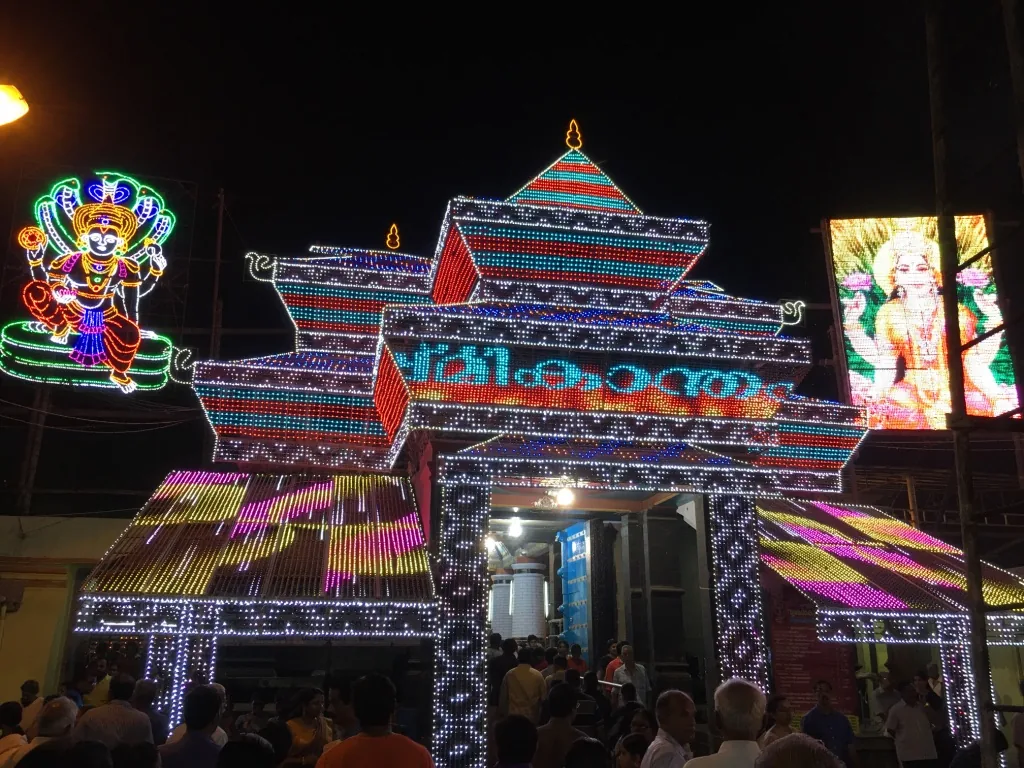
Open any account of Sree Poornathrayeesa Temple at Tripunithura and you will meet the same sentence. This was the state deity of the Kingdom of Cochin, and the temple was the first — the foremost — of the kingdom’s eight great royal temples.
Then try to find out which the other seven were.
The list is missing
We have looked in the reference works, in the temple literature and in the accounts that state the ranking most confidently. The phrase is everywhere. The membership is nowhere. Even the standard encyclopedic entry asserts the primacy and declines to name the group.
This is not a scandal, and we do not think anyone is hiding anything. It is what happens to administrative categories when the administration that used them goes away. The eight royal temples were presumably a working classification of the Cochin court — establishments under direct royal patronage, with the obligations and revenues that came with it. When the kingdom was integrated into independent India and its temples passed to a Devaswom board, that classification stopped doing any work. The ranking survived as a compliment. The list did not survive at all.
What survived instead is better
The relationship that did last is not a hierarchy. It is a family.
Poornathrayeesa is held to be the elder brother of the goddess at the Eroor Pishari Kovil. During the festival, the deities of Perumthrikovil — a Shiva temple — and of Eroor come to Tripunithura, and the processions and rituals are conducted jointly.
Read that carefully, because it describes something a list cannot. The temples of the old kingdom were not simply ranked against each other; they were “related” to each other, with kinship terms, directions of seniority, and obligations to visit. A deity travels. A deity is somebody’s elder brother. Rituals are performed together because the parties are family, not because a schedule says so.
- Documented: Poornathrayeesa was the state deity of the Kingdom of Cochin.
- Documented: the temple is described as the foremost of eight royal temples.
- Not documented anywhere we can find: which the other seven were.
- Documented, and more interesting: the deity is the elder brother of the goddess at Eroor Pishari Kovil, and deities from Perumthrikovil and Eroor visit for joint festival ritual.
What a state deity actually was
It is worth being concrete about the phrase, because it sounds ceremonial and was not. In a princely state like Cochin, the tutelary deity was the sovereign’s own — the kingdom was held, in the constitutional fiction of the thing, on the deity’s behalf. Ritual at the family shrine was an act of state, and the temple’s upkeep was a charge on the treasury rather than a charity.
Tripunithura was the royal town, and this temple its centre. Walk from here to Hill Palace, the royal residence, and you have traversed the whole apparatus in twenty minutes: the deity, the court, the household. That compression is unusual even by the standards of Indian princely capitals.
The building is younger than the institution
A fire in 1920 destroyed most of the temple including the original wooden sanctum, sparing the western gopuram. Reconstruction followed in 1921, with the design generally attributed to the architect Eachara Warrier.
The rebuilt sanctum is concrete — but faced with copper, wood and granite, so the material palette a visitor sees is traditional and the structure behind it is not. It is widely said to be the first concrete temple in Kerala. We would flag that: the claim is repeated constantly and appears to be uncited even in the standard reference sources. It may be perfectly true. Nobody seems to have shown that it is.
Two features are worth finding while you are inside. The sanctum is built in the form of a chariot, a reference to the Santhanagopalam legend in which Krishna and Arjuna ride beyond the created world to recover a Brahmin’s lost sons — the episode behind the deity’s reputation as Santhana Gopala, granter of children, which we tell in full here. And the Ganesha shrine faces south, described as the only one in Kerala that does, rather than the customary east or west.
And the festival is where the network becomes visible
Vrischikotsavam runs eight days in the Malayalam month of Vrischikam, roughly November into December. Something over forty elephants take part across the festival, with around fifteen present on a typical day; on the fourth day the deity is carried in jewelled golden accoutrements on a tusker surrounded by fourteen more.
That is the spectacle, and it is covered in our piece on the elephants and the fire. But notice what else is happening: this is the week when the neighbouring deities arrive. The kinship that no document records is enacted annually, in public, by carrying gods to each other’s temples. The list of eight is gone; the family is still visiting.
Elephant participation now operates under court-supervised welfare and safety norms and arrangements change from year to year — confirm before planning around it.
Frequently asked questions
What were the eight royal temples of the Kingdom of Cochin?
We cannot tell you, and neither, as far as we can find, can anybody else. Poornathrayeesa is universally described as the first or foremost of the eight, but the remaining seven are not named in the reference works or the temple literature. The classification appears to have been an administrative one belonging to the Cochin court, which stopped doing any work when the kingdom was integrated into India — leaving the compliment behind without the list.
What does it mean that Poornathrayeesa was the "state deity"?
More than ceremony. In a princely state the tutelary deity was the sovereign’s own, and the kingdom was understood to be held on the deity’s behalf. Ritual at the family shrine was an act of state, and the temple’s maintenance was a charge on the treasury. Tripunithura was the royal town and this temple its centre, a short walk from Hill Palace, the royal residence.
Is Poornathrayeesa related to other deities?
Yes. He is held to be the elder brother of the goddess at the Eroor Pishari Kovil, and during the festival the deities of Perumthrikovil, a Shiva temple, and of Eroor come to Tripunithura for joint processions and shared ritual. The temples of the old kingdom were tied by kinship and visiting obligation, not only by rank.
Was this really the first concrete temple in Kerala?
Possibly, but treat it with care. The sanctum was rebuilt in 1921 after the 1920 fire, in concrete faced with copper, wood and granite, and the claim to be Kerala’s first concrete temple is repeated very widely — while appearing to be uncited even in the standard reference sources. We have not found the evidence behind it.
What survived the 1920 fire?
The western gopuram, which is the ancient part of the complex and the one to look at properly. Almost everything else, including the original wooden sanctum, was destroyed and rebuilt the following year.
What is unusual about the temple architecture?
Two things. The sanctum is built in the form of a chariot, referring to the Santhanagopalam legend of Krishna and Arjuna journeying to recover a Brahmin’s lost sons. And the Ganesha shrine faces south, said to be the only one in Kerala oriented that way rather than east or west.