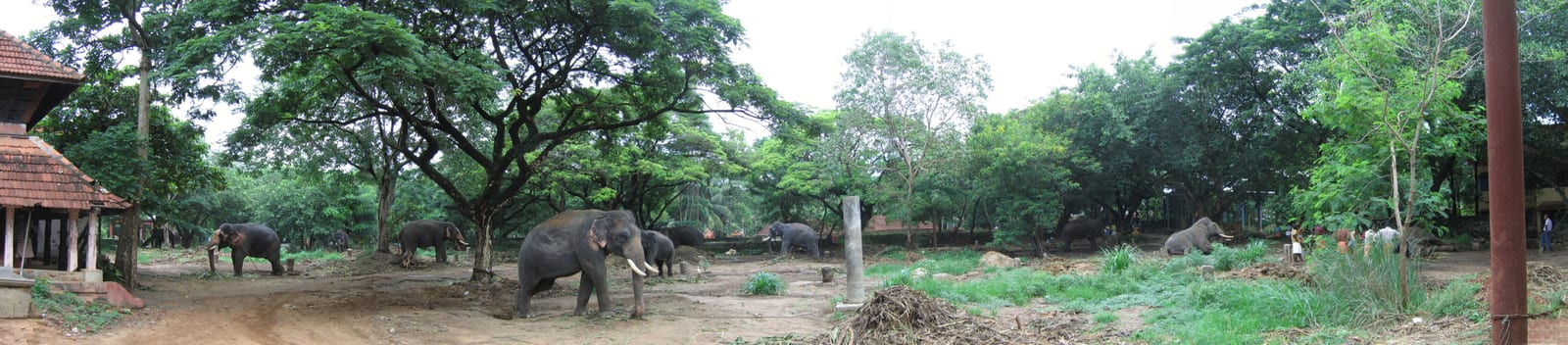
A few kilometres from the great Krishna temple of Guruvayur, behind the walls of a five-hundred-year-old palace, live dozens of elephants. This is Punnathur Kotta — once the seat of a local ruler, now known to everyone simply as Anakkotta, the Elephant Fort. There are few stranger or more wonderful sights in Kerala than a former royal palace given over, entirely, to elephants.
A palace that lost its king
Punnathur Kotta was the palace of the Punnathur Raja, one of the countless small chieftains who once ruled patches of Kerala. The kingdom is long gone, but the palace remains — a classic nalukettu, the traditional Kerala manor of sloping tiled roofs, carved wood and a central open courtyard, standing quietly amid the greenery near Guruvayur, five centuries old.
How the elephants moved in
The great Guruvayur temple has, for centuries, been given elephants — offered to Lord Guruvayurappan by devotees as the most precious of gifts. By the twentieth century the temple owned a whole herd of them, and they needed somewhere to live. In 1975 the Guruvayur Devaswom board bought the old Punnathur palace and its grounds and turned them over to the elephants, and so the seat of a forgotten raja became a home for the temple’s sacred herd — at times numbering dozens of animals, among the largest such gatherings of captive elephants anywhere.
The elephant Kerala never forgot
No account of the place is complete without Guruvayur Kesavan — perhaps the most celebrated temple elephant in Kerala’s history. Donated to Guruvayur by the royal family of Nilambur in 1922, Kesavan stood over ten feet tall and was famed less for his size than for his uncanny devotion: he seemed to know the temple’s rituals, and behaved, people said, like a true devotee. In 1973 the Devaswom gave him the unique title Gajarajan, “king of elephants.” When he died in 1976, after fifty-four years of service — fittingly, on the day of the god’s own festival — Kerala mourned. A twelve-foot statue of him stands near the temple, and each year, on his death anniversary, the other elephants lay floral tributes at his image.
Gajapooja and Anayoottu
The herd is honoured with rituals of its own. The Gajapooja is a ceremonial worship of the elephants, and the Anayoottu — the “feeding of the elephants” — is a spectacular offering in which the great animals are lined up and fed enormous quantities of rice, jaggery, sugarcane, coconut and Ayurvedic tonics by thousands of devotees, an act of merit dedicated to the elephant-headed god Ganesha. To watch it is to see the deep, complicated bond between Kerala and its elephants laid out in full.
Visiting Punnathur Kotta
Anakkotta lies at Kottapadi, about three kilometres from the Guruvayur temple, and is an easy and popular add-on to a Guruvayur visit. Go in the cool of the morning when the elephants are being bathed and fed, and treat the animals with the respect the place asks for. Details are on the Punnathur Kotta place page; more of the district is on the Thrissur hub.
Frequently asked questions
What is Punnathur Kotta?
It is a five-hundred-year-old palace near Guruvayur, once the seat of the Punnathur Raja, that since 1975 has housed the temple elephants of the Guruvayur Sree Krishna temple. It is popularly called Anakkotta, the “Elephant Fort.”
Who was Guruvayur Kesavan?
Guruvayur Kesavan was the most celebrated temple elephant in Kerala’s history, donated to Guruvayur by the Nilambur royal family in 1922. Famed for his devout behaviour, he was given the title Gajarajan (“king of elephants”) in 1973 and died in 1976 after 54 years of service. A statue of him stands near the temple.
What are Gajapooja and Anayoottu?
Gajapooja is a ceremonial worship of the temple elephants, and Anayoottu is the ritual “feeding of the elephants,” in which the animals are fed large quantities of rice, jaggery, sugarcane and tonics by devotees as an offering to Lord Ganesha.
Where is Punnathur Kotta?
It is at Kottapadi, about 3 km from the Guruvayur Sree Krishna temple in Thrissur district.