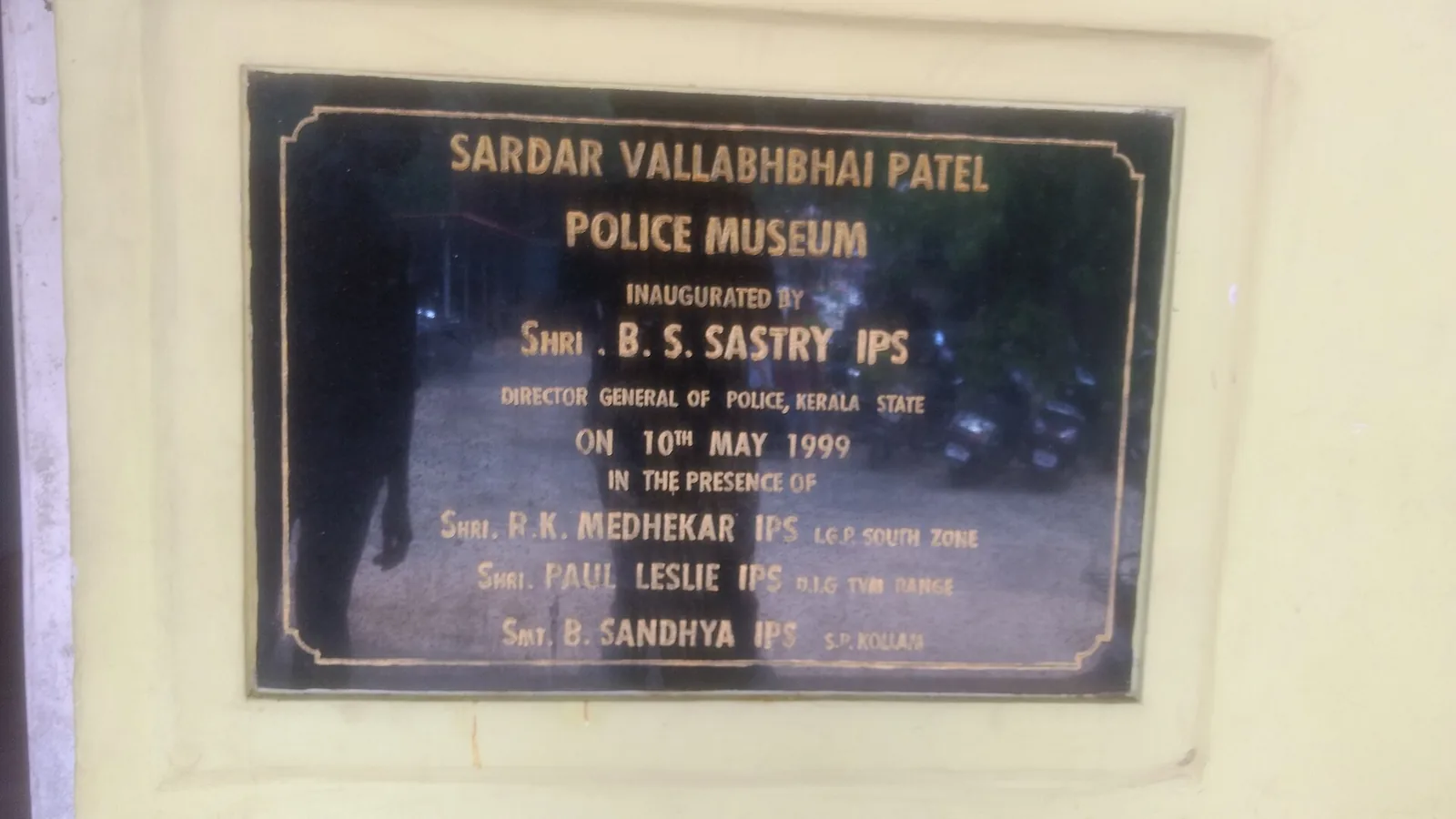
Step out of Kollam Junction and walk about 150 metres, and you reach a low old mansion with a tiled roof, olive-green walls and a white columned porch. This is the Sardar Vallabhbhai Patel Police Museum, and the best guide to its history is fixed to its own walls. Three dedication plaques stand in the compound, one in the porch and one on each of the two statues outside. Read together, they tell how a district police museum came to be built and who kept it going.
The plaque in the porch starts the story on 10 May 1999. It records that the museum was inaugurated by B. S. Sastry, Director General of Police for Kerala, with R. K. Medhekar, Inspector General for the South Zone, and Paul Leslie, Deputy Inspector General of the Thiruvananthapuram Range, in attendance. Beside them it names B. Sandhya as Superintendent of Police, Kollam. Kerala Police's own institutional history credits her, as Kollam's SP at the time, with starting the museum within the limits of Kollam East Police Station.
The statues outside carry the next chapter, seven years later. Sardar Vallabhbhai Patel stands upright holding a book, while Gandhi sits cross-legged on a white plinth, and both plaques record that they were unveiled on 25 January 2006 by T. P. Senkumar, then Inspector General for the South Zone. Incredible India describes the Patel figure as a 1.1-ton statue sculpted by a police constable. The Gandhi plaque names its own artist, A. Ashok Kumar, so the two figures came from different hands.
The 2006 plaques also show how the museum is run, which is a detail few visitors notice. They name A. R. Santhosh Varma, Superintendent of Police in Kollam, as President of the Police Museum, and N. A. Rasheed, Circle Inspector of Kollam East, as its Secretary. So the museum has its own office-bearers drawn from the local force rather than a separate museum staff. That arrangement explains its modest scale and its small ticket price.
Inside, the mansion itself shapes the visit. DTPC Kollam describes it as an old house with four courtyards, and the collection moves through them in order. The first rooms trace firearms, ammunition, machines and other weapons through the eighteenth and nineteenth centuries. Kerala Tourism and Incredible India both describe it as the only museum of its kind in the country, and the old arms give that history something solid to look at.
The story then turns from weapons to evidence. One courtyard explains investigation work, with charts on fingerprints, DNA testing and human bones, so the visitor moves from the tools of force to the science of proof. Photographs of police dogs and cases of medals given to officers of every rank fill in the human side of the job. The order works well because each room answers a question the room before it raises.
The Martyr's Gallery closes the visit, and it gives the museum its weight. Kerala Tourism calls it a tribute to those who gave their lives in the line of duty, and it turns a collection of old rifles into a memorial. Most visitors slow down here. It is the room people remember after they have walked back to the station.
The compound is still working police ground, which shapes how people visit. A 2017 photograph of the gate shows the museum's board with a second board beneath it for the Kollam Vanitha Cell, the women's cell. People come here to report problems as well as to see exhibits. DTPC Kollam's page, read on 22 November 2026, lists tickets at ₹20 for adults and ₹10 for children, booked only at the counter. It gives opening hours of 9 am to 6 pm on all days. Incredible India lists the museum as closed on Sundays, so travellers between trains usually plan it for a weekday.
That closeness to the station makes the museum a favourite way to spend a long connection. An hour covers the arms, the forensics and the gallery, and the statues and their plaques stand outside the ticketed building. The Police Museum place page has the location, and the Kollam town guide shows what else sits within reach of the junction.
Frequently asked questions
When did the Police Museum in Kollam open?
The porch plaque records its inauguration on 10 May 1999 by B. S. Sastry, Director General of Police, Kerala.
Who started the Kollam Police Museum?
Kerala Police's institutional history credits B. Sandhya, then Superintendent of Police, Kollam.
How far is the Police Museum from Kollam railway station?
DTPC Kollam puts it about 150 metres from Kollam railway station.
What is in the Kollam Police Museum?
Arms from the eighteenth and nineteenth centuries, forensic charts on fingerprints and DNA, police-dog photographs, medals and a Martyr's Gallery.