The Sarkaradevi Temple is known for the Kaliyoottu, and almost every account of the place stops there. It has a second great festival — the Meena Bharani, ten days long, structurally quite different, and significant enough on its own that the temple is a principal Devi centre for the whole northern part of the district. If you are trying to time a visit, it is worth knowing that there are two windows rather than one.
Flag to water
The Meena Bharani falls around March or April and runs for ten days. It opens with a flag-hoisting — the standard Kerala temple signal that a festival has formally begun and that the shrine is now under festival discipline — and it closes with the arat, the ceremonial immersion of the deity in the temple tank. That shape, from flag to water, is the classic Kerala festival arc, and it is a useful thing for a visitor to recognise: the raising of the flag tells you a temple has committed to something, and the arat tells you it is over.
The Pallivatta
The ninth day carries the Pallivatta, a ritual hunting procession, which has historically involved caparisoned elephants — accounts mention five. A hunt performed by a goddess who was born to hunt down and destroy a demon is not an arbitrary piece of pageantry; it belongs to the same logic as the Kaliyoottu, which is that this deity’s character is expressed through pursuit. It is worth adding that animal sacrifice formed part of the older observance here and was given up in later periods, which is a fairly common trajectory at Kerala Bhadrakali shrines and one that temples do not always mention themselves.
Thookam
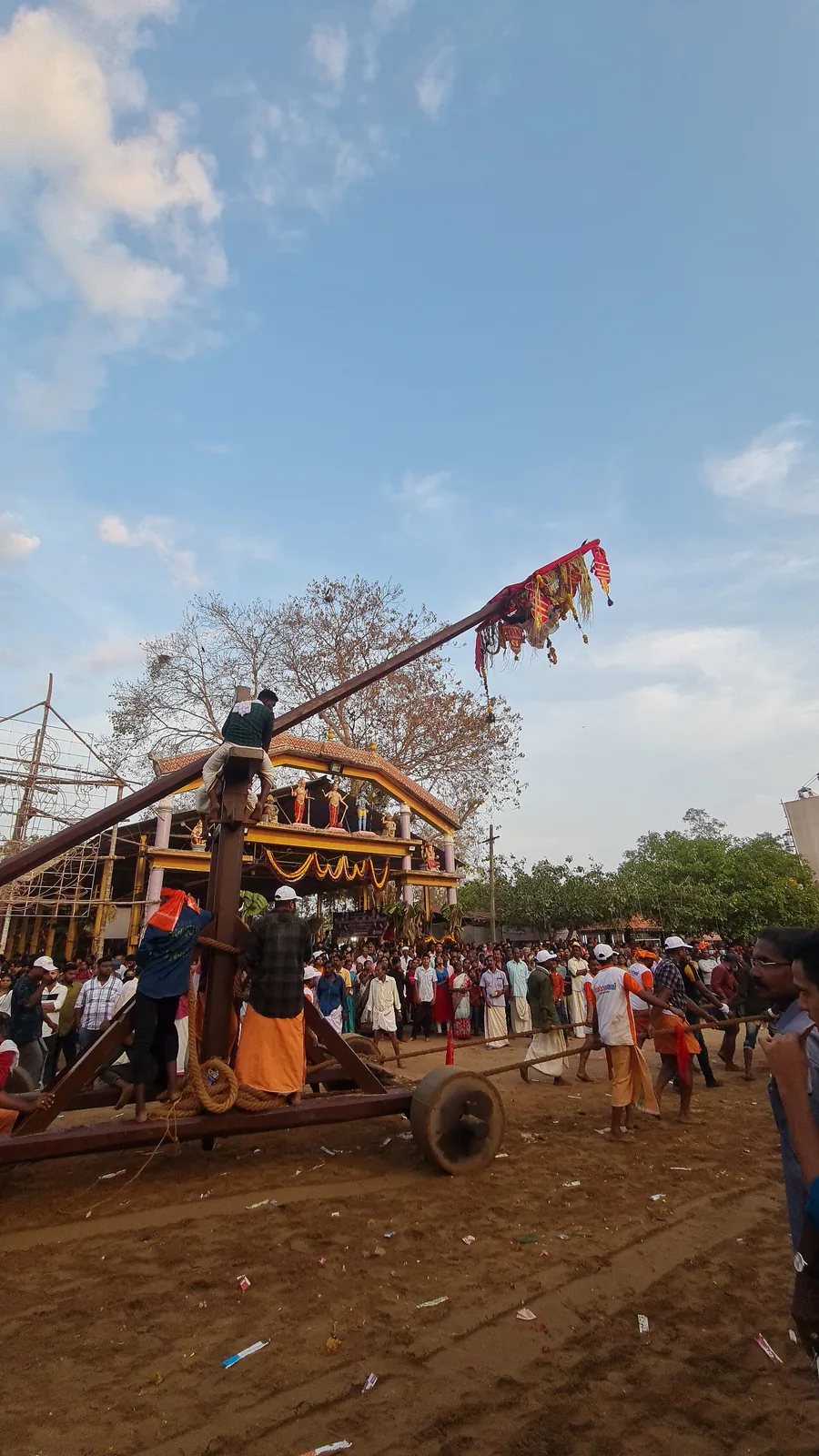
Sarkara’s festival season also carries the Thookam, one of the more startling things to come across if you do not know what you are looking at. The apparatus is a wheeled wooden frame carrying a long counterbalanced beam, hauled by a team of men, with the far end decorated and raised high above the ground. Thookam is a vow-fulfilment rite associated with Bhadrakali temples in this part of Kerala, and like Kuthiyottam at Attukal it sits in the category of austerities offered rather than spectacles staged. Treat it accordingly: it is not put on for visitors, and it is not a fairground ride.
Two festivals, one temple, different characters
The useful mental model is that Sarkara runs two quite different registers. The Kaliyoottu is narrative — nine days working through a story to its violent conclusion, imported from north Malabar by Marthanda Varma in 1748 and covered separately in A Ritual With a Birth Certificate. The Meena Bharani is processional and cyclical — flag, days, hunt, water — and belongs to the ordinary grammar of the Kerala temple year. A visitor who catches one has not seen the other, and neither substitutes for an ordinary quiet morning at the shrine, which is a third thing again.
Planning around it
Both festivals move with the Malayalam calendar, so confirm the current year’s dates locally rather than working from a listing — and be clear which of the two festivals a date you are reading refers to, because they are easily conflated. Sarkara is at Chirayinkeezhu on the road north towards Varkala and Anchuthengu, and pairs naturally with either. Ordinary temple conventions apply: conservative dress with legs covered, no photography inside, and entry rules that may restrict access to Hindus and should be checked at the gate. Full practical detail is on the Sarkaradevi Temple page.
Frequently asked questions
What is the Meena Bharani at Sarkara?
A ten-day festival, separate from the Kaliyoottu, falling around March or April. It opens with a flag-hoisting and closes with the arat, the ceremonial immersion of the deity in the temple tank.
What is the Pallivatta?
A ritual hunting procession on the ninth day of the Meena Bharani, historically involving caparisoned elephants. It reflects the same character as the Kaliyoottu — a goddess whose defining act is pursuit.
What is Thookam?
A vow-fulfilment rite carried at Bhadrakali temples in this part of Kerala, using a wheeled wooden frame with a long counterbalanced beam raised high above the ground. Like other austerities of its kind it is offered rather than performed for an audience.
Does the temple still practise animal sacrifice?
No. Animal sacrifice formed part of the older observance and was given up in later periods, a common trajectory at Kerala Bhadrakali shrines.
How do I know which festival a date refers to?
Ask specifically, because the Kaliyoottu and the Meena Bharani are distinct festivals at the same temple and are easily conflated in listings. Both follow the Malayalam calendar and move each year.