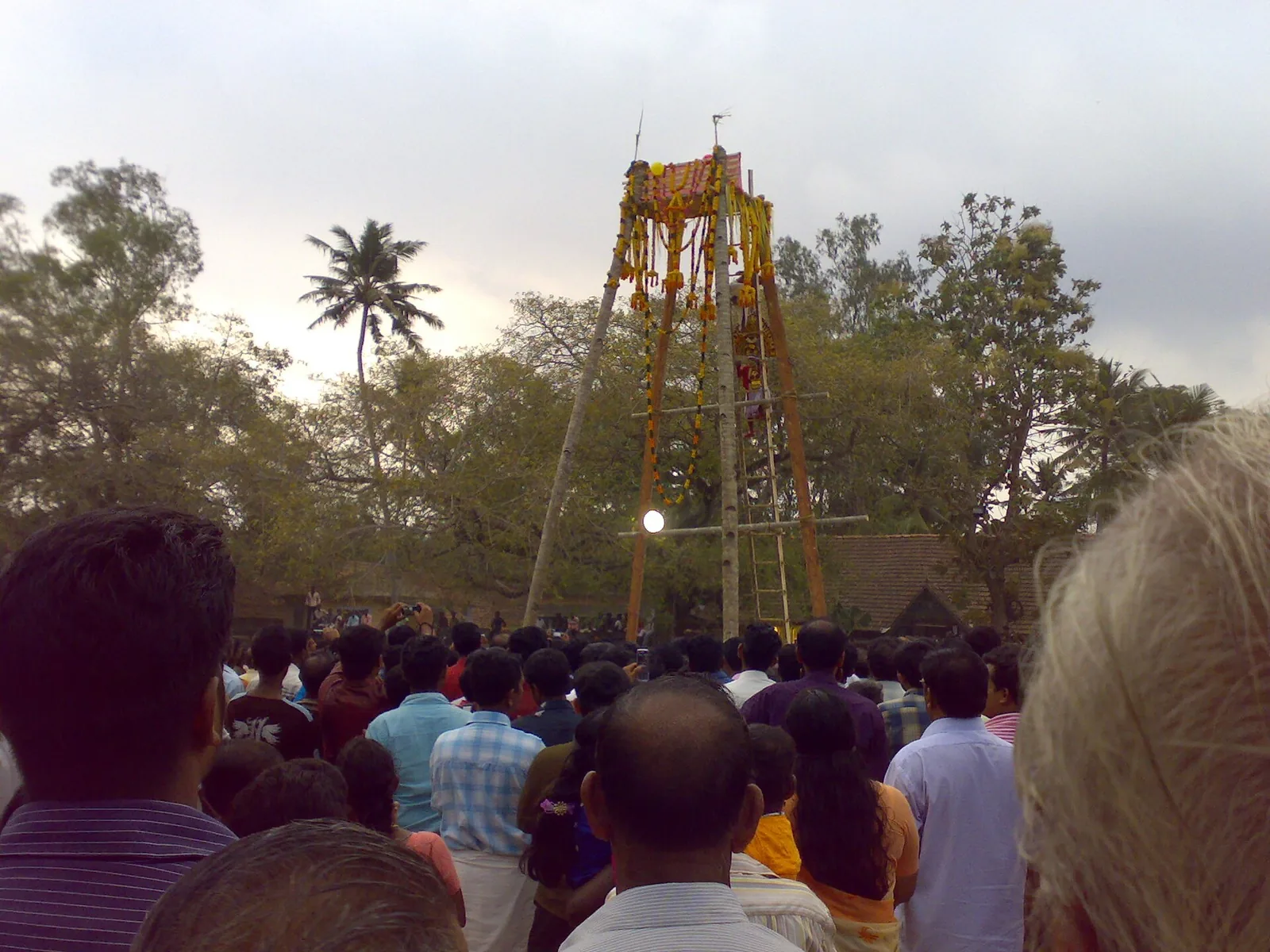
Ritual traditions almost never have a start date. They are described as immemorial, or as very old, and the honest historian shrugs. The Kaliyoottu at the Sarkaradevi Temple at Chirayinkeezhu is the rare exception: it can be dated, it can be attributed, and the reason it happens here at all is a promise made by a king in the middle of a war.
Imported, in 1748
The Kaliyoottu is a north Malabar form. It did not grow up at Sarkara, and it is not native to southern Kerala at all. The account is that Marthanda Varma — the ruler who assembled modern Travancore, reigning from 1729 to 1758 — halted near the Sarkara temple during his campaign against Kayamkulam, and vowed the goddess a Kaliyoot if she gave him the victory. He won. He kept the vow, and the rite was brought south in 1748 and established here. What a visitor watches at Sarkara is therefore a deliberate royal transplant, endowed well enough at its founding that it has run continuously ever since. That is a very different thing from a village custom of unknown antiquity, and rather more interesting.
The northern thread, twice over
The imported ritual is not the only thing at this temple that points north. Hereditary responsibility for the festival is held by the Ponnara family, whose role descends from those who accompanied the adopted Kolathunadu princesses to Attingal — and Kolathunadu is in north Malabar, the region the Kaliyoottu itself came from. So the shrine carries two separate strands of northern inheritance, one ritual and one familial, at a site well to the south of both. Travancore’s dynastic practice of adopting from Kolathunadu moved people as well as titles, and this temple is one of the places where you can still see the consequence.
Nine days, and what happens on them
The rituals run over nine days. The first seven build the story: the sequence of events leading to the confrontation between Bhadrakali and the demon Darika, presented in stages rather than delivered at once. The eighth day is the Mudi uzhichil, in which the goddess searches for Darika and blesses devotees directly — the point at which the rite turns outward and involves the people present rather than only depicting something for them. The ninth is the Nilathil poru, the fight on the ground, in which Darika is finally destroyed. The structure matters for planning: turning up on the wrong day of a nine-day sequence does not get you a smaller version of the same thing, it gets you a different part of the story.
Why Kali, and not somebody stronger
The theology underneath is worth having, because it is more precise than the usual good-versus-evil summary. Darika held a boon that made him invulnerable to any man in any of the fourteen worlds — an exhaustive-sounding grant with a gap in it. Bhadrakali is produced expressly to occupy that gap: born of Shiva, not male, and therefore outside the terms entirely. She does not defeat Darika by being more powerful than the boon. She defeats him by not being covered by it. The story is, at bottom, about a contract read carelessly by the party it was meant to protect, and the nine days are the working-out of that clause.
Not a show
One caution that matters more here than at most festivals. Listings routinely describe the Kaliyoottu as a performance or a dance-drama, which sets exactly the wrong expectation. It is ritual, conducted for the goddess and for the community that owns it; an audience is incidental to it rather than the reason it takes place. There is no ticket, no stage and no interval. Attend as a guest at somebody else’s rite — stand where you are directed, do not obstruct, and be careful about photography, particularly of participants. The same applies to the temple on ordinary days: entry rules may restrict access to Hindus and should be checked at the gate.
Going
Dates follow the Malayalam calendar and move every year, so confirm the current year’s Kaliyoottu locally rather than trusting a listing. Sarkara sits at Chirayinkeezhu in the north of the district, on the road towards Varkala and Anchuthengu, and belongs on that northern line rather than as an out-and-back trip from the city. On an ordinary morning it is genuinely quiet and worth twenty minutes for its own sake. Practical detail is on the Sarkaradevi Temple page; the temple’s separate ten-day Meena Bharani is covered in The Other Nine Days.
Frequently asked questions
What is the Kaliyoottu?
A ritual festival at the Sarkaradevi Temple enacting the confrontation between the goddess Bhadrakali and the demon Darika. It runs over nine days and is ritual rather than theatre — conducted for the goddess and the community, with any audience incidental.
How old is the Kaliyoottu at Sarkara?
It dates here from 1748. The Kaliyoottu is a north Malabar form brought to southern Kerala by Marthanda Varma, who is said to have vowed one to the goddess while campaigning against Kayamkulam and kept the promise after his victory.
What happens on each day?
The first seven days build the story leading to the confrontation. The eighth is the Mudi uzhichil, when the goddess searches for Darika and blesses devotees directly. The ninth is the Nilathil poru, the fight on the ground, in which Darika is destroyed.
Why could only Kali defeat Darika?
His boon made him invulnerable to any man in any of the fourteen worlds. Bhadrakali, born of Shiva and not male, fell outside the terms of that boon altogether — so she defeats him not by exceeding the protection but by not being covered by it.
Can visitors attend?
It is a public ritual, but it is not staged for visitors. Confirm dates locally as they move with the Malayalam calendar, check entry rules at the gate since many Kerala temples restrict access to Hindus, stand where directed and be careful about photographing participants.