The Sarkaradevi Temple is named after sugar. Sarkara is jaggery — unrefined cane sugar, boiled down and set in blocks or pots — and the temple’s name preserves a story about a consignment of it. The detail of that story is worth getting right, because the version in general circulation, including the version this site carried until recently, is not the one told at the temple, and the difference changes what the legend is about.
What the story actually is
In the telling given at Sarkara, a party of jaggery merchants halted at the vazhiyambalam — the wayside rest — near where the temple now stands. When they came to move on, the pots of sharkara could not be shifted. Not lost, not broken, not found to contain anything: simply immovable. The merchants read the refusal as the goddess making it known that this spot was hers, and the site was afterwards confirmed as a Shakti shrine by Vilwamangalam Swamiyar, the seer who turns up in the founding accounts of a great many Kerala temples and whose function in them is precisely this — to recognise and authenticate a presence that ordinary people have stumbled into.
Why the difference matters
The commonly repeated version has an image of the goddess discovered inside a load of jaggery, which makes the legend a straightforward discovery story: something hidden, then found. The version told here is not about discovery at all. Nothing is found. What happens is a refusal — an ordinary commercial load that declines to continue its journey — and the meaning has to be inferred from it. That is a subtler kind of origin story, and it belongs to a recognisable Kerala pattern in which the divine announces itself by making something impossible rather than by revealing an object. We had the wrong variant as the main one, and correcting it makes the temple’s own account both stranger and better.
The variants, which are the point
None of this means the other tellings are errors to be swept away. You will hear versions in which the image is discovered by someone processing or boiling jaggery, and others in which it is found in a load being carried or traded. These are not competing claims for adjudication; they are what a living oral tradition looks like after several centuries, and the disagreement between them is evidence of age rather than of unreliability. What survives unchanged through every version is the jaggery itself — which is, after all, the part the name had to carry.
A merchants’ road, and why that fits
It is worth noticing what kind of people the legend puts at the founding. Not a king, not a Brahmin, not an ascetic — traders, on a road, with goods. The vazhiyambalam in the story is a piece of ordinary commercial infrastructure, the wayside shelter where people carrying things between places stopped for the night. Chirayinkeezhu sits on the coastal run north of the capital that also carries Varkala and Anchuthengu, and it was exactly the sort of route along which jaggery would have moved. Whatever the legend is as history, it is at least set in the right economy.
Seeing it
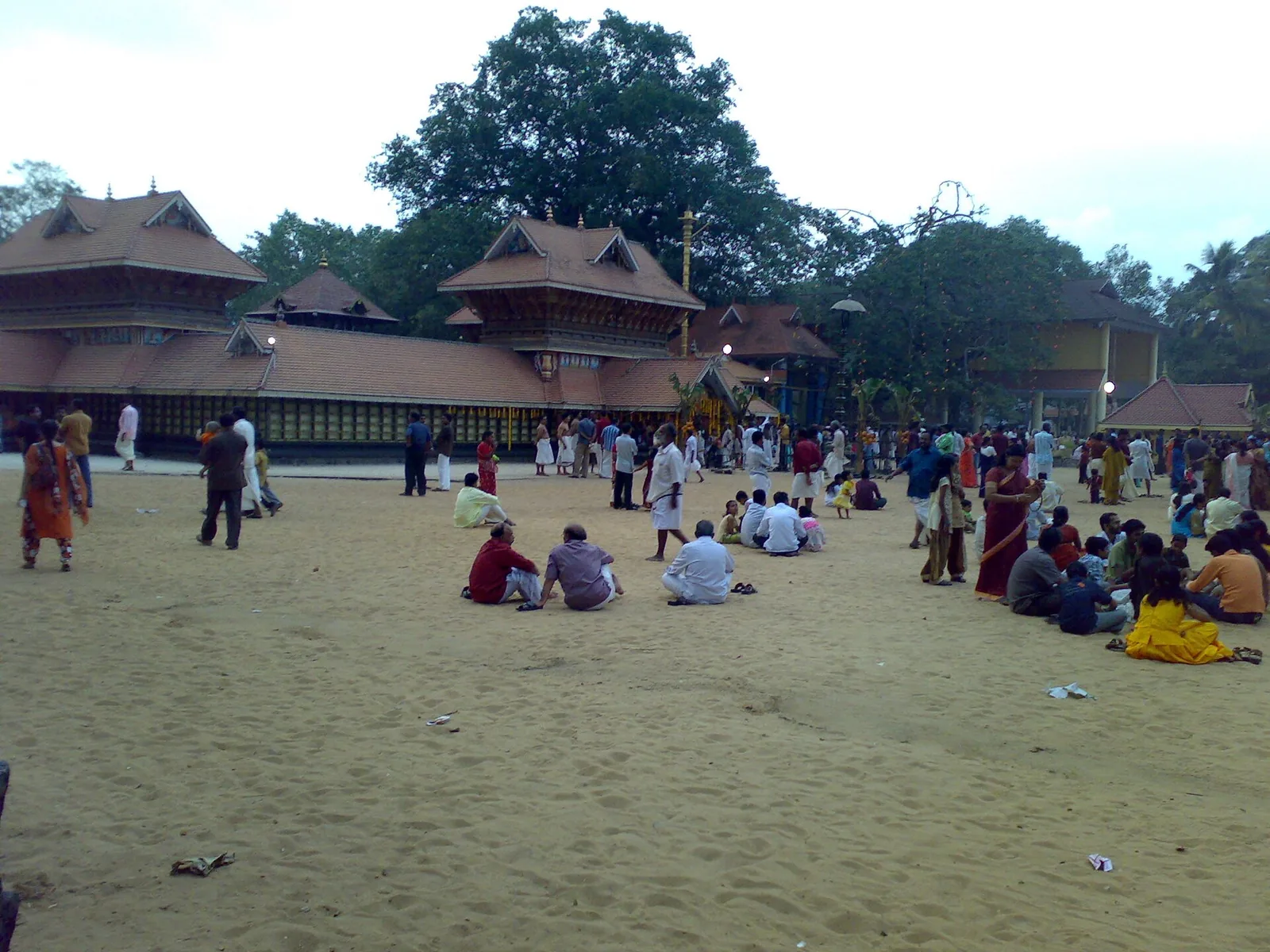
On an ordinary morning Sarkara is calm and handsome and almost entirely free of visitors: a working Kerala shrine with tiled gabled roofs around a broad sand courtyard, the flat green country of the northern district beyond it. It is one of the more pleasant places in the district to sit for twenty minutes without anybody asking you for anything. Come during the Kaliyoottu, though, and it is a completely different place — that nine-day ritual, and how it came here from north Malabar in 1748, is covered in A Ritual With a Birth Certificate. Practical detail is on the Sarkaradevi Temple page.
Frequently asked questions
What does Sarkara mean?
Jaggery — unrefined cane sugar. The temple’s name comes from the legend attached to its founding.
What is the jaggery legend?
In the telling given at the temple, jaggery merchants halted at the wayside rest here and found that their pots of sharkara could not be moved when they tried to leave. They took the immovability as the goddess claiming the spot, and the site was later confirmed as a Shakti shrine by Vilwamangalam Swamiyar.
Was an idol found inside the jaggery?
That is the version most widely repeated, but it is not the one told at Sarkara. In the temple’s account nothing is discovered — the load simply refuses to move, and the meaning is inferred from that refusal.
Who was Vilwamangalam Swamiyar?
A seer who appears in the founding accounts of many Kerala temples, typically in the role he plays here: recognising and authenticating a divine presence that ordinary people have encountered without understanding.