Long before anyone came to sit on these lawns, the boats were already coming in. From the close of the nineteenth century, The Hindu says, the Ernakulam boat jetty was the busiest place in the town. Passengers came from Kollam, Alappuzha, Kottapuram, Kodungallur and the islands nearby. Subhash Park history starts right there, at the water's edge, because the green park that now spreads beside the jetty grew up around all that coming and going.
The busiest passengers of all were students, because Maharaja's College stood just across the road from what is now Subhash Park. Two double-decker boats, Lord Hari and Champachan, carried them to class. Near the shore the boats cut their engines, so men had to push them by hand to their moorings. The Hindu says that old mooring spot is now the little pool in the Children's Park. A child splashing there today is playing where the college boats once tied up.
Where crowds wait for boats, people talk, and that is why the jetty also became a meeting place for writers. Vaikom Muhammad Basheer ran a book stall close to the ticket counter, and the writers of the time gathered around it between ferries. When Basheer moved on, he handed the stall to the novelist and critic P K Balakrishnan, so the little shop kept its place in Kerala's literary life for another generation.
The same crowds that made the jetty good for books also made it the natural place to be heard. Political workers from Travancore who faced arrest took the boat here to find shelter across the border in Cochin State. The old State Legislative Assembly, now the Government Law College, stood close by. That nearness meant the waterfront saw anger as well as arrivals. Police used lathis on people protesting a press law here when Panampilly Govinda Menon was prime minister of Cochin State.
Those were not the last marches to end at the water. Workers of Tata Oil Mills came here behind their leader Mathai Manjooran. Passengers also gathered to fight a rise in boat fares in what people still remember as the "one anna" agitation. Even during the Emergency the jetty kept its role, because the Communist leader A K Gopalan was arrested here while he led a protest.
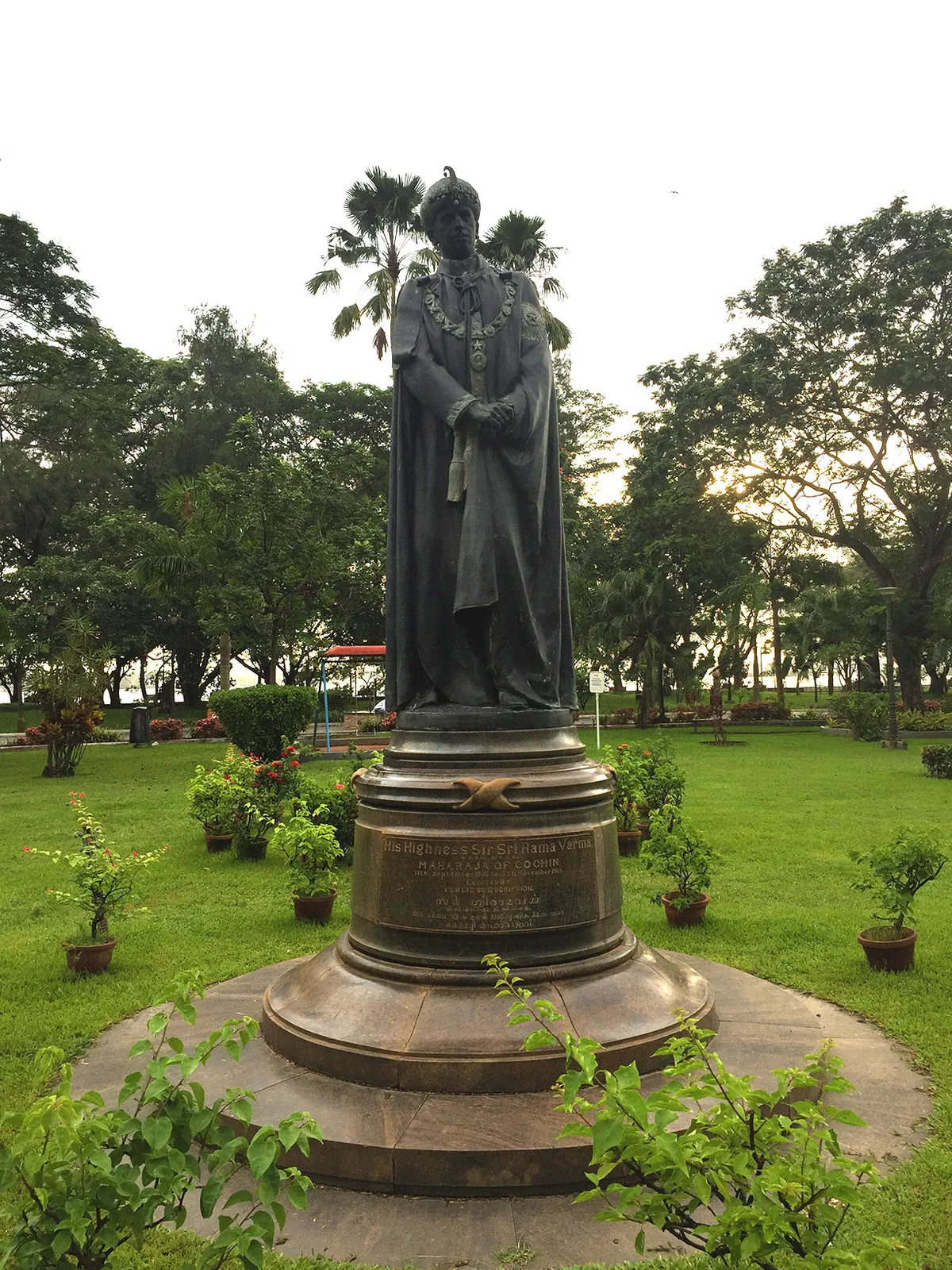
Among all these stories of ordinary people stands one royal figure, a statue of Rama Varma XV, Maharaja of Cochin, and its own story is one of bad timing. The New Indian Express tells how the Diwan, A R Banerjee, saw a statue of Ganga Singh, the Maharaja of Bikaner, and wanted one like it for his king. Then the First World War broke out, metal grew scarce and costly, and the statue cost far more than planned. By the time it was ready, the king had already given up his throne and never saw himself in bronze while he ruled.
The ground around that statue has changed even more than the crowds have, because part of the park did not exist a century ago. In the 1980s the Greater Cochin Development Authority reclaimed land from Vembanad Lake for its Marine Drive scheme. That scheme gave the city an extension of Subhash Park along with Rajendra Maidan, the Children's Park and the Marine Drive walkway. Some of the lawn under your feet was once open water, and our Marine Drive Kochi story follows how that whole waterfront took shape.
The new land also gave the park its art. In 1990 fourteen sculptors, seven from India and seven from abroad, worked in the open here, and their pieces still stand among the trees of the southern quarter. How those works were made, and rescued from rust in 2018, is told in the story of the Subhash Park sculptures.
Today the place carries the name of Subhash Chandra Bose, the freedom fighter, and Kerala Tourism gives its area as 11.5 acres, looking out over Vembanad Lake and Cochin Harbour. Yet a park this loved nearly lost its people. The Kochi Corporation's heritage body, C-HED, says new malls drew families away while poor upkeep made things worse. Slowly the lawns that had once been the city's living room grew quiet.
That decline is why the Kochi Municipal Corporation Council handed C-HED the job of running the park. A major facelift followed with new lawns, lights, benches, toilets, play equipment and corners set aside for older visitors. The best-loved addition is the musical walkway, split into four zones that each play a different kind of music. The actor Mammootty reopened the renovated park with Mayor M Anil Kumar, and C-HED went on to plant a medicinal garden and a butterfly garden with ICLEI South Asia.
With the people back, the park became a stage again, hosting concerts, performing arts and other cultural evenings. In July 2022 a water treatment plant opened here beside a small nature interpretation centre. C-HED now calls the park a green lung and breathing space for Kochi, and one of the most frequented public spaces in the city. In the evenings the ferries still pull in next door, so the old jetty and the new park finally share the same crowd.
That crowd rarely stops at the park, because it sits at the heart of the mainland sights. Broadway market, the old shopping street, is a short walk inland, and the Durbar Hall Art Centre shows work by Kerala artists not far beyond it. North along the water, Mangalavanam Bird Sanctuary guards a patch of mangrove. The ferries from the jetty still cross the harbour to Fort Kochi, just as they did when this was the busiest landing in town. The Kochi guide picks up the journey from there.
Frequently asked questions
Who is Subhash Park in Kochi named after?
It is named after the freedom fighter Subhash Chandra Bose. Its full name is the Subhash Chandra Bose Park, and most people call it Subhash Park or Subhash Bose Park.
Why is the Ernakulam boat jetty part of the park's history?
The Hindu calls the jetty the busiest place in the town from the late nineteenth century. Writers met at Basheer's book stall there, and many protests began on this waterfront.
Whose statue stands in Subhash Park?
The statue is of Rama Varma XV, a Maharaja of Cochin. The Diwan A R Banerjee planned it, and the First World War delayed it until after the king had left the throne.
How big is Subhash Park?
Kerala Tourism gives its area as 11.5 acres. Part of it sits on land that GCDA reclaimed from Vembanad Lake in the 1980s for the Marine Drive scheme.