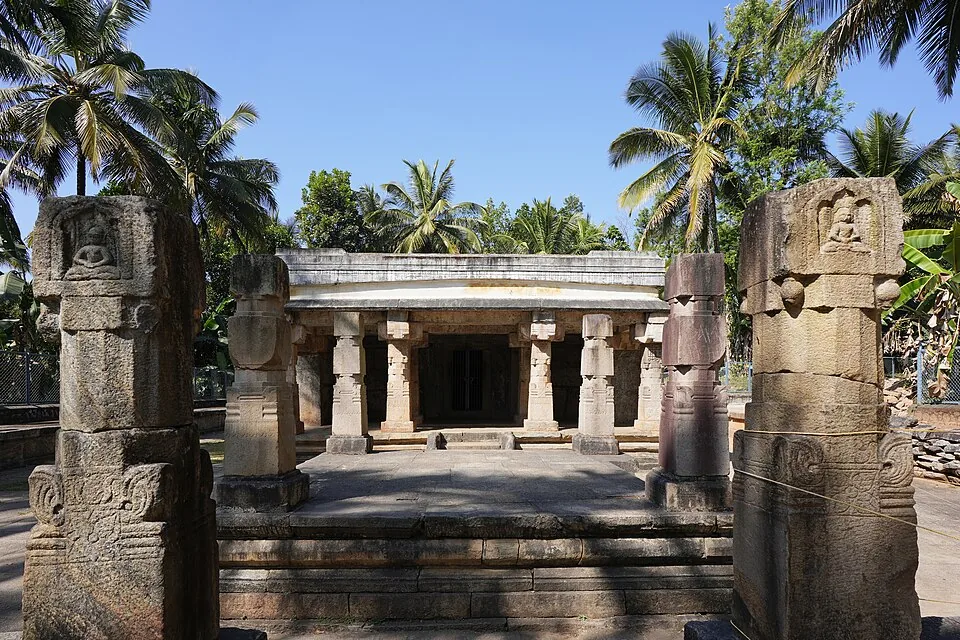
A whole town in Wayanad is named after a warlord’s ammunition dump — and the ammunition dump was a temple. The Jain temple at Sultan Bathery is a serene thing of carved granite, seven hundred years old; its improbable second life, stacked with a conqueror’s gunpowder, is written into the name every signpost in the district now carries.
A temple of the Jain merchants
The temple was built in the thirteenth century, in the elegant Vijayanagara style, entirely of granite — square carved pillars raised on a platform, holding up slabs of stone roof, their cornices and surfaces worked with the intricate, restrained detail of the Jain tradition. It is a reminder of something easily forgotten: that Jainism, which has all but vanished from Kerala, once flourished in these hills. Jain merchants had been migrating into Wayanad since the twelfth century, and this temple stood at the heart of their community — first a place of worship, then a bustling centre of trade.
The town before the name
The area around it went through names as it went through rulers. The villages here were once known simply as Kidanganadu. A Ganesha temple, probably raised in the Vijayanagara period, gave the place a new name — Ganapathivattam, the ground of Ganapathi. It was a settled, sacred, trading town, its identity woven from Jain and Hindu threads. And then, in the eighteenth century, war came up into the mountains.
Tipu’s battery
When Tipu Sultan, the ruler of Mysore, was waging his campaigns against Malabar, his armies pushed through Wayanad — and the old Jain temple, solid, granite-walled and defensible, was pressed into brutal service. Tipu is said to have used it as a battery, a place to store his artillery and ammunition, a stone strong-room for the tools of war. From that arsenal — the Sultan’s battery — the town took the name it still carries: Sultan Battery, or, as everyone here says it, Sulthan Bathery. A place of Jain prayer had lent its walls to a warlord’s guns, and been renamed for the guns forever.
What survived
The gunpowder is long gone; the temple remains. It stands today as a protected monument, quiet and dignified, its carved pillars and stone mandapas still standing after seven centuries and one very strange chapter. There is a particular poignancy in visiting it — a house of one of the world’s most rigorously non-violent faiths, which once held a conqueror’s cannon, and outlasted him.
Visiting the Sultan Bathery Jain temple
The temple sits right in Sulthan Bathery town, easy to reach and an essential stop on any Wayanad heritage trail — pair it with the prehistoric rock art of the nearby Edakkal Caves. It is a monument as much as a shrine; visit with quiet respect for both its faith and its history. Details are on the Sultan Bathery Jain temple place page; more of the district is on the Wayanad hub.
Frequently asked questions
How did Sultan Bathery get its name?
When Tipu Sultan of Mysore campaigned in Malabar in the 18th century, he is said to have used the town’s ancient Jain temple as a battery — a store for his artillery and ammunition. The town, earlier called Ganapathivattam (and before that Kidanganadu), came to be named Sultan Battery, or Sulthan Bathery, after that arsenal.
How old is the Sultan Bathery Jain temple?
It was built in the 13th century in the Vijayanagara architectural style, entirely of carved granite. Jain merchants had been migrating into Wayanad since the 12th century, and the temple was the heart of their community.
Where is the Sultan Bathery Jain temple?
It is in Sulthan Bathery town in Wayanad district, an easy stop on a Wayanad heritage trip and close to the Edakkal Caves.