Most visitors climb this tower for the view from the balcony. The more interesting thing is inside the lantern, and it is described in detail in a document almost nobody reads: the Master Ledger that the Directorate General of Lighthouses and Lightships keeps for every station in the Cochin district.

The ledger entry for station F-0712, Tangasseri Point, is an inventory rather than a history, and it is far more revealing for it.

A lens floating on mercury

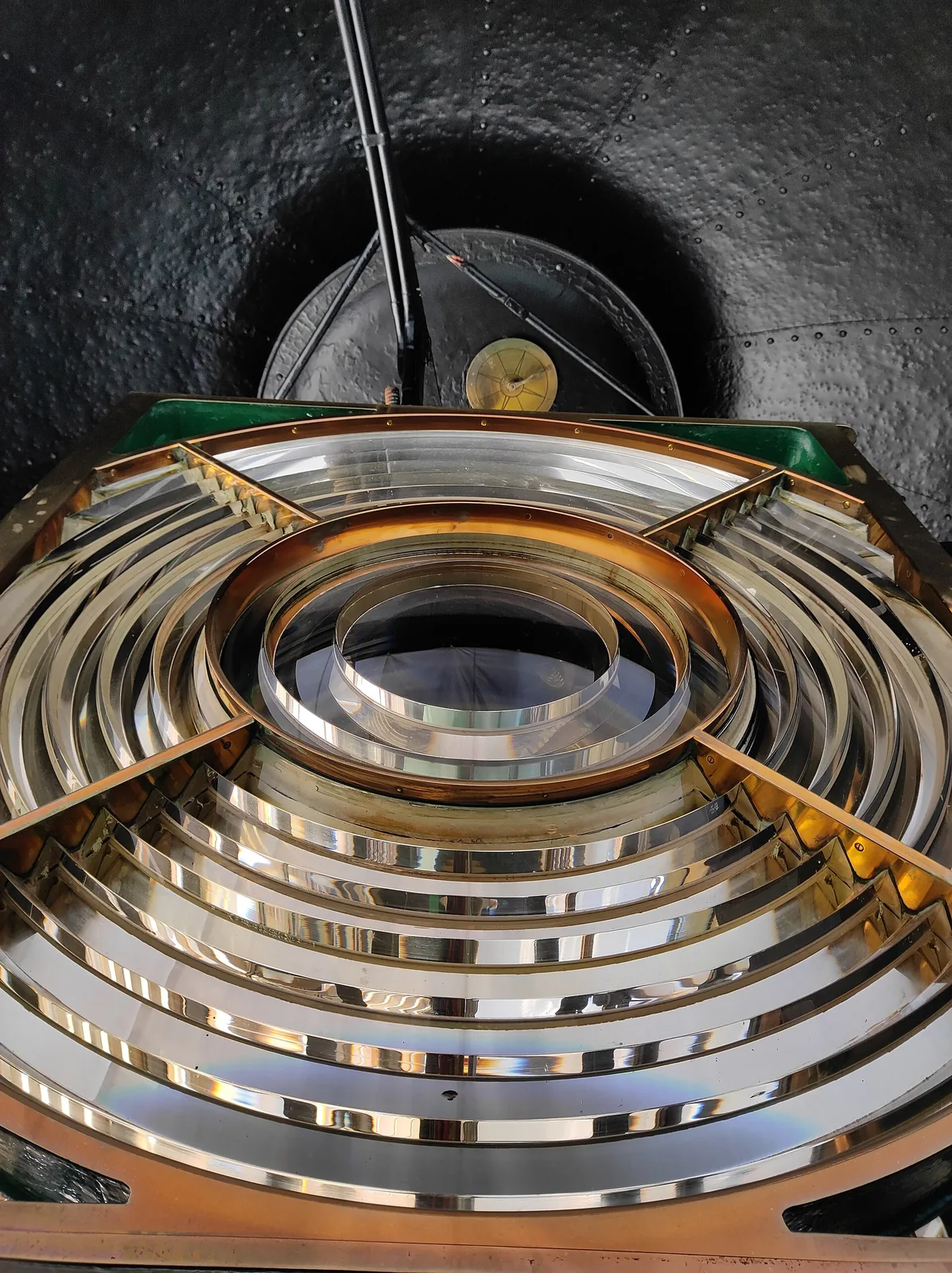
The optic is a revolving lens by Chance Brothers of Birmingham — second order, 700 millimetres, three panels. It has been in place since the light was installed on 1 March 1902.

It does not sit on bearings. It floats. The ledger records the pedestal as a mercury float carrying 89.2 kilograms of mercury, which is how the great nineteenth-century lenses achieved a rotation so nearly frictionless that a modest weight could drive several tonnes of glass and brass. The assembly turns at four revolutions a minute.

Nearly ninety kilograms of liquid mercury, in a working installation, a hundred and twenty-four years after it was poured. It is one of the last technologies you would design today and one of the best anyone ever built.

And the clock is still the backup

The rotation is now driven by two stepper motors rated at 40 kilogram-centimetres. That is the modern part. Directly beneath it in the same ledger field is the entry that stops you:

The ledger entry, verbatim
  • Rotation Device — 2 no's Stepper motor 40 Kg-cm
  • Clockwork machine with hand winding (Standby)

The original mechanism — a falling-weight clock, wound by hand by the keeper, of the kind that made the phrase "lighthouse keeper" mean what it means — has not been removed, retired or put in a display case. It is listed as the station's standby rotation device. If the motors and the generators and the battery banks all fail, somebody winds the clock and the light keeps turning.

It sits, in the ledger, a few lines away from a VSAT satellite terminal, two AIS base stations, a programmable logic controller and twelve CCTV cameras.

The lamp that went backwards

The light source has a stranger history than the machinery that turns it.

It began, on 1 March 1902, as a petroleum vapour light with a 55 millimetre burner. In 1962 that was replaced with a 230-volt, 5 kilowatt incandescent lamp — the obvious modernisation, sixty years late and entirely expected.

Then, in 1967, the station reverted to petroleum vapour.

The DGLL's own account is blunt about the sequence without dwelling on the reason. Whatever lay behind it — supply of lamps, supply of power, reliability on an exposed coast — a lighthouse was quietly un-modernised and ran on burning oil vapour for another twenty-seven years. Only on 15 May 1994 did it move to metal halide, and that is what burns there now: a cluster of three lamps at 150 watts each, 230 volts, producing an effective beam intensity of 127,950 candelas visible 26 nautical miles out.

Eight panes that are not glass

The lantern room is 3.65 metres across with 1.83 metres of glazing and thirteen ventilators. It has thirty-two panes, in two tiers.

Twenty-four of them are glass. The other eight are mild steel blank sheets, and the ledger says exactly where they are: on the land side.

This is the detail that changes how you look at the tower from the beach. The light has been deliberately blinded towards Kollam. A beam of that intensity is useless to anyone inland and intolerable to anyone living beneath it, so a quarter of the lantern has simply been plated over. What you see sweeping the sky at night from the town is scatter and spill, not the beam itself. The beam is out at sea, where it was always pointed.

What the character means

The ledger gives the light's signature as a group flash of three every fifteen seconds, timed 0.2 + 2.8 + 0.2 + 2.8 + 0.2 + 8.8.

Read that as instructions rather than as numbers. Flash. Two and eight-tenths of a second of dark. Flash. The same gap again. Flash. Then nearly nine seconds of nothing, and begin again. Three quick blinks and a long pause, every fifteen seconds, for a hundred and twenty-four years.

That pattern is the entire point of the building. A navigator offshore at night does not need to know that the tower is red and white or thirty-five metres tall, because they cannot see any of it. They need to be able to count to three, time the pause, and know which piece of coast they are looking at. Everything else on this cape — the fort, the graves, the enclave, the stripes — is for people standing on land in daylight.

Frequently asked questions

What is inside the Thangassery lighthouse lantern?

A revolving second-order optic by Chance Brothers of Birmingham, 700 mm, three panels, in place since 1 March 1902. It floats on a mercury bath containing 89.2 kg of mercury and turns at 4 revolutions per minute.

Is the original clockwork mechanism still there?

Yes, and it is not a museum piece. The DGLL Master Ledger lists the rotation device as two stepper motors plus a "Clockwork machine with hand winding (Standby)" — the hand-wound original is the station's designated backup.

What lamp does it use?

Metal halide since 15 May 1994 — a cluster of three 150 W, 230 V lamps giving 127,950 candelas and a range of 26 nautical miles. Before that it ran on a petroleum vapour light with a 55 mm burner from 1902, was converted to a 5 kW incandescent lamp in 1962, and then reverted to petroleum vapour in 1967 for a further twenty-seven years.

Why does the beam not shine over the town?

Because it has been blocked. The lantern has 32 panes in two tiers, of which only 24 are glass; the other eight are mild steel blank sheets fitted on the land side. The light is deliberately blinded towards Kollam, as working lights usually are.

How do I identify this light at night?

Count the flashes. Its character is a group of three flashes every fifteen seconds — three quick blinks about 2.8 seconds apart, then a pause of roughly 8.8 seconds before the group repeats.