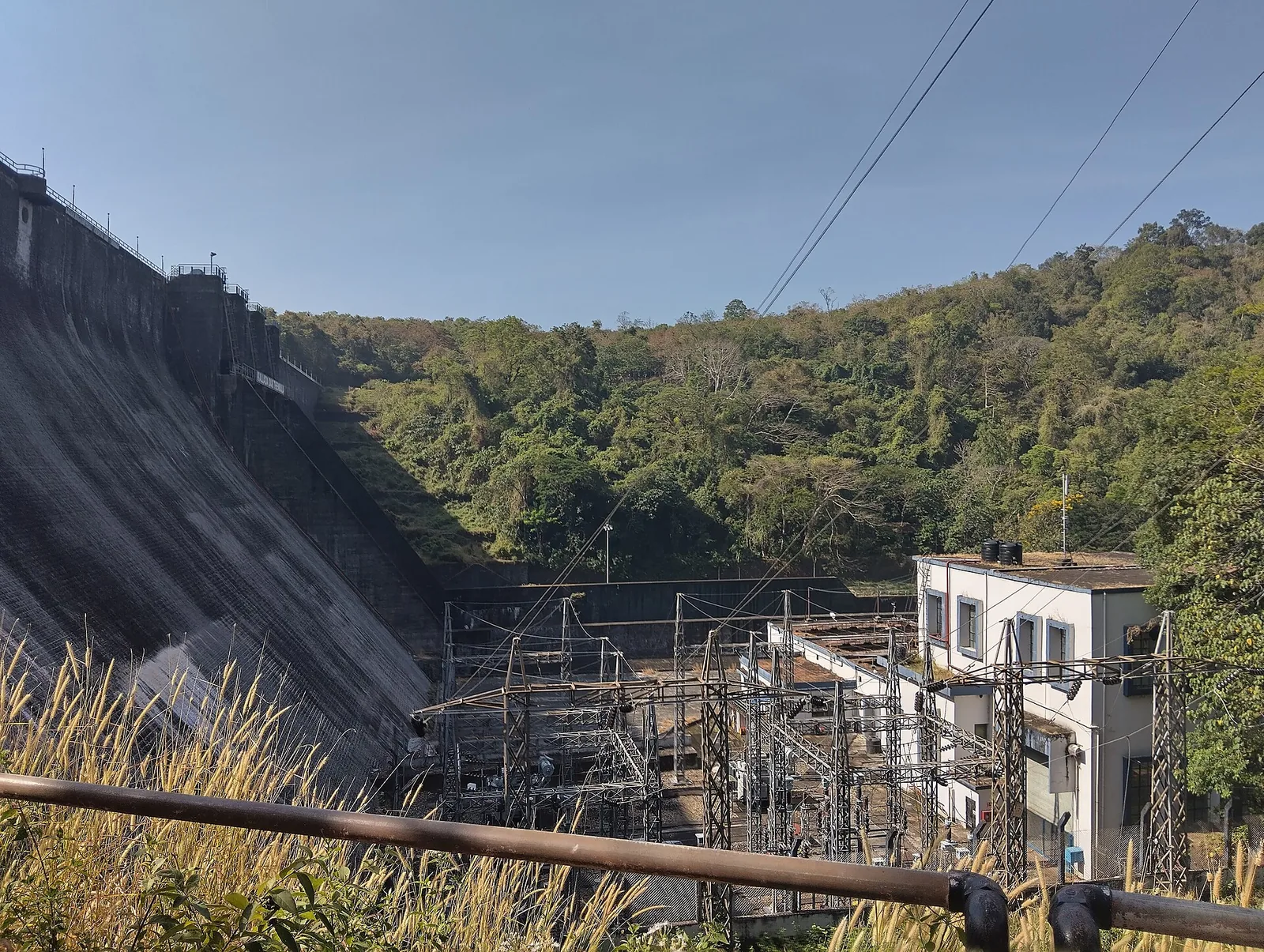
For years this site described the dam at Thenmala as a piece of pure irrigation engineering. There is no elegance in it and none was wanted, we wrote; the job was storage and irrigation. The words power, hydro and KSEB appeared nowhere on the page.
There is a 15 MW power station standing at the toe of the wall. It is in the corner of almost every downstream photograph of this dam, with KERALA STATE ELECTRICITY BOARD LTD and KALLADA HYDRO ELECTRIC PROJECT painted on the side of it. The Irrigation Department’s own mission statement for the project is to ensure water in the canals for irrigation and power generation. Kerala Tourism calls the dam a significant source of irrigation and hydropower. We were the only ones who missed it, and this story is the correction.
What is down there
The Kallada Hydro Electric Project: two 7.5 MW vertical-shaft Kaplan machines, 15 MW installed, sited by KSEB’s own description at the dam toe of the Kallada irrigation dam, in Thenmala village, Punalur taluk, Kollam district.
The numbers underneath that are unusually legible for anyone who likes knowing how a thing works. Average net effective head 43 metres. Full-load discharge of one machine 20.32 cubic metres a second. Water required to generate one million units, 9.75 million cubic metres. Firm annual generation capability 65 million units. The energy equivalent of one full reservoir, 48.41 million units — that is, a completely full lake is worth about three-quarters of a normal year’s firm output. The power leaves on two 66 kV feeders.
Why it was a first
KSEB puts the idea plainly: the Kallada power station is the first of its kind in Kerala in utilising the water for irrigation release for power generation. The dam is owned by the Irrigation Department; after generation, water from the power station is released into the Kallada river, and from there it is diverted into the irrigation canals by a diversion weir during irrigation seasons.
That is the whole engineering thought in one paragraph. The water was going to be let out for the canals regardless. Put a turbine in its path and the electricity is free in every sense that matters — no new reservoir, no new inundation, no new river taken.
It also fixes the hierarchy permanently. The station is hostage to the irrigation calendar and not the other way round. When the canals do not need water, the turbines do not turn.
One wall, two state agencies
The Irrigation Department owns the dam. KSEB owns the powerhouse and the switchyard at its foot. Two arms of the Kerala government, one structure, one river.
That split is the quiet explanation for something a reader will notice as soon as they start checking: the dam’s own department page and the electricity board’s page carry different numbers for the same reservoir. KSEB gives the water spread as 13.72 square kilometres; the Central Water Commission gives 23. Two custodians, two sets of books.
Seven years late
The station was in the plan from the start, and it took twice as long as promised.
The World Bank’s 1982 appraisal of the project records that provisions have been made for the construction of a power station with a 16 MW installed capacity, with the penstock and intake gates included in the project and the electrical equipment to be paid for by the state electricity side. Its economic analysis assumed the benefits of power generation — 65 gigawatt-hours after 1987.
What actually happened: 15 MW, not 16. First generation in 1993 or 1994, not 1987. Roughly seven years late on the power alone, on top of a dam that was itself commissioned in 1986 against a schedule of early 1984.
We cannot give you a single commissioning date, because KSEB cannot either. One KSEB table gives unit 1 as 5 January 1994 and unit 2 as 5 September 1994. Another KSEB page gives unit 2 as 29 November 1993 and unit 1 as 18 September 1994, with the station dedicated to the nation on 5 January 1994 — which is the first table’s date for unit 1. If the second page is right, the station was dedicated when only one of its two machines existed. We publish the range and the disagreement rather than picking a date.
What it actually produces
Against that 65 million unit firm capability, KSEB’s published run of six years reads: 60.41, then 72.25, then 65.62, then 21.81, then 67.76, then 68.99.
The fourth number is the interesting one. In one year this station produced a third of its normal output — not because anything broke, but because there was not enough irrigation water to release. That single figure tells you more about what this power station is than any of the design specifications do.
And it nearly happened again. In late April 2026 the reservoir stood at 98.46 metres against a full level of 115.82 — about 34 per cent, after a failed summer rain — with officials warning that both canal irrigation and generation would be disrupted if the level fell below 95 metres. One of the two machines was under maintenance; the working unit was releasing 12.47 cubic metres a second, and the water then passed into the left and right bank canals at two and a half metres of head. The site’s public washrooms were shut for lack of water. The boats at Pallamvetty kept running.
The argument for finishing the dam
One last figure from the 1982 appraisal, which is worth sitting with. The Bank ran the economics of the dam on power alone, with the project years late and half-built, and found that its economic rate of return would be 7 per cent counting the money already sunk, and 13 per cent ignoring it — indicating, in its words, that it would be economically viable to complete the dam on the basis of power benefits alone.
So the building in the corner of your photograph was, at one point, the reason the wall behind it got finished at all. It is worth a second look on the way past.
Frequently asked questions
Does the Thenmala dam generate electricity?
Yes. The Kallada Hydro Electric Project sits at the dam toe: 15 MW from two 7.5 MW vertical Kaplan turbines, run by KSEB, generating first in 1993/94, with a firm annual capability of 65 million units and evacuation on two 66 kV feeders.
Why is it described as a first for Kerala?
Because it generates from water that was being released for irrigation anyway. In KSEB’s own words it is the first of its kind in Kerala in utilising the water for irrigation release for power generation — after the turbines, the water returns to the Kallada and is diverted into the canals by a weir.
Who owns what here?
The Irrigation Department owns the dam; KSEB owns the powerhouse and switchyard at its foot. That divided custody is also why the two agencies publish different figures for the same reservoir — KSEB gives the water spread as 13.72 sq km, the Central Water Commission as 23.
When exactly was the power station commissioned?
In 1993 or 1994 — and KSEB’s own pages disagree about the detail. One table gives unit 1 on 5 January 1994 and unit 2 on 5 September 1994; another gives unit 2 on 29 November 1993 and unit 1 on 18 September 1994, with 5 January 1994 as the dedication date. We give the range rather than choose.
How much does it actually generate?
Against a firm capability of 65 million units, KSEB’s published six-year run was 60.41, 72.25, 65.62, 21.81, 67.76 and 68.99 million units. The 21.81 year is the point: output here is set by how much irrigation water there is to let go.
