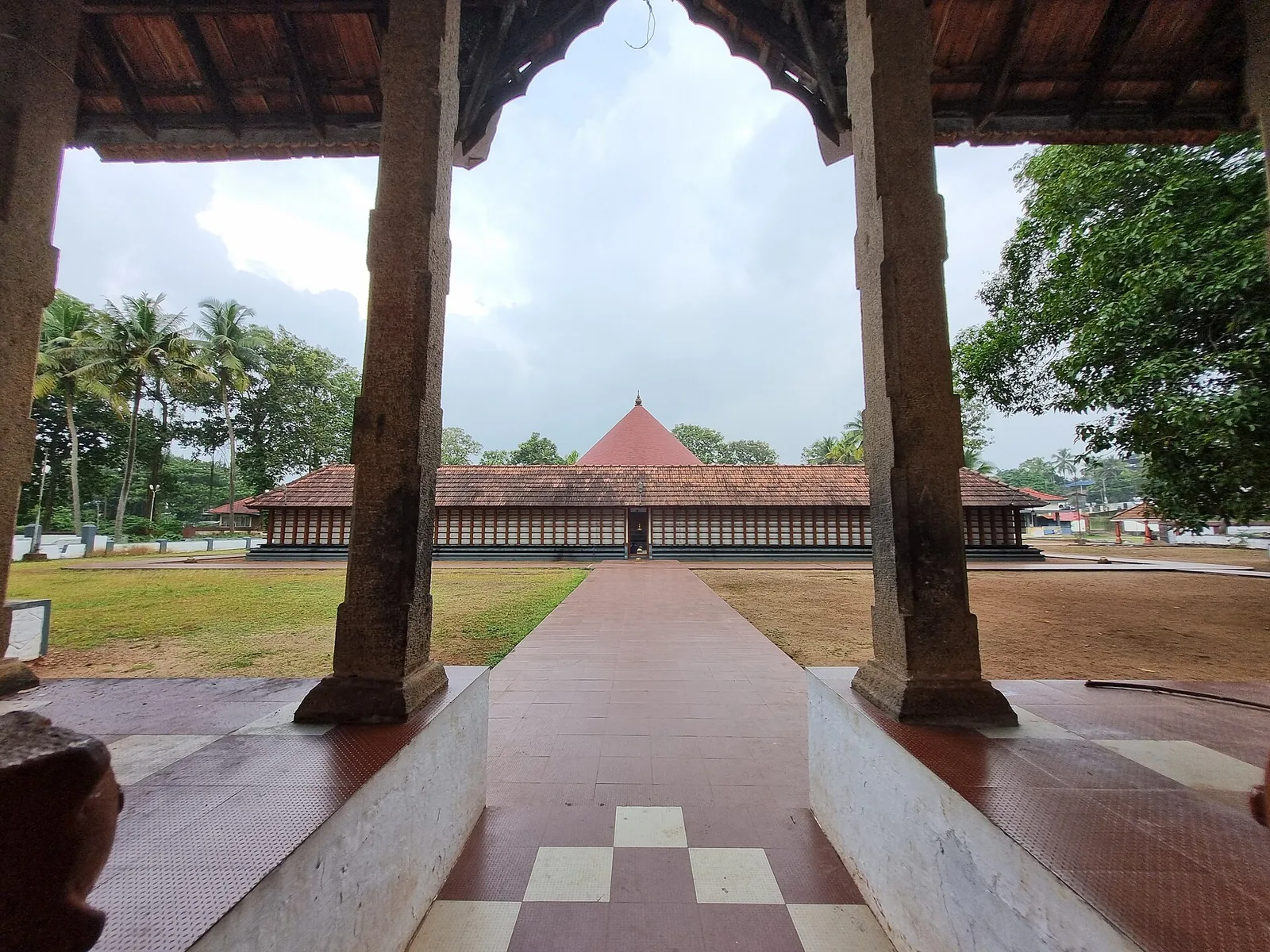
Thrikkakara Vamana Temple is where Kerala says Onam began — Mahabali’s capital, the ground where Vamana set his foot, the shrine whose deity is remoulded in clay on doorsteps across the state every Chingam. We have told the legend and we have covered what happens here during the festival.
This is the part underneath, and it is odder than the legend. The birthplace of Kerala’s national festival spent something like eight centuries as a ruin, and the festival did not falter for a day.
What the stones record
The hard evidence at Thrikkakara is epigraphic. Around eighteen inscriptions survive, cut into the granite basement of the circular sanctum, into the passages, the steps and the floor of the nalambalam. They date from the late tenth and early eleventh centuries and run on into the thirteenth. The language is Malayalam; the script is Vattezhuthu, the old round hand of the coast.
What they describe is not a quiet devotional site. Onam here was a state occasion: the inscriptions record the festival kept with great ceremony under the Chera kings, and describe local chieftains gathering at Thrikkakara at festival time to pay their respects to the Kulasekhara emperor. This was a durbar with a religious calendar attached. The temple was where the region assembled and where authority was acknowledged, once a year, in public.
Then it stopped
By the official Kerala account the temple went into decline in the twelfth century, amid disputes between kings. Given what the inscriptions say the place was “for”, that follows: an assembly point for a paramount authority stops being maintained when there is no longer an undisputed paramount authority to assemble for.
And it stayed down. Not for a generation — for the better part of eight hundred years, through the arrival of the Portuguese, the Dutch and the British, the temple that Kerala regarded as the origin of its greatest festival sat dilapidated.
The festival did not care
Here is the mechanism, and it is recorded in the tradition itself. The Kulasekhara emperor, having gathered his chieftains here at festival time, is said to have declared that Onam should be kept in every home.
That single devolution is the whole story. Once Onam was a household observance — the flower carpet at your own door, the sadya on your own floor, and above all the “Thrikkakarayappan”, the small clay pyramid of Vamana moulded and painted and set up in your own courtyard — the festival no longer required the shrine. Kerala had a portable temple. Every house made its own each August.
- Late 10th–13th c. — inscriptions record Onam as a Chera state occasion, chieftains assembling before the Kulasekhara emperor.
- 12th c. — the temple declines amid disputes between kings, and stays derelict for centuries.
- Throughout — Onam is kept in every household, with the clay Thrikkakarayappan standing in for the deity.
- 1916 — the inscriptions are recorded and published in the Travancore Archaeological Series.
- 1921 — the temple is restored by Sree Moolam Thirunal, Maharaja of Travancore.
Institutions usually try very hard not to become dispensable. This one succeeded so completely at spreading its own practice that the practice outlived it by eight centuries. Whether that counts as failure or as the most complete success available to a religious institution is a genuinely open question, and standing in the courtyard is a good place to think about it.
The epigraphists got here before the builders
A detail worth savouring. The inscriptions were recorded and published in the Travancore Archaeological Series in 1916. The temple was restored in 1921. For five years, the best-documented thing about Kerala’s most mythically important temple was a ruin that scholars had read and nobody had repaired.
The restoration, when it came, was carried out by Sree Moolam Thirunal, the Maharaja of Travancore — following representations from devotees and a report from the archaeological department. Note the kingdom. Thrikkakara does not sit in Travancore, and it was a Travancore ruler who put the roof back on.
What this means for what you are looking at
Split the building in two as you walk round. The granite is ancient and carries the inscriptions: the basement of the circular sanctum, the steps, the paving of the nalambalam. Everything above it is essentially a century old.
That is not a disappointment; it is a more honest and more interesting building than an undisturbed antiquity would be. Very few Indian temples let you see, in the join between stone and superstructure, the exact place where a tradition broke and was reattached.
One more correction while you are here. The Athachamayam is usually described as the Maharaja of Kochi’s ceremonial procession from Tripunithura to this temple. The longer record is messier: the Samoothiris — the Zamorins of Calicut — are recorded as conducting the Athachamayam up to 1756. The procession changed royal hands with the politics of the region, and the version most people picture is a late one.
Going
Thrikkakara is on the eastern edge of Kochi between Edappally and Kakkanad, close to the IT corridor, so it is an easy detour rather than an expedition. It is an active temple: dress traditionally, follow the posted customs, and be aware that entry conventions for non-Hindus differ from temple to temple in Kerala. The ten-day Onam festival in Chingam is the great season and the concluding communal sadya draws enormous crowds — magnificent to witness, and not the visit to choose if you want to look at inscriptions.
Frequently asked questions
Is Thrikkakara Vamana Temple really ancient?
The site and its granite are. The building largely is not. Inscriptions on the sanctum basement, steps and nalambalam floor run from the late tenth century into the thirteenth. But the temple declined in the twelfth century amid disputes between kings and lay dilapidated for centuries, and what stands today is a restoration of 1921. Claims that the temple is two thousand years old are devotional rather than documentary.
Who restored the temple, and when?
Sree Moolam Thirunal, the Maharaja of Travancore, in 1921, after representations from devotees and a report by the archaeological department. It is worth noticing that Thrikkakara is not in Travancore — the restoration came from a neighbouring kingdom.
How did Onam survive while the temple was derelict?
Because the festival had already been devolved into the household. Tradition holds that the Kulasekhara emperor declared Onam should be kept in every home, and once families were making their own clay Thrikkakarayappan, laying their own flower carpets and cooking their own sadya, the observance no longer depended on this shrine. The temple effectively distributed itself and then went quiet.
What do the Thrikkakara inscriptions say?
Around eighteen inscriptions, in Malayalam and in the Vattezhuthu script, dated from the late tenth and early eleventh centuries onwards. They record Onam being celebrated here with great ceremony under the Chera kings, and describe local chieftains assembling at Thrikkakara to pay respects to the Kulasekhara emperor — making the festival a political occasion as much as a religious one. They were published in the Travancore Archaeological Series in 1916.
Who conducted the Athachamayam?
It is popularly the Maharaja of Kochi’s procession from Tripunithura, but the record is longer: the Samoothiris, the Zamorins of Calicut, are recorded as conducting the Athachamayam up to 1756. The rite appears to have passed between ruling houses with the politics of the region rather than belonging to one dynasty throughout.
What should I actually look at when I visit?
The granite. The circular sanctum — a vattasrikovil — stands on a granite basement, and the inscriptions are cut into it and into the steps and the nalambalam floor. Then look at where the old stone stops and the twentieth-century work begins. It is a rare chance to see the exact seam where a tradition broke and was mended.