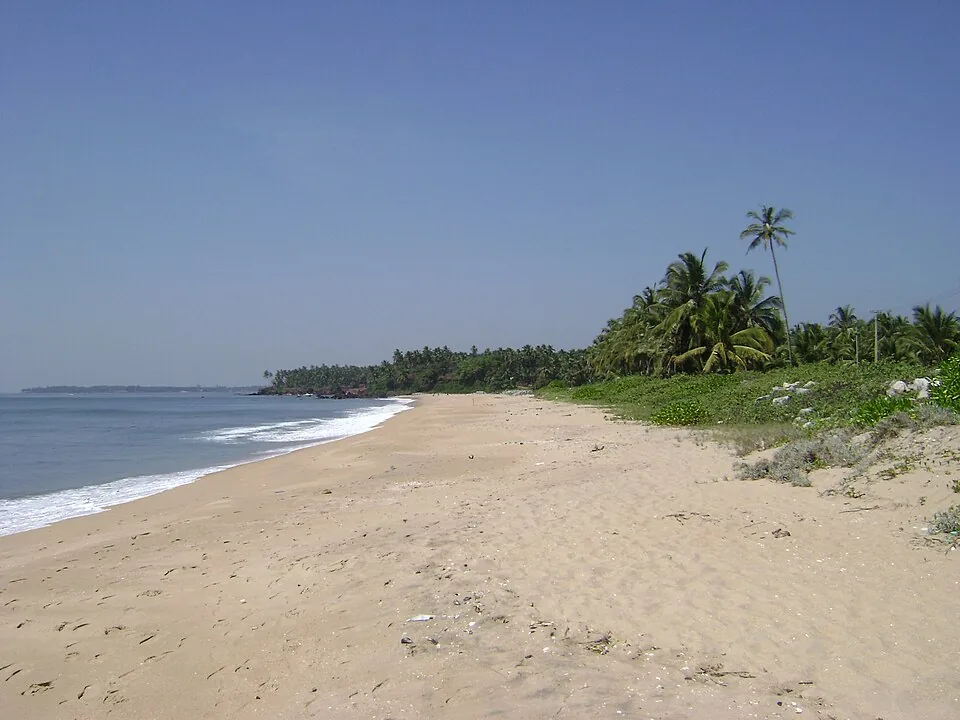
Thottada is a settlement inside Edakkad grama panchayat, about eight kilometres south of Kannur city and roughly two and a half kilometres off NH-66 down a narrowing lane. It is not a town, it has no centre of its own, and the single most useful thing to understand about it is that nearly every business here is somewhere to sleep.
Three coves, north to south
The coast here is broken into pockets by laterite bluffs, and the coves run in order: Thottada Beach first, then Kizhunna Beach, then Ezhara. Locals and signboards use all three names loosely, so a stranger asking for "Thottada beach" may well be sent to any of them. Adikadalayi Beach lies just north, on the way in from the city. The rocks have working names rather than tourist ones: Vattakkallu is the group of laterite boulders stepping into the sea at Kizhunna, Cherakallu the low reef standing offshore. Both are tide-dependent — walk out on a falling tide, never a rising one.
- There is no restaurant strip, no beachfront shop and no chemist near the sand.
- Meals come from your host. Tell your homestay what you want and roughly when, the day before.
- The coves are unlit and unguarded after dark. They are daylight beaches.
The rite you can see without a festival date
Sree Oorpazhachi Kavu, about three kilometres inland, performs a Daivathar Vellattom at noon every day — which both the temple and Kerala Tourism describe as a rare thing in the district. Most Theyyam and Theyyam-adjacent ritual in Kannur is seasonal and needs a calendar; this one needs only that you arrive by midday. Temple hours run roughly 5.30am–1.30pm and 5.30–8pm; confirm locally.
What else is in the village
Two things that have nothing to do with tourism, and both are worth the walk. The Institute of Handloom and Textile Technology, the state’s nodal body for bringing technical training to the handloom industry, stands at Kizhunna P.O. within the village; Government Polytechnic College, Kannur, established in 1958, is a few minutes away. A weavers’ street sits within a couple of kilometres of the sand. A fishing-and-weaving hamlet most maps did not bother to label ended up carrying two of Kannur’s working technical institutions.
How long, and when
A full day if you pair the coast with the kavu and the weaving street — but most people who come stay two or three nights, because there is nothing here to do quickly. November to February is the dry, calm window; the monsoon closes the sea. Nothing in the village charges an entry fee: the coves are public beaches and the kavu takes no ticket.
Frequently asked questions
Is there anywhere to eat at Thottada beach?
Essentially no. Almost every business in the village is a homestay with a kitchen rather than a restaurant, and nothing near the sand serves walk-ins. Arrange meals with your host in advance.
Which beaches are at Thottada?
Three coves in a row from north to south — Thottada, Kizhunna and Ezhara — with Adikadalayi just to the north. The names are used loosely by locals and on signboards.
Can you swim at Thottada?
The coves are calm and uncrowded outside the monsoon, but they are unguarded and the laterite rocks are tide-dependent. Swim in daylight, on a falling tide, and never at the rocks on a rising one.
Is Thottada a town?
No. It is a village settlement inside Edakkad grama panchayat with no council of its own, and much of what visitors call "Thottada" is the panchayat’s coastal fringe.