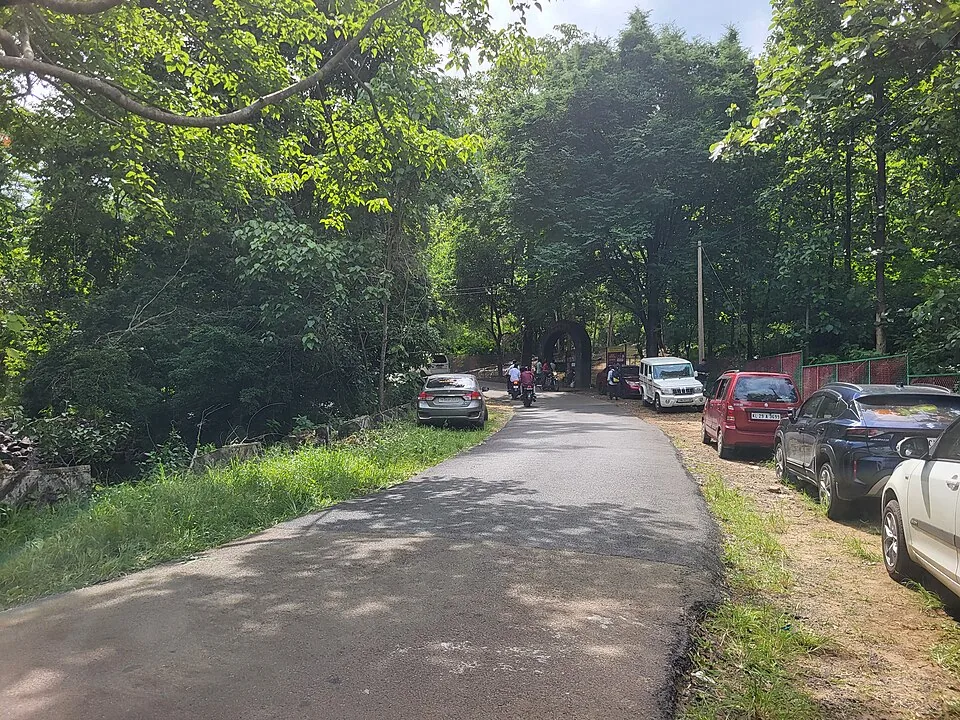
Passes through this section of the Western Ghats are rare. There is the Kollam–Sengottai route, there is the Kumily road, and there is this one — a road from Mekkarai on the Tamil Nadu side that runs about sixteen kilometres to Achankovil and continues down to Konni, some eighty kilometres in all, almost entirely inside reserved forest. What distinguishes it is not scenery. It is that hardly anybody uses it.
Forest kilometres are not road kilometres
This is the single most useful thing to know before setting out, and it is the thing most write-ups omit. Eighty kilometres reads like ninety minutes. It is not: the surface is variable, the alignment is a forest alignment, and the number you should be planning with is hours rather than distance. Anything that presents this as a short hop between two points on a map is misleading by omission — not by lying, but by giving you a figure that does not mean what a figure normally means.
- Do not travel the forest stretch after dark.
- Weather affects this road. Check current conditions locally before setting out, particularly in and after the monsoon.
- There is no fuel-and-food strip along the way. Provision as though there were nothing between the two ends, because there very nearly is nothing.
- Observe forest department instructions about where you may and may not stop.
The elephants are not an attraction
Elephants, peacocks and Malabar giant squirrels are the animals most consistently reported along this route. It is worth being blunt about the first of those, because the risk here runs towards understating it rather than overstating it: this is working elephant country and the road passes through their range, not beside it. An elephant on the road is the ordinary condition of this route rather than a lucky sighting.
The correct posture is the one the forest department asks for. Do not approach. Do not stop where you are told not to stop. Do not treat an animal on the road as a photo opportunity that you get out of the car for. None of that is unusual advice; what is unusual is how often it actually applies here.
What is on the road
Two things, and they are most of the reason to come this way rather than take a main road. Achankovil Sree Dharma Sastha Temple is the major forest Sastha shrine that the settlement exists around, and the reason there is a road here at all — a forest shrine that draws pilgrims is how a place this remote comes to be reachable. Kumbhavurutty Waterfalls is the other established stop, downstream on the same river system. Reed grows thickly along the river on the Konni side.
What is not on it
No market, no accommodation strip, no viewpoint infrastructure, no reliable line of restaurants. Services that exist at Achankovil may be seasonal and tied to the pilgrimage calendar. Anyone treating this as a day out with facilities at the end will be disappointed; anyone treating it as a forest drive to a remote shrine, provisioned accordingly, will not. The reward is a stretch of Kerala that looks the way most of the state looked before the coconut and the rubber — and a state border you cross through trees instead of through towns.
Frequently asked questions
How long is the Achankovil forest road?
Mekkarai on the Tamil Nadu side to Achankovil is given as about 16 km, and the full Mekkarai–Achankovil–Konni run as roughly 80 km, almost entirely through forest. Plan in hours, not kilometres.
Are there elephants on the Achankovil road?
Yes. This is elephant country and the road runs through their range. Peacocks and Malabar giant squirrels are also consistently reported. Treat an elephant on the road as the ordinary condition of the route, follow forest department instructions, and do not travel the forest stretch after dark.
Is the Achankovil road open to ordinary vehicles?
It is a motorable forest route rather than a highway. The surface is variable and weather affects it, so confirm current conditions locally before setting out.
Is there anywhere to stay or eat at Achankovil?
There is no reliable accommodation or restaurant strip. What exists may be seasonal and tied to pilgrimage. Provision for the whole crossing.