A town of about 26,000 people on the highway between Dindigul and Madurai, where the sound you notice first is a loom rather than traffic.
Chinnalapatti is a town panchayat in Athoor taluk of Dindigul district, and at the 2011 census it held 26,285 people in 6,981 households across roughly 4.5 square kilometres. Literacy stood at 87.1 per cent, and there were 1,032 women for every 1,000 men — a ratio that tips the other way from most of India, and one that makes more sense once you know what the town does for a living. It is not a monument town. What it has is a trade, carried on in private sheds behind ordinary houses, and a highway running through the middle of it.
That highway matters. NH-44 — the Dindigul–Madurai four-lane — puts the town roughly fifteen minutes from a district headquarters and an hour from a city of a million people, which is why the saree shops face the road and the looms sit behind them. Almost everyone who passes Chinnalapatti passes it at speed, on the way to somewhere with a temple in it.
The cloth it is known for pairs a kora silk warp with a mercerised cotton weft, and takes its pattern from weft ikat. That is a slower thing than it sounds. The yarn is stretched on a grid and tied off, bundle by bundle, exactly where the pattern is meant to resist the dye; it goes into the vat; it comes out and is untied. Then the whole sequence runs again for the next colour, and again for the one after that. Only when the dyeing is finished does any of it reach a loom, and the weaver’s job is to keep the tied sections landing where the design says they should — the pattern is already in the thread before the first pass is thrown. Isha’s Save the Weave project, which documents the cluster, puts the weaving of a single saree at about two days, and says roughly 4,000 people in the town live off the trade.
Chinnalapatti is also one of the main places where sungudi is made — tie-dyed cotton patterned with fields of small resist dots, each one tied by hand before dyeing. It is the everyday cloth of the southern districts rather than a festival silk, and the difference between a genuinely tied sungudi and a printed imitation of one is the difference between a fortnight of somebody’s labour and an afternoon at a screen table. Both are sold. They do not cost the same to make, and it is a fair question to ask in a shop.
What a visitor sees, then, is not much: a highway, a row of shops, streets of low houses with looms inside them. The interest is entirely in knowing what is happening behind the doors, and in the fact that it is still happening at all.
More about Chinnalapatti
History
For most of its weaving history the town made plain single-colour silk sarees with a simple gold border. That was a good product. It was also a common one — a dozen other Tamil Nadu towns made something close enough that a buyer could not tell them apart, and once power looms could turn out the same look for less, Chinnalapatti was losing on price and on distinctiveness at the same time. This is the ordinary way a handloom cluster dies, and it is worth saying plainly that most of them do.
The way out came from outside the state, which is the unusual part. Through a Co-optex initiative — Co-optex being the Tamil Nadu handloom weavers’ co-operative society, the state body that markets what the co-operatives make — weavers here were taught the tie-and-dye technique practised at the Puttapaka cluster in Nalgonda district, Andhra Pradesh. They did not copy Puttapaka’s cloth. They took its method and put it on their own kora-silk-and-cotton base, and the result was something neither town had been making before.
It is a genuinely odd bit of craft history: a Tamil weaving town kept alive by an Andhra technique, taught through a government co-operative, and now sold as the thing that makes the place distinctive. Sarees from here reach buyers in Singapore, Malaysia, Sri Lanka and South Africa — largely through the Tamil diaspora rather than through any export push.
The wider sungudi trade is bigger than one town and is commonly credited with supporting more than 10,000 workers across the region. Its Geographical Indication was registered in 2005 under the name Madurai Sungudi. The protected name is Madurai’s: Chinnalapatti is a major weaving centre for the style, not the holder of its GI. Public sources disagree on the exact date and registry number within 2005, so any single figure quoted for it should be treated with caution — and a shop here describing its cloth as sungudi is describing a style, which is fair, rather than claiming a protected origin.
Why visit
Come for the weaving, and come knowing there is nothing staged. There is no visitor centre, no ticketed workshop and no organised tour. The saree shops along the highway road keep normal retail hours and are the easy way in; going further, into a shed to watch a loom, is a matter of asking politely and accepting that the answer may be no. Ask before photographing anyone at work.
What makes it worth the stop is the chance to buy the cloth where it is made, from people who made it, at a price that has not passed through four hands first. That is rarer than it sounds. Most handloom sold to visitors in Tamil Nadu is bought in a showroom in a city, and the distance between the showroom and the shed is the whole story of why weavers earn what they earn.
It also rewards a particular kind of traveller and disappoints another. If you want a monument, a viewpoint or an afternoon that organises itself, this is not it — go on to Dindigul or up into the hills. If you like understanding how a thing is made, and you are willing to stand in a doorway and ask, an hour here is worth more than most ticketed attractions in the district.
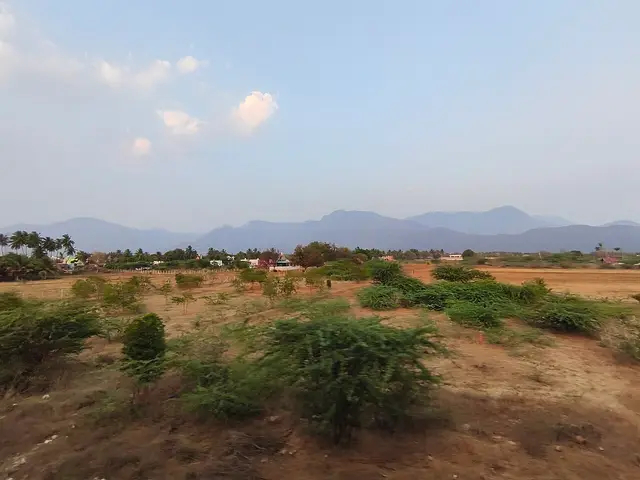
The town pairs naturally with Dindigul twelve minutes up the road, and with the Sirumalai hills to the east, whose slopes are known for grapes. Gandhigram Rural Institute, the Gandhian deemed university founded in the countryside just outside the town, shares Ambaturai station with it — and the pairing is not accidental, since a rural university built on Gandhian lines sits deliberately next to the kind of village industry Gandhi argued for.