
The bottom of the Indian peninsula narrows to a point, and along the way it stacks up three of the most storied places in Tamil Nadu: the temple-city of Madurai, the island shrine of Rameswaram, and Kanyakumari, where the mainland runs out into the sea. This is a pilgrimage circuit as much as a sightseeing one, and it rewards a steady pace. Five days covers the essentials without spending every hour in a car — two days in Madurai, a day on Rameswaram island, a day at the tip, and a travel day to leave.
The route runs southeast, then south. Madurai to Rameswaram is about 170 km (3.5 to 4 hours), crossing the sea onto Pamban island. Rameswaram to Kanyakumari is the long leg — about 300 km (6 to 7 hours) through Ramanathapuram, Tirunelveli and Nagercoil. Trains and buses serve all three towns, but a hired car makes the temple-hopping and the Dhanushkodi run far simpler.
- Day 1–2: Madurai — Meenakshi Amman Temple, Thirumalai Nayak Palace, Thiruparankundram, Gandhi Memorial Museum.
- Day 3: Drive to Rameswaram (Ramanathaswamy Temple, Pamban bridge, Dhanushkodi, Agnitheertham).
- Day 4: Drive to Kanyakumari (Vivekananda Rock, Thiruvalluvar Statue, Kumari Amman, Suchindram, three-sea sunset).
- Day 5: Depart from Kanyakumari or Nagercoil.
- Best season: October to March, when the south is dry and cooler.
The 5-day circuit, at a glance
| Day | Base | Drive | Highlights |
|---|---|---|---|
| 1 | Madurai | — | Meenakshi Amman Temple, Puthu Mandapam, evening aarti |
| 2 | Madurai | local | Thirumalai Nayak Palace, Thiruparankundram, Gandhi Memorial Museum |
| 3 | Rameswaram | ~170 km | Pamban bridge, Ramanathaswamy corridors, Agnitheertham |
| 4 | Kanyakumari | ~300 km | Suchindram en route, Vivekananda Rock, Thiruvalluvar Statue, three-sea sunset |
| 5 | Depart | — | Kumari Amman at sunrise, then onward travel |
Day 1 — Madurai and the temple of the fish-eyed goddess
Madurai is one of the oldest continuously inhabited cities in India, and its whole plan radiates outward in concentric streets from a single centre: the Meenakshi Amman Temple. The temple is dedicated to Meenakshi, a form of Parvati, and her consort Sundareswarar, a form of Shiva. Most of what stands today was built or expanded under the Nayak rulers in the 16th and 17th centuries. It carries fourteen gopurams — the tallest, the southern tower, rises about 52 metres — encrusted with thousands of painted stucco figures that are repainted every twelve years. Inside, the Thousand Pillar Hall (Aayiram Kaal Mandapam) holds nearly a thousand carved granite columns, some of which ring with musical notes when tapped.
The goddess who gives the temple its name is a warrior as much as a bride; her origin story is told in full in our guide to Meenakshi, the warrior-goddess of Madurai. Plan around the temple's rhythm: it opens early, closes for a midday break, and reopens in the afternoon. Non-Hindus may enter most of the complex but not the innermost sanctums; leave shoes and cameras outside, and go early to beat the heat and the crowds.
Just east of the temple, the pillared bazaar of Puthu Mandapam — a 17th-century hall built by Thirumalai Nayak — is now a warren of tailors and cloth stalls. Return after dark for the nightly ceremony in which an image of Sundareswarar is carried to Meenakshi's chamber; it is the temple at its most atmospheric.
Day 2 — a palace, a hill shrine, and Gandhi's last cloth
Start the second day at the Thirumalai Nayakkar Mahal, the palace the Nayak king Thirumalai built in 1636. Only about a quarter of the original complex survives, but the surviving courtyard — the Swarga Vilasam, ringed by tall cream columns and topped by a great dome built without a single supporting rafter — is one of the finest examples of the Indo-Saracenic style in the south. The king behind it, and the era that reshaped Madurai, is the subject of our guide to the king who rebuilt Madurai.
A short drive southwest brings you to Thiruparankundram Murugan Temple, a rock-cut cave temple carved into a hillside and revered as the first of the Arupadai Veedu, the six war-camps or abodes of the god Murugan — the circuit we cover in our guide to the six abodes of Murugan. By tradition it is where Murugan married Deivanai, and the sanctum is cut deep into living rock.
End the day at the Gandhi Memorial Museum, housed in the 17th-century Tamukkam palace and opened in 1959. Its most affecting exhibit is the blood-stained dhoti Gandhi was wearing when he was assassinated in January 1948 — kept here because it was in Madurai, in 1921, that he first adopted the loincloth as his everyday dress.
Day 3 — over the sea to Rameswaram
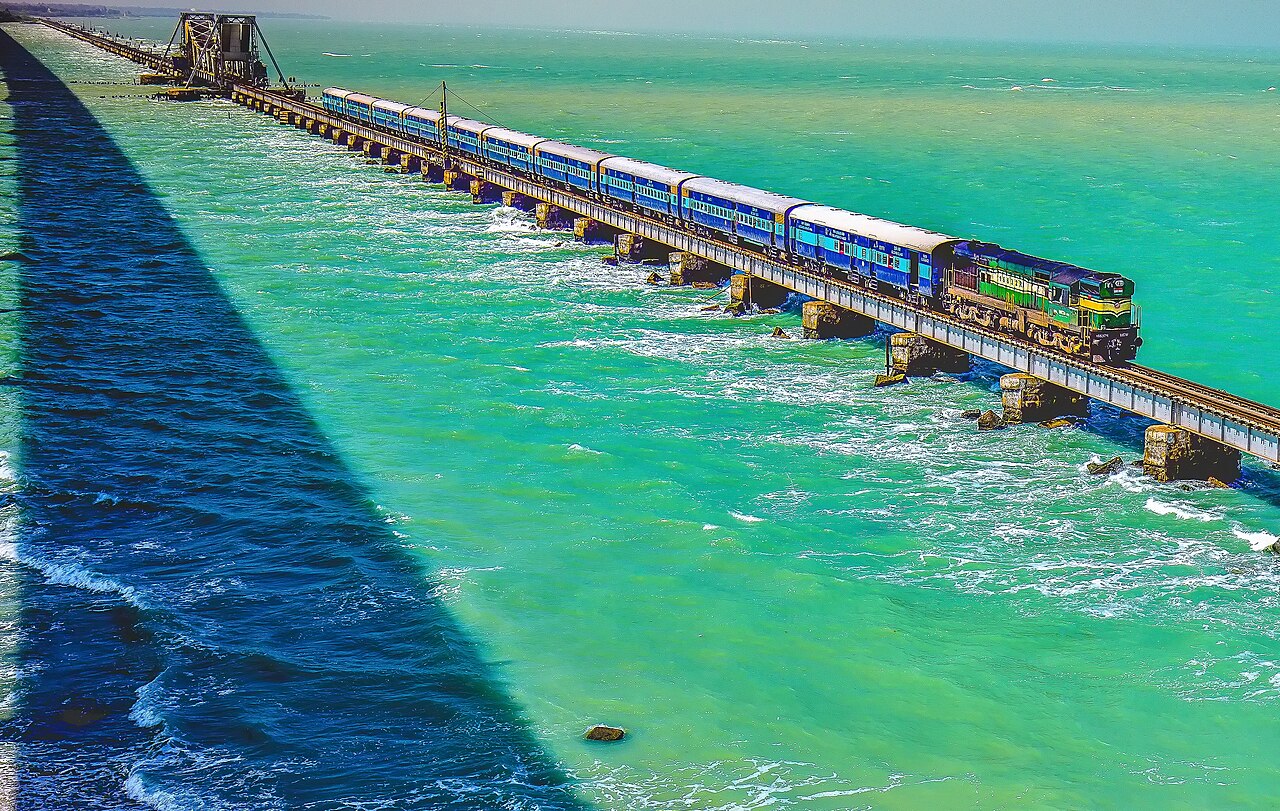
Leave Madurai after breakfast for the drive to Rameswaram, an island in the Gulf of Mannar reached by crossing a narrow strait. The crossing is the drama of the day: the old Pamban Bridge, opened in 1914, was India's first sea bridge — a 2 km rail causeway with a central Scherzer double-leaf section that once swung open to let ships and dhows pass. Running alongside it now is the New Pamban Bridge, a vertical-lift rail bridge whose central span rises to let vessels through — the first of its kind in the country. The road bridge beside them gives you the view.
Rameswaram's heart is the Ramanathaswamy Temple, one of the twelve Jyotirlinga shrines of Shiva and one of the four Char Dham pilgrimage sites that anchor the corners of India. Its fame is architectural as well as sacred: the temple's corridors are held to be the longest of any temple in the country, a colonnade of around 1,200 carved granite pillars running in long, receding perspectives around the sanctums. By tradition the lingam here was set up by Rama himself, on his way back from Lanka, to atone for the killing of Ravana.

Pilgrims prepare for the temple with a ritual bath: first a dip in the sea at Agnitheertham, the shore directly east of the temple, then a circuit of the twenty-two theerthams — sacred wells inside the complex — where attendants douse worshippers with a bucket from each. In the afternoon, drive out to the island's eastern tip and the ghost town of Dhanushkodi, a fishing town wrecked and abandoned after the Rameswaram cyclone of December 1964. Its roofless church and station shells stand on a spit of sand that thins to Arichal Munai, the end of the land, where the Bay of Bengal meets the Indian Ocean and the shoals of Adam's Bridge point toward Sri Lanka. On the way back, the Kothandaramar Temple — the only structure the cyclone spared — sits alone between two waters. With spare time, the A. P. J. Abdul Kalam House, family home of the president born here in 1931, is a short stop back in town.
Day 4 — the long drive south to the tip
The fourth day is the itinerary's longest drive: roughly 300 km and six to seven hours from Rameswaram down to Kanyakumari, back across the Pamban bridge and south through Ramanathapuram, Tirunelveli and Nagercoil. Break the journey near the end at the Suchindram Thanumalayan Temple, about 12 km before Kanyakumari. It is unusual for honouring the Hindu trinity — Brahma, Vishnu and Shiva together, as Sthanu-Mal-Ayan — in a single lingam, and its hall of musical pillars, slender granite columns that sound different notes when struck, is among the finest in the south.
Kanyakumari is the southern tip of mainland India, the place where the Bay of Bengal, the Arabian Sea and the Indian Ocean are said to meet. Two monuments stand offshore on separate rocks. The Vivekananda Rock Memorial, reached by ferry, marks the spot where Swami Vivekananda is said to have meditated in 1892 before leaving for the West; the memorial itself was completed in 1970. Beside it rises the Thiruvalluvar Statue, a 133-foot stone figure of the ancient Tamil poet, unveiled in 2000 — its height a deliberate nod to the 133 chapters of his ethical classic, the Tirukkural. The same ferry serves both rocks; go early, as queues build fast and the last boats leave in the late afternoon.
On the mainland shore stands the Kanyakumari Bhagavathy Amman Temple, dedicated to the virgin goddess Kanya Kumari who gives the town its name; her diamond nose-ring is said to be so bright that ships once mistook it for a lighthouse. Then position yourself for sunset over the sea from the Kanyakumari sunrise/sunset point. Because the land ends here, you can watch the sun set into the water and, on a full-moon evening, the moon rise on the opposite horizon almost at the same moment. A quieter alternative to the crowds at the point is the Gandhi Memorial Mandapam, built so a shaft of sun falls each year on the spot where Gandhi's ashes were kept before immersion.
Day 5 — sunrise, then onward
Kanyakumari is one of the few places in India where you can watch the sun rise and set over the sea from nearly the same spot, so make the last morning count. Be at the shore before first light for sunrise over the Bay of Bengal, then a final darshan at the Kumari Amman temple as the town wakes. From here the mainline is Nagercoil, about 20 km north, with trains and buses to Trivandrum (about 90 km southwest, the nearest major airport), Madurai (about 240 km back north) and Chennai. Padmanabhapuram Palace, the old wooden palace of the Travancore kings, lies on the Trivandrum road if you are heading that way and want one more stop.
- Timings: all three temples close for a long midday break; go early morning or late afternoon.
- Dress: cover shoulders and knees; you will remove footwear at every temple, so wear slip-ons.
- Dhanushkodi: private cars can drive to Arichal Munai; the last stretch is best done before dark.
- Ferries: Vivekananda Rock boats stop mid-afternoon and pause in rough weather; carry cash for tickets.
- Season: October to March is dry and comfortable; avoid the April–June heat inland at Madurai.
Frequently asked questions
How many days do you need for Madurai, Rameswaram and Kanyakumari?
Five days is a comfortable minimum: two in Madurai, one in Rameswaram, one in Kanyakumari, and one to travel out. Four is possible if you cut the second Madurai day, but the long Rameswaram–Kanyakumari drive makes a rushed trip tiring.
How far is it from Rameswaram to Kanyakumari?
About 300 km by road, taking six to seven hours, down through Ramanathapuram, Tirunelveli and Nagercoil. It is the longest single drive on this circuit, so start early and break it at Suchindram near the end.
Where do the three seas meet at Kanyakumari?
At the southern tip of mainland India, tradition holds that the Bay of Bengal, the Arabian Sea and the Indian Ocean meet. The confluence is best seen from the shore point and from the Vivekananda Rock Memorial offshore.
Can non-Hindus visit these temples?
Yes. Non-Hindus can enter most of the Meenakshi Amman, Ramanathaswamy and Kumari Amman complexes, though the innermost sanctums are usually restricted. Dress modestly, remove footwear, and note that photography is often barred inside.
What is the best time of year to do this trip?
October to March, when the deep south is dry and cooler. Madurai gets very hot from April to June, and the coast can see rough seas and ferry suspensions during the monsoon months.