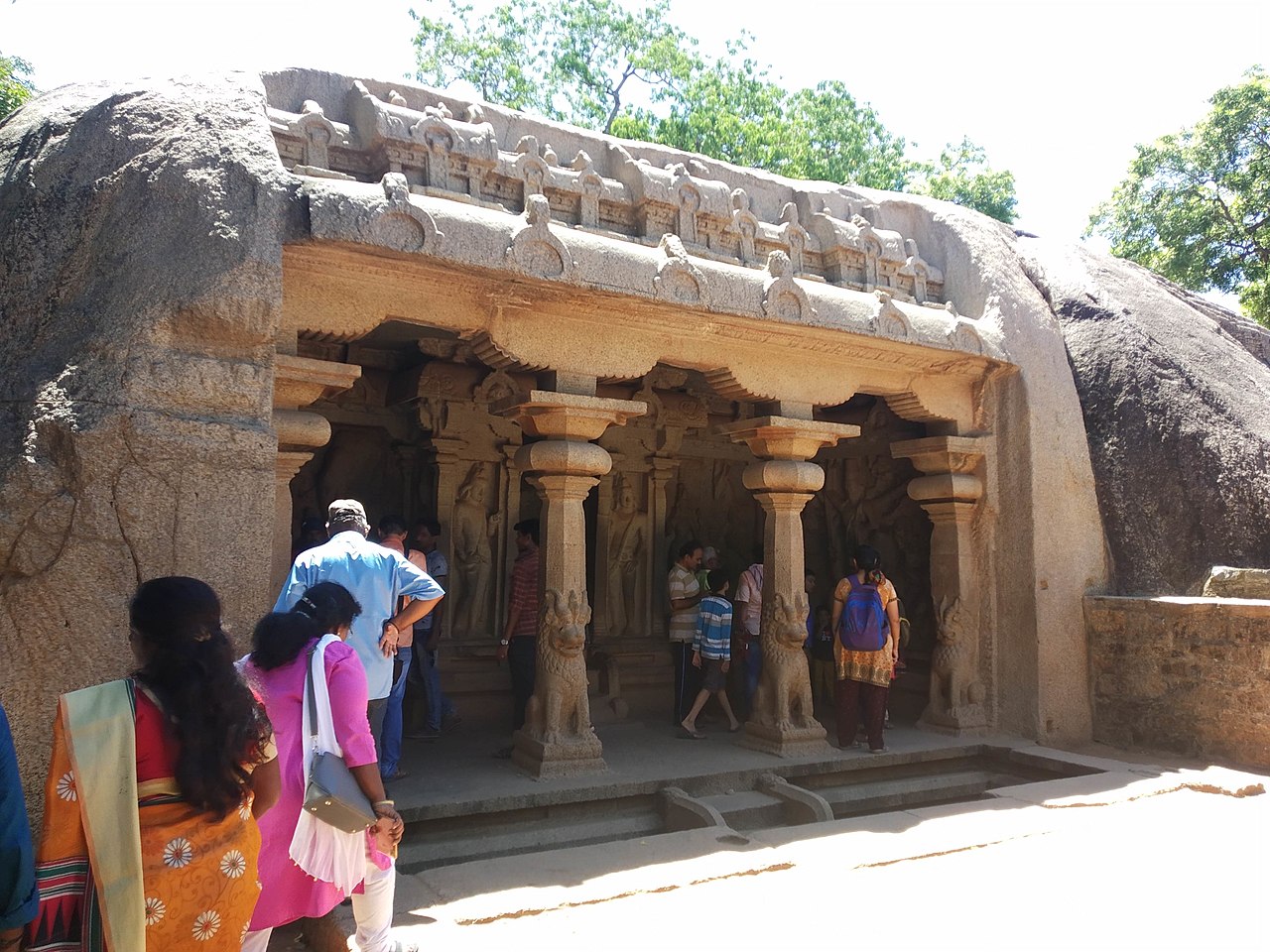
Long before Tamil Nadu’s builders learned to raise temples from stacked and dressed stone, they carved them straight into the rock. Across the state, low granite hills and boulder outcrops hide pillared halls, guardian figures and sanctums that were not built at all but excavated — hollowed out of the living stone by Pallava, Pandya and Muttaraiyar sculptors between roughly the 7th and 9th centuries. This trail links the most rewarding of them, from the seaside caves of Mahabalipuram to the frescoed Jain shelter at Sittanavasal, and shows how one carving tradition eventually gave way to the built temples that followed.
- Peak era: roughly the 7th to 9th centuries, under the Pallavas, Pandyas and Muttaraiyars
- Star sites: Mahabalipuram (a UNESCO World Heritage Site), Sittanavasal, Thirumayam and Narthamalai
- Districts covered: Chengalpattu and Pudukkottai, with an outlier at Thirumalapuram in Tenkasi
- Don’t miss: the 9th-century Jain frescoes at Sittanavasal — flash photography is banned to protect them
What is a rock-cut temple?
A rock-cut temple is carved rather than constructed. Sculptors began at the exposed face of a hill and cut inward, removing stone to leave behind pillars, walls, sanctums and reliefs — a subtractive process closer to sculpture than to building. A structural temple is the reverse: it is assembled upward from quarried and dressed blocks. The two traditions overlap in Tamil Nadu, and a handful of sites let you watch the handover happen. The earliest Pallava caves were, in effect, deliberate demonstrations of the new excavated technique, among them the modest cave at Pallavaram on the southern edge of Chennai.
Mahendravarman I and the early experiments
The great flowering of the cave temple in the Tamil country began in the early 7th century with the Pallava king Mahendravarman I, who took the title Vichitrachitta, the "curious-minded". He championed pillared rock-cut mandapas cut into hillsides, each with a plain columned porch fronting one or more sanctums. One of his earliest, at Mandagapattu, carries a famous inscription claiming the temple was made for Brahma, Vishnu and Shiva without brick, timber, metal or mortar — a proud boast about the new method of carving directly into rock. These first caves are austere, their power lying in clean proportion and the massive square or octagonal pillars rather than in dense ornament.
The Pallava caves of Mahabalipuram
Under Mahendravarman’s successor Narasimhavarman I, known as Mamalla, the workshop moved to the coast at Mahabalipuram and the results grew far more ambitious. Here the caves fill with narrative sculpture: the Varaha Cave Temple, with its panel of Vishnu as a boar lifting the earth-goddess; the Mahishasuramardini Cave, where the goddess Durga rides into battle against the buffalo-demon on one wall while Vishnu sleeps on the cosmic serpent on the other; and the small triple-shrined Trimurti Cave Temple. The nearby Krishna Mandapa shows Krishna lifting Mount Govardhana across a broad relief. A short drive north at Saluvankuppam, the Atiranachandeswara Cave Temple adds an inscribed Shaiva shrine to the group. Together with the town’s monolithic rathas and open-air reliefs, these caves form the core of the UNESCO-listed Group of Monuments at Mahabalipuram.
The Pudukkottai caves — Sittanavasal to Narthamalai
Further south, the Pandyas and the Muttaraiyar chieftains cut their own caves across what is now Pudukkottai district, and this cluster is the trail’s quiet highlight. The most celebrated is Sittanavasal, a rock-cut Jain temple known as the Arivar Koil. Its sanctum and veranda still carry fragments of 9th-century Jain fresco — a lotus pond alive with fish, elephants and dancers — painted with such refinement that it is often described as a southern counterpart to the murals at Ajanta in quality, if not in scale. The paintings are fragile and light-sensitive, so flash photography is prohibited.

The district holds several more. At Thirumayam a hillside fort shelters twin cave shrines — a Shaiva sanctum and a large reclining Vishnu cut from the rock. Kunnandarkoil preserves an early cave later encased in structural additions, while at Malayadipatti the Pallikonda Perumal rock-cut temple frames another monumental sleeping Vishnu. Best of all for understanding the wider story is Narthamalai, where early rock-cut caves sit within sight of the Vijayalaya Choleeswaram — an early structural stone temple. Standing between the two, you can read the shift from carving into rock to building up from blocks almost as a single sentence.

Planning a rock-cut trail
The two clusters sit at opposite ends of the state, so most travellers treat them separately. Mahabalipuram is an easy day trip from Chennai, roughly two hours by road, and its caves cluster within a compact heritage zone you can walk in a morning. The Pudukkottai caves are more scattered and reward a car and a full day, ideally paired with a night in Pudukkottai town or Tiruchirappalli. Far to the south, if you are travelling near Tenkasi, the Thirumalapuram rock-cut cave temples make a rewarding outlier. Bring a torch for the dim interiors, wear footwear you can slip off at active shrines, and remember that many of these sites are protected monuments under the Archaeological Survey of India — carry cash for small entry fees and never touch the carvings or the paintings. If this trail whets your appetite, follow it up with the wider Pallava story at /india/tamil-nadu/guides/mahabalipuram-pallava-monuments-story and see how the built temple reached its zenith in /india/tamil-nadu/guides/great-living-chola-temples.
Frequently asked questions
What is the difference between a rock-cut and a structural temple?
A rock-cut temple is excavated out of a solid hillside or boulder, with pillars and sanctums carved by removing stone. A structural temple is built up from separate quarried and dressed blocks. Narthamalai in Pudukkottai lets you see both side by side.
Where are the best rock-cut cave temples in Tamil Nadu?
The finest are the Pallava caves at Mahabalipuram in Chengalpattu district and the Pandya and Muttaraiyar caves of Pudukkottai district, especially Sittanavasal, Thirumayam and Narthamalai.
Who built the earliest Tamil cave temples?
The Pallava king Mahendravarman I championed rock-cut pillared temples in the early 7th century. His successor Narasimhavarman I developed the more elaborate relief caves at Mahabalipuram.
Why is Sittanavasal famous?
Sittanavasal is a rock-cut Jain temple, the Arivar Koil, that preserves fragments of 9th-century Jain frescoes. Their refinement has earned them comparison with the murals at Ajanta in quality, though on a much smaller scale.
Can I photograph the Sittanavasal paintings?
You can take photographs without flash, but flash photography is banned because the light damages the fragile centuries-old pigments. Follow all posted rules and any instructions from the site staff.
Is Mahabalipuram a UNESCO World Heritage Site?
Yes. The Group of Monuments at Mahabalipuram, which includes the rock-cut caves, monolithic rathas and open-air reliefs, is inscribed on the UNESCO World Heritage list.