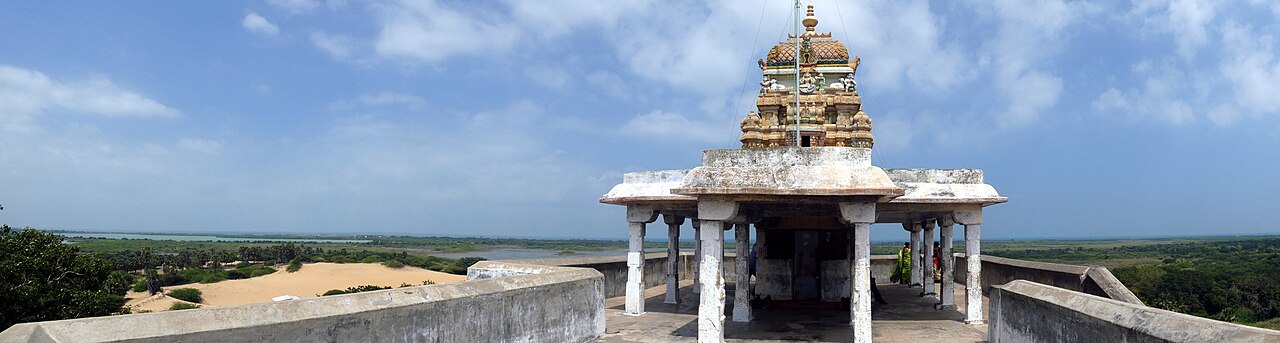
A coastal freshwater spring on the way to Dhanushkodi, believed to have been created by Lakshmana's arrow, where pilgrims bathe in a small freshwater pool beside the sea.
The story of Villoondi Theertham
For Villoondi Theertham, a coastal freshwater spring on the way to Dhanushkodi, believed to have been created by Lakshmana's arrow, where pilgrims bathe in a small freshwater pool beside the sea. For Villoondi Theertham, the useful visit is built around the specific feature described here, not around promotional superlatives or facilities that have not been verified.
A sensible plan for Villoondi Theertham begins in Dhanushkodi: settle the return journey, carry water and keep time in reserve for a closed gate or a slower rural road. For Villoondi Theertham, do not infer toilets, food, parking or step-free access from the existence of a map pin.
The value of Villoondi Theertham lies in close observation rather than a rapid photograph. For Villoondi Theertham, notice materials, setting and present-day use, while treating locked rooms, unstable remains, working premises and private homes as firm limits to the visit.
Understanding Villoondi Theertham also means placing it within Ramanathapuram: the attraction's identity comes from its own surviving feature, living use and local setting, not from borrowing the fame or story of a better-known site elsewhere in Tamil Nadu.
Do not make Villoondi Theertham responsible for an overfilled district itinerary. For Villoondi Theertham, one carefully observed visit, followed by a meal or transport break in Dhanushkodi, is more reliable than assuming several rural sites share the same hours and facilities.
Legend & myth
The tradition attached to Villoondi Theertham is part of how worshippers and local communities understand the site. This guide keeps that account explicitly labelled as tradition: it explains the place's living meaning without presenting sacred narrative as independently dated history.
At Villoondi Theertham, traditional accounts should be read alongside inscriptions, architecture, museum interpretation or other physical evidence available on site. These forms of knowledge answer different questions and should not be blurred together.
Read the full history of Villoondi Theertham 256 more words
History
A coastal freshwater spring on the way to Dhanushkodi, believed to have been created by Lakshmana's arrow, where pilgrims bathe in a small freshwater pool beside the sea. This documented core is the safest starting point for understanding Villoondi Theertham. Dates, dynastic associations and superlatives repeated without a named inscription, conservation record or official interpretation should be treated cautiously rather than added as fact.
Villoondi Theertham also belongs to the history of Dhanushkodi and the wider Ramanathapuram district. Its present condition reflects continuing use, repair, environmental exposure or changing settlement around it; the surviving place is not an unchanged remnant of one period.
A useful historical visit compares the defining feature described above with what is visible now. Notice materials, plan, landscape and present use, and allow a locked area, altered structure or living ritual to remain part of the honest account rather than filling the gap with an unsupported reconstruction.
Why visit
Visit Villoondi Theertham for the specific feature and local history described on this page, rather than as a generic stop in Ramanathapuram.
The most useful visit combines close observation at Villoondi Theertham with a realistic return plan through Dhanushkodi; it does not depend on an unverified ticket, unrestricted access or a promised experience.
Its value is clearest when you give the place enough time to understand the feature named in its story instead of reducing the stop to a photograph.
The surrounding Dhanushkodi context makes Villoondi Theertham practical to combine with verified local food, accommodation and visitor services while keeping the attraction itself in focus.