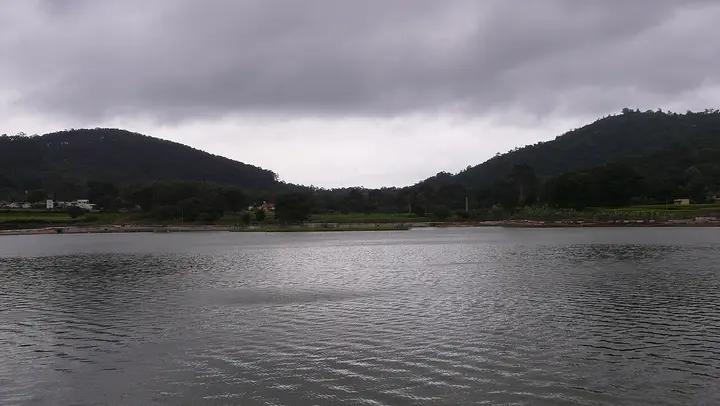
Alangayam is a small town at the western edge of the Javadi Hills whose visitor purpose is unusually focused: it is the practical road base for Vainu Bappu Observatory at Kavalur. Come on the institute’s public Saturday, understand the science before sunset, and plan the dark return as carefully as the sky.
Every route on this page begins in central Alangayam, postcode 635700. The town is signed in Tamil as ஆலங்காயம்; use the coordinates 12.622667, 78.752504 if a driver or navigation app needs a precise starting point.
Alangayam matters because the official road to one of India’s most important optical observatories passes through it. The Indian Institute of Astrophysics directs drivers from Bengaluru through Hosur, Krishnagiri, Vaniyambadi, Alangayam and Kavalur. The town is therefore a planning hinge: the last place to confirm transport and supplies before a controlled research campus in the hills.
VBO belongs to Kavalur, not to central Alangayam. The institute describes it as lying in the picturesque neighbourhood of Kavalur village in the Javadi Hills at about 750 metres altitude. The town page retains it as an excursion because the official approach uses Alangayam and the routed road is 11.78 kilometres, not because the two names are interchangeable.
That distinction corrects the usual district-page blur. Yelagiri, Vaniyambadi, Jolarpettai and Kavalur can all appear under Tirupathur, yet each is a separate arrival problem. Alangayam has no railway station. IIA gives Vaniyambadi station as 29 kilometres from VBO and Jolarpettai as 46; rail passengers still need a planned road transfer.
The observatory began with M. K. Vainu Bappu’s search for a site suited to stellar astronomy. IIA’s historical account says Kodaikanal’s skies did not allow prolonged stellar exposures through enough of the year. Bappu searched hills from Kanyakumari towards Tirupati and recognised a plateau ringed by the sandalwood-forested Javadi Hills as a place of stable air and access to the southern sky.
The first instrument was modest by later standards: an indigenously made 34-centimetre reflector used from 1968. A 102-centimetre Carl Zeiss telescope followed four years later. Those steps matter because the campus was not born around one finished giant dome; it accumulated capability, workshops, observers and increasingly ambitious instruments.
The 102-centimetre telescope quickly entered planetary history. IIA records detection of an atmosphere around Jupiter’s moon Ganymede in 1972. In 1977, astronomers at Kavalur and collaborators observing a star pass behind Uranus detected the planet’s rings. It was an occultation experiment: the star dimmed before and after the planet itself crossed it, revealing material no one had gone there expecting to see.
Later work included an outer ring system around Saturn, monitoring of supernova SN 1987A and discovery of a minor planet subsequently named Ramanujan. These are not claims that a Saturday visitor will reproduce. They explain why the white towers are laboratories with active schedules rather than museum props built solely for public viewing.
Bappu’s most ambitious instrument was the 2.34-metre telescope, often described as 93-inch and now rounded on the institute’s visitor page to 2.3 metres. It was designed and built substantially in India, with a Zerodur mirror blank acquired from West Germany. Bappu died in 1982 before completion, so the instrument that bears his name is also a posthumous memorial to institution-building.
Prime Minister Rajiv Gandhi inaugurated the large telescope on 6 January 1986, when the Kavalur Observatory and telescope were formally named for Vainu Bappu. The institute’s account links the timing with the return of Halley’s Comet. The public story therefore joins engineering, political ceremony and an astronomical event without pretending that a comet built the instrument.
Today the campus lists the 40-inch Carl Zeiss Telescope, the 1.3-metre J. C. Bhattacharya Telescope and the 90-inch Vainu Bappu Telescope. Inch and metric labels vary by rounding across official pages. This guide keeps the institute’s current public wording—2.3 metres—while noting the historic 2.34-metre and 93-inch forms so visitors do not mistake them for three different large telescopes.
The current visitor programme is far more open than the old page suggested. IIA’s page, updated 4 September 2025, says VBO opens to the public every Saturday from 2 to 9 PM. It publishes a ₹50 ticket for visitors aged twelve and above, free admission for younger children, and sales at the security gate from 2 to 4:30 PM.
People interested only in the sky-observation programme have a second ticket window, 6:30 to 7:15 PM. That is a crucial constraint. Arriving at eight because the campus closes at nine is not a workable plan. The ticket window, security process, daytime material and road home all own a place in the itinerary.
Evening stargazing is expressly subject to weather. IIA describes guided observations with small 5-inch and 6-inch telescopes and powerful binoculars, not an entitlement to look through the research telescope. Clouds, humidity, maintenance and scientific work can change what happens. A clear forecast improves odds but never becomes a guarantee.
Daylight is not dead time. The programme introduces the Vainu Bappu Telescope and a solar tower coelostat, a two-mirror system that sends sunlight to a fixed position so an image and spectrum of the Sun can be projected. Understanding how light is directed, separated and recorded gives the night sky a technical foundation before the first star appears.
The Creative Commons photographs opened for this page show why the campus needs time. There are distinct buildings for the 15-inch, 40-inch and 93-inch telescopes; the large instrument fills a tall interior rather than sitting at the top like a domestic telescope under a lid. Control rooms, access roads and direction signs reveal an institution distributed through forest, not one dome beside a car park.
Several photographs show the 93-inch telescope from the 40-inch tower and vice versa. The views explain how height, vegetation and separated buildings reduce obstruction while keeping equipment within a managed estate. They are historic 2010 records and not evidence that visitors may climb those viewpoints today. Follow the route assigned by staff.
The campus roads are narrow, tree-lined and deliberately dark. Photographs titled “Darkness at Vainu Bappu Observatory” are nearly black because that darkness is working infrastructure. Bright white torches, flash photography, uncovered phone screens and careless headlights destroy night adaptation and can interrupt observation. Carry a red light but switch it on only where permitted.
The entrance photographs show barriers, a gate and security post. They are not decorative obstacles. A public programme grants access on specified terms to specified parts of a working campus. Institutional and educational group visits need advance notice and approval so staff can arrange them; an ordinary Saturday ticket does not authorise a class, commercial shoot or access to a control room.
Alangayam’s practical role becomes sharper at the end of the evening. App taxis cannot be assumed in Kavalur, and the last useful bus may have gone before a weather-delayed sky session finishes. Arrange a driver before entering, agree whether waiting is included, keep the number, and choose an unmistakable gate pickup. Do not begin an eleven-kilometre walk on a dark hill-edge road.
The OSRM route from the exact town node to the observatory coordinate is 11.78 kilometres and about fourteen minutes in free-flow conditions. The number is useful for scale, not a promise. Buses, bends, rain, livestock, roadworks and darkness can double the lived time. Leave a generous buffer for the ticket window, especially if arriving by train at Vaniyambadi.
Some older travel listings place an “Alangayam Dam” near the town centre, but no dependable government visitor information establishes it as a public attraction. It has therefore been removed from this town circuit; use the documented water and hill destinations around Alangayam instead.
Removing the dam leaves one place card, but it makes the page more useful. VBO alone can occupy an afternoon and evening, and the science, access rules and transport risks are richer than two generic cards. A thin inventory is honest when the surrounding planning is deep; a crowded inventory built from a phantom pin is not.
The wider Javadi Hills carry their own cultural worlds. Scholarship records traditions among hill communities, including a story of Seven Elders connected with ritual and street theatre. That is regional heritage, not an Alangayam origin myth and not an observatory tale. It belongs here only as a reminder that the plateau was lived, named and narrated long before astronomers selected a site.
The Seven Elders tradition should never be used as colourful filler for a science trip. It comes from community practice and deserves its own context, language and performers. This page identifies the existence of the documented regional tradition and its relationship to Javadi life while refusing to invent a version tied specifically to Alangayam town.
That caution produces an honest myth section rather than an apology. The hills are not empty darkness waiting for modern science. People farmed, worshipped, travelled and performed stories there; the observatory brought a new institution into an already meaningful landscape. Regional oral tradition and astrophysical observation are different ways of making relationships visible, not rival explanations of the same fact.
Alangayam itself is hot compared with the plateau at night. Carry water and sun protection for the afternoon, then a light layer for hours outdoors after dusk. Closed shoes are more practical than sandals on campus roads, but accessibility remains uncertain: no complete step-free route, accessible toilet or seated viewing arrangement is promised on the public page.
Families should prepare children for waiting and uncertainty. The under-twelve ticket is free, but weather does not improve for young visitors and a nine o’clock finish can be tiring. Bring quiet activities that do not emit bright light, food only if permitted, and a plan to leave early without treating the evening as a failed lesson.
Photography should serve memory rather than compete with observation. Ask at security what is allowed, keep flash off, never point a light into an instrument, and do not publish staff or control-room details without consent. The lawful gallery demonstrates that good documentation can identify every building and licence while respecting a research setting.
A strong Saturday begins with lunch and supplies in Alangayam, reaches the gate before 2 PM, spends daylight on the telescope and solar explanations, then waits for staff to judge the sky. The driver waits or returns at an agreed time. If cloud wins, the day still contains engineering, institutional history and the experience of a dark-sky research landscape.
A weak plan arrives from Yelagiri after sunset, assumes the research telescope is a tourist eyepiece, discovers ticketing has closed and starts searching for an app cab at nine. Nearly every disappointment in that sequence is avoidable. The page is built to prevent it by giving the gate windows, instrument distinction, weather condition and return problem equal prominence.
Stay in Alangayam only after confirming a real room directly; no government accommodation register entry or town directory was found that proves one. Vaniyambadi and Jolarpettai have broader transport and lodging choices. Choosing them as sleeping bases does not weaken Alangayam’s role as the last practical town on the official road.
The visitor leaves with a more precise sense of darkness. It is not merely the absence of urban light but a resource protected by location, vegetation, controlled roads and disciplined behaviour. The observatory converts that darkness into measurements, while the town below converts a remote campus into an achievable journey through buses, food, drivers and directions.
Weather planning needs two separate questions: will the public road be comfortable, and will the sky be usable? A dry afternoon can still cloud over after sunset; a cloudy session can still offer an excellent instrument and solar programme before dusk. Read the forecast, but do not reduce the day to a binary promise. The institute, not an app icon, makes the final observing decision.
Moonlight is another honest trade-off. A bright Moon can be a rewarding small-telescope target, especially for children seeing craters for the first time, while making faint nebulae and a densely starred background harder to see. There is no universally “bad Moon” for outreach. Decide whether lunar detail or the darkest possible sky matters more, then check the phase without assuming the programme’s exact targets.
The large telescope’s multiple names require care in captions and conversation. Ninety-inch is common on IIA’s current centre page, ninety-three-inch reflects 234 centimetres more closely, and 2.3 or 2.34 metres appears in metric accounts. Rounding explains most of the variation. A visitor should not turn it into a false mystery or count separate domes for each number.
The 1.3-metre J. C. Bhattacharya Telescope adds another layer to the campus, although it may not form part of each public route. Its presence shows continued development beyond the early 34-centimetre and Carl Zeiss instruments. Buildings and working telescopes vary with staff, maintenance and research schedules, so follow the route assigned to your group.
The photographs date mainly from July 2010. They are unusually valuable because the photographer documented structures, roads, signs, interiors and darkness rather than repeating a single dome view. They are not current access evidence. Landscaping changes, rooms acquire new uses, barriers move and a control centre photographed then may now be restricted or refitted. Every caption keeps that distinction visible.
Food should be solved before the gate. A campus dining building in the gallery is not a promise of public meal service, and the Saturday visitor page does not advertise a restaurant. Eat in Alangayam or carry only what current visitor rules permit. Keep wrappers sealed and remove all waste; food smells and litter are unwelcome in a forest-edge research estate.
Mobile coverage and battery should also be treated as uncertain. Save the return driver’s number, route, official visit page and key addresses offline. A power bank is useful, but a charging cable does not solve a missing signal. Agree the pickup time before entering and identify what the driver should do if the programme ends early because of weather.
The road may look short on a map, yet a missed 4:30 ticket cutoff cannot be recovered by driving faster. Leave Alangayam with enough margin for slow vehicles and gate formalities. If travelling from Vaniyambadi or Jolarpettai, add the institute’s longer published distance to the town-to-campus route logic and avoid a tight train-to-ticket connection.
Visitors with hearing or visual access needs should ask about the form of presentations rather than only physical ramps. Astronomy outreach can depend on spoken explanations, dim conditions, steps and looking through a small eyepiece. Ask whether a companion may assist, whether tactile or high-contrast material exists and whether a seated alternative can be arranged. No such provision is assumed here.
The regional Seven Elders story belongs to living people rather than to an observatory brand. If a visitor encounters a performance or shrine tradition elsewhere in the Javadi Hills, permission, context and local interpretation matter. Do not ask observatory staff to authenticate a community narrative outside their institutional role, and do not use astrophysical language to make the tradition sound more exotic.
One focused excursion is sufficient for this page because quality comes from verified decisions. The anchor is read, the assignment is explicit, the road is routed, the gate hours are current, the price has a first-party date, every selected image has been opened, and the unverified dam has gone. The remaining uncertainty—weather, access details, transport supply and tonight’s targets—is named where it changes a plan.
Clothing should solve both halves of the day. Alangayam’s afternoon can be hot, while a stationary hour outdoors at roughly 750 metres after rain may feel cool. Use light layers, covered footwear and insect protection that does not inconvenience other visitors. Avoid spraying strong repellent beside instruments or a crowded group; apply it before entering and follow campus rules.
Do not confuse quiet with unlimited time. Staff are running a scheduled outreach programme around a working institution, and explanations may move on even if one visitor is still composing a photograph. Listen first, ask concise questions at the invited moment and let children reach an eyepiece without a camera occupying the position. Courtesy is part of access.
If the sky closes, resist driving to an unverified clearing in search of darker conditions. Forest margins, private land and unfamiliar village roads are not substitute observatories. Return on the planned route, keep headlights appropriate for public-road safety and save another Saturday for the stars. A cancelled view is preferable to trespass or a night-road accident.
Alangayam also works as a pause between transport systems. Use the town to confirm the driver, buy water, eat and check the official page one last time. Those ordinary actions are why the hub exists. The observatory supplies the reason to travel; the town supplies the small practical decisions that make the scientific visit possible and the return uneventful.