Udumalpet is the service town for two distinct Anaimalai-foothill water landscapes: Amaravathi to the south-west and Thirumoorthy to the west. The page treats them as separate road days with wildlife, forest and water-safety rules.
Udumalpet and Udumalaipettai are common spellings for the same town. Use the railway station or central bus stand as the practical arrival point before leaving on the separate dam roads.
Udumalpet sits in a dry, windy plain at the foot of the Anaimalai range. Coconut fields, wind turbines, canals and the abrupt western wall explain the town more clearly than a generic hill-station label.
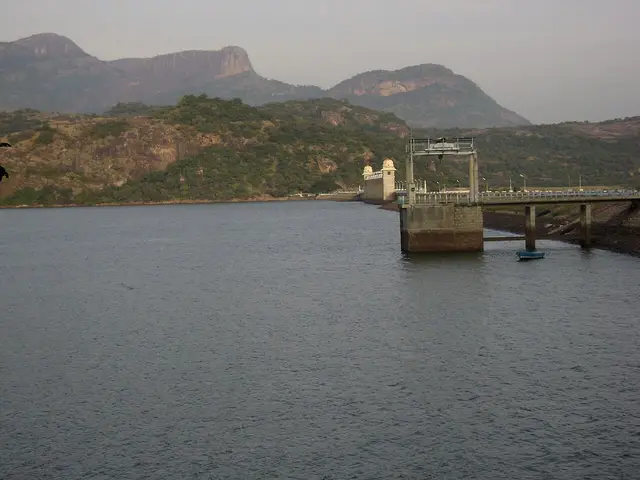
Amaravathi Dam is a working irrigation structure and reservoir, not an unrestricted promenade or swimming lake. Use the marked visitor location and follow every on-site barrier.
The crocodile rehabilitation centre is associated with Amaravathi Nagar. Its current opening, ticketing and animal display must be confirmed with the Forest Department; an old photograph or map mention does not promise admission.
Mugger crocodiles are native to the river system. Captive viewing should build respect for distance and habitat, not encourage feeding, tapping barriers or seeking wild crocodiles at the reservoir edge.
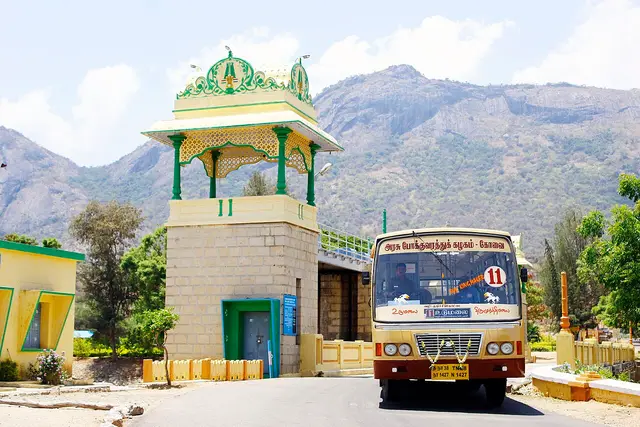
Thirumoorthy Dam lies on a different westward road from Amaravathi and should not be squeezed into the same hurried half-day.
The mapped Thirumoorthy village node is 11359915983 at 10.4864878, 77.1512651, while the temple is node 2504759795 at 10.4572204, 77.1609137. Those exact objects help separate arrival, worship and dam viewpoints.
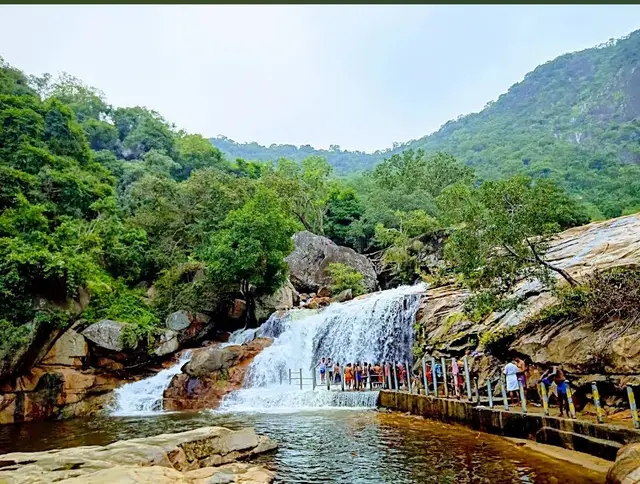
Panchalinga Falls is seasonal and forest-managed. The permitted public approach can change, so confirm the current entrance, guides and bathing restrictions with authorised staff on the day.
Water released from dams, sudden rain in the hills and slippery rock can change risk quickly. Barriers and closures override every itinerary. Never enter a spillway, canal, reservoir or waterfall pool merely because others do.
Thirumoorthy’s name and temple tradition connect the landscape with the Hindu trinity. Sacred narrative gives meaning to the hill and water, but it does not certify a geological date or guarantee access through reserve forest.
Udumalpet’s Mariamman car festival is another living town tradition. The chariot belongs to crowded streets and collective worship; watch from stewarded space and do not block ropes, wheels or processional turns.
The region’s wind farms are visible across the plains. Turbines stand on industrial and agricultural land, not open visitor sites. Photograph from legal public roads without entering compounds or fields.
November to February gives the most comfortable general weather. Waterfall flow depends on recent catchment rain, while summer exposes reservoir margins and sharply increases heat stress.
A hired vehicle is the simplest choice for either circuit. Agree the route and return, refuel in town, download maps and avoid assuming mobile signal or app taxis near the forest edge.
Public buses reach settlements on both corridors, but a bus stop is not the same as the dam gate, zoo entrance or waterfall trailhead. Ask about the last return before leaving Udumalpet.
Accessibility varies. Dam viewpoints may offer a vehicle-based view, but paths, steps, gravel, toilets and barriers require current confirmation. The waterfall is not presented as step-free.
The strongest two-day plan gives Amaravathi one morning and Thirumoorthy another. Return to Udumalpet for food and rest rather than waiting for darkness at an isolated water edge.
Images on the page distinguish the reservoir, crocodile centre, Thirumoorthy hills, falls, town chariot and wind landscape. Similar green hills are not substituted under multiple attraction names.
Legend & myth
Thirumoorthy tradition connects the hill with Brahma, Vishnu and Shiva; it is sacred interpretation rather than a geological explanation.
Panchalinga is a devotional name associated with the landscape and worship route, not proof that every pool or rock is open to visitors.
Mariamman festival practice belongs to the town community; ask before photographing vows or close ritual moments.