What to expect
Highlights
- Fortified hill landscape
- Kalyana Mahal and lower monuments
- UNESCO serial World Heritage component
Gingee Fort is a fortified hill landscape in Viluppuram district and part of UNESCO’s Maratha Military Landscapes of India World Heritage property.
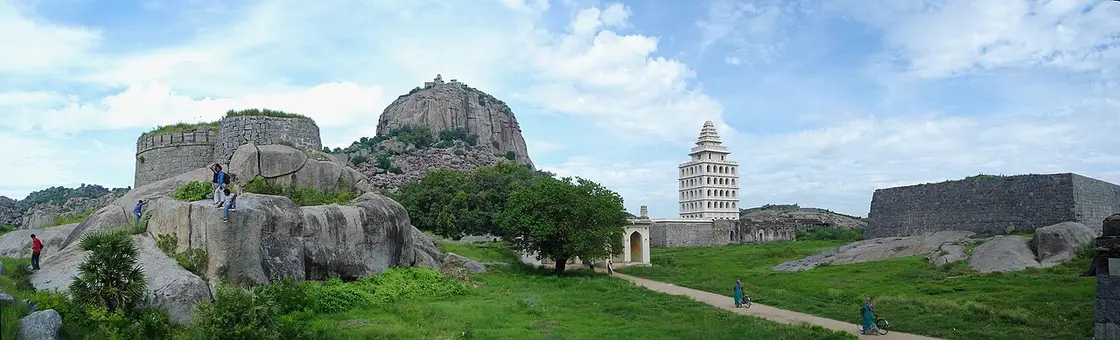
Gingee Fort is a fortified hill landscape in Viluppuram district and part of UNESCO’s Maratha Military Landscapes of India World Heritage property. Choose how much climbing your group wants to do before arriving. The lower monuments and hilltop routes are not the same level of effort.
The complex includes structures such as Kalyana Mahal, granaries and defensive works, so there is more to see than a summit viewpoint. Understanding the lower spaces helps explain how the stronghold functioned.
Its World Heritage inclusion recognises it within a wider group of Maratha military landscapes. That does not mean every surviving part was built by one dynasty or at one time.
Bring water, use shoes with grip and plan your descent as carefully as the climb. Ask about the last permitted ascent rather than assuming the main closing time is the latest safe time to start uphill.
For the visit itself, allow two to four hours for selected areas; a wider fort exploration needs longer. The best time is an early opening-period start in cooler weather is preferable for a climb. Choose a lower-level visit or a hill climb according to your group’s ability. Check the permitted route and latest ascent time at entry. Avoid exposed edges, closed stairways and climbing during unsafe heat or rain.
An early opening-period start in cooler weather is preferable for a climb.
Live forecast loads in your browser.
Sunset is in about 1 hour.
Sun and moon are calculated for this location and shown in IST. Photography windows are the hour around sunrise and sunset; the sunset bearing is degrees clockwise from true north. Moon phase is accurate to about half a day.
Verified hotels, homestays, restaurants, experiences, sights, shops and rentals around Gingee Fort — commission-free, with direct contact. Filter by what you need.
Gandhi Bazaar is an accommodation option in Gingee. Contact the property directly to confirm room availability, current tariff, check-in time, accessibility and parking, then use Directions for the listed location.
VR Residency is an accommodation option in Gingee. Contact the property directly to confirm room availability, current tariff, check-in time, accessibility and parking, then use Directions for the listed location.
A.N.A Lodge is an accommodation option in Gingee. Contact the property directly to confirm room availability, current tariff, check-in time, accessibility and parking, then use Directions for the listed location.
Devi Lodge is an accommodation option in Gingee. Contact the property directly to confirm room availability, current tariff, check-in time, accessibility and parking, then use Directions for the listed location.
Book with the place itself. India’s cyber-crime coordination centre warned in April 2025 that convincing copies of hotel and pilgrimage booking sites are being pushed through sponsored search and social ads, taking payment for rooms the property never hears about. Every listing here links to the business’s own contact details and its own Google or Bing profile — we take no commission and sit in nobody’s payment path. If a booking page reached you through an ad, check the address bar against the property’s own site before you pay. Fraud can be reported on cybercrime.gov.in or on 1930.
Find food, accommodation and activities across Gingee. Browse the guides for places to eat, stay and explore along your route.
4 more places around Gingee. Open a guide to plan the visit and onward journey.

670 m · 8 min walk
A large Vijayanagara-period temple in Gingee town popularly called the 1000-pillar temple, known for its elaborately carved mandapas.

17.1 km · ~29 min by cab
A 7th-century Pallava rock-cut cave temple bearing an inscription of Mahendravarman I describing himself as 'Vichitrachitta', regarded as one of the earliest rock-cut temples in Tamil Nadu.

13.2 km · ~22 min by cab
A centuries-old Jain monastery (math) seat of the Bhattaraka pontiffs, housing Parshwanath idols and traditional residences within a walled courtyard complex.

270 m · 3 min walk
A Vaishnavite temple dedicated to Venugopala (Krishna) within the Gingee fort-town precinct, reflecting the Vijayanagara-era temple patronage in the area.
Roampedia is commission-free — own or know a stay, eatery, guide or shop near Gingee Fort? List it and it appears here once verified.
Add a nearby businessIf you need step-free access, contact the site before travelling. Ask about a level entrance, steps along the route, the nearest drop-off point, seating and accessible toilets.
Emergency numbers are verified against official government and state tourism sources. 112 works anywhere in India.
A Vaishnavite temple dedicated to Venugopala (Krishna) within the Gingee fort-town precinct, reflecting the Vijayanagara-era temple patronage in the area.
270 m · 3 min walk · straight lineA mosque built in 1717-1718 CE by Sadatullah Khan, Nawab of the Carnatic, to commemorate his victory over Raja Desingh. It carries a Persian inscription recording the date of construction. It is one of the notable Islamic-period monuments within the Gingee fort complex.
510 m · 6 min walk · straight lineA large Vijayanagara-period temple in Gingee town popularly called the 1000-pillar temple, known for its elaborately carved mandapas.
670 m · 8 min walk · straight lineA granite hillock about 2 km north of Gingee with rock caverns and early Jain sculptures, including carvings of the Tirthankaras. Early Tamil-Brahmi and later inscriptions record Jain monks who undertook ritual fasts-unto-death here, notably Chandranandi's 57-day fast in the 5th-6th century. It is one of the important early Jain monastic sites of the district.
2.4 km · 29 min walk · straight lineThe memorial and cremation platform associated with Raja Desingh (Tej Singh), the young Bundela chieftain of Gingee who died fighting the Nawab of the Carnatic in 1714, after which his wife committed sati. His heroic stand is celebrated in Tamil ballads and folk plays. The site near Gingee fort commemorates the episode.
2.7 km · ~7 min by auto · straight lineA 7th-century Pallava-period rock-cut cave shrine set on a hill just north of Gingee Fort. It enshrines a large monolithic reclining Ranganatha (Vishnu) figure carved from the living rock, about 24 feet long. The temple served as a lookout and refuge point linked to the Gingee fortifications.
3.4 km · ~9 min by auto · straight lineA site near Gingee featuring a reclining Vishnu (Anandasayana Perumal) depicted as a rock bas-relief, together with early Jain rock beds and Tirthankara carvings on the same outcrop. It reflects the layered Vaishnava and Jain heritage of the Gingee hinterland.
10.6 km · ~18 min by cab · straight lineA centuries-old Jain monastery (math) seat of the Bhattaraka pontiffs, housing Parshwanath idols and traditional residences within a walled courtyard complex.
13.2 km · ~22 min by cab · straight line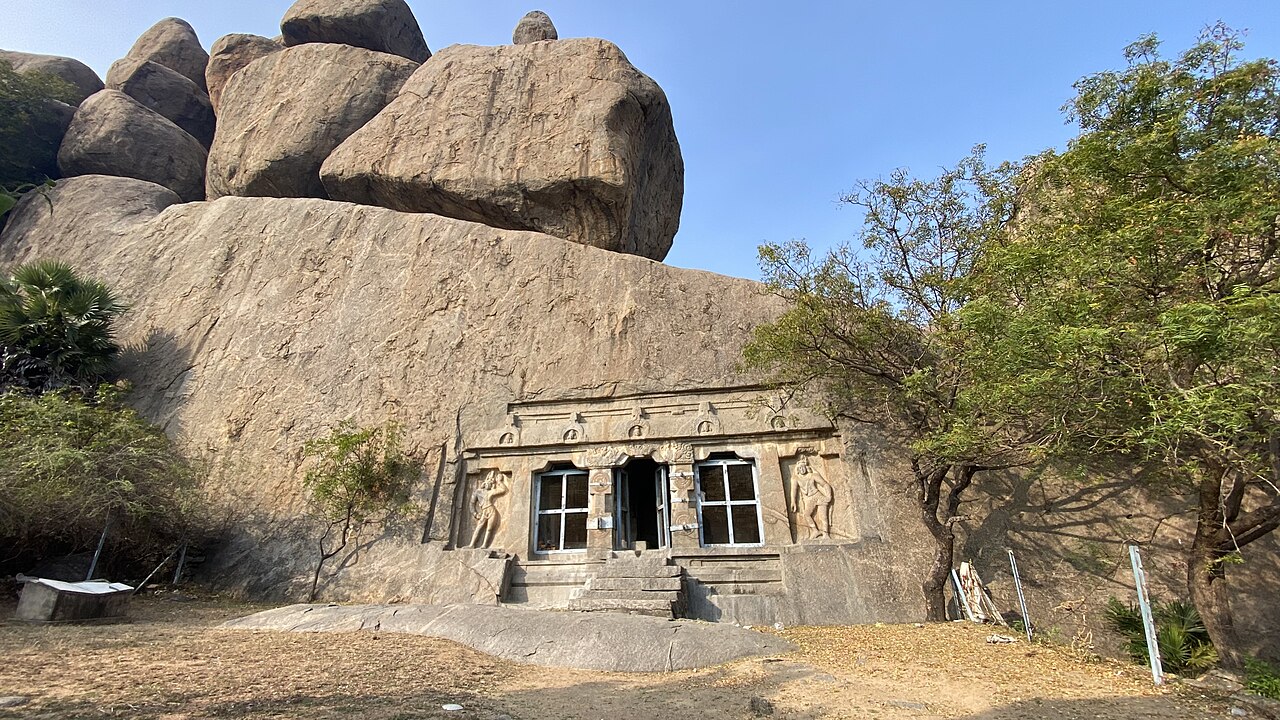
One of the earliest Pallava rock-cut cave temples, excavated by King Mahendravarman I in the early 7th century, pre-dating the monuments of Mamallapuram. A Sanskrit foundation inscription records that it was made without brick, timber, metal, mortar or stucco. It is a protected Archaeological Survey of India monument, with Jain rock beds cut into the hill above the Shiva cave.
14.2 km · ~24 min by cab · straight lineA 7th-century Pallava rock-cut cave temple bearing an inscription of Mahendravarman I describing himself as 'Vichitrachitta', regarded as one of the earliest rock-cut temples in Tamil Nadu.
17.1 km · ~29 min by cab · straight lineA Vishnu temple famous for detailed Tamil inscriptions from the reign of Rajendra Chola I documenting a large residential Vedic college and hostel run in its precincts. The inscriptions record instruction in the Vedas, grammar, logic and Vedanta and provision to feed hundreds of scholars. It is a key record of Chola-era higher education.
17.2 km · ~29 min by cab · straight line
A Shakti temple famous for the night-long Mayana Kollai festival held after Maha Shivaratri, drawing large crowds for its dramatic cremation-ground ritual re-enactment.
20.5 km · ~34 min by cab · straight lineIt is a component of the Maratha Military Landscapes of India World Heritage property.
The complex also includes lower monuments; choose the permitted areas that suit your mobility and time.
An early opening-period start in cooler weather is preferable for a climb.
Choose a lower-level visit or a hill climb according to your group’s ability. Check the permitted route and latest ascent time at entry.
Allow two to four hours for selected areas; a wider fort exploration needs longer.
Nearby you can pair Venugopala Swamy Temple, Gingee (270 m), Sadatullah Khan Mosque, Gingee (510 m), Venkataramana Temple, Gingee (670 m), Thirunathakunru Jain Caves (2.4 km).
Avoid exposed edges, closed stairways and climbing during unsafe heat or rain.
Written about Gingee Fort itself — its history, its legends and the arguments about them.
These guides explore Gingee and the surrounding area. Choose a visit that fits your interests, allowing separately for travel between stops.
Route-level itineraries and practical guides for the rest of Tamil Nadu.
Photographs: PlaneMad (CC BY-SA 2.5), MariaSelvamSavarimuthu (CC BY-SA 4.0), ஜவகர் ராபின்சன் மார்டீன் (CC0), Vinodtgv (CC BY-SA 4.0). Wikimedia Commons.
