What to expect
Highlights
- The ancient granite outcrop and the restored Kempe Gowda watchtower.
- Shaded walking paths, an aviary and rock-garden landscaping.
- A quiet stop combined with the adjacent Bull Temple.
Bugle Rock Park in Basavanagudi is built around a dramatic granite outcrop estimated to be around 3,000 million years old, one of the oldest exposed rocks in the country. In Kempe Gowda’s time a watchtower here was used to sound a bugle warning across the city.

Today it is a shaded neighbourhood park with the restored watchtower, an aviary, walking paths and old trees, an easy pairing with the Bull Temple next door.
A municipal park where old Bengaluru’s geology, Kempe Gowda’s watchtower tradition and a living flying-fox roost occupy the same shaded Basavanagudi hill.
Bugle Rock is not simply a lawn beside Bull Temple. The park wraps an exposed granite rise in Basavanagudi, and its paths repeatedly bring stone, mature trees and the surrounding temple neighbourhood into the same view.
The name is tied to the watchtower tradition associated with Kempe Gowda’s Bengaluru: a signal sounded from the high point to mark or warn the settlement. The surviving tower is a historic marker, not a viewing platform visitors should climb without clear permission.
The park also supports a visible colony of flying foxes. The two reusable Commons photographs available for this page show those bats in the canopy, not the outcrop; their captions say exactly that so wildlife evidence is not passed off as an architectural view.
BBMP records identify Bugle Rock as a municipal park and document repeated park improvements. That modern maintenance history matters because the visitor experience is an urban public space layered over far older stone.
The right visit links four distinct places without merging them: Bugle Rock Park, Bull Temple, Dodda Ganapathi Temple and Gandhi Bazaar. Each has its own function and etiquette even though the walking distances are short.
Kempe Gowda-era tradition associates the elevated rock with one of Bengaluru’s watchtowers and a bugle signal.
BBMP records list maintenance and improvement works for Bugle Rock Park in Basavanagudi ward.
The park remains a public urban habitat as well as a heritage landscape, including a conspicuous flying-fox roost.
For an unusually compact meeting of geology, civic park history, old-city planning and urban wildlife.
For a shaded pause between Basavanagudi’s temples and market streets.
To see how an ancient rock survives as ordinary neighbourhood space rather than a fenced museum object.
Road km to Bengaluru Urban; ghat roads and traffic vary — allow extra.
October to February; early morning or late afternoon for shade and cooler air.
Live forecast loads in your browser.
Sun and moon are calculated for this location and shown in IST. Photography windows are the hour around sunrise and sunset; the sunset bearing is degrees clockwise from true north. Moon phase is accurate to about half a day.
Verified hotels, homestays, restaurants, experiences, sights, shops and rentals around Bugle Rock Park — commission-free, with direct contact. Filter by what you need.
Hotel on 13th Cross Rd, Dollar Layout, 3rd Phase, J. P. Nagar in South Bengaluru.
Book with the place itself. India’s cyber-crime coordination centre warned in April 2025 that convincing copies of hotel and pilgrimage booking sites are being pushed through sponsored search and social ads, taking payment for rooms the property never hears about. Every listing here links to the business’s own contact details and its own Google or Bing profile — we take no commission and sit in nobody’s payment path. If a booking page reached you through an ad, check the address bar against the property’s own site before you pay. Fraud can be reported on cybercrime.gov.in or on 1930.
Find food, accommodation and activities across South Bengaluru. Browse the guides for places to eat, stay and explore along your route.
Walking routes start at Bugle Rock Park. Check the route and access before setting out, especially where a road, gate or waterway separates the stops.
8 more places around South Bengaluru. Open a guide to plan the visit and onward journey.

2.2 km · 27 min walk
A historic 240-acre botanical garden begun under Hyder Ali and Tipu Sultan in the 1760s, famous for its Glass House, lake, ancient rock and the biannual flower shows.

480 m · 6 min walk
The Dodda Basavana Gudi in Basavanagudi, a 16th-century Kempe Gowda-era temple housing a huge monolithic Nandi bull carved from a single granite boulder.

1.4 km · 17 min walk
A rock-cut cave temple in Gavipuram attributed to Kempe Gowda I in the 16th century, famous for a solar phenomenon on Makara Sankranti (mid-January) when the setting sun’s rays pass between the horns of a stone Nandi to light the Shiva linga inside.
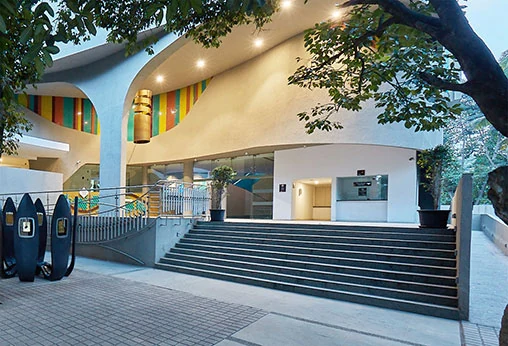
India's first interactive music museum, in JP Nagar, with nine themed galleries and a Sound Garden of musical outdoor installations spanning Indian classical, folk, film and contemporary music.

6.1 km · 10 min drive
A popular Hanuman (Anjaneya) temple built on a granite hillock in Jayanagar, with a large monolithic Hanuman idol, Ganesha and Shiva shrines and steps up the rock; busiest on Saturdays and during Hanuma Jayanti.

A seasonal waterfall and picnic valley near Anekal about 40 km south of the city, within Bengaluru Urban district’s Anekal range, where a stream drops through a rocky wooded gorge beside a small Shiva temple; fullest in and just after the monsoon.

The Dodda Alada Mara at Ramohalli about 28 km west of the city — a single roughly 400-year-old banyan whose aerial roots spread over nearly three acres so that it looks like a small forest; a shaded picnic and photography spot with a Muneshwara shrine.

450 m · 5 min walk
A Basavanagudi temple housing a colossal monolithic Ganesha, immediately beside Bull Temple and Bugle Rock Park; worship and festival access should be confirmed at the entrance.
Roampedia is commission-free — own or know a stay, eatery, guide or shop near Bugle Rock Park? List it and it appears here once verified.
Add a nearby businessEntry: No general admission fee is published by BBMP for this municipal park.
Photography: Photograph the public landscape without climbing barriers. Do not use flash on roosting bats or pursue wildlife for a closer frame.
Parking: Street and public parking is limited around the temple-and-park cluster and becomes difficult during fairs. Public transport is the better choice.
The park is a walking visit over paved paths, steps and exposed granite. Bull Temple, Dodda Ganapathi Temple and Gandhi Bazaar form the useful nearby circuit; cross roads at marked points and allow for slopes.
Online taxis: Bengaluru has app-cab and app-auto supply, but pickup beside Bull Temple Road can be disrupted by events. Set a clear public-road pickup and use BMTC or the metro as the dependable alternative.
If you are travelling by bus or ferry, check the return service with the operator before setting out. Leave time to reach the stop or jetty after your visit.
Ask at the jetty or stand for the time of the last service back, not the next one. If you miss it, an auto or app cab is the fallback — agree the fare before you get in.
Benches and shaded areas occur along the public paths.Use the surrounding Basavanagudi neighbourhood for an accessible toilet and vehicle pickup.
Checked 5 September 2026 against source 1source 2. Conditions change and surfaces vary with weather — if step-free access is essential, confirm with the site before you travel.
Emergency numbers are verified against official government and state tourism sources. 112 works anywhere in India.
A Basavanagudi temple housing a colossal monolithic Ganesha, immediately beside Bull Temple and Bugle Rock Park; worship and festival access should be confirmed at the entrance.
450 m · 5 min walkThe Dodda Basavana Gudi in Basavanagudi, a 16th-century Kempe Gowda-era temple housing a huge monolithic Nandi bull carved from a single granite boulder.
480 m · 6 min walkA rock-cut cave temple in Gavipuram attributed to Kempe Gowda I in the 16th century, famous for a solar phenomenon on Makara Sankranti (mid-January) when the setting sun’s rays pass between the horns of a stone Nandi to light the Shiva linga inside.
1.4 km · 17 min walk
An ornate two-storey teak palace completed in 1791 for Tipu Sultan, richly carved and painted, now an ASI-protected monument beside the KR Market fort area.
1.9 km · 24 min walk · straight line
A late-17th-century temple to Venkataramana (Vishnu) built by the Wodeyars beside Tipu Sultan’s Summer Palace and the old fort, in a Vijayanagara-Dravidian style with carved pillars and a gopuram.
2.0 km · 25 min walk · straight lineA historic 240-acre botanical garden begun under Hyder Ali and Tipu Sultan in the 1760s, famous for its Glass House, lake, ancient rock and the biannual flower shows.
2.2 km · 27 min walk
The surviving Delhi Gate and bastions of the old fort founded in mud by Kempe Gowda in 1537 and rebuilt in stone by Hyder Ali and Tipu Sultan, beside the KR Market; scene of the 1791 British siege, and a natural pairing with Tipu’s Summer Palace.
2.4 km · 30 min walk · straight line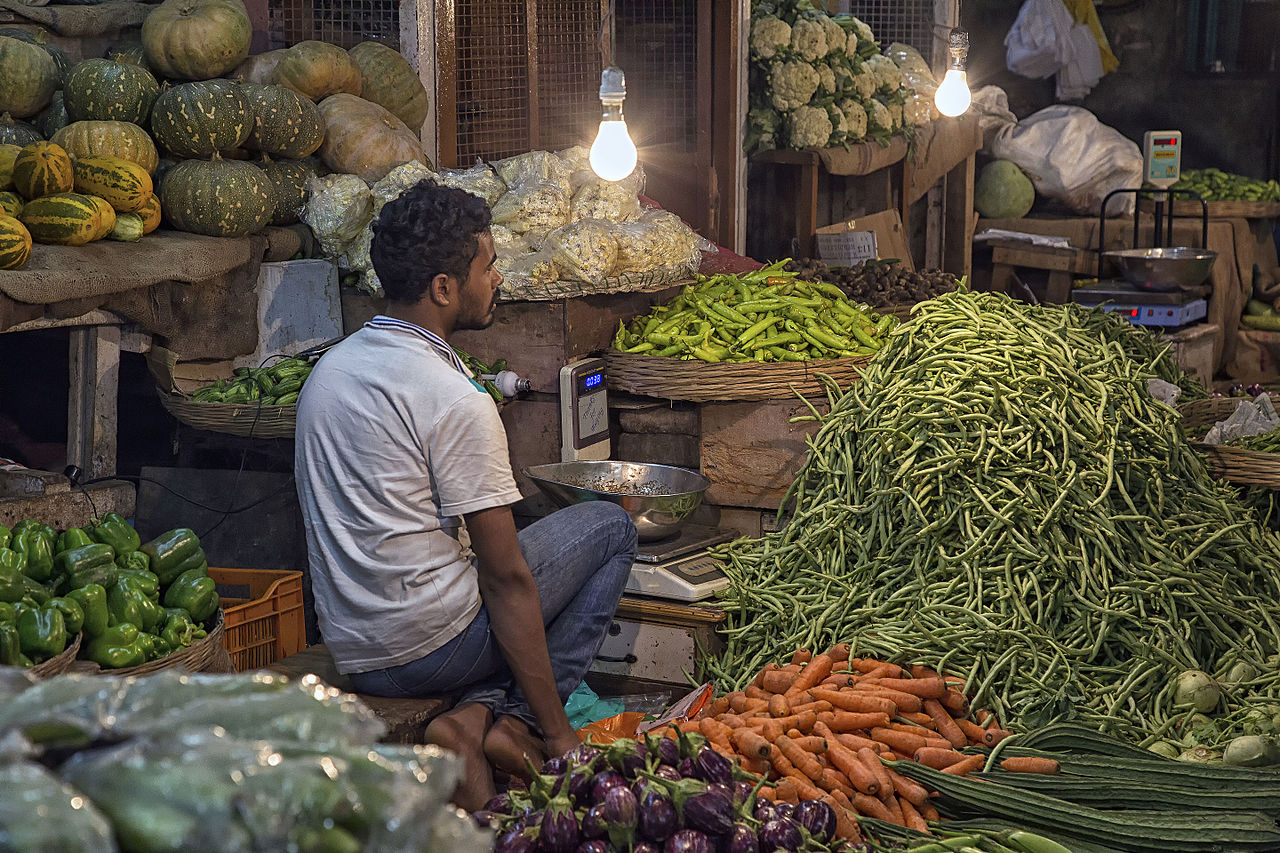
The Krishna Rajendra Market (City Market), the largest and oldest wholesale market in the old city — a teeming bazaar of flowers, fruit, produce and wholesale goods beside the Jamia Masjid and Tipu’s fort area.
2.5 km · ~6 min by auto · straight line
A teaching museum associated with the Human Brain Bank at NIMHANS, displaying preserved human brains and neurological specimens only through the institution’s current confirmed visitor arrangement.
3.2 km · ~8 min by auto · straight line
A large public park in Gandhi Nagar on the site of the old Central Jail where freedom fighters were held; some jail structures are preserved, and it is now a green space and the city’s main venue for protests and public events.
4.1 km · ~10 min by auto · straight line
A 300-acre landscaped green lung in the city centre, laid out in 1870, ringed by the red-brick Attara Kacheri (High Court), State Central Library and Government Museum.
4.6 km · ~11 min by auto · straight lineA popular Hanuman (Anjaneya) temple built on a granite hillock in Jayanagar, with a large monolithic Hanuman idol, Ganesha and Shiva shrines and steps up the rock; busiest on Saturdays and during Hanuma Jayanti.
6.1 km · 10 min driveWalking and driving times are real routed distances, except the few marked “straight line”, which are direct-line estimates and will read short.Routing: © openrouteservice.org by HeiGIT | Map data © OpenStreetMap contributors
No. They adjoin one another, but the park, Bull Temple and Dodda Ganapathi Temple are separate mapped places with different purposes.
They show flying foxes photographed in Bugle Rock Park. They do not show the granite outcrop or watchtower, and the captions make that limitation explicit.
Stay on public paths and obey barriers. A visible rock or tower is not permission to climb it.
No general admission fee is published by BBMP for the municipal park.
No complete step-free audit was found. Some paths are paved, but slopes, steps and exposed rock interrupt the circuit.
October to February; early morning or late afternoon for shade and cooler air.
Entry: No general admission fee is published by BBMP for this municipal park. Timings: Use staffed daylight and follow the opening hours displayed at the gate; BBMP sources reviewed do not publish a dependable current daily schedule.
Adjoining the Bull Temple in Basavanagudi; the National College metro station (Green Line) and buses are nearby. Easy, walkable and family-friendly; combine both sites in one visit.
30 to 45 minutes.
Nearby you can pair Dodda Ganesha Temple (450 m), Bull Temple (480 m), Gavi Gangadhareshwara Temple (1.4 km), Tipu Sultan's Summer Palace (1.9 km).
We have not published a story about Bugle Rock Park itself yet. These cover South Bengaluru and the wider district, with separate journeys between stops.
These guides explore South Bengaluru and the surrounding area. Choose a visit that fits your interests, allowing separately for travel between stops.
Route-level itineraries and practical guides for the rest of Karnataka.
Photographs: Krishna, CC BY-SA 4.0, via Wikimedia Commons (CC BY-SA 4.0), Krishna (CC BY-SA 4.0). Wikimedia Commons.


