
Tamil Nadu’s Kaveri delta is the cradle of the Chola empire, and three unhurried days here string together the finest medieval temple architecture in South India. This route builds outward from Thanjavur, taking in all three of the UNESCO-listed “Great Living Chola Temples”, the bronze-casting workshops of Swamimalai and the music town of Thiruvaiyaru — with a car, a driver and a respect for the long afternoon closures that govern temple life.
- Day 1: Thanjavur town — Brihadeeswarar Temple, the Maratha Palace, art gallery and Saraswathi Mahal Library.
- Day 2: Kumbakonam’s temple-belt and the UNESCO Airavatesvara Temple at Darasuram (~40 km / about 1 hr from Thanjavur).
- Day 3: Gangaikonda Cholapuram (~35 km north of Kumbakonam), Swamimalai bronze workshops and Thiruvaiyaru.
- Getting there: Fly or train to Tiruchirappalli (~60 km), then hire a car with driver by the day.
- Best time: November to February — cool, dry and the heart of festival season.
Getting there & getting around
The delta has no major airport of its own. The nearest is Tiruchirappalli International Airport, about 60 km south-west of Thanjavur, with domestic flights and a handful of Gulf routes; Thanjavur Junction is also well connected by train to Chennai, Madurai and Tiruchirappalli. Once here, the sights are spread across two districts — Thanjavur and Ariyalur — with no useful public transport between the smaller temple towns, so the sane option is a car with a driver hired by the day. The roads are flat but slow, so budget more time than the map suggests.
A word on timings: nearly every temple closes for a long afternoon break, typically from about 12.30 pm to 4 pm. Plan your driving and lunch for that window and save darshan for the cooler mornings and evenings. Dress modestly, remove footwear before entering, and carry small change for the shoe-minders and camera fees.
Day 1: Thanjavur town
Begin at the Brihadeeswarar Temple, the granite colossus that Rajaraja I completed in 1010 CE and the oldest of the three “Great Living Chola Temples”. Its vimana rises some 66 metres, crowned by a single carved capstone, while a huge monolithic Nandi guards the approach. Aim for the 6 am opening or the golden hour before the 8.30 pm close; the sanctum itself shuts between roughly 12.30 and 4 pm, and entry is free.
Spend the afternoon inside the Thanjavur Maratha Palace complex, a rambling warren begun by the Nayaks and extended by the Marathas. Within it sit two essentials: the Thanjavur Art Gallery, whose Chola bronzes and stone sculptures are among the finest anywhere, and the Saraswathi Mahal Library, one of the oldest working libraries in Asia, holding palm-leaf manuscripts gathered by Raja Serfoji II. End the day browsing the town’s workshops for Tanjore paintings and the famous bobble-headed dancing dolls.
Day 2: Kumbakonam & Darasuram
Drive the 40 km north-east to Kumbakonam (about an hour), a temple town threaded with gopurams. Start at the Adi Kumbeswarar Temple, whose name and the town’s founding legend trace to a pot (kumbha) of nectar; then the towering Sarangapani Temple, a Vishnu shrine whose chariot-shaped sanctum and soaring gopuram dominate the skyline. If your dates happen to fall in a Mahamaham year, held once every twelve years, expect vast pilgrim crowds around the great tank.
In the afternoon, make the short 4 km hop to Darasuram for the Airavatesvara Temple, the third and most intricate of the UNESCO trio. Raised by Rajaraja II in the 12th century, it is far smaller than its Thanjavur cousin but denser in craft: a stone chariot mandapa drawn by horses, celebrated “musical” steps and friezes so fine they reward an hour of slow looking. Timings run roughly 8 am to 8 pm, with the usual midday break, and entry is free.
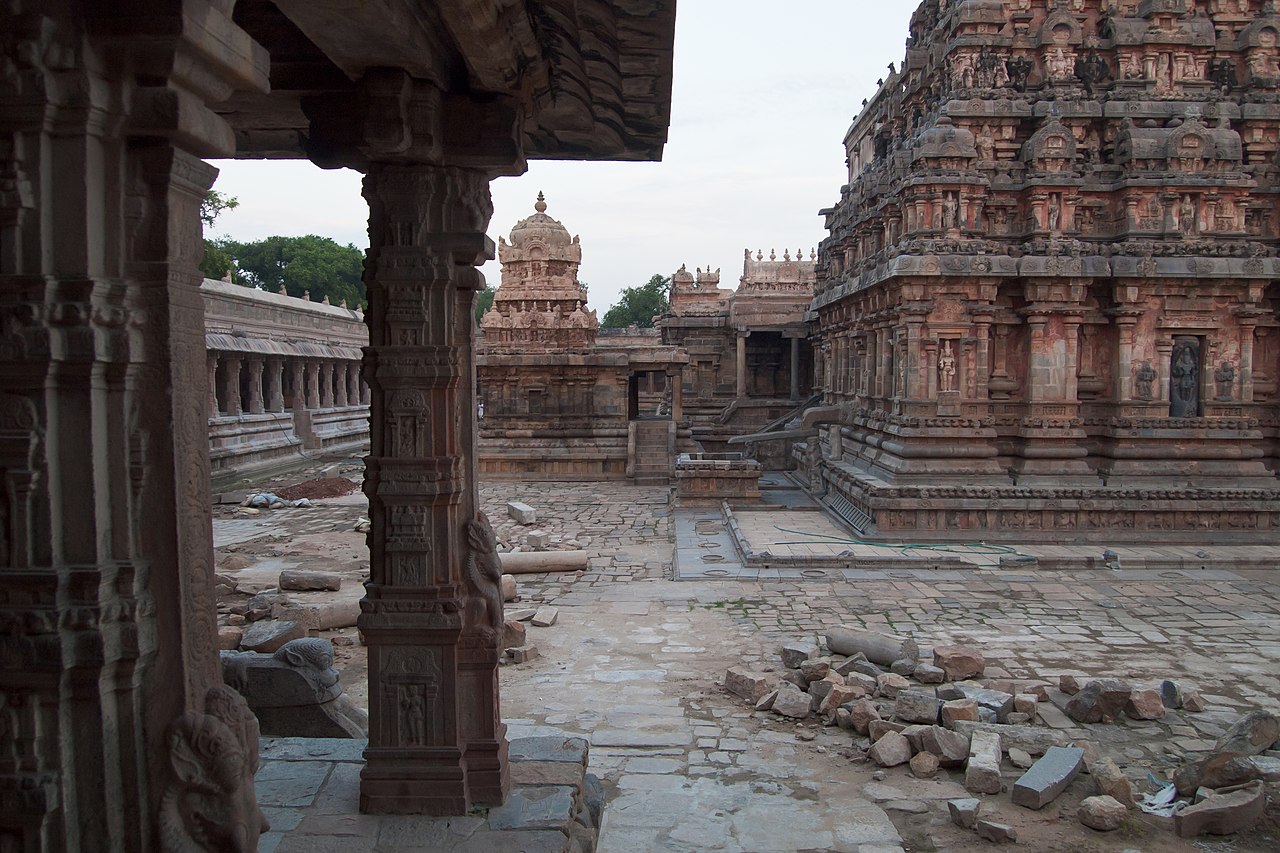
Day 3: Gangaikonda Cholapuram, Swamimalai & Thiruvaiyaru
Head 35 km north of Kumbakonam to Gangaikonda Cholapuram in Ariyalur district, the imperial capital that Rajendra I raised to mark his army’s victorious march to the Ganga. Its Brihadeeswarar Temple, finished around 1035 CE, is the second of the UNESCO Chola temples — sister to Thanjavur’s but softer in line, with a gracefully curved vimana and a superb gallery of Chola-era sculpture. It opens early, from about 4 am to 8.30 pm.

Loop back via Swamimalai, roughly 5 km from Kumbakonam. Its hilltop Murugan temple is one of the six sacred abodes (Arupadai Veedu) of Murugan; by tradition, this is where the boy-god taught the meaning of “Om” to Shiva. The village is also India’s leading centre for lost-wax bronze icon craft, and its workshops welcome visitors. Finish 13 km from Thanjavur at Thiruvaiyaru — “the town of five rivers” — where the samadhi of the Carnatic composer Thyagaraja hosts the five-day Thyagaraja Aradhana music festival each January. With time in hand, detour to the Grand Anicut, or Kallanai, the ancient Kaveri dam attributed to Karikala Chola and still diverting water after nearly two millennia.
When to go
Come between November and February, when the delta is cool, dry and freshly green after the north-east monsoon. October can still be wet, and the stretch from March to June is punishingly hot. January is the liveliest month, bringing both Pongal and the Thyagaraja Aradhana at Thiruvaiyaru, though it also draws the largest temple crowds. Whenever you visit, structure each day around the midday closures and the fierce afternoon sun, and keep the mornings for the marquee temples.
To go deeper on the architecture and craft behind this route, pair it with our companion guides at /india/tamil-nadu/guides/great-living-chola-temples and /india/tamil-nadu/guides/chola-bronzes-and-the-lost-wax-craft.
Frequently asked questions
How many days do you need for the Chola temples?
Three days is the sweet spot: one for Thanjavur town, one for Kumbakonam and Darasuram, and one for Gangaikonda Cholapuram, Swamimalai and Thiruvaiyaru. Two days can cover the three UNESCO temples if you are pressed, but you will be rushing.
Which are the three UNESCO Great Living Chola Temples?
The Brihadeeswarar Temple at Thanjavur (completed 1010 CE), the Brihadeeswarar Temple at Gangaikonda Cholapuram (about 1035 CE) and the Airavatesvara Temple at Darasuram (12th century). All three are on this itinerary.
What is the best base for the trip?
Thanjavur has the widest choice of hotels and is central for Days 1 and 3. Kumbakonam is a good alternative base for Day 2, sitting within a few kilometres of Darasuram, Swamimalai and the wider temple-belt.
Do the temples charge an entry fee?
The working temples, including Brihadeeswarar and Gangaikonda Cholapuram, admit worshippers free. Darasuram is maintained as an Archaeological Survey of India monument; check locally, as ticketing at ASI sites can change. Camera and shoe-minding fees are small and paid on the spot.
When do the temples close during the day?
Most follow a split schedule and shut their sanctums for a long afternoon break, roughly 12.30 pm to 4 pm. Gangaikonda Cholapuram keeps longer hours (about 4 am to 8.30 pm), but it is safest to plan darshan for the morning or evening.
How do I reach the Kaveri delta?
Fly or take a train to Tiruchirappalli, about 60 km south-west of Thanjavur, or use the direct trains to Thanjavur Junction from Chennai and Madurai. From either point, hire a car with a driver for the temple towns, which have little public transport between them.