What to expect
Highlights
- The large scale-model of the Hampi site.
- Galleries of Vijayanagara sculpture and hero-stones.
- Coins, weapons and inscriptions from the ruins.
The Archaeological Museum at Kamalapura, run by the ASI, is the main museum of the Hampi ruins. Its galleries hold Vijayanagara sculpture, hero-stones, arms, coins, copper plates and inscriptions recovered from the site.
The centrepiece is a large scale-model of the whole Hampi ruin field, which makes it a genuinely useful orientation stop — a good first or last thing to do to make sense of the scattered monuments.
Road km to Vijayanagara; ghat roads and traffic vary — allow extra.
Any time of year; a cool midday break from the sun.
Live forecast loads in your browser.
Sunset is in about 1 hour.
Sun and moon are calculated for this location and shown in IST. Photography windows are the hour around sunrise and sunset; the sunset bearing is degrees clockwise from true north. Moon phase is accurate to about half a day.
Verified hotels, homestays, restaurants, experiences, sights, shops and rentals around Archaeological Museum, Kamalapura — commission-free, with direct contact. Filter by what you need.
Verified places are being added. The category filters will fill in as approved stays, restaurants, experiences, sights, shops and nature listings go live.
List your place23 more places around Hampi. Open a guide to plan the visit and onward journey.

The living heart of Hampi — a Shiva temple in continuous worship since the 7th century, with a towering ~50 m gopuram on the bank of the Tungabhadra at the head of Hampi Bazaar.
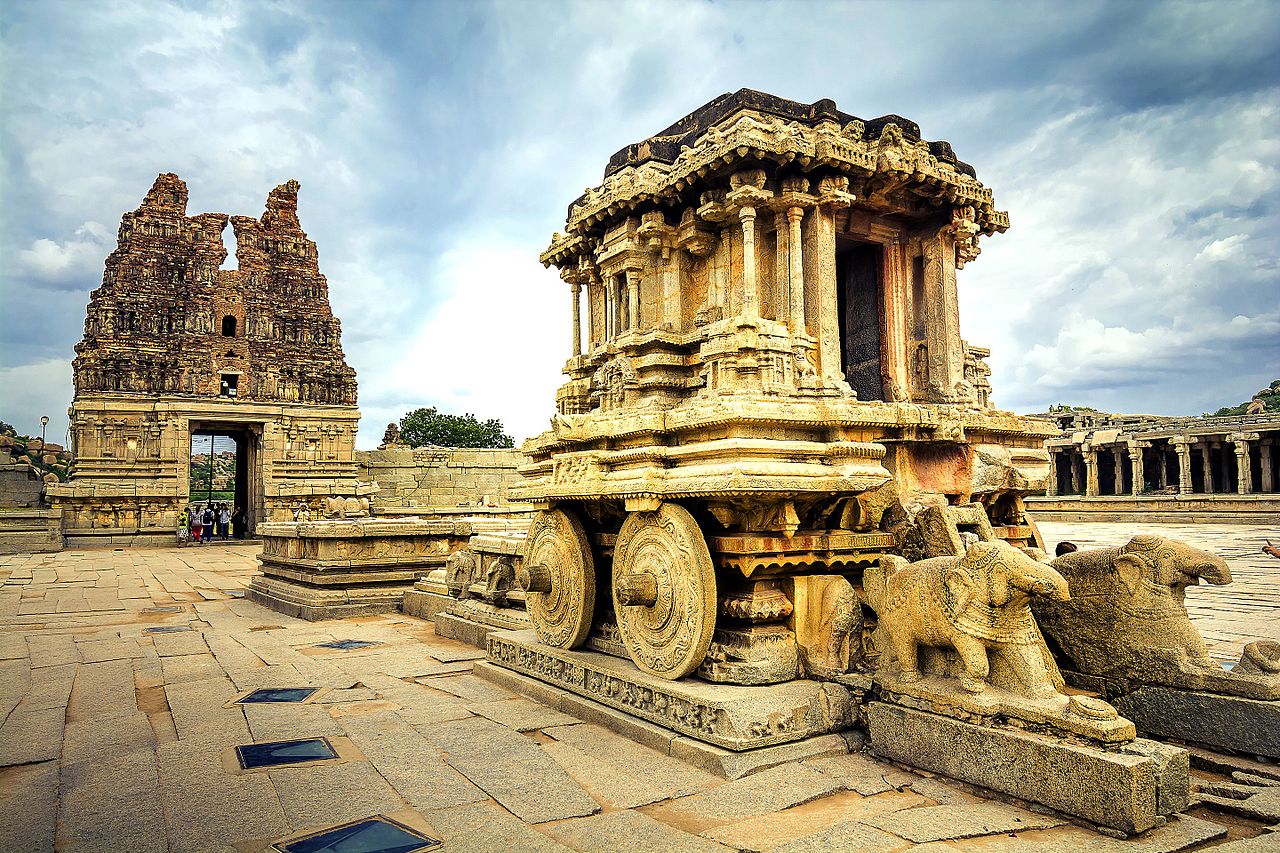
The masterpiece of Hampi — a 16th-century Vishnu temple famed for its iconic stone chariot and the "musical" pillars of its ranga mantapa that ring like instruments when tapped.

The long colonnaded market street running east from the Virupaksha temple, once a thriving medieval bazaar of diamond and horse traders; its ruined pavilions front the temple gopuram.

A low granite hill just south of the Virupaksha temple studded with pre-Vijayanagara temples, gateways and monolithic shrines — Hampi’s favourite sunset spot with views over the ruins.

2.9 km · ~7 min by auto
The highest point in central Hampi, topped by the Veerabhadra temple, giving a 360° sunrise-and-sunset panorama over the whole ruin field and the Tungabhadra — a short, steep climb.

The largest monolith in Hampi — a 6.7 m image of Narasimha, the man-lion avatar of Vishnu, carved in 1528 and seated under a seven-hooded serpent; the adjacent Badavilinga is a large monolithic Shiva linga.

A 2.4 m monolithic Ganesha carved from a single boulder within an open pillared pavilion on the Hemakuta slope, named for its "mustard-seed" belly; the larger Kadalekalu Ganesha stands nearby.

1.5 km · 19 min walk
The compact royal chapel of the Vijayanagara kings, its outer walls and inner pillars covered in bands of relief carving telling the Ramayana — "a thousand Ramas".

1.6 km · 20 min walk
An elegant two-storey pavilion in the walled Zenana (ladies’) enclosure, blending Hindu and Islamic arches into a lotus-bud shape — once an airy retreat for the royal women.

1.6 km · 20 min walk
A grand symmetrical row of eleven domed chambers that housed the royal elephants, with a central tower — one of the best-preserved and most photographed structures at Hampi.

840 m · 11 min walk
A plain square exterior hiding an ornate arcaded bathing pavilion with a large sunken tank, projecting balconies and lotus-shaped fountains, once fed by aqueducts for the royal household.

2.9 km · ~7 min by auto
A large, austere Vijayanagara temple to Tiruvengalanatha (Vishnu) at the foot of Matanga Hill, fronted by the ruined Courtesans’ (Sule) Bazaar and set among boulders.

A ruined Balakrishna (Vishnu) temple built by Krishnadevaraya in 1513 to mark his conquest of Udayagiri, just south of Hemakuta Hill — a walled complex with a large gopuram, pillared halls and a colonnaded bazaar street; the deity it once held is now in a Chennai museum.

1.8 km · 23 min walk
The "Underground" Shiva temple — one of Hampi’s oldest shrines, built below the surrounding ground level so its pillared halls and sanctum, reached down a flight of steps, flood and stay cool; it sits on the road toward the royal centre.

A giant monolithic Ganesha about 4.5 m tall, carved from a single boulder and named for its "gram-seed" belly, sheltered in an open pillared pavilion on the Hemakuta slope near the Krishna temple.

1.2 km · 15 min walk
The great three-tiered granite ceremonial platform at the heart of the Royal Enclosure, from which the Vijayanagara kings watched the Mahanavami (Dasara) festivities; its sides carry carved friezes of elephants, horses, hunts and dancers, with the stepped Pushkarani tank close by.

1.7 km · 21 min walk
The walled compound of the royal women, entered past watchtowers, enclosing the Indo-Islamic Lotus Mahal and, just outside, the domed Elephant Stables — a quiet, garden-like corner of the royal centre.

610 m · 8 min walk
One of the largest and best-preserved temple complexes at Hampi, near Kamalapura — a spacious Dravidian Rama temple with a tall gopuram, a big pillared mandapa and a colonnaded courtyard, and usually blissfully quiet.

2.3 km · 28 min walk
A living Rama temple atop the boulder-strewn Malyavanta Hill on the Kampli road, where legend says Rama and Lakshmana waited out the monsoon; the walled complex has rows of monolithic lingas and wide views over the ruin field.

A riverbank Rama temple at the sacred Chakratirtha ghat on the Tungabhadra, east of Hampi Bazaar, enshrining Rama, Sita and Lakshmana carved from a single boulder; still in worship and reached along the coracle-crossing path.

A tall stone weighing arch (Tula Bhara) near the Vittala temple, where on holy days kings were weighed against gold and jewels that were then given away; two carved granite pillars support a beam with hanging stone loops.
2.0 km · 25 min walk
A small riverside hill shrine holding a powerful image of Hanuman set within a yantra (mystic diagram), consecrated in the 16th century by the saint Vyasaraja/Vyasatirtha — a revered Madhwa pilgrimage spot reached by a short climb.

A pillared riverside pavilion below the Vittala temple dedicated to Purandaradasa, the 16th-century "father of Carnatic music" said to have lived and composed here; it hosts the annual Purandaradasa Aradhana music festival.
Roampedia is commission-free — own or know a stay, eatery, guide or shop near Archaeological Museum, Kamalapura? List it and it appears here once verified.
Add a nearby businessEntry: Small ASI ticket
At Kamalapura, ~4 km from Hampi Bazaar
If you are travelling by bus or ferry, check the return service with the operator before setting out. Leave time to reach the stop or jetty after your visit.
Ask at the bus stand for the time of the last service back, not the next one. If you miss it, an auto or app cab is the fallback — agree the fare before you get in.
If you need step-free access, contact the site before travelling. Ask about a level entrance, steps along the route, the nearest drop-off point, seating and accessible toilets.
Emergency numbers are verified against official government and state tourism sources. 112 works anywhere in India.
One of the largest and best-preserved temple complexes at Hampi, near Kamalapura — a spacious Dravidian Rama temple with a tall gopuram, a big pillared mandapa and a colonnaded courtyard, and usually blissfully quiet.
610 m · 8 min walk · straight lineA plain square exterior hiding an ornate arcaded bathing pavilion with a large sunken tank, projecting balconies and lotus-shaped fountains, once fed by aqueducts for the royal household.
840 m · 11 min walk · straight lineThe great three-tiered granite ceremonial platform at the heart of the Royal Enclosure, from which the Vijayanagara kings watched the Mahanavami (Dasara) festivities; its sides carry carved friezes of elephants, horses, hunts and dancers, with the stepped Pushkarani tank close by.
1.2 km · 15 min walk · straight lineThe compact royal chapel of the Vijayanagara kings, its outer walls and inner pillars covered in bands of relief carving telling the Ramayana — "a thousand Ramas".
1.5 km · 19 min walk · straight lineAn elegant two-storey pavilion in the walled Zenana (ladies’) enclosure, blending Hindu and Islamic arches into a lotus-bud shape — once an airy retreat for the royal women.
1.6 km · 20 min walk · straight lineA grand symmetrical row of eleven domed chambers that housed the royal elephants, with a central tower — one of the best-preserved and most photographed structures at Hampi.
1.6 km · 20 min walk · straight lineThe walled compound of the royal women, entered past watchtowers, enclosing the Indo-Islamic Lotus Mahal and, just outside, the domed Elephant Stables — a quiet, garden-like corner of the royal centre.
1.7 km · 21 min walk · straight lineThe "Underground" Shiva temple — one of Hampi’s oldest shrines, built below the surrounding ground level so its pillared halls and sanctum, reached down a flight of steps, flood and stay cool; it sits on the road toward the royal centre.
1.8 km · 23 min walk · straight lineA small riverside hill shrine holding a powerful image of Hanuman set within a yantra (mystic diagram), consecrated in the 16th century by the saint Vyasaraja/Vyasatirtha — a revered Madhwa pilgrimage spot reached by a short climb.
2.0 km · 25 min walk · straight lineA living Rama temple atop the boulder-strewn Malyavanta Hill on the Kampli road, where legend says Rama and Lakshmana waited out the monsoon; the walled complex has rows of monolithic lingas and wide views over the ruin field.
2.3 km · 28 min walk · straight lineThe highest point in central Hampi, topped by the Veerabhadra temple, giving a 360° sunrise-and-sunset panorama over the whole ruin field and the Tungabhadra — a short, steep climb.
2.9 km · ~7 min by auto · straight lineA large, austere Vijayanagara temple to Tiruvengalanatha (Vishnu) at the foot of Matanga Hill, fronted by the ruined Courtesans’ (Sule) Bazaar and set among boulders.
2.9 km · ~7 min by auto · straight lineAny time of year; a cool midday break from the sun.
Entry: Small ASI ticket. Timings: 10:00 AM - 5:00 PM; closed Fridays.
At Kamalapura, ~4 km from Hampi Bazaar; moped, auto or bus. A small ASI ticket applies; it is usually closed on Fridays and photography inside is generally not allowed.
45 minutes to an hour.
Nearby you can pair Pattabhirama Temple (610 m), Queen's Bath (840 m), Mahanavami Dibba (1.2 km), Hazara Rama Temple (1.5 km).
We have not published a story about Archaeological Museum, Kamalapura itself yet. These cover Hampi and the wider district, with separate journeys between stops.
These guides explore Hampi and the surrounding area. Choose a visit that fits your interests, allowing separately for travel between stops.
Route-level itineraries and practical guides for the rest of Karnataka.
