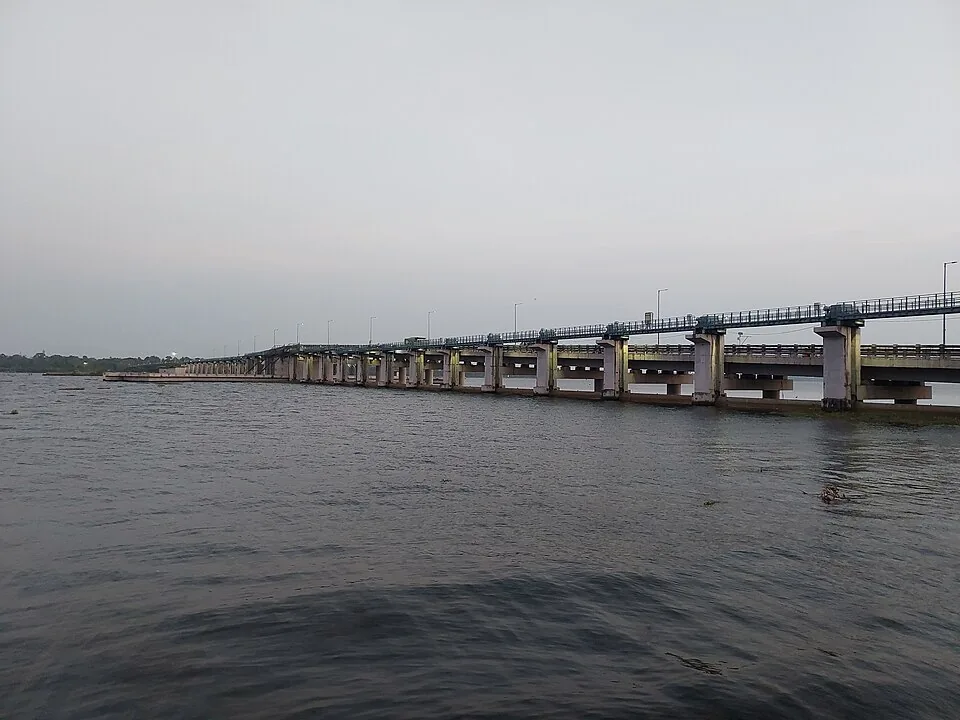
Twice a year, a quiet decision on Vembanad Lake changes life for thousands of families. In December the shutters of the Thanneermukkom Bund go down. Months later they go up again. Rice farmers wait for the first date. Fishers and clam workers wait for the second. This guide explains how that yearly cycle works, who decides it, and why it is argued over every season.
For the bund itself, with the road crossing and the best time for a visit, see our Thanneermukkom Bund place page.
Why salt water is the enemy
Kuttanad grows rice at and below sea level. In the dry months the rivers run low. Sea water then pushes in from the Kochi side and creeps south up Vembanad Lake. Rice plants cannot take that salt. The main dry-season crop is called puncha. Onmanorama explains that the shutters close to save this puncha crop from brackish water. Reclaimed lake fields such as R Block depend on the same protection.
So the bund works like a seasonal door. Shut, it keeps the southern lake fresh for the fields. Open, it lets the tide and the sea fish back in.
The calendar on paper
The rule is simple. The Kuttanad agricultural calendar says the shutters close by 15 December and reopen by 15 March. Onmanorama repeated those dates in its reports of December 2025 and April 2026. The decision each year rests with an advisory committee chaired by the District Collector of Alappuzha. The Irrigation Department then does the physical work.
The machine side has changed over time. In 2020, Onmanorama described motors fitted to every shutter, with generators ready in case the power failed. Before the motors, raising the shutters by hand took about a week.
How the 2025-26 closing went
The 2025-26 season is a good example of the cycle running on time. The advisory committee met on 11 December 2025 under District Collector Alex Varghese. Work began on the following Monday. The first shutters lowered were the 28 in the middle section, which is the third phase of the bund. The shutters of the first and second phases followed.
On 19 December 2025, Onmanorama reported the bund fully closed. All 90 shutters and four navigation locks were down, and the work was finished by Thursday noon. The Irrigation Department used machinery for every gate. Its assistant engineer, M Jamsheed, said the navigation locks would be opened during duty hours so that boats could still pass. Onmanorama’s headline called the timely closure a relief for Kuttanad farmers.
How the shutters open again
Opening is done in stages, not all at once. Onmanorama’s 2020 report gives the order. First, 31 shutters on the Thanneermukkom side go up. Next comes the same number on the Ambika Market side, which includes ten emergency shutters. Last, the 28 shutters in the middle are raised. The aim is to control the rush of water into the southern lake.
When the gates open, the lake changes quickly. Water levels in the canals rise, and the flow starts moving again. Garbage that collected in the canals is carried away. Fish ride in on the current. The same report says the saltier water also helps coconut trees and keeps some of their diseases down.
Late openings, year after year
The opening date is where the trouble starts. In 2020, Onmanorama noted that over the previous few years the shutters had gone up only around 15 April. That year they opened later still, on 1 May, after four and a half months shut. In 2025 they opened on 11 April.
The 2026 opening ran late again. On 16 April 2026, Onmanorama reported that no date had yet been fixed. The harvest in Kuttanad and most of Alappuzha was nearly complete. The holdup was in the western fields of Kottayam district, where harvesting was behind. A high-level meeting ended without a decision. Irrigation officials said no order had been issued.
The fishers’ side of the story
For the people who fish Vembanad, a closed bund means a poorer lake. Onmanorama’s December 2025 report from the Vaikom side described fishing and clam workers in hardship. The long closure cuts the flow of fish from the sea. Less salt water hurts the black clam beds. Workers also complained of shutters in the third block being opened without warning at low tide, which damaged their nets.
The April 2026 report went further. Waste had piled up in the lake and its canals south of the bund. Pesticides from the paddy fields had made the water toxic, and oxygen levels fell. Fish deaths were seen across the lake. Hundreds of Chinese fishing nets stood almost idle. Sand mining south of the bund for national highway work added to the damage.
Fishing unions have a clear demand. D Babu, district secretary of the AITUC Matsya Thozhilali Federation, told Onmanorama that fishing workers and environmentalists have long asked to keep the bund open for one year as a trial. He also called for desilting the lake.
The middle section and its long gap
The third phase in the middle has its own history. Onmanorama’s 2020 report describes a sandbank that was built where the third-phase shutters now stand. By 2020 the sand had been removed only to a depth of 80 cm. What remained still blocked the smooth flow of water from north to south. Today those 28 middle shutters are part of the full set of 90, and they are the first to close each December.
What it means for a visitor
You can read the season from the bund road. In winter the lake to the south is calm and the shutters stand in a closed line. In spring, after opening, the water runs hard through the gates and fishing boats gather close by. Combine a crossing with the lake views at Punnamada or an evening at Marari Beach. You will then see salt water and fresh water, the two sides of the bund’s argument, in one day.
To see how boats pass through the barrier, read how a boat crosses a wall. From the bund you can reach Pathiramanal Island on the lake, the Cherthala Karthyayani Temple by road, and the reclaimed fields of R Block further south.
Frequently asked questions
When are the Thanneermukkom Bund shutters closed?
The Kuttanad farming calendar sets 15 December to 15 March; in the 2025-26 season all 90 shutters were down by 18 December 2025.
Why are the shutters closed?
To stop salt water from the sea entering Kuttanad’s rice fields during the dry-season puncha crop.
Who decides the dates?
An advisory committee chaired by the Alappuzha District Collector; the Irrigation Department operates the shutters.
Can boats pass when the bund is closed?
Yes. The four navigation locks are opened during duty hours for vessels.
Why do fishers want the shutters open?
Closure cuts the inflow of sea fish, harms black clam beds and lets pollution build up in the lake.