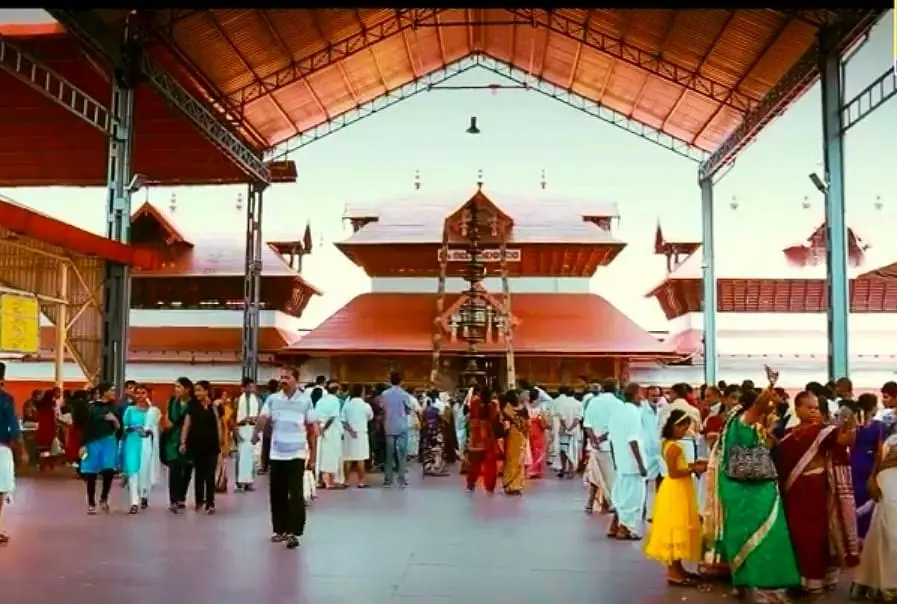
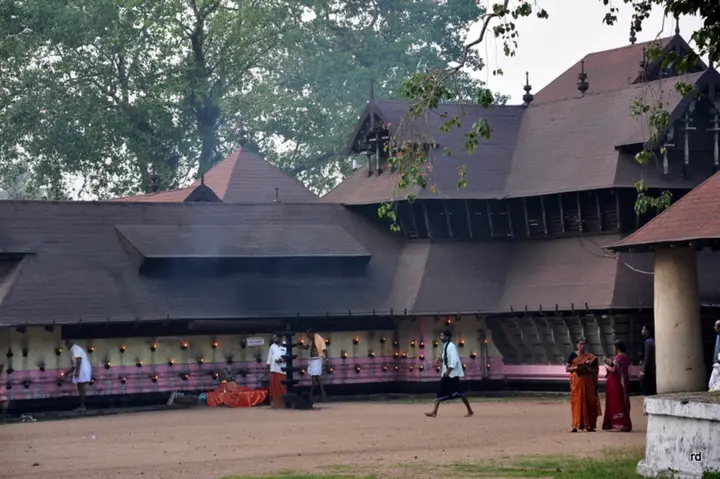
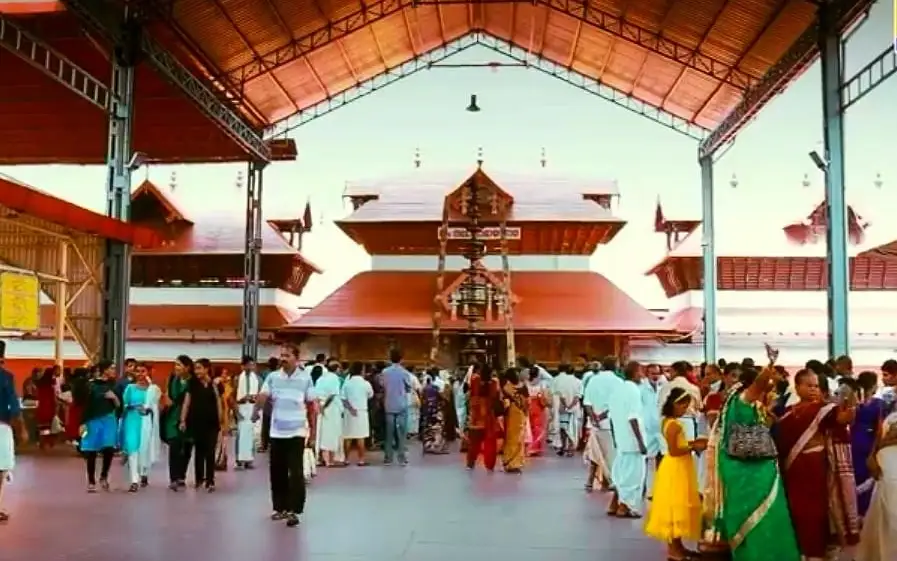
Guruvayur is a Grade-1 municipality of about 67,000 people (2011 census) spread over 29.66 sq km in Chavakkad taluk, 26 km north-west of Thrissur, and it exists because of one temple. Almost everything else here — the lodges, the garland stalls, the two bus stands at the east and west gates, the wedding halls, the multi-storey car parks opened in 2021 — is an answer to the question of how to move, feed and house pilgrims. But the town has a civic history of its own that is bigger than a visitor’s itinerary: it was the site of the 1931–32 temple-entry satyagraha, one of the decisive campaigns of Kerala’s social reform; it lost most of its temple to fire in 1970 and was taken over by the state as a result; and it is now the address of a long-running court fight over the welfare of the elephants kept in its name.
The shape of the town is easy to read once you know that the temple faces east. The private bus stand sits at the east nada near Manjulal junction, where a Garuda in painted concrete stands under an old tree on a traffic island; the KSRTC stand is at the west nada. National Highway 66, the Kanyakumari–Panvel road, runs past the western side. State Highway 49, at eight kilometres the shortest state highway in Kerala, begins here and ends at Choondal. The railway station is out to the east, and it is quieter than a town of this size deserves — the branch line from Thrissur only opened in 1995, and it carries express services towards Chennai Egmore and Thiruvananthapuram plus a few passenger trains. The long-standing local demand is to extend the line north to Tirur; in 2023 a group of Guruvayur citizens went to E. Sreedharan and asked him to lead the project on the Konkan Railway model. It has not happened.
The institution that runs the town is the Guruvayur Devaswom, and it is worth being precise about what that is. It is not a private trust and not part of the Travancore or Cochin boards. It is a statutory body under the Guruvayoor Devaswom Act, 1978 (Kerala Act 14 of 1978), supervised by the state government. The Managing Committee has three ex-officio members — the Zamorin Raja, the karanavan of Mallisseri Illom and the temple’s Thanthri — and six nominated ones, of whom one represents the Devaswom’s employees and one, by statute, must be from a Scheduled Caste. That last clause is the satyagraha of 1931 written into a law of 1978. The committee’s secretary is the Administrator, a government officer on deputation who may not be below the rank of Deputy Collector, and who is required to be full-time.
The Devaswom’s estate goes a long way beyond the temple wall. It runs Sree Krishna College and Sree Krishna Higher Secondary School, an English-medium school, a medical centre, the Melpathur Memorial Ayurveda Hospital, a museum, a school of temple arts, a mural-painting school, a bookshop and religious bookstall, and the Ambadi housing complex. Out in Malappuram district at Vengad it holds the hundred-acre Vrindavan Estate, growing palm alongside coconut and cashew, and next to it, on twenty-five acres, the Gokulam, where roughly a thousand cows given to the deity by devotees are kept. Two more cattle sheds sit elsewhere, one of them beside the Kaveed Karthyayani temple. For a Kerala municipality, that is an unusually large share of the local economy sitting inside a single religious body.
The priesthood works on a rota that is stranger than most visitors realise. The melsanthi, the chief priest, is appointed for exactly six months and takes charge in April and October. For that half-year he is a purappedasanthi — he may not leave the temple precinct at all, and he observes strict celibacy. Before taking office he spends a fortnight learning the temple’s own usages under the tantri and the othikkans, and stays in bhajanam at the temple until the day of handover. Traditionally the melsanthis come from Namboothiri families of the old Sukapuram and Peruvanam grammams. Two keezhsanthis assist him, drawn two illams at a time by monthly turn from a list of thirteen families the Zamorin is said to have brought to Guruvayur from Karissery in Kozhikode district. The keezhsanthis cook the offering, grind the sandal, carry the water and the thidambu and distribute prasadam, but they are forbidden to touch the idol and cannot stand in for the melsanthi; that duty falls to the othikkans, an office that survives today at only two Kerala temples, Guruvayur and Tripunithura.
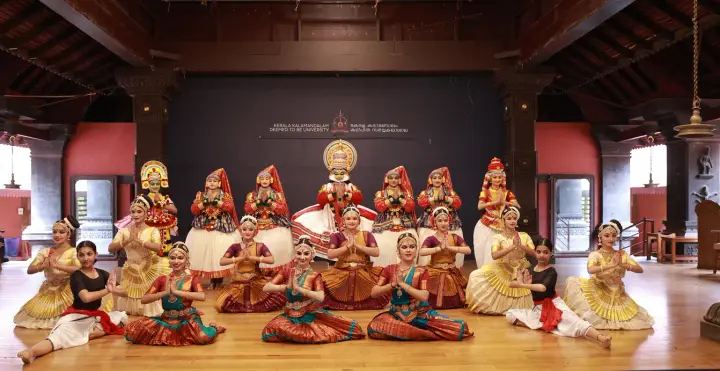
Weddings are the town’s second economy and they are unusual in a specific way: at Guruvayur no muhurtham is required. The belief is that the Lord never tires of weddings, so a marriage may be solemnised at any hour the nada is open, and hundreds are performed on a single auspicious date. The ceremony itself is short and plain, with a tulsi garland rather than a heavy one, and it takes place in the marriage mandapam outside the east gate — which is why the groom may wear a shirt at his own wedding here when he could not inside. Because a newly married couple may not enter the nalambalam immediately afterwards, most seek the deity’s blessing the previous day or earlier the same morning and then walk out to the mandapam. Families booking a Guruvayur wedding often add a Krishnanattam performance as a vazhipadu, or an Umamaheswara pooja at Mammiyoor, or a swayamvara pushpanjali. A commercial Guruvayur booking service publishes a figure of 6,926 weddings in a recent year and a single-day record of 264 on 5 September 2016; we have not found an official Devaswom confirmation of either number and report them as that source’s claim.
For about a fortnight each Vrischikam the town belongs to Carnatic music. The Chembai Sangeetholsavam is held on a purpose-built stage, the Chembai Sangeetha Mandapam, at the Melpathur Auditorium outside the temple, and it has been run by the Devaswom under that name since 1974, the year Chembai Vaidyanatha Bhagavatar died. English Wikipedia dates the festival’s origin much earlier, to 1910, and says Chembai conducted it himself for about sixty years before the Devaswom took it over and renamed it in his memory; the Malayalam article simply dates the present festival from 1974. Both can be true and we give both. Around three thousand musicians take part, from established vidwans to schoolchildren, and the mass rendering of Tyagaraja’s Pancharatna kritis is the centrepiece. It closes on the night of Guruvayur Ekadasi with everyone singing Chembai’s own favourite, the Sriragam kirtanam “Karuna cheyvanenthu thamasam Krishna”.
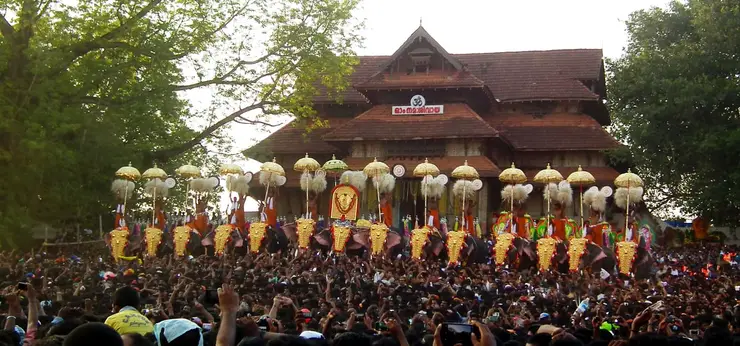
Guruvayur Ekadasi itself, the sukla-paksha ekadasi of Vrischikam, is the pratishtha-day observance and is also kept as Gita Day, on the belief that this was the day Krishna taught Arjuna at Kurukshetra. Devotees take no rice that day. A month of nightly lamp-lightings runs up to it, with different families and trusts sponsoring particular nights — the Pulikkeezhe Variyam family on Ashtami, the Koladi family’s ney-vilakku on Navami, the Guruvayurappan Sankeerthana Trust on Dasami, and the Devaswom’s own udayasthamana pooja and vilakku on Ekadasi. At the night procession the deity’s golden kolam is carried by the lead tusker of Punnathur Kotta, an honour that once belonged to Kesavan. Before dawn on Dwadasi the Dwadasippanam begins in the koothambalam, devotees offering purses to agnihotri Brahmins of the Sukapuram, Peruvanam and Irinjalakuda grammams, the first purse placed by the melsanthi on the deity’s behalf. Then the doors shut at nine in the morning and do not reopen until half past three, and no weddings, choroonu or tulabharam are held.
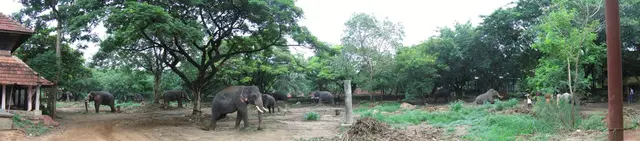
The elephants are the part of Guruvayur that visitors find hardest, and it is better to arrive informed than surprised. On 9 February 2024, after video circulated of mahouts striking elephants with a vadikkol, a Kerala High Court bench of Justices Anil K. Narendran and G. Girish told the Devaswom that no iron rods or bullhooks were to be used, ordered CCTV at Anakkotta and sent the Divisional Forest Officer’s flying squad to inspect; three animals were identified in the footage — Krishna, given by the late Tamil Nadu chief minister J. Jayalalithaa, Kesavankutty, and Gajendra, who was walking with a limp. Two mahouts were suspended. The petition was brought by Sangita Iyer of the Asian Elephants Society. In the same proceedings (WP(C) No. 16514 of 2023) the court has since issued interim directions covering the 39 elephants then at the camp: iron chains to be replaced with cotton rope or cushioned tethers except for animals in musth, a working RO water supply, an end to hose-bathing animals beside their tethering points, four to five kilometres of walking a day on rotation, CCTV across the site, and upgraded veterinary equipment. LiveLaw dates that order to July 2026; we have not independently confirmed the day.
The wider picture is grimmer and is not Guruvayur’s alone. In November 2024 a division bench of the Kerala High Court, Dr A. K. Jayasankaran Nambiar and Gopinath P., issued a long set of directions on captive elephants across the state, requiring fitness certification only by government veterinarians, enforcing model feeding schedules, and ending the use of “elephant squads” and the capture belt; the judgment described the life of a captive elephant as an “Eternal Treblinka”, and noted that roughly a third of the state’s recorded captive elephants had died between 2018 and 2024. Advocacy bodies put numbers to the human cost too — the Heritage Animal Task Force says captive elephants killed 526 people in Kerala over fifteen years, and the Centre for Research on Animal Rights counts about fifty mahouts killed between 2014 and 2021 and 138 captive elephant deaths between 2018 and 2023. Those are campaigners’ figures and should be read as such, but no one on either side of the argument disputes that the toll is real.
Legend & myth
Start with the name, because the town’s own answer and the scholars’ answer are not the same and the temple’s story is told elsewhere on this site. The devotional derivation — Guru, meaning Brihaspati, plus Vayu, plus ur, place — belongs to the shrine and is set out on our Guruvayur Sree Krishna Temple page; it is not repeated here. What the town’s record adds is the argument against it. The oldest written form of the place-name is not Guruvayur at all but Kuruvayur, which is how the fourteenth-century Sanskrit-Malayalam sandesa kavya Kokasandesam refers to it. The historian V. V. K. Valath guessed that a lost performing art called kuravakkoothu was staged here and gave the settlement its name. That guess has two problems, and the Malayalam sources say so plainly: Kokasandesam is heavily Tamil-inflected, and Tamil writes ka and ga with the same letter, so a shift from Kuravayur to Guruvayur proves nothing; and no other trace of kuravakkoothu survives anywhere, which is odd for a Kerala art form. A third proposal simply says kurava grass grew thickly here. The historian Puthezhath Raman Menon offered the sharpest theory of all: that Melpathur Narayana Bhattathiri coined “Guruvayur” by Sanskritising the local name so that it would scan in his verse. If that is right, the town is named after a poet’s convenience, and the divine etymology came afterwards to explain it.
The legend that most shapes how people actually move around Guruvayur belongs to Mammiyoor, a kilometre north-west on the Kunnamkulam road. The tradition holds that Shiva witnessed the installation of Guruvayurappan and then manifested here of his own accord, swayambhu, with Parvati beside him. From that follows a rule of practice rather than a story: a Guruvayur pilgrimage is not complete until you have also had darshan at Mammiyoor. For those who genuinely cannot go, there is a documented substitute — worship the Bhagavati inside the Guruvayur compound, and while walking the pradakshina turn and bow towards the north-west. Mammiyoor is counted among the hundred and eight Shivalayas of old Kerala, and beside the Shiva it holds a Mahavishnu of equal standing whom devotees understand to be Guruvayurappan himself. It is administered by the Malabar Devaswom Board, not by Guruvayur, yet its tantric authority rests with the same family, Puzhakkara Chennas Mana. Note what the belief is doing: it makes the great Krishna temple structurally incomplete on its own.
There is an older claimant still, and she is inside the wall. Guruvayur is said to have begun as a Bhagavati temple, and the goddess of that earlier shrine is the deity now standing in the north-east of the compound under the name Idathrikkathu Kavilamma, held in the Parashakti–Vanadurga–Bhadrakali conception. She is not treated as a leftover. The belief is that she is the protecting deity of the whole Guruvayur temple, which is why she is given special prominence and why the substitute for a Mammiyoor darshan routes through her shrine. A visitor who knows only the Krishna story will walk past the oldest thing in the compound.
The tank on the north side, behind the ootupura, is the Rudratheertham, and the aarattu is held in it. Tradition says the idol brought here by Guru and Vayu was bathed in this water before Shiva installed it — the tank is older than the shrine in the story’s own telling. Beyond that, the tank has legends of its own: that it was once a great lake covered in lotuses, and that Shiva and the Prachetas performed tapas on its bank for a very long age. Saligramams and other sacred objects are believed to lie in it, though this has never been confirmed. What is confirmed is more prosaic: heavy beautification since the 1960s, an inner and outer pool of which the inner is normally closed to the public, and a sculpture of Krishna subduing Kaliya set in the middle of the water in 1975. Bathing with oil or soap is forbidden, and so is swimming.
Two temples out by the railway station carry stories about identity being lost and recovered. The Parthasarathy temple is believed to have been consecrated by Adi Shankara; it was wrecked in Tipu Sultan’s campaigns and lay neglected for a very long time before Anjam Madhavan Namboothiri rebuilt and reconsecrated it, and its srikovil is now built in the form of a chariot, wheels and horses included. Next to it stands the Thiruvenkatachalapathi temple, called the Kerala Tirupati and believed to have been founded by Ramanujacharya. Tipu’s men smashed the original idol so badly — the head and the right hand were gone — that nobody could any longer say whose image it had been, and for generations the place was simply known as a Bhagavati temple. Only a devaprasnam in 1974 concluded that Venkatachalapathi’s presence was still there. A new four-armed idol was made with the blessing of the Periya Jeeyar of Tirupati and consecrated in 1977 by the then chief tantri, Puzhakkara Chennas Parameswaran Namboodiripad. Whatever one makes of divination as a method, it is a striking piece of local history: a deity restored to a building by a séance.
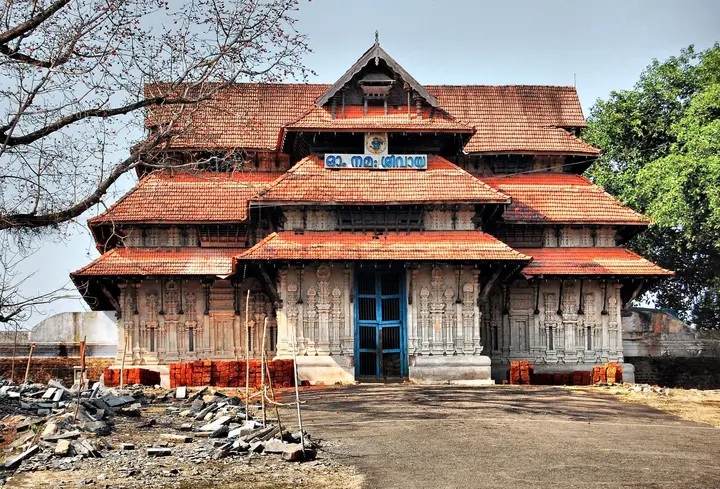
One more thread ties the town’s legends to a book. Ravinarayanan Namboodiripad of Chennas Mana wrote the Tantrasamuchayam, the Sanskrit manual whose rules Kerala temples still follow, and the tradition is that its first testing grounds were Guruvayur and Mammiyoor. The family’s hold on both temples is itself the residue of a political act — the tantric right originally lay with Vadakke Puliyannur Mana at nearby Elavally, and passed to Chennas only after the Zamorin took Guruvayur from the Raja of Cochin and gave the office to a man of his own court. Five kilometres east, just outside the municipality in Kandanassery panchayat, the Harikanyaka temple at Ariyannur is credited to Uliyannur Perumthachan of the Parayi-petta Panthirukulam, and the village name is explained as a worn-down Harikanyakapuram; at its Meenam pooram, custom allows only cow elephants. The point of collecting these is not that any of them is provable. It is that Guruvayur’s stories cluster around ownership — who consecrated, who lost, who was here first, whose family holds the right — in a town where all of that has been contested in earnest, in court and on the street, within living memory.
More about Guruvayur
History
The event that made Guruvayur matter beyond pilgrimage was the temple-entry satyagraha. Like most Kerala temples, Guruvayur was closed to avarna communities, who in many places could not even use the roads beside it. A KPCC meeting at Vadakara resolved that Hindu temples should admit all Hindus; K. Kelappan argued the case at the AICC in Bombay on 7 July 1931 and secured Gandhi’s consent, and on 2 August 1931 the KPCC at Kozhikode adopted his resolution and put him in charge of a satyagraha at Guruvayur. A. K. Gopalan was chosen as captain of the volunteers, with Subrahmanyan Thirumumbu taking the northern campaign. The temple authorities responded by building a thorn fence around the shrine, and traditionalists threatened to beat the satyagrahis to death.
A jatha of twenty volunteers under Thirumumbu walked from Kannur and reached the temple gate on 31 October 1931. The satyagraha began on 1 November, kept across Kerala as Temple Entry Day, starting each morning at three when the nada opened. Kelappan fasted for twelve days. The NSS, the SNDP and the Unni Namboothiri Sabha declared solidarity. Thirumumbu was arrested on 7 November and A. K. Gopalan on 4 January. When P. Krishna Pillai rang the bell before the sreekovil — a right reserved to Brahmins — temple guards beat him savagely; he did it again the next day and was beaten worse, then picketed the gate asking devotees to stay away until the injustice ended. On 28 December Gopalan was badly beaten, and the following day the crowd tore the thorn fence down; the authorities closed the temple indefinitely and reopened it only on 28 January. Kelappan then began a fast unto death, telegrams reached the Zamorin from across India, and Gandhi finally wired him to suspend the struggle and take the responsibility on himself. Kelappan stopped, without enthusiasm.
The campaign’s most famous incident happened far to the north. At Kandoth near Payyannur, lower castes were barred from the public road in front of a Thiyya temple. Kelappan and Gopalan led a procession of Harijans down it; a crowd of about two hundred set on them, and women beat Gopalan with ulakka, the long wooden pestles. The assault lasted half an hour. Gopalan and the activist Keraleeyan were knocked unconscious, and Keraleeyan’s dying declaration was actually recorded. It was the first beating of A. K. Gopalan’s political life and, as the Malayalam account puts it, the best publicity the Guruvayur satyagraha ever got: a Malabar District Board officer came to Kandoth and put up a signboard stating that everyone had the right to use the road. Afterwards a referendum among Hindus of Ponnani taluk returned 15,568 in favour of opening the temple, 2,779 against and 2,106 neutral, with 7,302 refusing to take part — about 77 per cent of those voting in favour. Guruvayur itself did not open at once. It opened to all Hindus in June 1947 following the Madras government’s temple-entry settlement; Malayalam Wikipedia gives 12 June 1947 and English Wikipedia 2 June 1947, and we have not resolved which is right. The pressure the satyagraha created is also credited with helping produce the Travancore Temple Entry Proclamation of 1936. The town marks it with a municipal gateway at the east side named the A. K. G. Kavadam, the Guruvayur Temple Entry Satyagrahi Memorial.
The second turning point was fire. At about one in the morning on 30 November 1970, during the Ekadasi vilakku season with every lamp in the vilakkumadam burning and the gopuram doors shut for the night, fire broke out in the western chuttambalam. A resident of the western side, Komath Narayana Panicker, saw it and raised the alarm; thousands of people of every caste and religion fought it with earth and water, and fire crews came from Ponnani, Thrissur and FACT, because Guruvayur had no fire station of its own. It burned for roughly five hours and was out by half past five. The chuttambalam and the western, southern and northern vilakkumadams were destroyed, and the Anantasayanam mural painted by Pulakkattu Raman Nair behind the sreekovil at the west nada burned away entirely. The sreekovil stood about three yards from the burning chuttambalam and was never touched by flame, though the surrounding murals were badly smoke-damaged. The idols of Guruvayurappan, Ganapathi and Sastha had been carried out to the chuttambalam and then to the tantri’s house; the sreekovil, the main idol, the Ganapathi and Sastha shrines, the kodimaram and the balikkallu all survived.
The consequences were administrative as much as architectural. The Kerala government appointed a commission to investigate the fire; it reported extensive irregularities in the temple’s administration, and the government moved to take the Devaswom over. The dating of that statute is genuinely muddled in our sources: the Malayalam article’s administration section says the Guruvayur Devaswom Act came into force on 9 March 1971 and that the temple is now run under the 1978 revision, while its reconstruction section says the Act came into force in 1977; the statute on the books is the Guruvayoor Devaswom Act, 1978. Reconstruction itself was funded by public subscription, which raised ₹26,69,000. Astrologers were convened to determine the deity’s will and every proposal they made was adopted except the widening of the north and east doors of the nalambalam. The foundation stone was laid by the Kanchi Kamakoti Jagadguru Jayendra Saraswathi Swamigal, and ten round pillars in the two vathilmadams were newly carved — including the southern one where, in 1587, Melpathur had finished the Narayaneeyam. The lamps of the vilakkumadam were lit again for the first time on 14 April 1973, which was Vishu.
The third episode is the one nobody in Guruvayur has forgotten. On 31 March 1985 three ornaments went missing from the deity: a nagapadathali of about 60 grams set with twenty-four blue stones, a Mahalakshmi mala of about 45 grams and a blue-stone mala of about 90 grams. They were found missing by the melsanthi, Kakkad Damodaran Namboothiri, as he laid down the keys at the end of his six-month term, and he left the temple in tears. Suspicion fell on him; the Devaswom recovered ₹5,000 from him in compensation and he and his sons Anandan and Devadasan were put through lie-detector tests, his daughter Sudha’s marriage fell through, and police came and went at the illam. Others accused P. T. Mohanakrishnan, the Congress leader and Devaswom chairman later MLA for Ponnani, of having taken the ornaments and given them to the chief minister K. Karunakaran; the charge was campaigned on in the 1987 election, complete with cartoons of Guruvayurappan refusing to see Karunakaran until his jewels came back. The Left government elected on that campaign then let the investigation lapse. In 1993 the magistrate’s court at Kunnamkulam found Damodaran Namboothiri and his sons innocent, but he had died in 1989, broken by it. His son Devadasan served as melsanthi in 1998 and 2002; his grandson Dr Kiran Anand was selected on his first application in 2022. Devaprasnams in 1985, 1990 and 2007 all concluded the ornaments were in the temple well. The well was drained in 1990 and again in 2013, yielding some saligramams and puja vessels, and drained once more on 25 April 2014, when the nagapadathali was finally recovered. The other two have never been found.
Why visit
To stand at the A. K. G. Kavadam on the east side and see that the temple-entry satyagraha of 1931–32 is commemorated here as civic history, not as a footnote to a shrine.
Because Mammiyoor, a kilometre north-west, is by tradition what completes a Guruvayur pilgrimage rather than an optional extra, and is a fine 108-Shivalaya temple in its own right.
For the Chembai Sangeetholsavam, about a fortnight of Carnatic music each Vrischikam at the Melpathur Auditorium, ending with three thousand voices on one kirtanam on Ekadasi night.
To see how completely a Kerala municipality can be organised around one institution — the Devaswom’s college, hospital, schools, museum, estate and cattle farm are all within a short drive.
For the town’s outer ring of temples: the chariot-shaped Parthasarathy srikovil and the Kerala Tirupati by the railway station, Perunthatta on the Pavaratty road, Chowalloor and Ariyannur to the east.
Because weddings here need no muhurtham, which makes the east-nada mandapam one of the busiest and most cheerful places in Kerala on an auspicious morning.