Kottayam is the reason Malayalam has a printed shape. In March 1817 a young CMS missionary named Benjamin Bailey arrived at a place where Thirunakkara was still uninhabited forest and the working town was the Thazhathangadi market down on the Meenachil river. Within four years he had built a printing press by hand — a carpenter, two blacksmiths and an article in the Encyclopaedia Britannica — cast his own type, and started an industry. Everything Malayalis mean by “Akshara Nagari”, the city of letters, comes out of that shed: the first Malayalam book printed in Kerala, the first Malayalam periodical that began life in print, the first dictionaries in the language, and later Deepika, Malayala Manorama, the writers’ co-operative and D. C. Books. It is an ordinary mid-Travancore market town of about 137,000 people that happens to have set the alphabet.
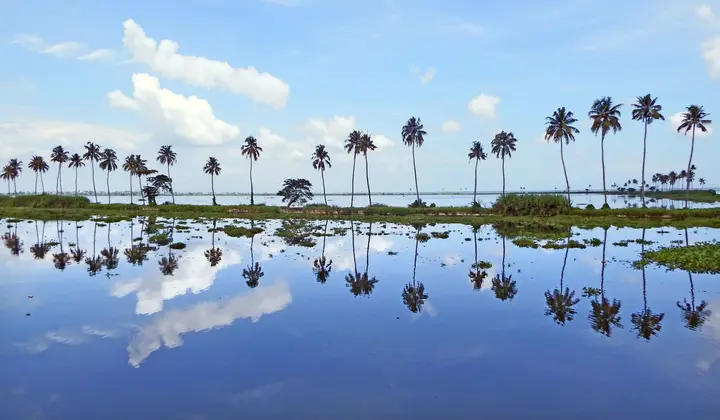
Modern Kottayam is a compact, busy district headquarters of roughly 137,000 people in the 2011 census, spread over the 55.4 square kilometres of a municipality constituted in 1924. It sits at about three metres above sea level, in the basin of the Meenachil river where it runs down to Vembanad, which is why the town works as the rail head for Kumarakom sixteen kilometres west and for the Pala and Erattupetta highlands to the east. Thirunakkara — the maidan and the temple hill — is the centre of it, the KSRTC and private stands and the shops radiating from there. The railway station is not in the middle of town at all but two and a half kilometres out at Nagampadam, and the town’s port is a further six kilometres away at Nattakom, with boats also running from Kodimatha.
None of that existed when the story starts. Malayalam Wikipedia’s account of Benjamin Bailey is blunt about what he found: Kottayam was not a town in the sense we mean now, Thirunakkara was uninhabited forest, the settlement clustered along the Meenachil, and the trading centre was the market at Thazhathangadi. Bailey and his wife Elizabeth Ella sailed from England on the Hero on 4 May 1816, reached Madras on 8 September, came down to Cochin on 16 November and to Alappuzha on 19 November, where on Colonel John Munro’s instruction they stayed to learn Malayalam. They reached Kottayam in March 1817 and moved into the old seminary, the building people then simply called the pathitha veedu, the study house.
He was put to work as its headmaster, and this is where English was first taught in Kerala; alongside it he arranged teaching in Hebrew, Latin, Greek, Sanskrit, Malayalam, geography, history and mathematics, and opened the place to ordinary students as well as ordinands. When Munro appointed Joseph Fenn to succeed him as principal, Bailey turned to translation — and immediately hit the wall that defines this town. He had translated the Syrian liturgy and was working on the Bible, and there was nowhere in Kerala to print any of it.
So he built a press. The machine promised from England was held up; the type ordered from Madras did not come. With a blacksmith he made the metal parts and with a carpenter he made the frame, working from the printing article in the Encyclopaedia Britannica, and put it in a small shed they called the achadippura — the printing hut. By the time it worked, the English machine finally arrived via Bombay with a fount of English letters. Printing began in 1821.
The type is the part that outlasted everything. A Calcutta foundry sent Malayalam sorts in the old square cut, and Bailey thought them oversized and ugly. He learned type-founding from books, and with a brazier and a goldsmith cast his own — reducing the fount from the 1,128 square sorts used for the Samkshepavedartham to a little over five hundred, by detaching the vowel signs from the consonants they had been welded above. He also abandoned the square cut for a rounded one. The round shape of printed Malayalam letters, the shape every Malayali reads today, begins at this press.
What came off it: tracts first, the oldest surviving being a temperance pamphlet, Madyanirodhini, of 1822; then the Gospel of Matthew; then, in 1824, a book of stories translated from English for the benefit of small children — the first Malayalam book printed in Kerala — and, in the same year, Raja Ram Mohan Roy’s commentary on the Upanishads, which did a good deal to end the notion that Malayalam was a lesser vehicle than Tamil. Five thousand copies of the New Testament were printed here in 1829, the complete Bible following. Bailey published the first English–Malayalam dictionary in 1846 and the first Malayalam–English dictionary in 1849. Until Swathi Thirunal set up a government press at Thiruvananthapuram in 1834, every printing job the Travancore government needed was done at Kottayam. He also built, in 1839–42, the Gothic Christ Church that Bishop Wilson called “the glory of Travancore”, now the cathedral of the CSI Madhya Kerala diocese.
In 1848 the press produced Jnananikshepam, and here the sources need separating carefully. Hermann Gundert’s Rajyasamacharam, started at Illikkunnu near Thalassery in June 1847, is the first Malayalam periodical — but it was cyclostyled, eight demy-octavo pages given away free, and it stopped after 42 issues at the end of 1850. Jnananikshepam was the first Malayalam periodical that began life in print, using movable type, at eight pages for one chakram; the English Wikipedia article on Kottayam calls it the first newspaper published by natives of Kerala, the Malayalam article on the CMS Press calls it simply the first Malayalam newspaper, and the Malayalam article on the magazine itself calls it the third Malayalam publication. Read together they mean the same thing said three ways. Its main workers were Geevarghese Kathanar and Archdeacon Koshi; it carried world news, government orders and science; the novel Pullelikunchu was serialised in it; and a piece in the Karkidakam 1849 issue about an elephant and a tailor may be the first short story printed in the language.
The newspapers followed the press. Deepika began on 15 April 1887 as Nasrani Deepika, founded by the Syrian Catholic priest Nidhirikkal Mani Kathanar and printed at first on a wooden press at St Joseph’s Press at Mannanam, not in Kottayam at all; it became a daily in January 1927 and only moved its headquarters into Kottayam town in 1939, dropping the word Nasrani at the same time. It is the oldest Malayalam newspaper still in circulation. Malayala Manorama came next, and its two dates get run together: Kandathil Varghese Mappillai, a Malayalam munshi at the CMS High School here, registered a joint stock company with ₹10,000 of authorised capital in a hundred ₹100 shares on 14 March 1888 — reportedly the first such company in publishing in British India — but the first issue did not appear until 22 March 1890, printed on a London-made Hopkinson and Cope press with Malayalam type cut by a local craftsman, Konthi Achari. Kerala Varma Valiya Koil Thampuran suggested the name. On 9 September 1938 the Travancore government sealed the press and jailed the editor K. C. Mammen Mappillai; the paper was printed from Kunnamkulam in Cochin state for nine months, then stopped, and did not resume until 29 November 1947.
The book trade is the part that is still visible on the street. In 1945 a group of writers set up the Sahitya Pravarthaka Sahakarana Sangham, the literary workers’ co-operative, which fixed a standard royalty of 30 to 40 per cent and an advance system so that writers could work full time, and whose retail arm, National Book Stall, is also based here. Its secretary, Dominic Chacko Kizhakemuri, left to found D. C. Books in 1974, adding Current Books in 1977; D. C. brought out 531 titles in 2004 alone. Labour India publishes from here too. The English Wikipedia article on Kottayam states that almost 70 per cent of the books published in Kerala come from this town — a striking figure that carries no citation there, so treat it as the received local claim rather than a measured one.
The last piece is the reading, not the writing. The Kottayam Public Library was founded in August 1882 by T. Rama Rao, Dewan Peshkar and Kottayam Peshkar, on seven cents bought near what is now Gandhi Square, in a thatched hut, with Rama Rao as president and the Rev. John Caley as secretary. It ran there until 1965, then built a four-storey block at Thirunakkara financed by printing and selling lottery tickets, opened by Indira Gandhi in 1966. The Rubber Board’s headquarters worked out of the library’s premises in its early days. The present building on Shastri Road went up from 1976; the Kerala-style entrance was designed by the sculptor Kanayi Kunhiraman, whose work also stands in the yard, and the library now holds more than 250,000 books and over 5,000 members, with a Lalithakala Akademi gallery and a 125-seat theatre. In 1989 Kottayam became the first town in India declared 100 per cent literate.
Legend & myth
The honest thing to say about legend in Kottayam town is that the town does not have much of its own — and that this is the most interesting fact about it, because Kottayam is where everybody else’s legends were written down. The great compendium of Kerala folklore, the Aithihyamala, is a Kottayam book by a Kottayam man, serialised in a Kottayam magazine and reprinted to this day by Kottayam publishers. A town hub that told you a borrowed temple story would be missing the point. What follows is the myth as this town actually handled it: as copy.
Kottarathil Sankunni was born Vasudevan at Kodimatha, in Kottayam, on 23 March 1855, and was called Thanku, then Sanku, then Sankunni. He learned Sanskrit under Manarkattu Sanku Warrier and traditional medicine under Vayskara Aryan Narayanan Mooss. In 1890 — the year Malayala Manorama published its first issue — he joined the paper as editor of its poetry section, and in 1893 was appointed Malayalam teacher at the M. D. Seminary High School here. He was a founding member of the Bhashaposhini Sabha that Kandathil Varghese Mappillai set up, and it was in Bhashaposhini, first published in 1892 and edited by Mappillai, that he began in 1909 to print the legends he had been collecting. It took him more than a quarter of a century. The finished Aithihyamala runs to eight volumes and 126 chapters: yakshis and magicians, feudal chieftains and vain poets, kalari masters, ayurvedic physicians, elephants and their mahouts. He died on 22 July 1937. The book was printed in book form by the Reddiar Press at Quilon, reprinted by National Book Stall of Kottayam in 1974 at the instance of his memorial committee, reissued by D. C. Books of Kottayam in 1991, and had sold more than 150,000 copies by 2004. Almost everything a visitor to Kerala will be told about Kerala’s past has passed through those pages, and those pages passed through this town.
One of the most famous chapters in it explains a temple four kilometres from the Kottayam bus stand, and it is worth telling because of what it explains about the whole river country. As the Aithihyamala has it, the nose ornament of the goddess at the Madurai Meenakshi temple went missing, and nobody could account for it. The Pandya king ordered a search; when the search failed he settled on the temple’s santhikkaran, the officiating priest, who was in fact entirely innocent and knew nothing. After hours of questioning the king gave him forty days to produce the jewel and promised to behead him if he did not. The priest wandered, found nothing, and on the thirty-ninth night lay down expecting to die.
In the night a young woman of extraordinary beauty appeared to him and told him it was dangerous to stay, that the guards were asleep, and that he should run. He woke, saw nobody, understood it as the goddess speaking, and ran; she appeared again ahead of him and said she was coming too. It was a new-moon night, but the light of her body and her ornaments lit the road. After some distance she vanished and the dark closed in; groping on, he found a wayside rest house by a flash of lightning, spread his second cloth and slept. He woke inside a half-built Subrahmanya temple at a place then called Kumarapuram, one of two that Cheraman Perumal was then building — the other for the goddess at Udayanapuram near Vaikom — and on the pedestal of its sanctum he saw the Madurai Meenakshi he had been worshipping all his life. Kumarapuram is Kumaranalloor, and its Bhagavathy is held to be that Meenakshi.
That legend is doing more work than it looks. Malayalam Wikipedia’s account of the Meenachil river records a second, drier explanation of the same devotion: Vellala cultivators from Kumbakonam and Vellala traders from Kaveripoompattinam migrated up into these hills, brought the Madurai Meenakshi with them, built her temples at Kanjirappally and Poonjar, and the country took the name Meenachil from the goddess — after which the river running through it, until then the Gaunar, became the Meenachilar. Downstream of Nagampadam in Kottayam it is still called the Kavanar. There is a rival tradition that derives Gaunar from a sage’s overturned water-pot in the manner of the Kaveri and Agastya; that one belongs to our Erattupetta page and is told there in full, and we are not going to repeat it here. What matters for this town is that its river is named after a Tamil goddess who is said to have walked here overnight.
The town’s own name is more prosaic and rather less settled than the tourist boards suggest. Kottayam is taken to be kotta plus akam — inside the fort — from Kottaykkakam, the fort in question being the Thaliyilkotta that protected the Thekkumkur ruler’s palace. But the English and Malayalam Wikipedia articles both place that original royal seat at Vennimala, twelve to sixteen kilometres east in Puthuppally, say the locality took the fort’s name, and then have the Thekkumkur kings move their capital to Nattassery near Kumaranalloor while ruling from Thazhathangadi. Three sites and one name; the sources do not reconcile them and we are not going to pretend they do.
Vennimala itself carries the district’s oldest surviving story. In the Rama avatara, the sages harried by asuras took refuge with Rama, who sent Lakshmana; Lakshmana won, and the sages named the place of victory Vijayadri, of which Vennimala is the Malayalam. Cheraman Perumal is said to have seen a divine light circling there like the seven sages, found an image of Lakshmana in a nearby pond and enshrined Lakshmana alone, since Rama was held to be present in spirit; the temple has twin flagstaffs and twin balikkallu for the two brothers, and the cave where the sage Kapila is said to have done penance is beside it. The fourteenth-century Manipravalam poem Unnuneli Sandesam names Vennimala and Manikandapuram as Thekkumkur capitals, which is the earliest literary notice this country gets.
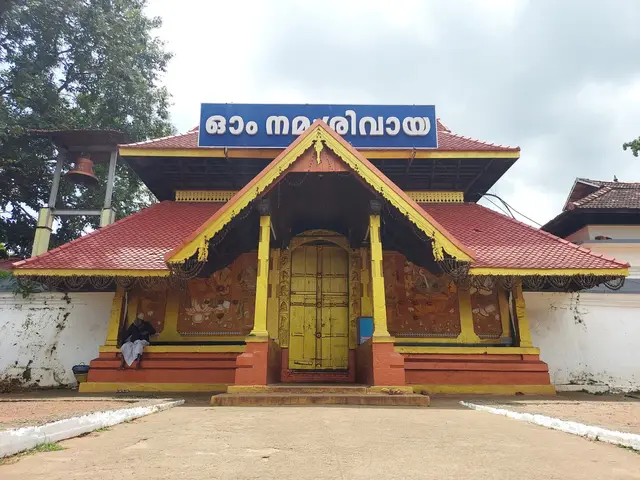
Two refusals, because a page like this should say what it would not print. Malayalam Wikipedia states that Sree Narayana Guru gave his sanction for the Sivagiri pilgrimage at the Nagampadam Sree Mahadeva temple in this town; we could not find a date or a second source for that and we are recording it as a local claim rather than a fact. And searching in Malayalam — കോട്ടയം, ഐതിഹ്യം, ക്ഷേത്രം, തിരുനക്കര, നാഗമ്പടം — turned up no origin legend for the town itself distinct from the temple hill’s own story, which belongs to the Thirunakkara record and is told there. Absence is a claim too, so: that is what we searched, and that is what we did not find.
More about Kottayam town
History
From the ninth century this country was Vempolinad, within the Kulasekhara empire. By 1103 Vempolinad had split into Thekkumkur and Vadakkumkur, the second becoming a vassal of Cochin, and from then on the history of Thekkumkur and the history of Kottayam are effectively the same thing. The Portuguese and the Dutch both traded here for black pepper and other spices, and the market they dealt at was Thazhathangadi on the Meenachil — the reason a river landing, not a hilltop, was the town for most of its life.
The end came from the south. After Marthanda Varma subdued the Dutch East India Company in the Travancore–Dutch war of 1741, his campaigns moved north; Thekkumkur allied with Chembakassery and Vadakkumkur, another account has its ruler siding first with Kayamkulam and then with Ambalappuzha, and when he refused terms after Ambalappuzha fell, his capital was taken on 11 September 1750 by Ramayyan Dalawa, Marthanda Varma’s general and prime minister. Thekkumkur was annexed to Travancore in 1753.
The nineteenth century is the one that made the town. Travancore became a British protectorate; Colonel John Munro, Resident and then Dewan, petitioned for the Orthodox seminary at Kottayam and backed the mission station here, and in 1817 the Church Missionary Society established CMS College — the first Western-style college in Kerala, with Bailey as its first principal, teaching Greek and Latin alongside English, and with the Travancore government glad of a supply of trained administrators. It is conventionally paired with Presidency College, Calcutta, founded the same year, as the two earliest Western-style colleges in India; note that the seminary Bailey lived and taught in from March 1817 was itself already running, which is why the college’s history is sometimes dated a couple of years earlier. In 1838 the college moved to the wooded hillock it still occupies; a Malayalam college magazine began in 1864 under Principal Richard Collins; women were not admitted until 1938.
Rubber arrived last and changed the district’s economy completely. Commercial Hevea planting in India began at Thattekad in 1902; after the Second World War, growers pressed for a permanent body, and the Rubber (Production and Marketing) Act came into force on 18 April 1947, constituting the Indian Rubber Board — renamed the Rubber Board by the 1954 amendment. Its headquarters is in Kottayam, its Rubber Research Institute of India was established in 1955 on a hillock at Puthuppally about eight kilometres east, and rubber is the dominant cash crop of a district that supplies a large share of Kerala’s output, with coconut, banana, pineapple and pepper behind it.
The modern town assembled itself quickly after that. The municipality dates from 1924 and the district from July 1949. Work on the metre-gauge line from Ernakulam to Kollam began on 24 December 1952; the Ernakulam–Kottayam section was completed and formally inaugurated in October 1956, and the line reached Kollam on 6 January 1958. In 1989 Kottayam was declared the first town in India to have achieved 100 per cent literacy, a year before the Ernakulam district campaign and two before the state one. We could not establish the exact date within 1989 or the declaring authority from any source we could reach, so we give the year and the claim as the encyclopaedias give them, and note that “100 per cent” in these campaigns means the target adult cohort was assessed as literate, not that no illiterate person remained: the 2011 municipal figure is about 96 per cent overall, 98 for men and 95 for women.
Why visit
Stand at the C. M. S. Press gate on the wall that reads ESTD. 1821 — this is where printed Malayalam was invented, and it is still a working press.
See Benjamin Bailey’s hand-built wooden press and the bust of him inscribed “the father of Malayalam printing”, both on the same compound.
Walk the CMS College hillock, one of the two oldest Western-style colleges in India, founded the same year as Presidency College, Calcutta.
Use the Kottayam Public Library of 1882 as the town’s reading room, with a Lalithakala Akademi gallery, a small theatre and a Kanayi Kunhiraman sculpture in the yard.
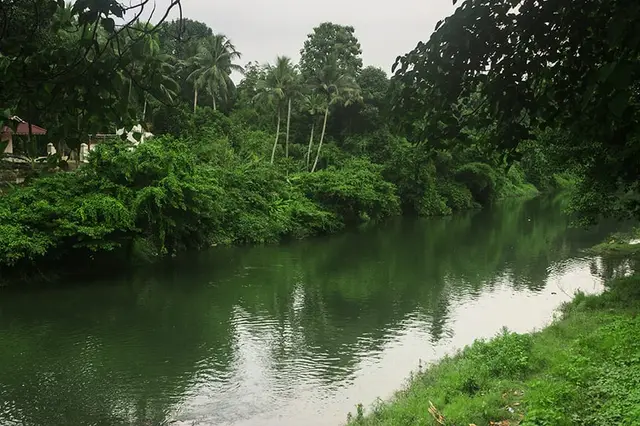
Take the riverside at Thazhathangadi for what Kottayam looked like before 1817, when the market on the Meenachil was the town and Thirunakkara was still forest.
Treat it as the practical base it is — rail at Nagampadam, buses at Thirunakkara, Kumarakom sixteen kilometres west and the Pala highlands east.