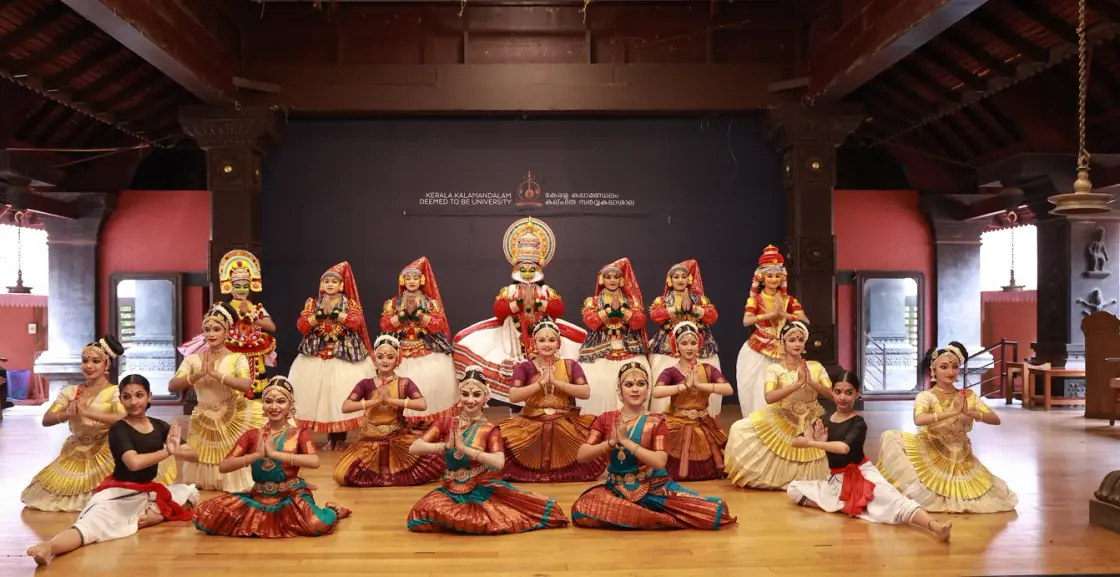
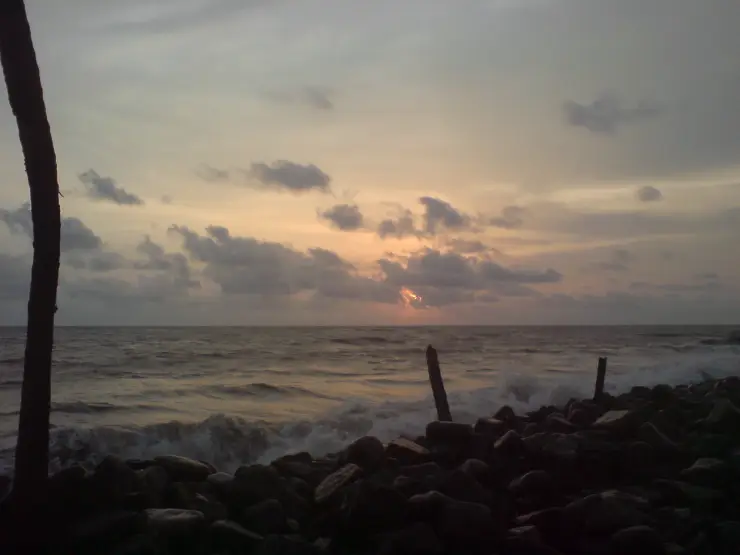
Cheruthuruthy sits on the north bank of the Bharathapuzha in Thalappilly taluk, 32 km from Thrissur, 17 km from Ottapalam and 47 km from Palakkad, with Shoranur Junction barely four kilometres away across the water. Officially the panchayat is Vallatholnagar — the village renamed itself after Vallathol Narayana Menon, the poet who moved his young arts academy here in 1936 and who was cremated in its grounds twenty-two years later. Almost every visitor comes for that academy and leaves again. What they drive past is a river town with a broken bridge standing in the current, a seven-village pooram that ends with a shadow-puppet Ramayana, a Shiva temple whose sanctum is built in the shape of an elephant’s back, and a stretch of the Nila that has been mined so hard it now runs in channels between sand flats.
Approach from the Shoranur side and you cross the Bharathapuzha to get here, which tells you most of what you need to know about the place. Cheruthuruthy is a north-bank village in Thrissur district that faces a railway town in Palakkad district across the water. The river is the district boundary, the bus route, the reason the academy was built here and the reason the village has a station of its own.
That station is called Vallathol Nagar. Its code is VTK, it sits on the Shoranur–Cochin Harbour section between Shoranur Junction and Mullurkara, and it is roughly four rail kilometres from Shoranur — close enough that most long-distance passengers change at the junction and finish the journey by road. The nameboard on the platform is painted in Malayalam, Hindi and English, and the English transliteration on it reads VALLATTOL NAGAR. The panchayat took the name too: the local body is Vallatholnagar Grama Panchayat, in Pazhayannur block, and the post office at Cheruthuruthy carries PIN 679531. Very few Kerala villages have renamed themselves after a writer.
Downstream of the modern road bridge, the old Cochin bridge is still standing in the water, in pieces. It carried traffic between Cheruthuruthy and Shoranur before the present crossing replaced it; today two of its girder spans have dropped off their piers into the river and the deck stops in mid-air. It is not maintained and it is not a monument. In the monsoon the current runs brown and fast between the surviving masonry piers; in February the same channel is a shallow braid between sandbanks, and the ruin is the most photographed thing in the village that is not on the academy campus.
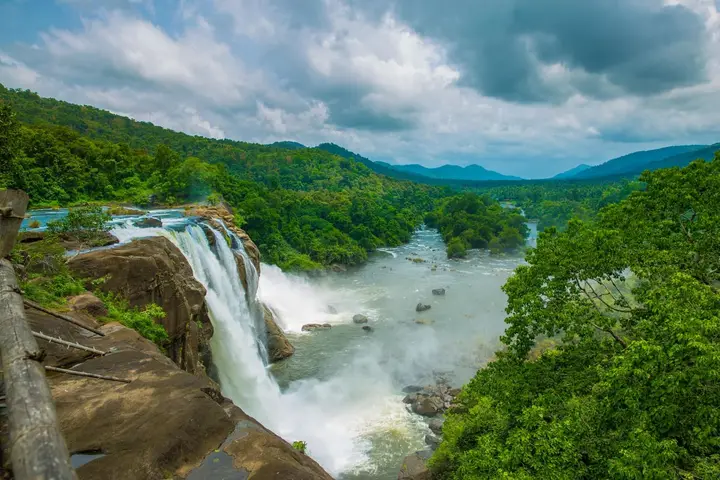
The Bharathapuzha is Kerala’s second-longest river at 209 km, and this is one of the reaches where its condition is impossible to miss. Decades of sand extraction — including, by local accounts, sand taken during construction of the Shoranur–Cheruthuruthy check dam — have stripped the deep sand bed that used to hold water through the dry months. What replaced it is grass, scrub and, in places, vegetable cultivation on the exposed bed. The practical effect for a visitor is simple: a river that once dried in April now begins drying in February, and what you see between February and May is sand with water in it rather than water with sand in it.
The academy itself occupies two sites, and the difference matters if you are trying to find anything. The original campus is the riverside one, the old buildings on the bank of the Nila; the working institution moved to a newer campus built as a Vallathol memorial around the poet’s birth centenary. The two are about two kilometres apart, and Vallathol’s samadhi is beside the old riverside buildings, not the new ones. His former house nearby is now the Vallathol Museum, a tiled, two-storey building set directly on the roadside behind a low laterite wall, with his bust at the gate and his most quoted couplet — the one about the blood quickening at the name of Kerala — set on a plaque at the samadhi itself.
The village’s own institutions are less visited and worth knowing about. Jyothi Engineering College stands at Vettikkattiri within the panchayat; the Poomulli Neelakandan Namboodiripad Memorial Ayurveda Medical College, which began at Shoranur in 2007 and is affiliated to the Kerala University of Health Sciences, is here; and the National Ayurveda Research Institute for Panchakarma at Cheruthuruthy was upgraded and re-inaugurated by the Union AYUSH ministry. For a village of this size that is an unusual concentration of teaching institutions, and it is why the local accommodation and food trade is built around students, parents and visiting scholars rather than around tourists.
Ten kilometres east, in Panjal panchayat, is Killimangalam, where kora grass is still woven into pulppaya floor mats. The grass is split, the white pith cut out with a knife, the outer sheath soaked and sun-dried, and the mats woven on frame looms at a small co-operative society. The craft was historically the work of the Kurava community; today it is kept going by about eight women, none of whom are from that community, buying grass from Chittur at around ₹300 a kilo and earning roughly ₹5,000 a month for mats that sell for ₹2,350 to ₹9,000. The mats hold a UNESCO Seal of Excellence, awarded in 2004. The society is a working co-operative, not a visitor centre — treat a visit as a request, not a right.
Panjal, the same panchayat, is where the Agnicayana or Athirathram — a Vedic fire ritual with a bird-shaped altar, among the oldest continuously performed rituals anywhere — was staged in April 1975 and again in 2011. The 1975 performance ran from the 12th to the 24th, was organised with the Dutch Sanskritist Frits Staal and funded by Harvard, the Smithsonian and the Rock Foundation, and produced both the two-volume study Agni and the film Altar of Fire. Panjal is also one of the seven villages that walk their processions into Cheruthuruthy for the Kozhimamparambu pooram, which is the point: the ritual life here is a neighbourhood, not a set of separate attractions.
So the honest shape of a day at Cheruthuruthy is this. The academy is the anchor and is best treated as a fixed appointment. Around it there is a broken bridge over a diminished river, a poet’s grave and house, a Shiva temple with an elephant-backed sanctum two kilometres west, a mat-weaving society ten kilometres east, and — if your dates land in Meenam — one of the larger poorams in Thalappilly taluk taking over the road. None of that needs a ticket.
Legend & myth
The ritual that gives Cheruthuruthy its strongest claim on Kerala’s mythology is not danced. It is projected. At the Kozhimamparambu Bhagavathi temple the annual pooram closes with tholpavakoothu, the leather shadow-puppet Ramayana of the Nila valley, and with the Sree Rama Pattabhishekam — Rama’s coronation — performed on the final morning. Tholpavakoothu survives in a narrow belt: the Ottapalam, Mannarkkad, Alathur and Palakkad taluks of Palakkad district, Ponnani taluk in Malappuram, and Thalappilly taluk in Thrissur, which is this taluk. Cheruthuruthy is inside the last of those, and the koothu here is a temple obligation rather than a performance booked for an audience.
The legend behind it is specific and it explains why the form is confined to goddess temples. Darika, an asura, had become intolerable to gods, sages and men alike, and Shiva created Bhadrakali out of the kalakuta poison held in his own throat to destroy him. The war between Kali and Darika was long, and it was fought — so the story goes — at exactly the same time as the war between Rama and Ravana. Kali therefore killed Darika but missed Ravana’s death entirely. The annual shadow play in her temples exists to make that good: the Ramayana is performed for the goddess, so that she sees what she was too busy to watch.
There is a second and stranger explanation for the same restriction, and it is worth printing because it points the other way. When Hanuman struck Lankalakshmi, the guardian of Lanka, she fled the city, and a crowd of kooli spirits fled with her. Some of them reached Kerala and settled here as bhagavathis. The Ravana-vadham is played out in the kavus, on this account, so that those exiles can watch the fall of the city they escaped from. One version has the goddess owed a debt; the other has her keeping company with refugees. Both end with the same puppets on the same screen.
The physical arrangement carries the theology. The koothumadam — the permanent puppet-house every temple that hosts the form must have — is set facing south. A long screen is hung, white above and black below, and the deer-skin puppets are pinned to the white with karamullu thorns, a thorn sharp and strong enough to hold hide. Lamps are lit behind the screen and each puppet is worked from below by a rod. Bhadrakali is understood to be present in the middle of the madam, watching; Rama and his people stand to her right, Ravana and his to her left. The verses chanted are from the Tamil Kamba Ramayanam, because when the form was set down Kamban was what Ramayana meant in Kerala — Ezhuthachan’s Malayalam version had not yet displaced it. The performers are called Pulavar, from the Tamil for scholar.
The full cycle is not a single night. Performed from Sree Rama avataram, the birth of Rama, it takes forty-one days, and by tradition may be begun that way only at Kavalappara Ariyankavu; from the entry into Panchavati it takes twenty-one days; from the building of the bridge to Lanka, eleven or twelve. Anywhere may perform up to the Pattabhishekam, which is why that coronation is what closes the Cheruthuruthy pooram at first light.
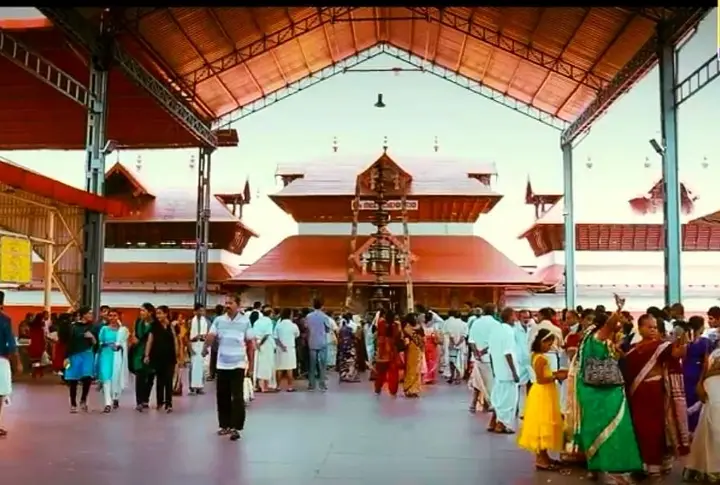
The pooram itself is a seven-village affair. Panjal, Puthussery, Nedumpura, Cheruthuruthy, Pallikkal, Thazhapra–Vettikkattiri and Aattoor each bring their own procession in; the arrival of the Panjal Ayyappan temple contingent opens proceedings, drums sound from around five in the morning, and the evening ends with a mass caparisoned-elephant display — twenty-nine elephants in the 2023 pooram. Between the processions come poothan and thira, kalavela, komarams, and the Pakkanar velas. The festival does not end with the elephants: it ends the following morning, after the coronation puppet play, when the Pakkanar komaram gives the kalpana, the ritual command, and the crowd disperses on his word.
That last detail invites an error that this record refuses. Pakkanar is the second of the twelve children of Vararuchi and Panchami in the Parayi Petta Panthirukulam, the great foundation legend of this river valley — a Brahmin astrologer of Vikramaditya’s court, a Paraya woman, twelve children given away to twelve castes. The legend belongs to the Nila, and families claiming descent live at Shoranur, Pattambi and Thrithala, all within an hour. But Pakkanar’s own shrine, the Erattingal Pakkanar temple, is at the Paraya colony near Kumbidi junction in Thrithala panchayat, in Palakkad district. It is not at Cheruthuruthy. What Cheruthuruthy has is the vela and the komaram who speaks for him — a ritual role, honoured here, in a story whose address is elsewhere.
One absence is worth stating plainly, with the search behind it. The Nedumpura Kulasekharanellur Shiva temple two kilometres west of the village is counted among Kerala’s 108 Shiva temples, the set traditionally ascribed to Parasurama, and its lingam is described as swayambhu, self-manifested. Beyond that we could not source a sthala purana for it. We searched in English and in Malayalam — ക്ഷേത്രം, ഐതിഹ്യം, കുലശേഖരനെല്ലൂർ, നെടുമ്പുര — across Kerala Tourism’s own temple page, shaivam.org, the Malayalam and English Wikipedias and Malayalam devotional sites, and found architecture and deity lists but no origin story. That is a gap in the record, not a statement that the temple has none.
More about Cheruthuruthy
History
The oldest layer of history around Cheruthuruthy is administrative, and it comes with a trap in the name. Nedumpuraiyur was one of the nadus of the Chera Perumal kingdom of Mahodayapuram, and its headquarters temple, Nedumpuram Thali, yielded a set of vattezhuthu inscriptions naming successive governors of the nadu — Manalmanrathu Yaakan Kota in the seventeenth year of Indu Kota, Kota Ravi in the twenty-first year of Bhaskara Ravi, and others. One inscription is dated to the seventeenth year of Kulasekhara Perumal Kotha Ravi, which scholars place at either AD 900 or AD 934; the temple’s inscriptions as a group are read as tenth to twelfth century. That temple, Thirumathaliyappan, is at Thichur in Varavur panchayat near Wadakkanchery — the same Thalappilly taluk, but roughly fifteen kilometres from here. It is not the Nedumpura Kulasekharanellur temple at Cheruthuruthy, despite both carrying the words Nedumpura and Kulasekhara. Nothing we could source attaches the Chera inscriptions to the Cheruthuruthy temple, and this record does not.
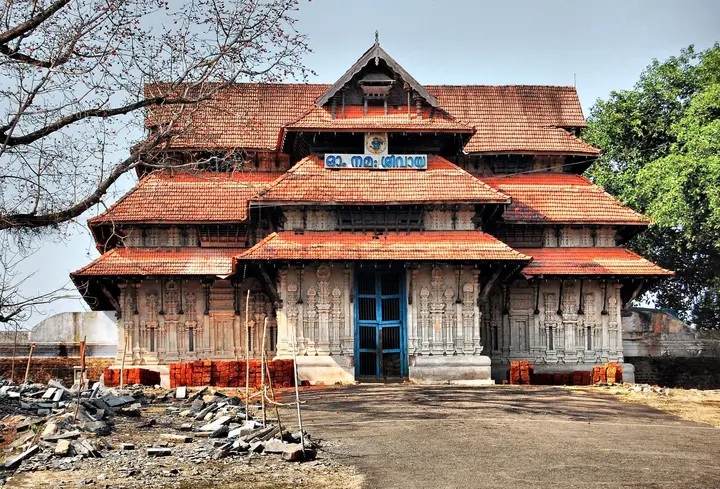
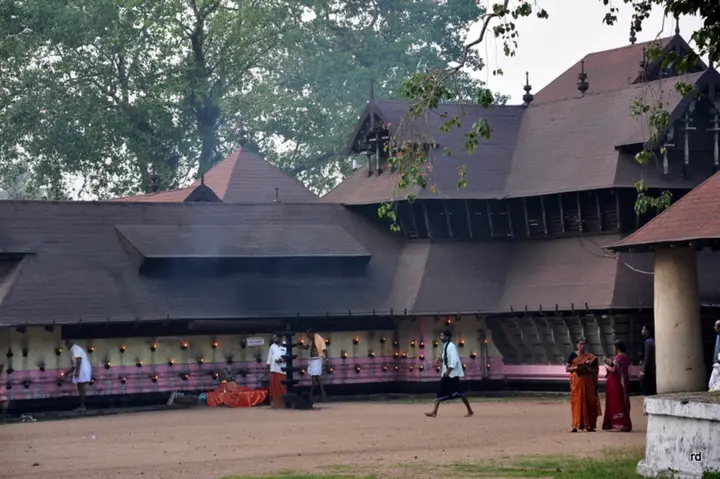
The Cheruthuruthy temple’s own distinction is architectural rather than epigraphic. Its sreekovil is built as a gajaprishtam — an apsidal plan, described locally as the back of an elephant — carried on a two-storey superstructure with a copper-clad roof and a carved wooden gable, and its subsidiary deities are Krishna, Ganesha and Sastha. Maha Shivaratri is its principal festival. It stands about two kilometres west of the Cheruthuruthy school, at roughly 10.7347°N, 76.2614°E.
The modern history of the village begins in 1927, when Vallathol Narayana Menon and Manakkulam Mukunda Raja formed a society to rescue Kathakali, Koodiyattam and Mohiniyattam from collapse, and raised money by public subscription and a lottery. The school opened on 9 November 1930 — not at Cheruthuruthy but at Kunnamkulam, in a house variously named in the sources as Kakkad house and Madappattil, under the patronage of the Kakkad Karanavappad. Within about six months it moved to Ambalappuram near Mulakunnathukavu. Only in 1936 did it reach Cheruthuruthy, onto a plot and building on the bank of the Bharathapuzha given by the Maharaja of Cochin. That gift is the reason this village, rather than Kunnamkulam, is the address of Kerala’s classical arts.
What followed was a slow transfer from private hands to the state. The Kerala government took over administration in 1957; in 1962 the institution was reconstituted as the state’s arts academy; the institution’s own account records grant-in-aid status from 1975 and the addition of formal schooling from Standard 8 in 1990; and in 2006 the Government of India conferred deemed-to-be-university status for art and culture, with the UGC assigning ‘A’ category in 2010. Four Prime Ministers have visited the campus — Jawaharlal Nehru in 1955, Indira Gandhi in 1980, V. P. Singh in 1990 and Manmohan Singh in 2012 — which is a fair measure of how the place was regarded through the second half of the twentieth century.
Vallathol himself was not from here. He was born on 16 October 1878 at Chennara near Tirur, in what is now Malappuram district, studied Sanskrit under his uncle Ramunni Menon and logic under Kaikkulangara Rama Warrier, and completed a Malayalam translation of the Valmiki Ramayana between 1905 and 1907 — the work that earned him the name Kerala Valmiki. An illness left him completely deaf; Malayalam Wikipedia dates this to 1908 and the English article to 1909, and the sources disagree. He wrote Badhira Vilapam, the lament of the deaf man, out of it. He took part in the Madras and Calcutta sessions of the Indian National Congress in 1927 and 1928, wrote Ente Gurunathan about Gandhi and Bapuji on his death, and received the Padma Bhushan in 1954.
He died on 13 March 1958, aged 79, at his son’s house in Ernakulam, and his body was brought back and cremated with full state honours inside the Kalamandalam grounds at Cheruthuruthy. The samadhi is a low black granite platform under trees, chain-linked at the corners, on the old riverside campus. The village’s renaming as Vallathol Nagar, the museum in his former house and the name on the railway board all follow from that grave.
Why visit
The old Cochin bridge lies broken in the Bharathapuzha within walking distance of the village centre — a genuine ruin, unfenced and unlabelled, and the best single view of the river here.
Vallathol’s samadhi and his former house, now the Vallathol Museum, are both in the village and are free to look at from the road.
The Nedumpura Kulasekharanellur Shiva temple, two kilometres west, has an apsidal gajaprishtam sanctum under a copper roof — an uncommon plan and easy to photograph from outside.
If your dates fall in Meenam, the Kozhimamparambu pooram brings seven villages, poothan and thira, kalavela and up to twenty-nine elephants onto one ground, and closes at dawn with a shadow-puppet Ramayana.
Killimangalam, ten kilometres east, still weaves kora-grass pulppaya mats that carry a UNESCO Seal of Excellence, at a co-operative kept alive by about eight weavers.
Shoranur Junction is four kilometres away, which makes Cheruthuruthy one of the easiest arts stops in Kerala to reach without a car.