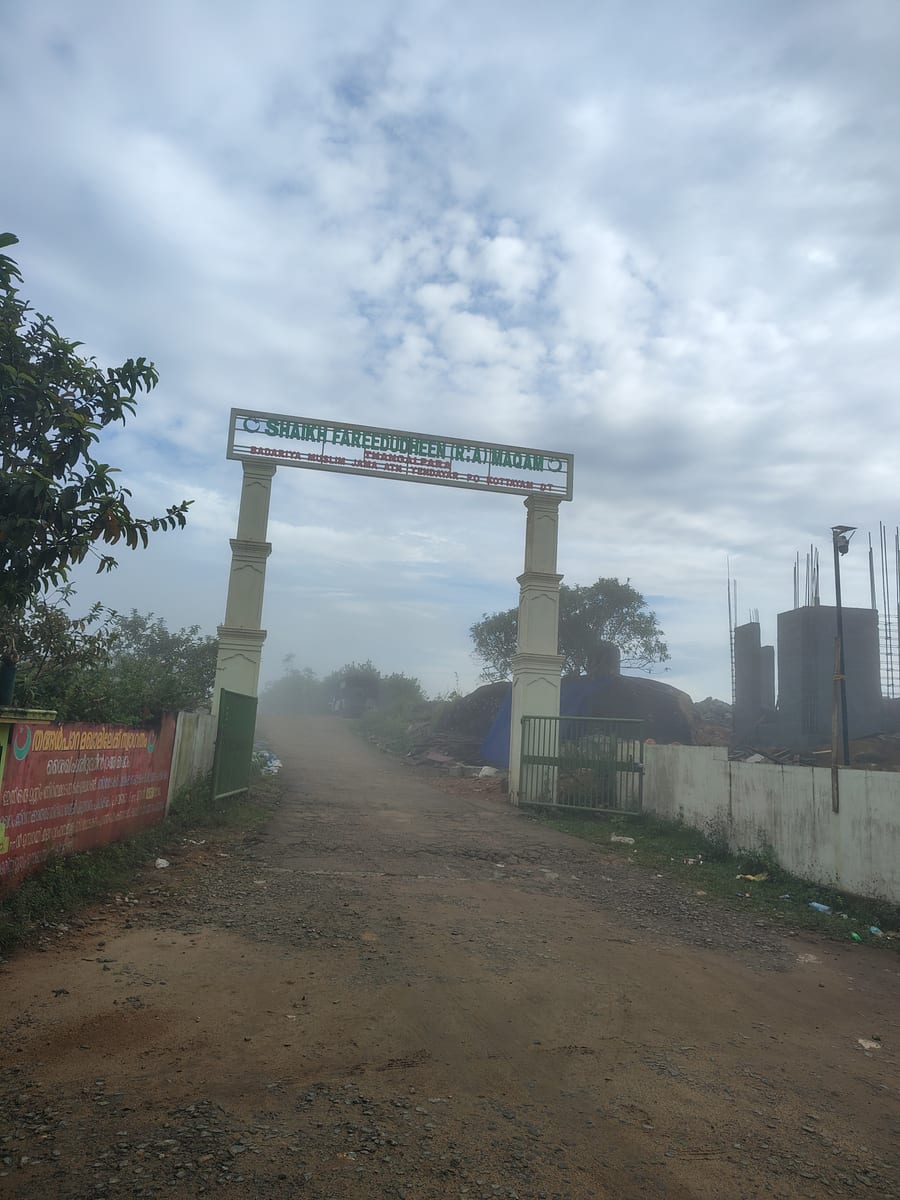
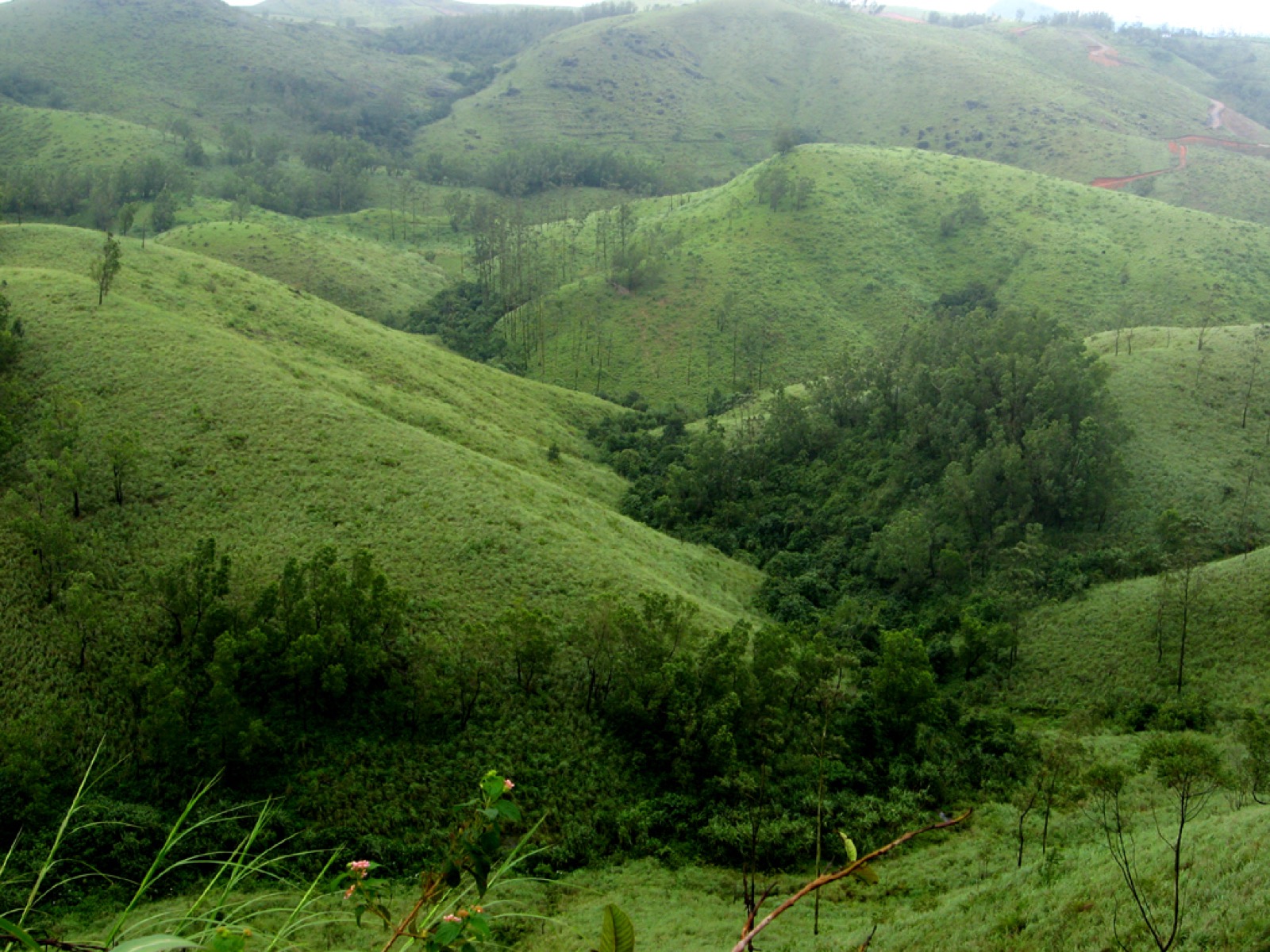
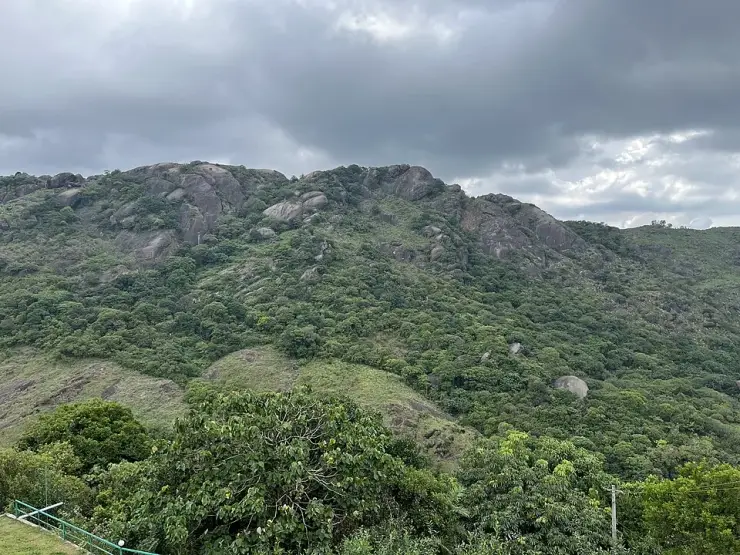
One name, two places, and almost everything written about Kurisumala runs them together. There is a bare rock dome you climb on foot past fourteen crosses to a parish church at the top — and there is a Cistercian monastery founded in 1958, eight hundred metres away, lower down, on a different road, run by different people. This page keeps them apart, because turning up at the wrong one is the commonest mistake made here.
The story of Kurisumala
Begin at the bottom, where a signboard settles the only question most people actually have. It stands on the open ground where the cars stop, it is headed വാഗമൺ കുരിശുമല / VAGAMON KURISUMALA, and along its foot it reads, in Malayalam and English: മലമുകളിലേയ്ക്കുള്ള ദൂരം – 1200 മീറ്റർ. DISTANCE TO KURISUMALA TOP - 1200 Mtr. That is the walk. Measured independently against the mapped footway, which is named “Kurishumala Way of the Cross” and runs from beside the car park to the church door, it comes out at 1,133 metres; routed as a walk it comes out at 1,160 metres and about fourteen minutes of moving time. Three figures, arrived at three ways, inside six per cent of each other. Call it a kilometre and a fifth, and add time for stopping, because stopping is the point.
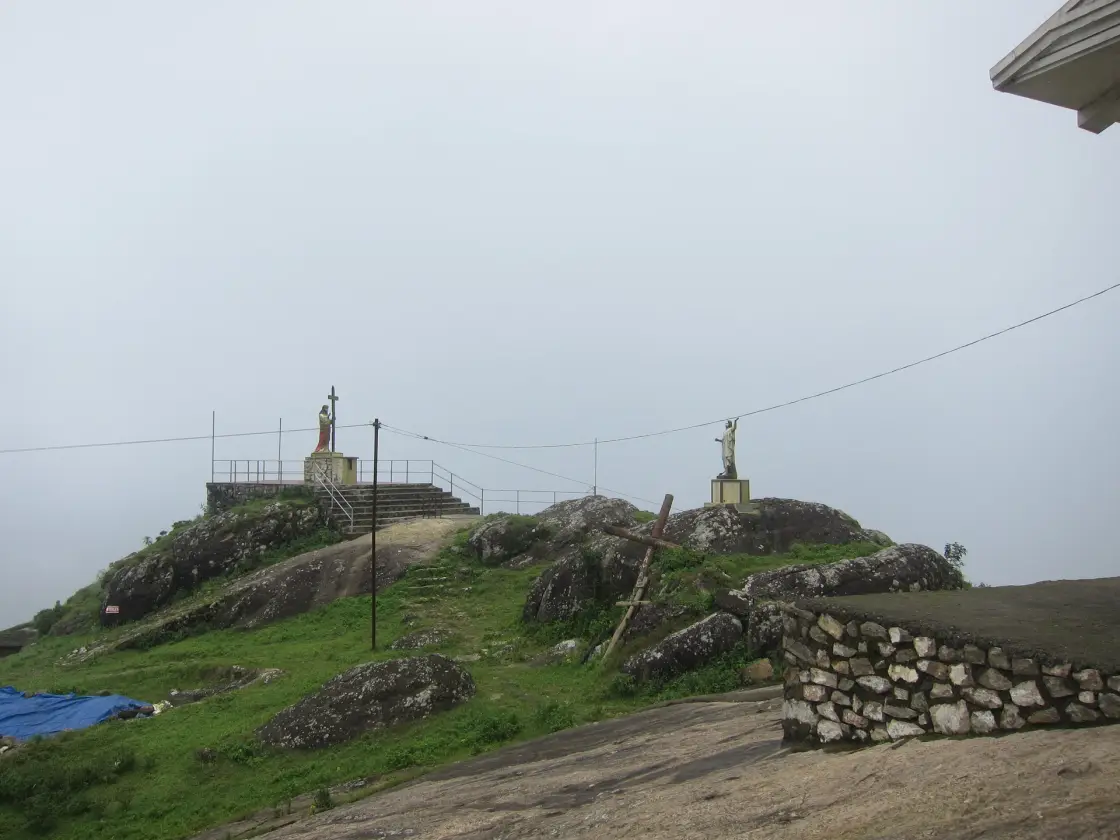
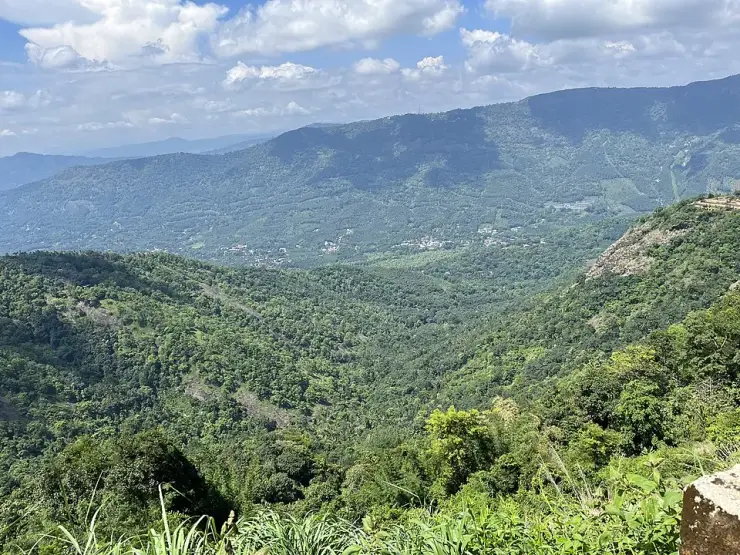
The climb itself is about a hundred and fifty metres of ascent — the car park sits at roughly 1,020 to 1,035 metres and the summit at 1,172 to 1,187, depending on which elevation model you ask, and two independent ones agree closely. That is a gentle number on paper and a steeper thing underfoot, because the last stretch is bare rock. The photographs on the signboard show what the hill looks like when it is full: a dense white river of people, thousands of them, moving up the dome towards the cross on the crest. Fourteen stations line the way, and in Holy Week people carry wooden crosses up them. The rest of the year it is a quiet walk with a very large view.
At the top there are three things. There is the church — St Thomas Church, Kurisumala, according to the board on its own gable, a plain building with a painted crucifixion behind the altar, a wooden canopy, and stacking chairs. There is a summit cross with a life-size corpus and figures of Mary and John standing on the rock beside it, which in cloud is the image everyone comes away with. And there is a low flat-roofed building whose sign, in both languages, marks it as the Kurisumala office and says that mass stipends and other donations are accepted there, with a phone number for the vicar and another for the assistant vicar. That last detail is the one that tells you who runs this hill: a vicar and an assistant vicar. A parish.
Now the other place. Kurisumala Ashram — formally the Monastery of Our Lady of Kurisumala, Vagamon — is 818 metres north of the summit church and about a hundred and forty-five metres below it. It is not on the pilgrim path and you do not reach it by climbing. Its own directions, published by the monks, send you to Vazhikkadavu bus stop on the Erattupetta–Peermade road and then up its own road: “The Ashram is located 1.5 Km. from Vazhikkadavu Bus Stop. It is about a 20-minute uphill walk from the bus stop to the Ashram,” with the suggestion that anyone who would rather not walk should stay on the bus to Vagamon and take a taxi. The District Tourism Promotion Council, describing the pilgrim hill, puts it plainly the same way: the monastery is at the foothills. Two destinations, two approaches, two sets of people in charge — and one name doing the work of both.
The monastery is a working enclosure, not an attraction, and its day starts at 03:45 with the night vigil. Its own timetable runs Lectio Divina at five, the Bharatiya Pooja at six — the Syro-Malankara Qurbana instead on Sundays — two spells of what it calls Bread Labour, evening prayer at half past six, satsang at eight and compline at half past. Guests are received; the tradition it belongs to treats hospitality as an obligation, and it keeps buildings for male and female guests and hermitages for people who want more solitude. Those who stay are expected to join in — “Ashram seva,” household chores, vegetable-cutting. The church is open round the clock. None of that is a tour, and it is worth understanding before you arrive expecting one.
One more thing to get straight, because two official bodies disagree about it. Kerala Tourism publishes Kurisumala as a Kottayam destination; the District Tourism Promotion Council of Idukki publishes it as one of its own. Tested against the mapped district boundary, the hill, the church, the office, the car park and the monastery are all in Kottayam district, in Meenachil taluk — and so says the monastery’s own letterhead, which gives its address as Vagamon P.O. 685 503, Kottayam Dt. Vagamon town, two kilometres east, is in Idukki. The border runs between the town and the hill. Both bodies are describing something real; the postal address is on the Kottayam side and the tourism circuit is on the Idukki one.
Legend & myth
The name is the plainest in Kerala and the most confusing. Kurisumala is kurisu, cross, and mala, hill: the hill of the cross. It is a description rather than a title, which is why there are several of them, and why searching for the name alone will hand you the wrong mountain. Malayalam Wikipedia’s article headed കുരിശുമല is not about this place at all — it describes തെക്കൻ കുരിശുമല, the southern Kurisumala, the official pilgrimage centre of the Latin diocese of Neyyattinkara, on a hill near Vellarada in Thiruvananthapuram district, more than two hundred kilometres south. A third, ഏലപ്പീടിക കുരിശുമല, stands near Peravoor in Kannur district under the diocese of Mananthavady, eight kilometres from Peravoor. Three hills of the cross, three dioceses, three different corners of the state. Figures quoted for one of them — an altitude, a pilgrimage date, a diocese — travel very easily onto the others.
The District Tourism Promotion Council records an older name for this hill: Kondaketty Mala, which it says the place was called before the cross gave it the one it has now. We have found that name published by no other body, and we print it as DTPC’s, not as settled.
The dedication is to St Thomas, the apostle whom Kerala’s Christians hold to have come to the Malabar coast, and the summit is captioned on Wikimedia Commons — in Malayalam, by the photographer who made the fullest record of it — as സെന്റ് തോമസ് മൗണ്ട്, St Thomas Mount. The board on the church at the foot of the hill says the same in English: ST. THOMAS CHURCH, KURISUMALA. English-language travel writing about this place almost never mentions the dedication, and several sites hand it to the wrong rite altogether by borrowing the monastery’s Syro-Malankara identity for the parish on the summit.
Read the full history of Kurisumala 433 more words
History
March 21, 1958 — Kurisumala Ashram is established near Vagamon. Its founder is Fr Francis Acharya, born John Mahieu in Belgium on 17 January 1912, the fifth son of a farmer, who by his own community’s account was turned towards India by hearing Gandhi speak while a student in London. He entered the Trappist monastery of Our Lady of Scourmont at Chimay, served as its novice-master, and sailed for India in 1955. With him at the founding is Fr Bede Griffiths, the English Benedictine, born 17 December 1906. They come at the invitation of Zacharias Mar Athanasios, Bishop of the Syro-Malankara diocese of Tiruvalla, who had signed the constitution establishing a contemplative monastery sui iuris in the Syro-Malankara Catholic Church on 3 November 1957. Everything in this paragraph is the monastery’s own published account of itself.
November 1956 — before Kurisumala there is Pushpagiri. The two monks first gather a small community at Tiruvalla under the same bishop, more than a year before the move to the mountain. This step is left out of nearly every description of the founding.
September 14, 1958 — the ashram church is consecrated and the first three novices are clothed in the monastic habit. The community grows to fifteen within three years. The monks terrace the slope, build stone barriers against erosion, plant, and raise a herd of cattle from scratch; the dairy becomes the thing that pays for the monastery and, in its own words, buys milk at a good price from almost a hundred families settled nearby, some of them on land the community gave them.
August 28, 1968 — Bede Griffiths leaves Kurisumala to take charge of Shantivanam in Tamil Nadu. He had been here ten years. Accounts that have him arriving and “soon” departing compress a decade into an aside. The same year, on 6 August, Francis Acharya becomes an Indian citizen.
July 9, 1998 — Kurisumala is formally incorporated into the Order of Cistercians of the Strict Observance with the status of an autonomous abbey, and Tarrawarra Abbey in Australia adopts it as a daughter house. Francis Acharya is blessed as abbot on 14 October 1999 and dies on 31 January 2002, aged ninety. Fr Yesudas is blessed as the second abbot on 20 March 2002 and Fr Ishanand as the third on 7 April 2014.
The monastery’s scholarly output is part of its history and is easy to miss: Francis Acharya’s four-volume Prayer with the Harp of the Spirit, translated from Syriac, and a Malayalam translation of the Philokalia produced as an inter-religious and inter-denominational effort, now in its third edition.