A delta town of narrow streets and stacked gopurams, built round a tank that fills with pilgrims once in about twelve years and sits quiet for the rest of them.
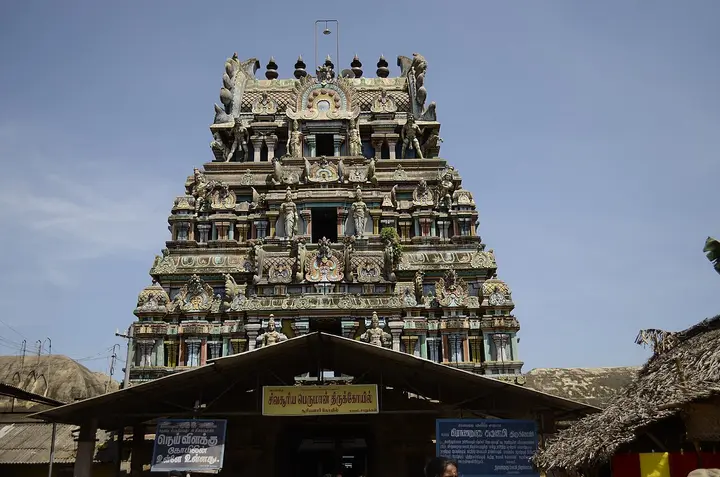
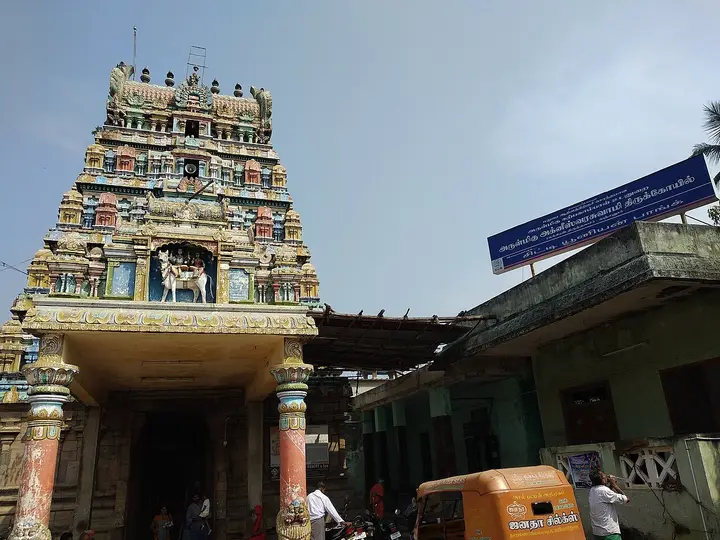
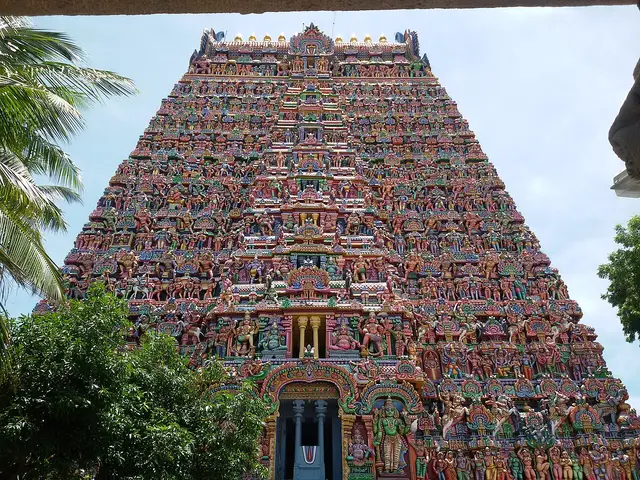
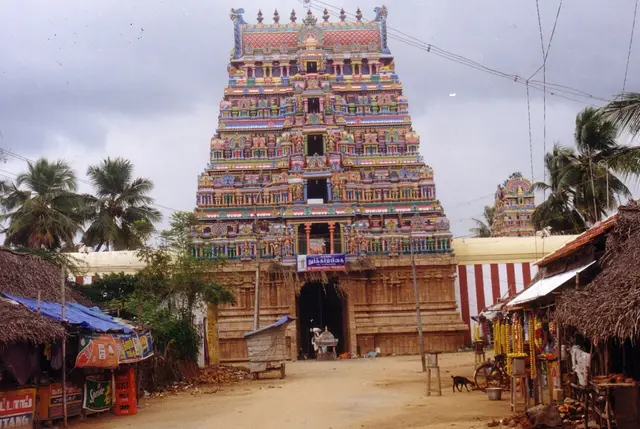
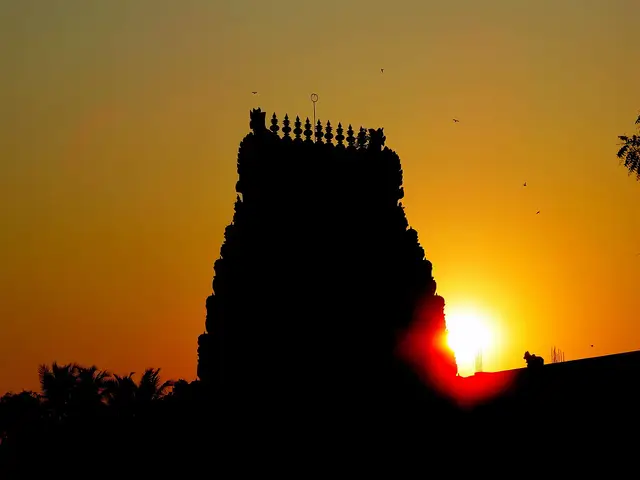
Kumbakonam is a town you arrive inside rather than approach. There is no skyline to see it by: the Cauvery country is flat, the roads in run between paddy and coconut, and the first thing that tells you the town has begun is that the streets narrow and the traffic thickens. Then you notice the towers. They come up over the rooftops in ones and twos — painted, tiered, crowded with figures — and once you have seen three of them you understand the shape of the place. About 140,156 people (2011 census) live across 42.95 square kilometres at 53 metres above sea level, between the Cauvery on one side and the Arasalar on the other, and the temples are not set apart from that. They are on the shopping streets, between the lodges and the silk showrooms, with autos parked against their walls.
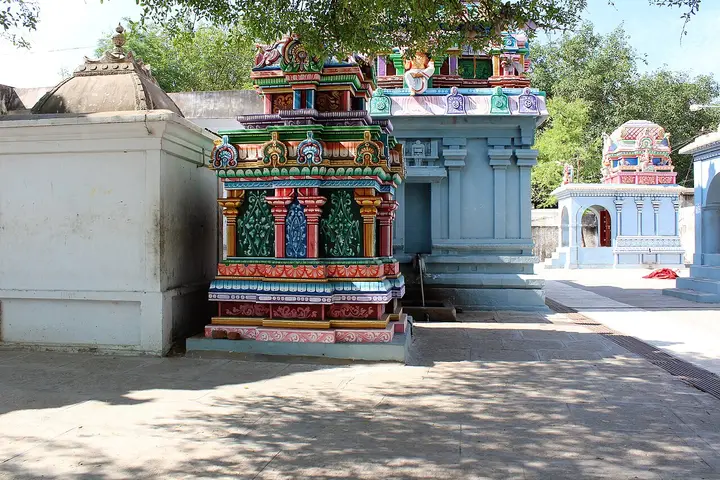
The centre of it is not a temple but a tank. The Mahamaham tank covers about 21 acres, is trapezoidal rather than square, and is ringed by sixteen small mandapams built by Govinda Dikshitar, chieftain to the Thanjavur Nayak ruler Ragunatha. Twenty-one wells are sunk inside the tank itself, named for deities and for rivers — Ganges, Yamuna, Godavari, Narmada, Saraswathi, Cauvery among them — with a central one called the sixty-six-crore theertham held to be the most sacred of all. On an ordinary morning it is a broad sheet of green water with a few people on the steps, a gopuram behind the far bank, and the well-heads standing out of the surface like small stone islands. It looks like municipal infrastructure with a long memory, which is roughly what it is.
Once in about twelve years it stops looking like that. When Jupiter enters Leo and the Magha star meets the full moon of the Tamil month of Masi, the Mahamaham falls, and the belief is that on that day the sacred rivers of India come to the tank to wash away what they have absorbed from everyone else. Then the water disappears entirely under people. The oldest photograph we can show you of it was published by the National Geographic Society in 1909 and it is the clearest possible statement of scale: no water visible, the mandapams islanded in a solid field of heads, the ghats packed to the top step. The last Mahamaham ran in February 2016; the next is due in 2028.
That density has a history the town does not hide. On 18 February 1992, during the main bathing day, a crush around the tank killed about fifty pilgrims and injured scores more; reported tolls vary between forty-seven and fifty, and the crowd that day is usually estimated in the millions. Arrangements have been reworked since — including sprinkling the sanctified water over the crowd so that not everyone needs to get down to the steps — but if you are planning to be here in 2028 it is worth knowing that this is a mass-gathering event in a town built for a fraction of it.
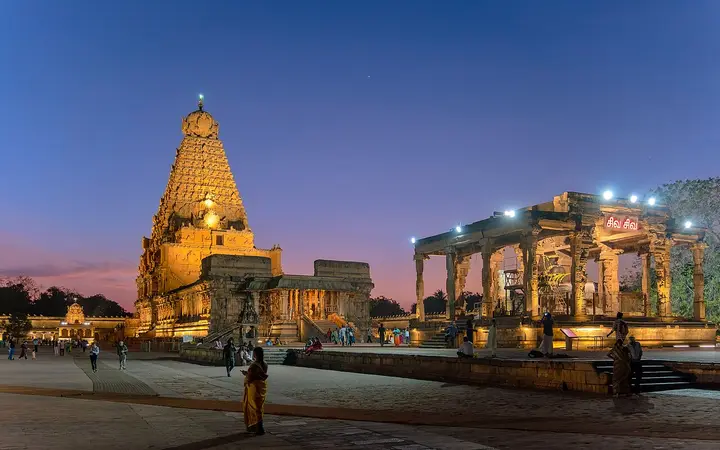
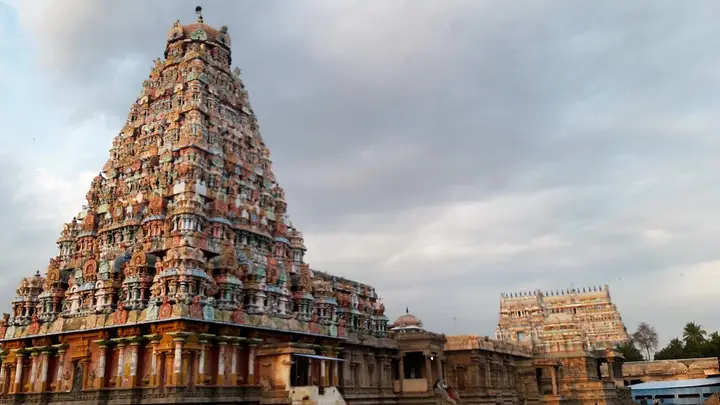
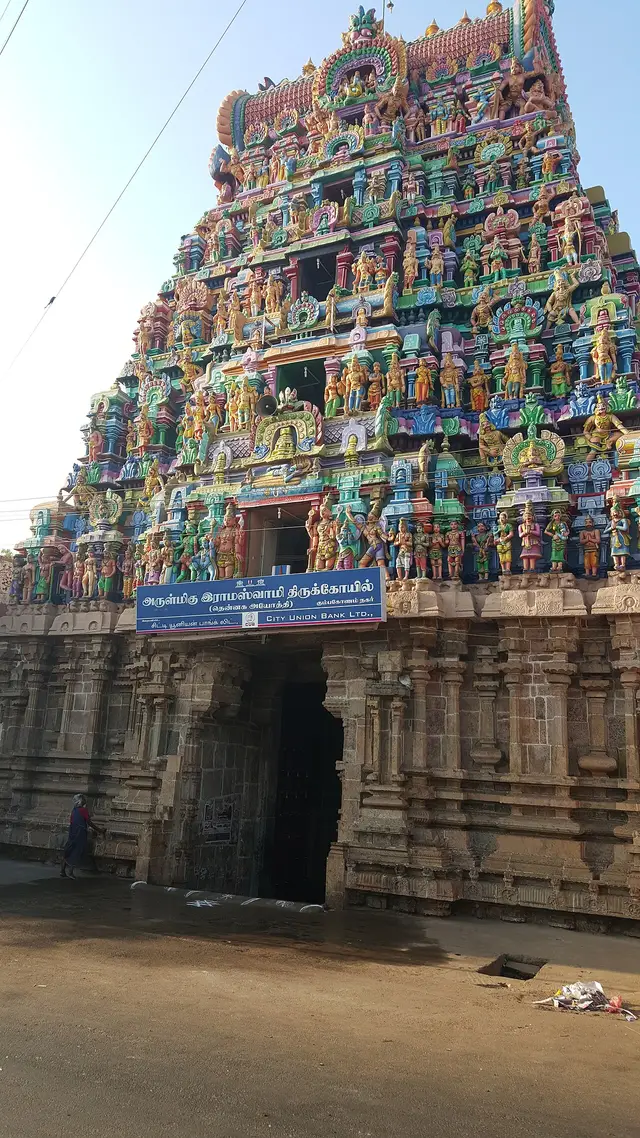
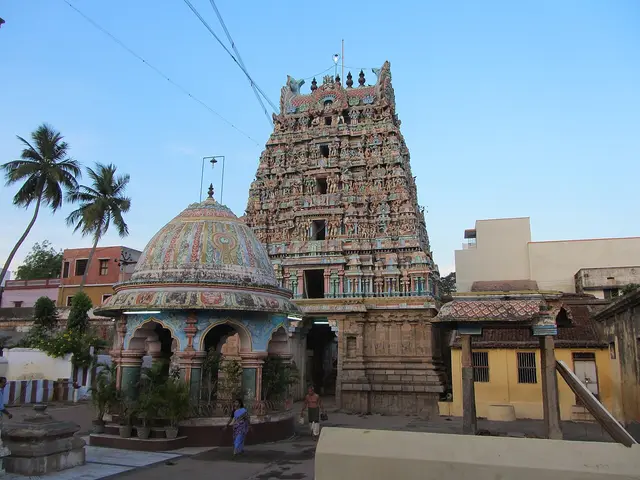
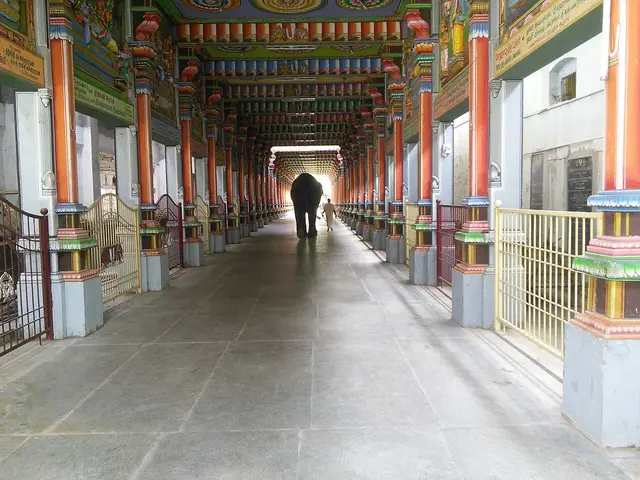
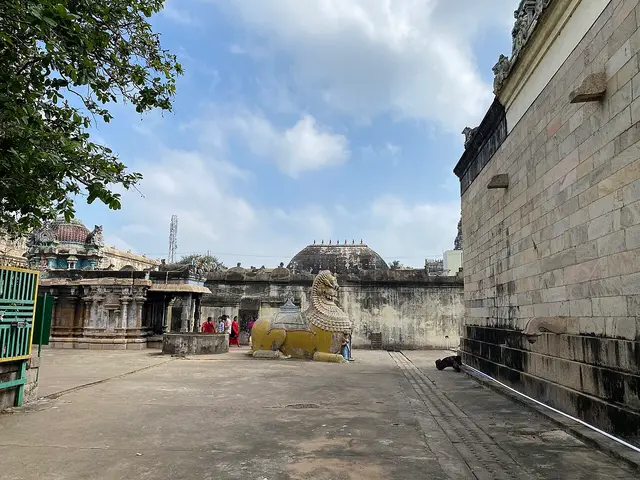
For the rest of the twelve years the town belongs to its own temples, and the practical fact about them is that they are walkable. Adi Kumbeswarar, Sarangapani, Ramaswamy, Chakrapani and Nageswaran all stand within a short grid of streets, and the railway station is 800 metres from the tank. Adi Kumbeswarar is the town’s namesake — about four acres in the middle of the streets, an eastern gopuram of eleven storeys and 128 feet, six rituals a day, and a lingam that tradition says Shiva shaped himself out of sand and spilled nectar. Sarangapani is the Vaishnavite counterweight, a Divya Desam sung by the Alvars, its gopuram eleven tiers and 173 feet, and its sanctum built as a stone chariot with two doors: the Uttarayana door open from 15 January to 15 July, the Dakshinayana door for the other half of the year. Which one you walk through is decided by your calendar, not your choice.
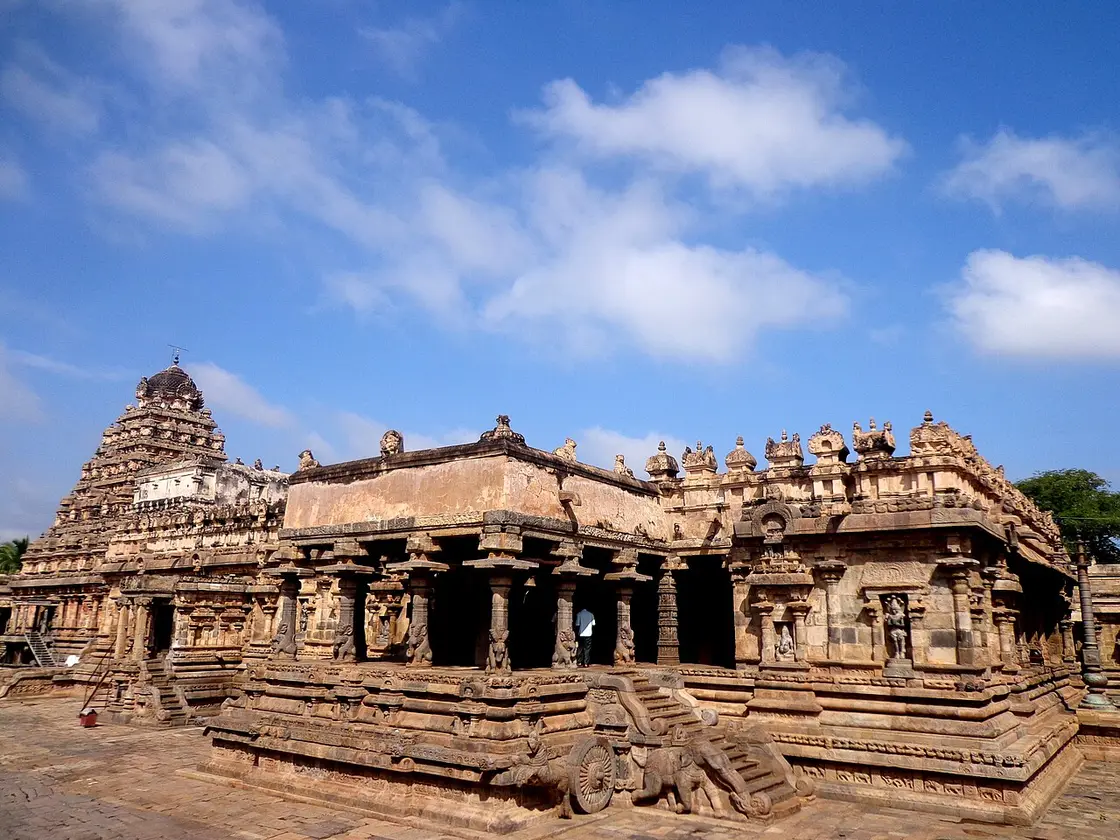
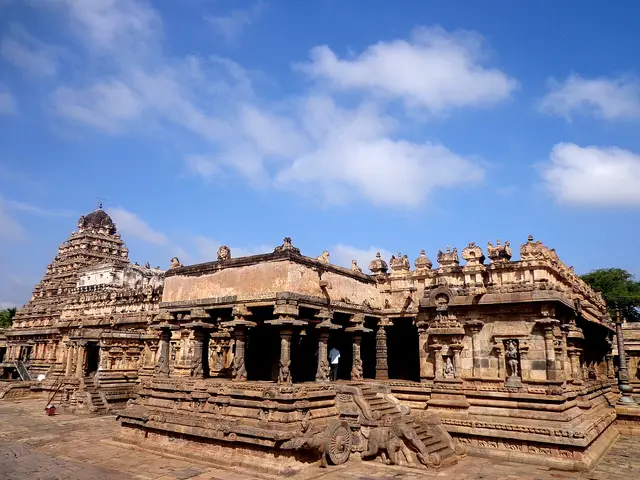
Outside the town the temples keep going, and this is the real argument for staying here. Darasuram and the Airavatesvara Temple are 4.0 km away by road — Rajaraja II’s temple, completed in 1166, inscribed by UNESCO in 2004 as one of the Great Living Chola Temples, with a mandapa cut in the shape of a chariot and carved steps that are said to sound. Thirunageswaram is 6.5 km, Patteeswaram 7.0, Oppiliappan 7.1, Swamimalai 7.8, Thiruvidaimarudur 9.5, and Gangaikonda Cholapuram 35.1. Thanjavur, which most visitors treat as the base for all of this, is 40.4 km and about forty-three minutes away — which is to say it is the day trip, not the centre.
And then there is the other Kumbakonam, the one that has nothing to do with temples. Government Arts College was founded here in 1867 and affiliated to Madras University in 1877, and the town became a centre of both Sanskrit learning and English education at the same time, which is where the old nickname the Cambridge of South India comes from. Porter Town Hall on the main road carries the name of William Archer Porter, the college’s first principal. And on Sarangapani Sannidhi Street, a few minutes from the temple that gives the street its name, there is a small tiled house with a raised tinnai where Srinivasa Ramanujan grew up. He went to Town Higher Secondary School here and on to the Arts College, and failed out of it. SASTRA owns the house now; A. P. J. Abdul Kalam dedicated it as a monument on 20 December 2003 and entry is free.
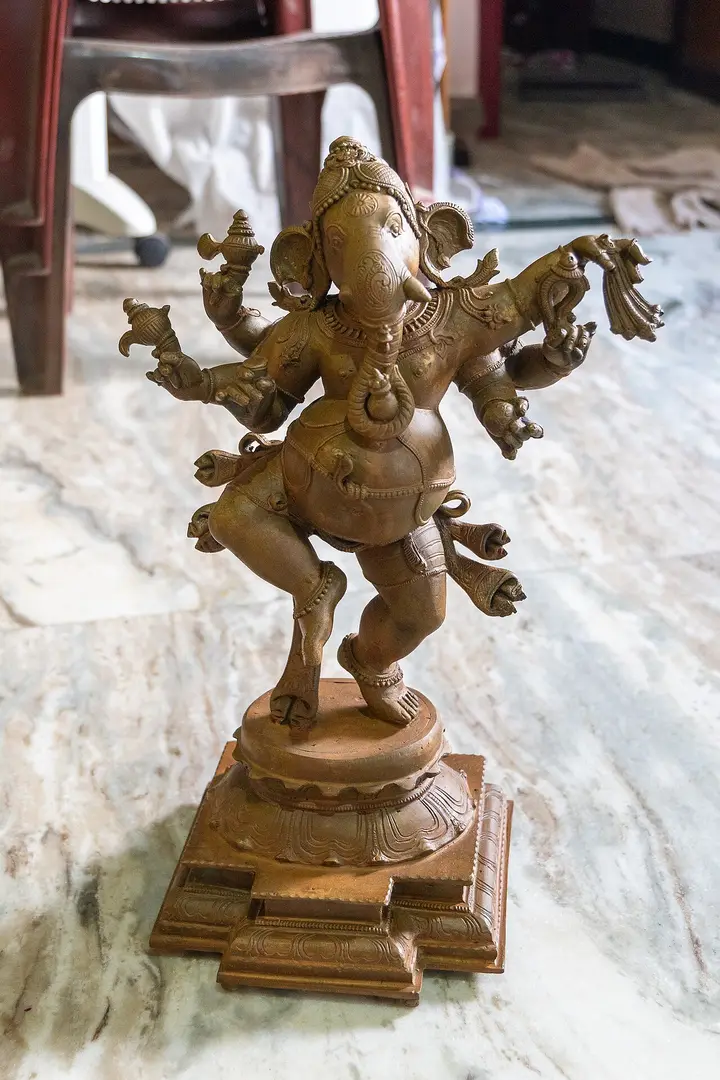
The trades are the last layer, and they are still working ones. The town is known across South India for brass, bronze and copper vessels, and Swamimalai up the road still casts icons by the lost-wax method the Chola bronze-casters used, under its own Geographical Indication. Silk is woven here and at Thirubuvanam, about six kilometres out. Betel leaf grown in this stretch of the Cauvery basin was granted a Geographical Indication on 31 March 2025 — the first agricultural product from this part of the delta to get one. And the town’s name is on a drink in every South Indian city: Kumbakonam degree coffee, made with undiluted milk and no water, poured back and forth between tumbler and dabarah until it stands up in froth.
Legend & myth
The name is a story about a pot. At the end of an age, when the world was to be dissolved in flood, Brahma’s kumbha — the vessel holding the seeds of all living things, sealed with the nectar of immortality — was set adrift so that creation could begin again afterwards. It came to rest here. Shiva, taking the form of a hunter, broke it with an arrow; the nectar spilled, and where it settled it made two tanks, the Mahamaham and the Potramarai. Out of the sand and the spilled nectar Shiva then shaped a lingam with his own hands, and that lingam is the one in the sanctum of the Adi Kumbeswarar Temple. Kumbakonam — kumbha and konam, the pot and the corner or bend — is the town that grew round the spot.
We tell that as the town tells it, and not as history. What it explains rather well is the geography: a settlement built around a tank rather than a temple, with the temple named for the vessel rather than the god, and a festival whose whole logic is that water arrives from elsewhere and is holier for it. The belief that the rivers of India come to bathe in the tank on the Mahamaham day is the same idea in a different form — sanctity carried in, not generated here.
More about Kumbakonam
History
The town’s antiquity is genuine, though its earliest identifications are argued. Kumbakonam is commonly identified with the ancient Kudavayil, where the Early Chola king Karikala is said to have held court, and Pazhaiyarai — about eight kilometres away — served as a Chola capital in the ninth century. Whatever the precise sequence, the town spent the Chola period at the administrative centre of the empire rather than at its edge, which is why the temple-building around it is so dense and so early.
The present buildings are mostly later than the dynasty at its height. Adi Kumbeswarar’s masonry structure dates to the Chola period in the ninth century with substantial Vijayanagara expansion afterwards; Sarangapani’s earliest inscriptions are late Chola, tenth to twelfth century, with the great gopuram and much of what you see added under the Vijayanagara and Nayak rulers in the fifteenth to seventeenth. The Mahamaham tank’s sixteen mandapams are Nayak-period work, Govinda Dikshitar’s, and Krishnadevaraya’s visit in 1445 is recorded in inscriptions elsewhere. The town, in other words, kept being invested in for six or seven centuries by successive powers, which is not true of most places that were important once.
The nineteenth century added a different institution. Government Arts College opened in 1867 and was affiliated to Madras University ten years later, and Kumbakonam became simultaneously a stronghold of traditional Sanskrit scholarship and one of the earliest centres of Western higher education in the Tamil country. Porter Town Hall, its rotunda still carrying the name in painted letters, dates from that period. The two systems produced, among others, a clerk’s son who filled notebooks with results nobody in the town could check and who is now the reason a good many visitors come here at all.
Why visit
Because it is the better base, and most itineraries get this the wrong way round. Thanjavur has the single greatest Chola temple and it deserves its day — but it has one, and Kumbakonam has a dozen inside eight kilometres, with the UNESCO temple at Darasuram four kilometres out and Gangaikonda Cholapuram thirty-five. Staying here removes an eighty-kilometre round trip from a delta itinerary and puts the walkable half of it outside your hotel door.
Because the town is compact in a way that rewards walking. Five significant temples, a twenty-one-acre tank, a bazaar and the railway station all sit inside a grid you can cross on foot in twenty minutes, and none of it has been cleared or landscaped into a heritage precinct. You see the temples the way the town uses them, which is as part of the street.
Because of the two dates. Sarangapani’s sanctum doors swap on 15 January and 15 July, and the Mahamaham comes round in 2028. Very few places let you plan a visit around a twelve-year clock and a six-month one at the same time.
And because of the house on Sarangapani Sannidhi Street. It is small, it is free, and it takes twenty minutes. If the temples are why you came, this is the thing you will find yourself telling people about afterwards.