Ponnani stands where the Bharathapuzha reaches the sea, and for something like four centuries it was the town that decided who in Malabar counted as a scholar. Students who had worked through the syllabus in village mosques came here for a final term, sat around an oil lamp inside the Friday mosque, and left with the title Musliyar — a qualification granted nowhere else and recognised everywhere. That is what the nickname “Mecca of Kerala” is actually about: not sanctity, but examinations. The same river mouth that brought the students brought the pepper, and when the bar silted and the Portuguese, the Dutch and then the British rearranged the coast, the trade went elsewhere while the lamp stayed lit. What is left is a dense municipality of about 90,000 people, a fishing harbour, a colonial canal running through the middle of town, and a very large amount of unmarked history.
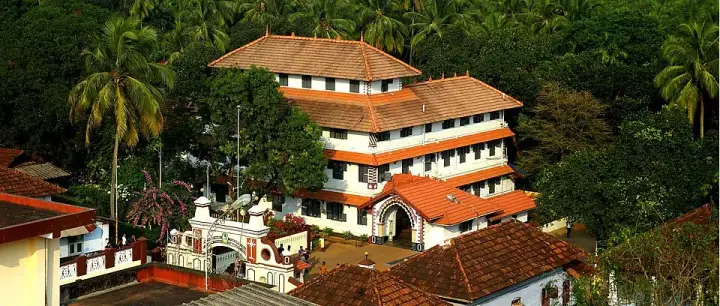
The institution that made Ponnani famous has a name that sounds domestic and was not: വിളക്കത്തിരിക്കൽ, vilakkathirikkal, “sitting at the lamp”. A student who had already read his way through grammar, logic and the elements of Shafi’i law in a village mosque came to Ponnani for a final period of study, took his place in the ring of students around the oil lamp burning in the Friday mosque, and at the end of it received the title Musliyar from the presiding Makhdum. There was no certificate in the modern sense. There was a place in a circle, a length of time, and a name you were afterwards entitled to use — and Malabar accepted it. A man who had sat at the Ponnani lamp could go home and open a dars of his own.
That is the mechanism by which one mosque reorganised the religious education of a whole coast. The system is called palli dars — mosque teaching — and Ponnani is generally credited with originating it in Malabar in the early sixteenth century. It spread by replication: every graduate who went home and started teaching produced more graduates, and the network fed students back to Ponnani for the final term. The Malayalam account by the Ponnani historian T. V. Abdurrahman Kutti describes the domestic side of it, which is the part usually left out — local households each undertook to feed and lodge two students, so the town itself carried the cost of the seminary. By 1887 roughly four hundred students from outside Kerala were studying at Ponnani, and the reach that is repeatedly claimed for it — Tamil country, Sri Lanka, Sumatra, Java — is the reach of a maritime, not a territorial, institution.
The Makhdums were a scholarly family of Ma’bari descent—from the Coromandel coast, with an earlier Yemeni origin—who settled at Ponnani and held the office in succession. Zainuddin ibn Ali al-Ma’bari, known as Makhdum I, built the Friday mosque, began the teaching and was buried beside it after his death in July 1522. One Malayalam source counts thirty-eight Makhdums in the Valiya Jaram and records Sayed M. P. Muttukoya as the fortieth in the line, installed on 4 October 2007. Treat the count as that source’s record; the continuing office itself is well established.
The library the family produced is the reason Ponnani matters outside Kerala. Around 1574 Zainuddin Makhdum II — grandson of the first, and a student of Ibn Hajar al-Haytami at Mecca — finished Fath al-Mu’in, a commentary on his own earlier digest Qurrat al-Ayn. It is a compact, exceptionally clear manual of Shafi’i law written to be taught, and it did what almost nothing else written in Kerala has done: it travelled. Fath al-Mu’in is still a standard text in Shafi’i madrasas across South and Southeast Asia, and the commentary written on it in Mecca, I’anat al-Talibin, is itself a standard work. A book written in a Malabar port town in the 1570s is on the syllabus in Indonesia today.
The other book is the one historians quote. Tuhfat al-Mujahidin, completed in 1583 and dedicated to Ali Adil Shah I, Sultan of Bijapur, is an Arabic account of the Portuguese on the Malabar coast written from inside the community they were fighting. Its four parts move from the doctrine of jihad, to the history of the Muslims of Malabar, to a description of Hindu custom in the region, to fourteen chapters on the Portuguese and the Kunjali Marakkars running to the fall of the Chaliyam fort in 1571. It is one of very few Asian narratives of the early Portuguese period, and it has been translated into Portuguese by David Lopes in 1898, into English by S. Muhammad Husayn Nainar in 1942 and into Malayalam by C. Hamza in 1995. It is worth saying plainly that it is a partisan document written to raise fighters, and that this is not a defect in a source — it is what makes it evidence of what people at Ponnani believed.
Nor was it the first attempt. Makhdum I had already written Tahrid Ahl al-Iman ala Jihad Abadat al-Sulban — roughly, “urging the people of faith to fight the worshippers of the cross” — an Arabic poem calling on Muslims to resist the Portuguese, composed while the Portuguese were burning shipping on this coast. Ponnani was attacked repeatedly: Francisco de Almeida in November 1507, Henrique de Meneses in February 1525, when thirty-eight ships belonging to the Calicut captain Chinna Kutti Ali were burnt. The scholarship and the fighting were not separate activities here, and pretending otherwise makes nonsense of both.
Ponnani also gave Malayalam a second alphabet. Arabi-Malayalam — the Malayalam language written in an expanded Arabic script, with extra letters invented for sounds Arabic does not have — is generally traced to Ponnani, and was known for a time simply as the Ponnani script. It was not a liturgical curiosity: it was the everyday literate medium of the Mappila community for centuries, used for poetry, letters, textbooks, polemic and commerce. A page survives from 1908 advertising a Ponnani shop’s stock of books and cloth, set in Arabic script and running in two languages, Arabic-Malayalam and Arabic-Tamil, at once. That is what a working script looks like.
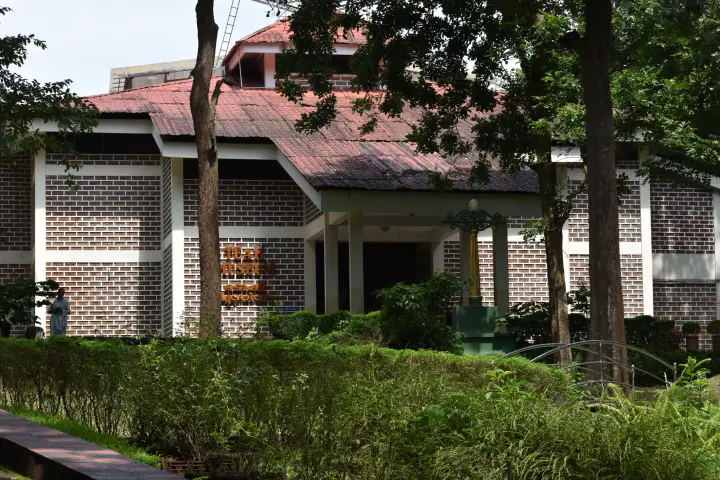
Then, unexpectedly, Ponnani produced a second literature in the other direction. In the 1930s a group of writers formed here that Malayalam criticism remembers as the Ponnani Kalari — the poet Edasseri Govindan Nair, the critic Kuttikrishna Marar, Akkitham Achuthan Namboothiri, Kadavanad Kuttikrishnan and Moothedath Narayanan Vaidyar among them. Uroob, one of the major Malayalam novelists of the century, was born in Ponnani on 8 June 1915 and married into Edasseri’s family. For a small coastal town to have been the address of the region’s Islamic jurisprudence in the sixteenth century and of its modernist literary argument in the twentieth is not a coincidence anyone has fully explained, but it is a fact, and Edasseri’s memorial and reading room still stand in the town.
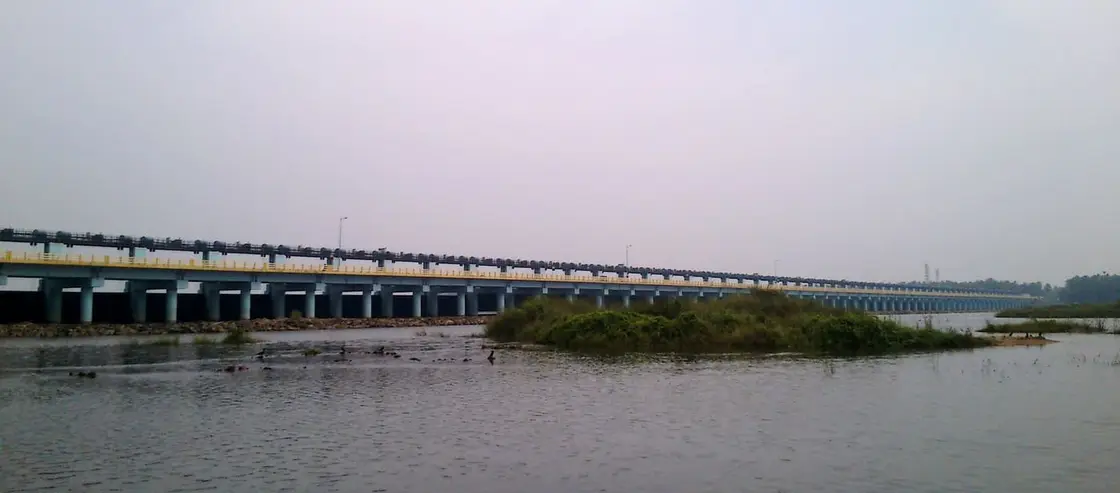
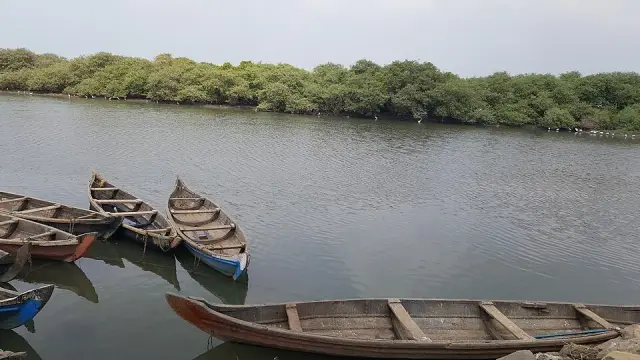
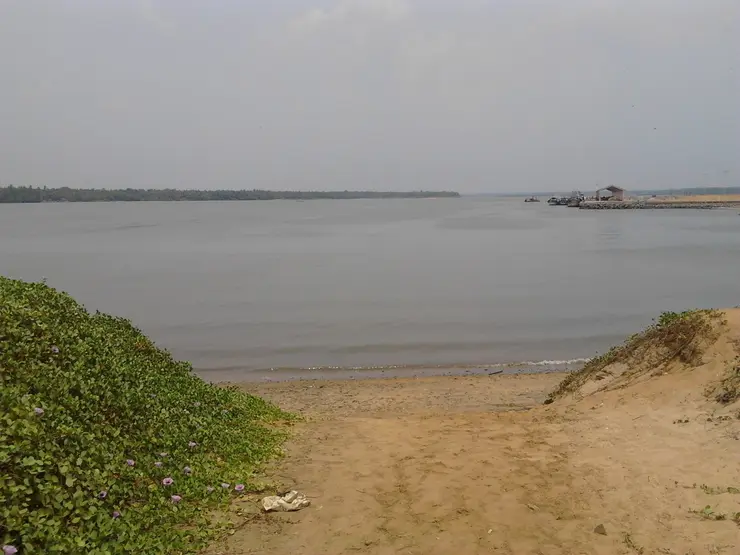
The last chapter is about water. Ponnani was a port because the Bharathapuzha met the sea here and because the river was the sea end of a route into the interior; it was the Zamorin’s second base and the point at which goods from the Malabar hinterland went out. In 1848–50 the Malabar Collector H. V. Conolly had a canal cut linking Ponnani northward and to Chettuva in the south, and by 1857 the acting Collector William Robinson was reporting more than eight thousand boats working the canal system. The colonial canal still bisects the town. The port did not survive: the Kerala Maritime Board’s own page describes Ponnani today as a riverine port with a channel four to five metres deep, about a hundred metres of wharf, no cargo pier and a staff of five. The working waterfront moved four kilometres to the fishing harbour, which is what Ponnani is now — one of Kerala’s significant fish-landing centres, and a town most visitors have heard of, if at all, because the viral 2024 music video for Hanumankind’s “Big Dawgs” was shot in a travelling well-of-death here, a fact Kerala Tourism has cheerfully claimed as its own.
Legend & myth
Nobody can agree on what the town is called after, and the four answers are worth having in full because each one is a different theory of what Ponnani was. The first says a ruler named Ponnan; the second, a river called Pon Vani, golden waters; the third, pon-nanayam, the gold coin, for the Arab and Persian gold that came ashore here in trade; the fourth, ponnana, golden elephants, dedicated to the temples by the Zamorins. A trading town, a river town, a temple town, a town named for a forgotten man. Malayalam Wikipedia carries all four without choosing, and that is the correct treatment: an etymology with four candidates is not a fact with three errors attached, it is a town telling you it has been several things.
The gold-coin story is the one that has stuck, and it is repeated so confidently on travel pages that it deserves a caution. It is a folk etymology of exactly the shape languages produce all the time — a name gets attached to the most prosperous thing the place is remembered for. The gold trade at Ponnani was real; the derivation of the name from it is a tradition, not a demonstration, and we print it as a tradition.
Inside the Friday mosque there is a legend that is genuinely local and is not carried in English at all. Oral tradition at Ponnani, recorded in Malayalam, holds that jinn lived in the mosque, and that the earlier Makhdums conducted a dars for them — a class for the jinn, at hours when no human student was present. It is a striking thing for a community to say about its own seminary. It is not a story about magic so much as a story about seriousness: the teaching at this lamp was of a standard that even the unseen came for it, and the building was never actually empty. The same tradition points out a round stone in the inner hall associated with Ibn Hajar al-Haytami, the Meccan jurist under whom Zainuddin Makhdum II studied, marking where the foundational texts were read.
There is a second mosque legend, of the ordinary marvellous kind, which says that every piece of timber in that enormous building came from a single tree. Anyone who has stood under the roof will see the point of the claim, and no one has ever tested it. Set beside it the tradition that the mosque was raised by a Hindu carpenter remembered as Ashari Thangal, working for the Muslim scholar who commissioned it — a story that survives because Ponnani wants it to survive, and which says something true about how a Kerala mosque of that period was actually built, whatever the individual name is worth.
The best of the Ponnani stories is the one that explains why the Thrikkavu temple and the Juma Masjid stand almost in sight of each other. As Kerala Tourism itself tells it, a Hindu and a Muslim were caught together in a storm at sea, and vowed that if they came ashore alive they would build a temple and a mosque side by side. They landed at Ponnani, and both buildings are pointed out as the discharge of that promise. Historically it will not survive contact with the dates — the temple is far older than the sixteenth-century mosque — but that is not what the story is doing. It is a town’s account of itself, offered by a place that is roughly two-thirds Muslim and one-third Hindu and has been mixed for a very long time, and it is told by both communities.
The temple has its own layer. Thrikkavu is counted among the hundred and eight Durga shrines that tradition attributes to Parasurama, the axe-bearing sage who is said to have thrown his weapon into the sea and raised Kerala out of the water — the founding legend of the whole coast, invoked here as it is everywhere from Kanyakumari to Gokarna. The goddess is four-armed, holding conch and discus. The name is usually derived from Thrikkanikkatu or Thrikkani Kadu, the sacred grove, which is a reminder that a kavu is a grove before it is a building.
In front of the temple lies a large tank called the Chira, and the story attached to it is the most human thing in Ponnani’s repertoire. A summer of drought and famine had left the town without food or clean water, and a deputation went to the Zamorin at Kozhikode. His answer was not alms: he told them to dig a tank in front of the temple, sent rice from Kozhikode free of charge, and had every person who worked on the digging fed with kanji and puzhukku — gruel and boiled vegetables — for the duration. It is a famine-relief public-works scheme dressed as a temple legend, and the tank is still there. Whether it happened in the form the story gives is unknowable; that the town remembers its relief as work rather than as charity is the interesting part.
One story we will not tell, because it is not one. Ponnani is regularly named as the site of Tyndis, the port of the first-century Periplus of the Erythraean Sea, and English Wikipedia’s article on the town asserts the identification outright. We do not, and neither should anything else: Kadalundi, Tanur and Panthalayini Kollam are proposed just as seriously, no source ranks the candidates, and no archaeological evidence of Tyndis has ever been found anywhere on this coast. Ponnani’s own documented antiquity — Chera-period inscriptions in the neighbourhood, a mosque of 1510 or 1519, a chronicle of 1583 — is quite substantial enough without borrowing a port nobody has located.
More about Ponnani
History
The country around Ponnani was inhabited and literate well before the town’s Islamic centuries: Old Malayalam inscriptions survive at Sukapuram, and one of them names Goda Ravi of the Chera line in 932 CE. Local rule before the Zamorins is credited to the Thirumanasseri rajas. Once Calicut absorbed the coast, Ponnani became the Zamorin’s southern and military base — the anchorage from which the fleet worked, and the place the Portuguese therefore had to attack.
They attacked it repeatedly and never held it. Francisco de Almeida struck on 24 November 1507 and lost eighteen men; Henrique de Meneses burnt thirty-eight of Chinna Kutti Ali’s ships on 25–26 February 1525, and Kutti Ali was captured in 1528. A Treaty of Ponnani was signed on 1 January 1540 by the Portuguese governor García de Noronha. In 1552 a Turkish gunner named Yoosuf landed here with heavy guns; in 1566 and 1568 Kutti Pokkar took Portuguese ships. Portuguese fort construction at Ponnani was begun in 1585 and an agreement for a church followed in 1597, and it was precisely because a Portuguese fort at Ponnani was in prospect that the Calicut admiral sought permission to build his own base at Kottakkal. On 11 November 1604 the Zamorin signed a treaty with Steven van der Hagen admitting a Dutch factory.
The Mysorean period changed the town’s economy rather than its faith. Hyder Ali took northern Kerala in 1766 and established an outpost at Ponnani; Tipu Sultan developed the port and made it a principal export point for Malabar. The same period is when the Thrikkavu temple was damaged: William Logan’s Malabar Manual records that the shrine was attacked and turned into an ammunition store during the Mysorean occupation, and it was the Zamorin who paid for its restoration — an extensive rebuilding is dated to 1861. Kerala’s history is not tidy, and neither is Ponnani’s.
Under the British the town’s fortunes ran with a canal. Between 1848 and 1850 the Malabar Collector H. V. Conolly had a canal system cut along the coast, partly to link Ponnani and Chettuva and pull the freight trade of the hinterland into taxable channels; by 1857 the acting Collector William Robinson counted more than eight thousand boats working it, carrying mainly coconut oil and coir. Ponnani, Chavakkad and Kandassankadavu grew on that traffic. The canal that runs through Ponnani town today is that canal. A separate cut carried goods from Ponnani to the railway at Tirur, and a steamer is described working the roughly ten-kilometre run.
Twentieth-century Ponnani produced politics as well as poetry. Ali Musaliyar, hanged in 1922 for his part in the 1921 Mappila rebellion, was from this taluk; so were the reformer Sayyid Sanaullah Makti Tangal, who died in 1912, and K. V. Raman Menon, the Congress activist locally called the Ponnani Gandhi. The Ponnani Lok Sabha constituency has existed since 1952. At the 2011 census the municipality held 90,491 people over 24.82 square kilometres — around 3,646 per square kilometre, the most densely populated municipality in Malappuram district — with literacy at 90.00 per cent and a population 68.31 per cent Muslim and 31.02 per cent Hindu.
Why visit
This is where Malabar’s scholars were certified — the mosque, the lamp and the Makhdum mausoleum are the physical remains of a five-century examination system.
Two books written here, Fath al-Mu’in and Tuhfat al-Mujahidin, are still read in Cairo, Colombo and Java; almost nothing else written in Kerala travelled that far.
Arabi-Malayalam, the Malayalam language in Arabic script, began at Ponnani and was once called the Ponnani script.
It is also the address of the Ponnani Kalari, the 1930s literary circle around Edasseri Govindan Nair, Kuttikrishna Marar and Uroob.
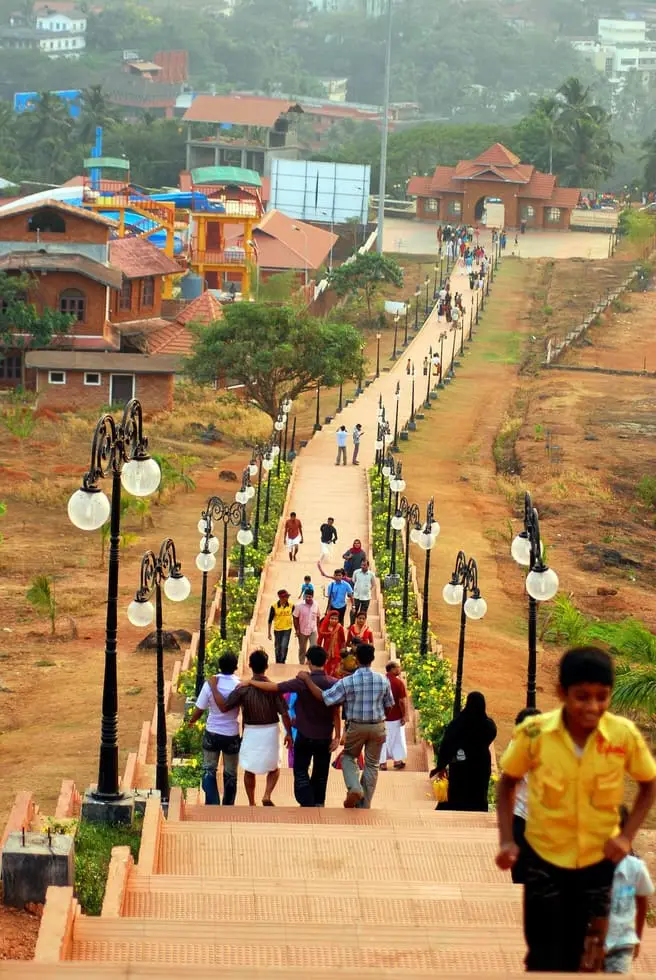
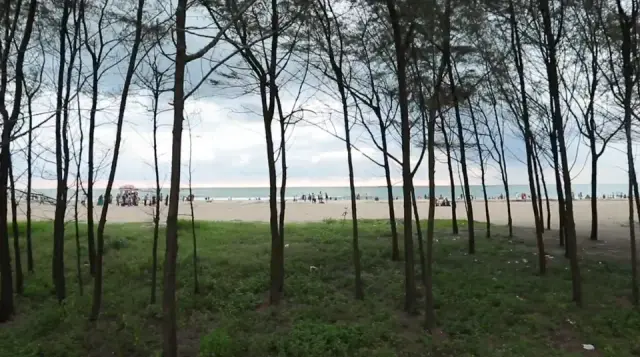
The Bharathapuzha meets the sea here, and the fishing harbour, the colonial canal and the Nilayora riverside walk give the town a working waterfront rather than a scenic one.
Biyyam Kayal, Padinjarekara Beach and the estuary are all within a short drive, so the heritage and the coast can be done in one day.