Tirur is a coastal-plain town in Malappuram district, a municipality of about 16.55 square kilometres and 56,058 people at the 2011 census, sitting 26 km west of Malappuram town and some 52 km south of Kozhikode with the Tirur river running along most of its boundary. It is best known as the town of Thunchath Ezhuthachan, and that is fair. What almost nobody says is that the same square mile of ground — the old settlement of Trikkandiyoor — also produced Nilakantha Somayaji, Jyeshthadeva and Achyuta Pisharati within about a century and a half, which makes Tirur the address of the Kerala school of astronomy and mathematics as well as the address of the language. Add the first railway in Kerala, a betel leaf with a GI tag and a wagon that left this platform in 1921, and the town is far denser than its reputation.
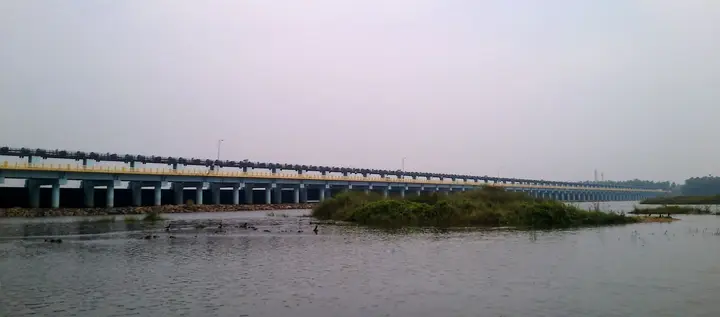
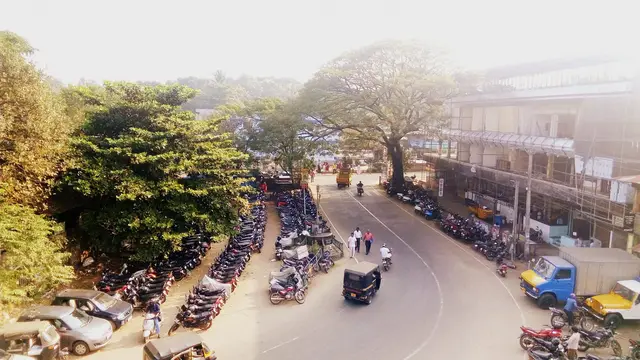
The town is compact and busy rather than pretty. Tirur is a trading centre first — betel leaf, fish, electronics — and the market streets run tight around the railway line, which cuts through the middle of town on an embankment with a road bridge over it. The Tirur river, the Tirurpuzha, loops along most of the municipal boundary and historically defined it. West of the town the land runs flat to the coast at Vakkad and Thirunnavaya lies south on the Bharathappuzha. Nothing here has been arranged for visitors, which is a large part of the pleasure of it: you come for what happened on this ground, and the ground is still in ordinary use.
The place-name that matters is Trikkandiyoor, now a locality of Tirur about two kilometres from the railway station. It carries the Trikkandiyoor Mahadeva temple, counted among Kerala’s hundred and eight Shiva shrines, and it carries Thunchan Parambu, the plot held to be Ezhuthachan’s. It also carried, in the fifteenth and sixteenth centuries, an extraordinary concentration of astronomers. The English Wikipedia article on Tirur puts it flatly: the Kerala school of astronomy and mathematics was mainly centred in and around present-day Tirur taluk. That is not a tourist-board line. It is where the men and the manuscripts were.
Nilakantha Somayaji was born on 14 June 1444 and lived at Kundagrama, which is Trikkandiyoor. He learned astronomy from Damodara, son of Parameshvara, and completed the Tantrasangraha in 1501 — the verses carry chronograms that fix the work to a handful of days in 1500. His Aryabhatiya-bhashya is one of the great commentaries in Indian astronomy. What he is most often cited for now is a computational scheme in which Mercury, Venus, Mars, Jupiter and Saturn go round the Sun, and the Sun goes round the Earth: a partially heliocentric model arrived at in Malabar roughly eighty years before Tycho Brahe published something structurally similar.
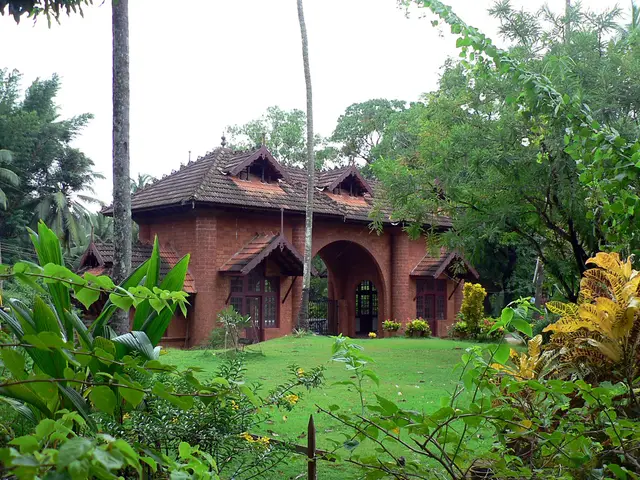
Jyeshthadeva, about 1500 to about 1575, was a pupil of the same Damodara and a contemporary of Nilakantha. His family house, Parangngottu, is recorded as still standing in the vicinity of Trikkandiyoor and Alathiyur. Around 1530 he wrote the Yuktibhasha, a companion to the Tantrasangraha that supplies proofs and rationales rather than results — including derivations of infinite series for trigonometric functions. Two things about it are remarkable. It argues rather than asserts, which is rare in the genre. And it is written in Malayalam, the spoken language, not Sanskrit, at almost exactly the moment Ezhuthachan was doing the same thing for poetry a short walk away.
The third of them, Achyuta Pisharati, was born at Trikkandiyoor around 1550 and died on 7 July 1621. He studied under Jyeshthadeva, wrote nine works spanning Sanskrit grammar and astronomy, and is credited with the technique known as the reduction to the ecliptic. He was also the teacher of Melpathur Narayana Bhattathiri. So the line runs Parameshvara to Damodara to Nilakantha and Jyeshthadeva, Jyeshthadeva to Achyuta, Achyuta to Melpathur — four generations of it, most of them living within a couple of kilometres of each other, on ground a visitor can walk across in an afternoon.
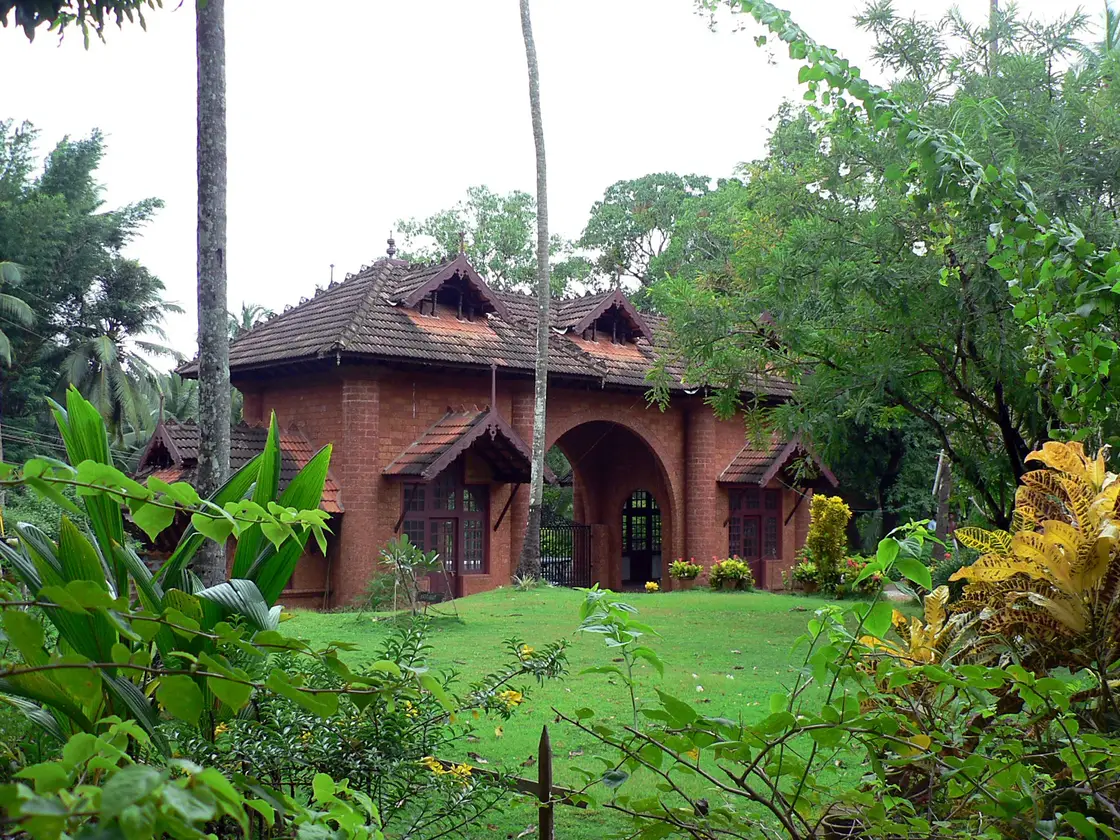
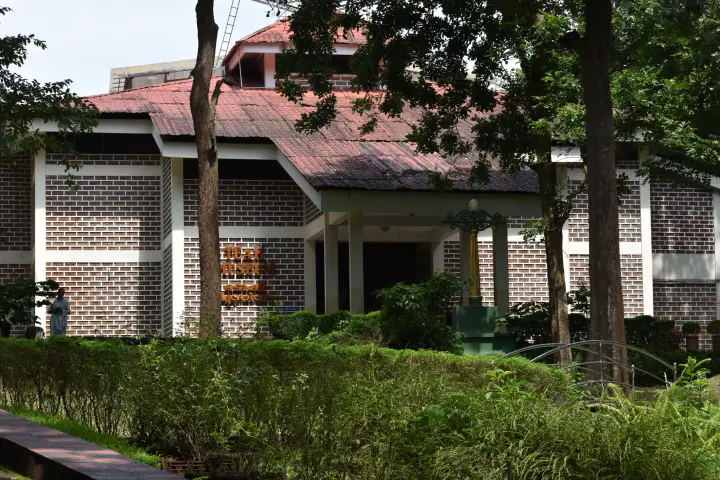
Thunchan Parambu itself is a working institution rather than a ruin, and it has its own page here — the museum, the manuscript library, the pavilion, the tree and the two ceremonies are all set out there rather than twice.
The town’s newest institution grew from the same root: Thunchath Ezhuthachan Malayalam University, out at Vakkad on the western edge of Tirur, which teaches its subjects through Malayalam rather than English. It has its own page here.
Then there is the crop. Tirur vettila, the Tirur betel leaf, received a Geographical Indication on 14 August 2019 on an application filed in December 2018 by the Tirur Vettila Ulpadaka Sangam — the first betel leaf from Kerala to be registered, and by the usual count the state’s thirty-sixth GI good. It is grown across six block panchayats: Tirur, Tanur, Tirurangadi, Kuttippuram, Malappuram and Vengara. The registered case rests on measurable difference — higher total chlorophyll and protein in the fresh leaf, a thicker leaf, a sharper pungency. The Puthukodi cultivar goes for export, chiefly to Pakistan, Afghanistan and Bangladesh; the Nadan is usually intercropped under coconut and areca and sold into Malappuram, Kozhikode and Thrissur markets. Kottakkal Arya Vaidya Sala buys from here.
And there is the platform. The first railway line in what is now Kerala opened on 12 March 1861 and ran from Tirur to the coast; Tirur is therefore the oldest railway station in Kerala still standing and still working, which is a quieter and more durable claim than the one usually made about the other end of that line. A passengers’ committee has proposed renaming the station after Ezhuthachan. Whatever is decided, the platform already carries a much heavier memory: it is where a hundred prisoners were shut into a goods wagon on the evening of 19 November 1921.
Legend & myth
The oldest story in Tirur is not about a poet. It is about Parasurama and a day of three consecrations, the last of them at dusk at Trikkandiyoor — a legend that arrives with a route attached and is still driven. It belongs to the Trikkandiyoor Mahadeva temple and is told on that temple’s page.
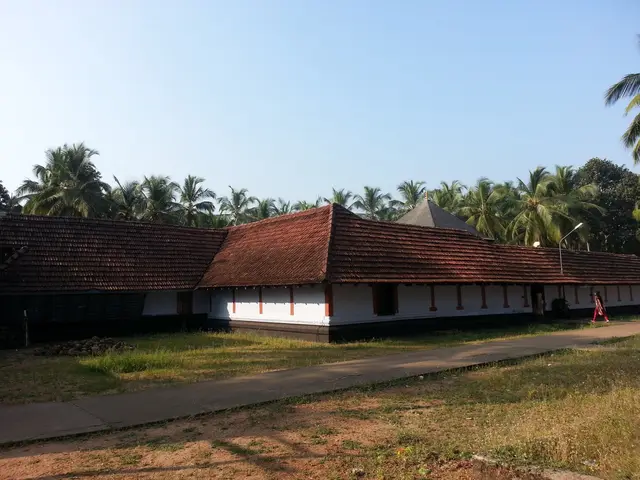
A few kilometres east, at Vairankode in Athavanad, the goddess arrived by water. The tradition is that a sister of the Kodungallur Bhagavathi crossed the Bharathappuzha and reached the Azhvanchery Mana at Athavanad; the family sensed her presence, took astrological counsel, and installed her at Vairankode. The temple’s most-repeated custom is a study in inverted hierarchy: the Azhvanchery Thamprakkal, the highest Brahmin authority in Malabar, do not enter the sanctum, because it is believed that the goddess would rise and bow to them, and they will not permit it. The Vela here, the Theeyattulsavam, falls in Kumbham, February into March, and opens with the ritual of maram muri. The claim sometimes printed that the temple is fifteen hundred years old comes from promotional and devotional sources and rests on nothing we can date.
Ezhuthachan’s own life is where legend has done the most work, and the sources say so themselves. The Malayalam Wikipedia article states plainly that his biography lies buried under myths and half-truths. His name is disputed — Ramanujan, or Krishnan, or simply Thunchan, meaning the youngest. His community is disputed three ways, between the Ezhuthachan scribe caste, the Kaniyar astrologer-teachers and a Chakkala Nair family. The Aithihyamala preserves a story that he was a gandharva cursed to be reborn a shudra as the price of spreading the Adhyatma Ramayanam; modern scholarship reads that as a later attempt to raise his ritual standing rather than as a record of anything. We repeat none of it as fact, and we would rather print the disagreement than resolve it.
Four legends belong to other places and this record refuses them. The Mamankam, with its twelve-yearly fair and its chaver warriors, happened at Tirunavaya on the Bharathappuzha, not at Tirur, and the two are constantly conflated; the Hanuman who stands leaning to listen belongs to Alathiyur; the Narayaneeyam was composed at Guruvayur, not here, even though the guru who taught its author lived at Trikkandiyoor; and Ezhuthachan’s end is not Tirur’s to claim. He is held to have founded a gurumatham at Chittur in Palakkad and to have died there around 1575, and his samadhi is on the bank of the Shokanashini there. Tirur has the beginning of that life and the ground he taught on. That is enough, and it is more than most towns can show.
More about Tirur
History
Before it was a town Tirur was part of the country of the Vettath or Tanur rajas, a small coastal principality whose headquarters is placed at Puthiyangadi, in the Tirur area. The Vettath line matters more to Kerala’s cultural history than its size suggests — this is the milieu in which the astronomers of Trikkandiyoor worked, and the Vettath Raja is credited in temple tradition with patronage in the district. After Tipu Sultan’s cession, Malabar passed to the East India Company from 1792 and then to direct British rule from 1858, which is the frame in which everything that follows happens.
The Trikkandiyoor Mahadeva temple is the oldest datable thing in the town — a ninth-century foundation, and the one building here that has been in continuous use longer than anything else. Its dating, its shrines and its trusteeship are set out on its own page.
The intellectual century runs from about 1444 to 1621 and is unusually well dated for Kerala. Nilakantha born 1444, the Tantrasangraha finished 1501, the Yuktibhasha around 1530, Achyuta Pisharati born about 1550 and dead on 7 July 1621, with Ezhuthachan placed somewhere across the fifteenth and sixteenth centuries and no firmer than that. The four are not a school in the institutional sense — there was no college — but they are a teaching lineage with named masters and named pupils, working within a few kilometres of one another. It ended, so far as anyone can show, with Achyuta’s generation.
The railway arrived on 12 March 1861, when the Madras Railway opened the first line in present-day Kerala from Tirur down to the coast, about nineteen miles or 30.5 kilometres of single broad-gauge track calling at Tanur, Parappanangadi, Vallikkunnu and Kadalundi. The famous confusion about where the far end of that line actually stood is dealt with in full on our Beypore and Chaliyam pages and is not repeated here. Tirur’s own end of it is simple and has one durable consequence: the coastal terminus was demolished in 1888 when the line was pushed on to Kozhikode, and Tirur was not, which is why Tirur station is the oldest railway station in Kerala.
Sixty years later that platform produced the town’s darkest day. On the evening of 19 November 1921, during the suppression of the Malabar rebellion, about a hundred Mappila prisoners were shut into a closed goods wagon here and sent south, and most of them did not arrive. The town hall was built as the memorial to it, in the shape of the wagon, and the whole account is on that memorial’s page.
The modern town is quickly told. Tirur became a municipality on 1 October 1971, administering the same 16.55 square kilometres it holds today, and the 2011 census returned 56,058 people and a literacy rate of 96.13 per cent. The Tirur betel leaf was registered as a Geographical Indication on 14 August 2019. Thunchath Ezhuthachan Malayalam University was inaugurated on 1 November 2012 and began teaching the year after. For a town of fifty-odd thousand people, that is an unusual density of firsts.
Why visit
It is the one place in Kerala where you can stand on the ground that produced both the modern Malayalam alphabet and the Yuktibhasha, within about two kilometres of each other.
Thunchan Parambu, the ground the town is known for, is a short hop from the station and keeps its own page.
Six places around the town have pages of their own: the poet’s ground, two ninth-century Shiva temples, the Hanuman shrine at Alathiyur, the wagon memorial and the Malayalam university.
Tirur station is the oldest working railway station in Kerala, and the town hall a few minutes away is built in the shape of the wagon that left it on 19 November 1921.
Tirur vettila carries a Geographical Indication registered in 2019, and the betel trade is visible in the market rather than staged for anyone.
It is a natural base for the Bharathappuzha heritage south of town — Thirunavaya and Alathiyur are both short drives — without the crowds of a tourist town.