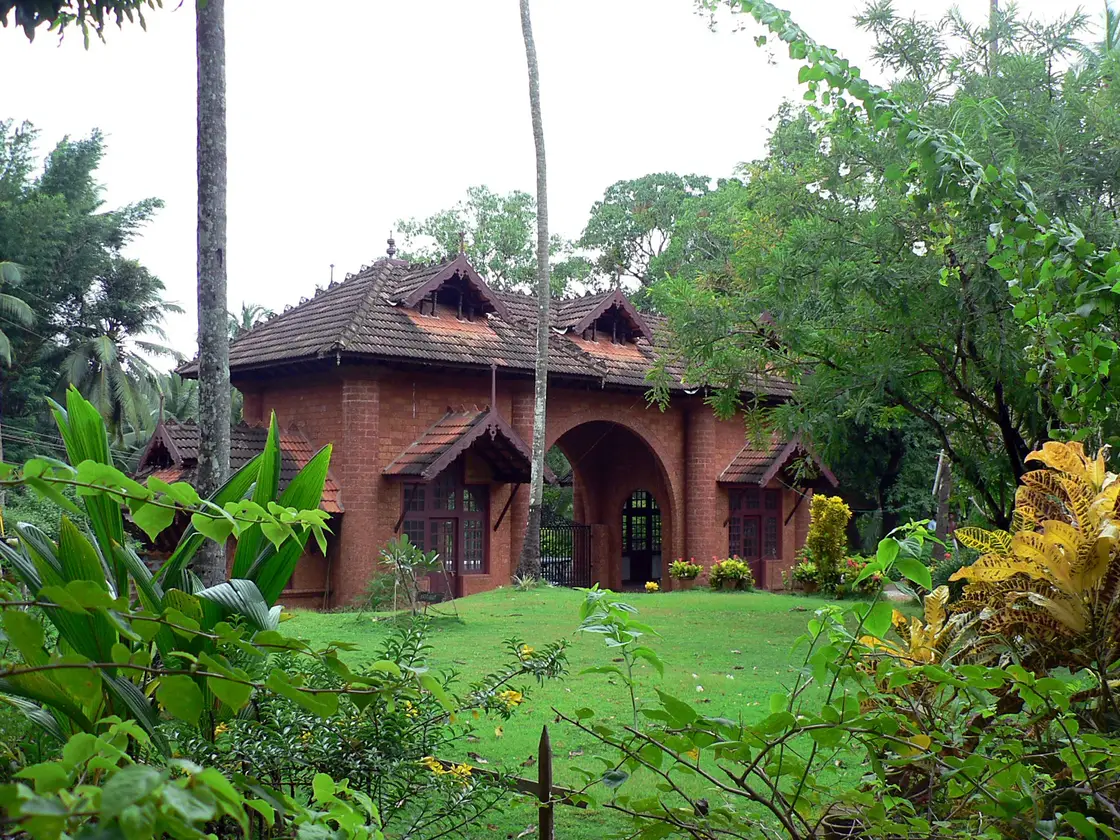
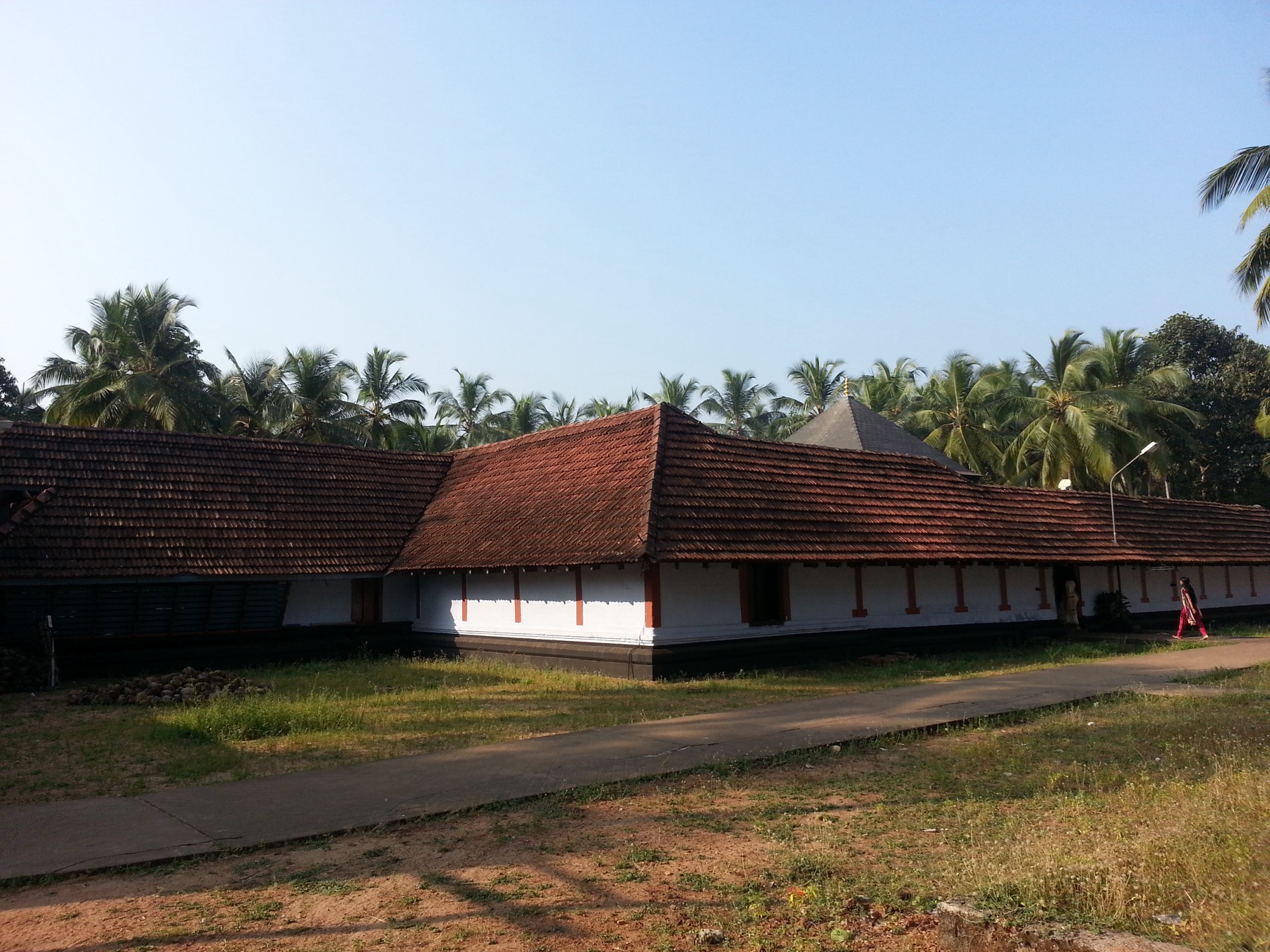
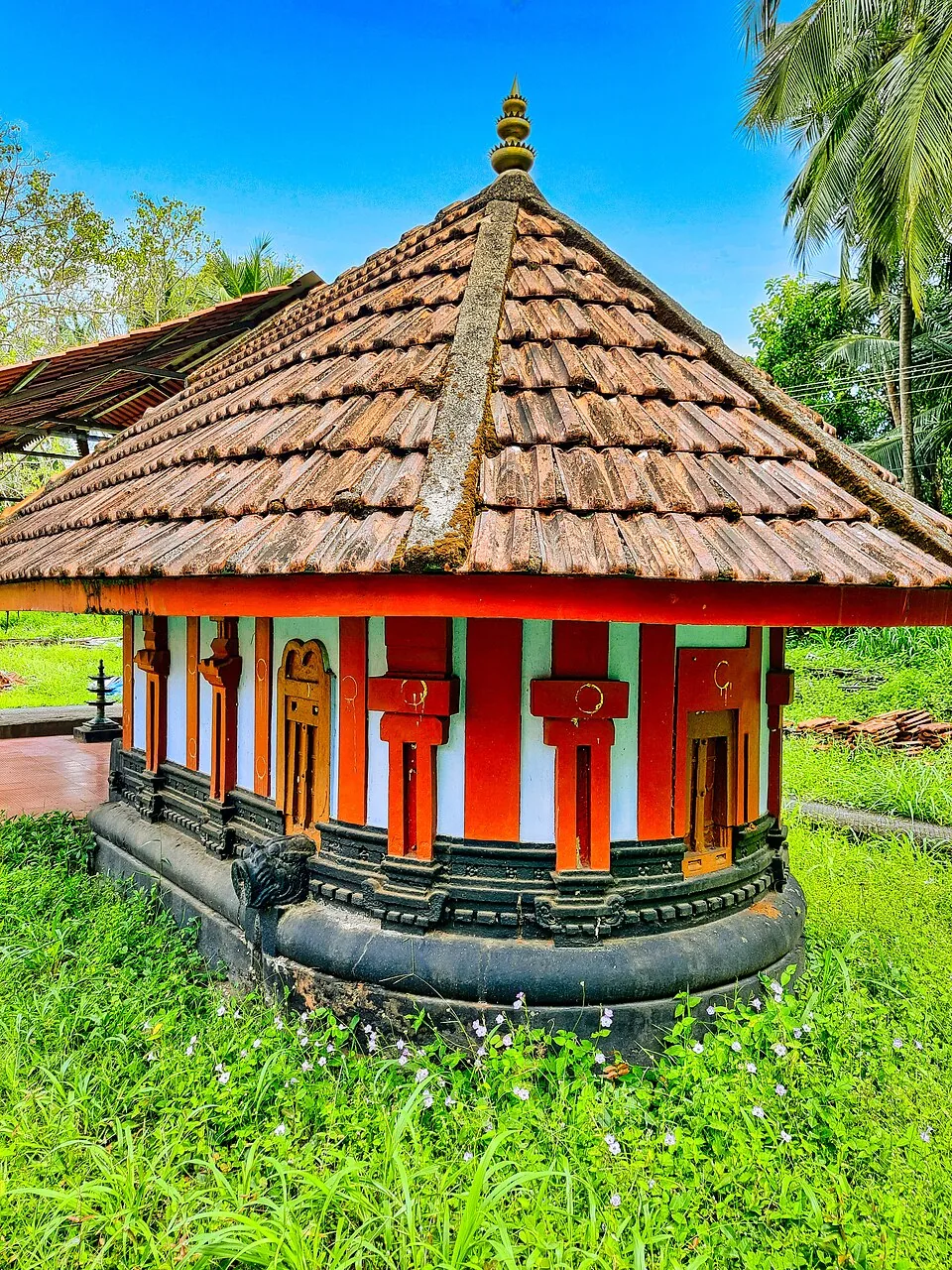
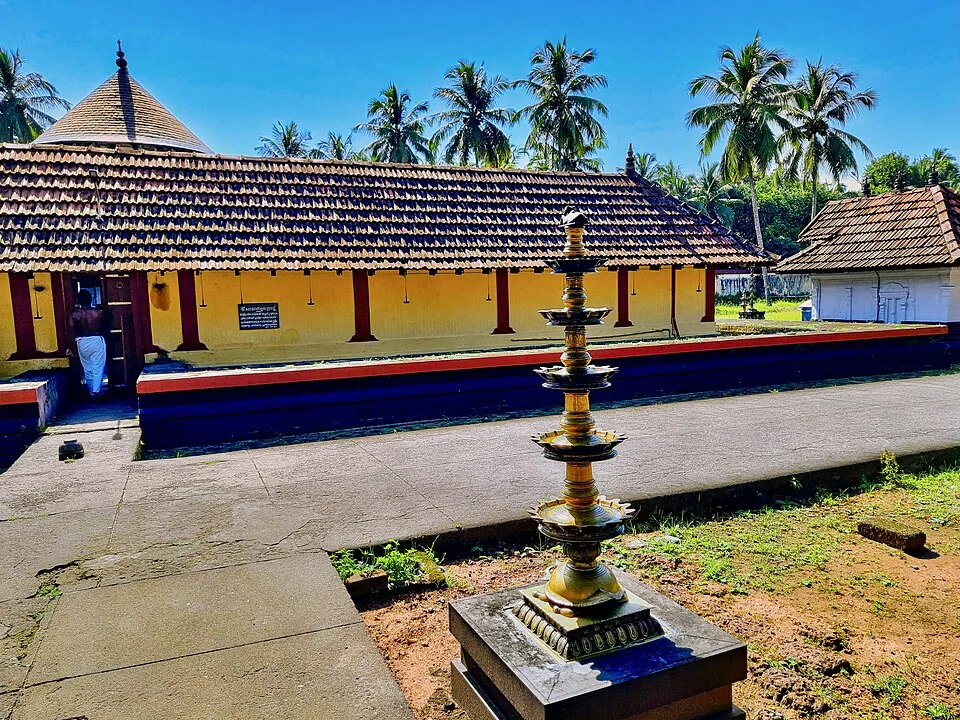
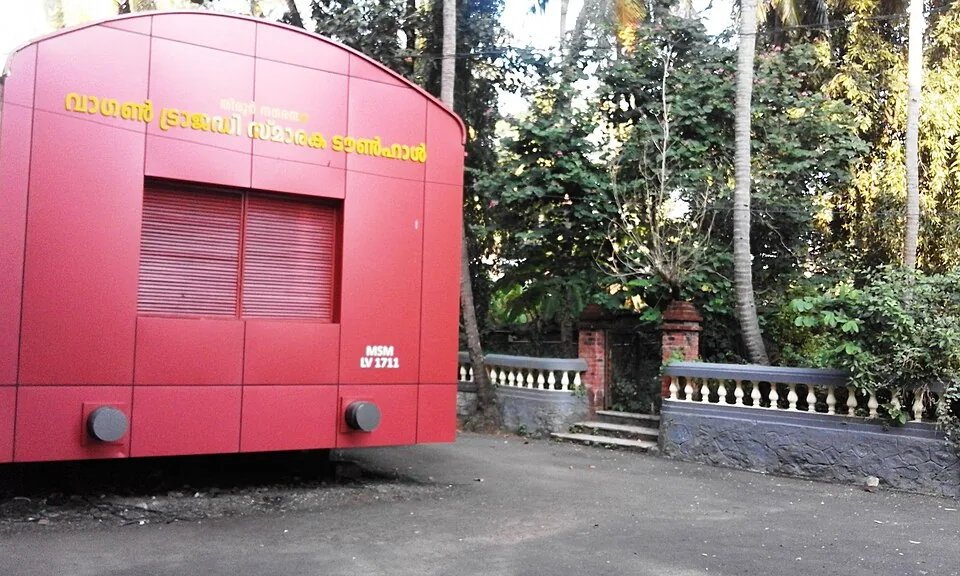
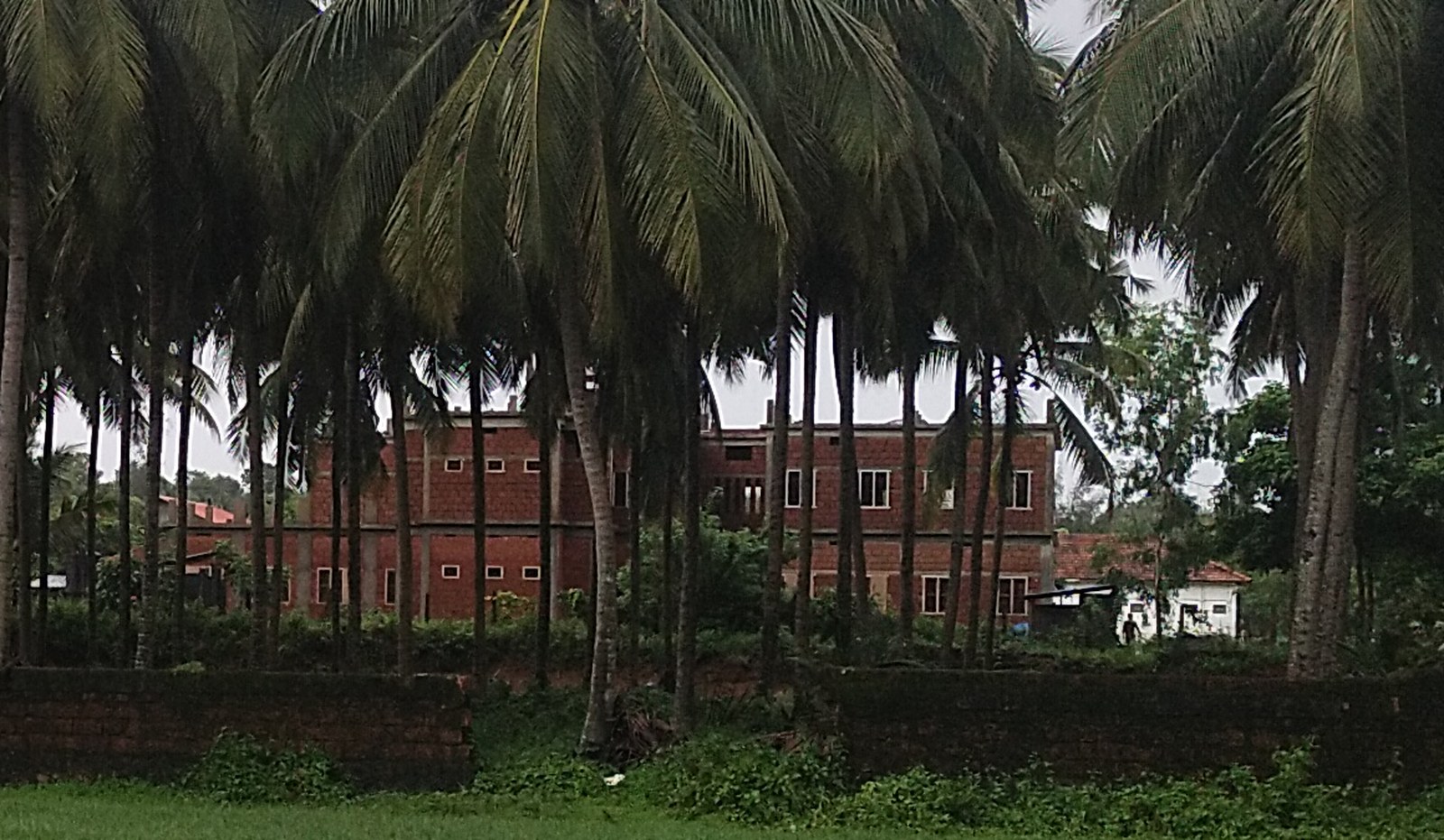
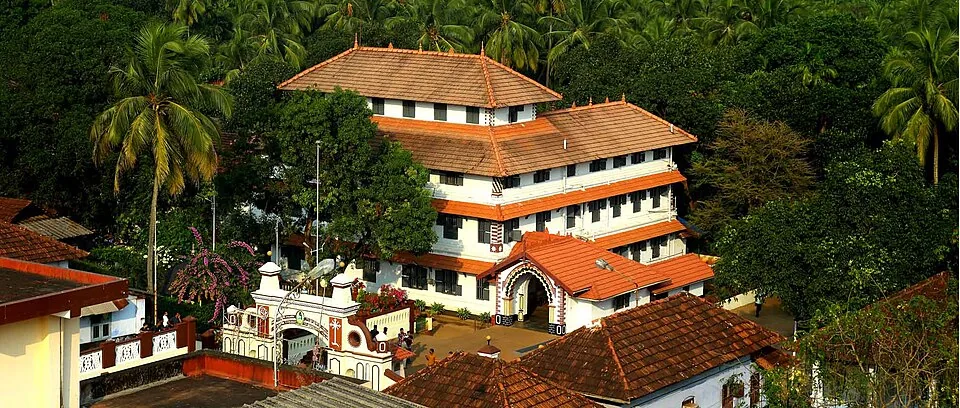
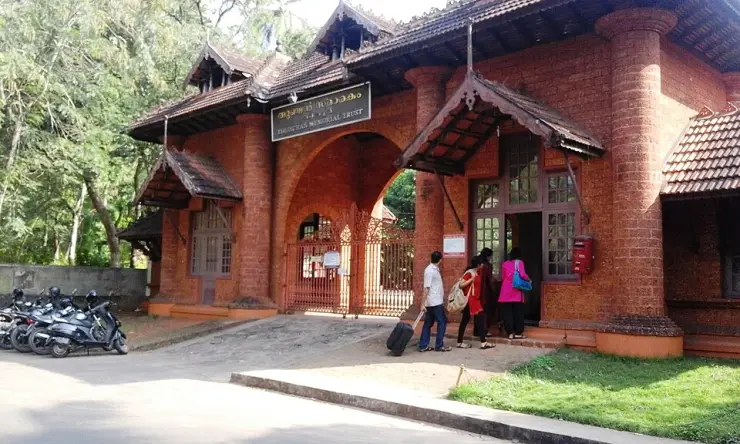
You come in under a laterite gateway with three tiled gables and a sign in Malayalam and English, off a road that carries the ordinary traffic of a market town. Behind it the noise stops. The ground is sand and shade — old trees, red-brick buildings with tiled roofs set back among them, a tank on one side, granite underfoot where the paths have been laid. This is four acres of Trikkandiyoor held to be the plot where Thunchath Ezhuthachan lived and taught, and the quietest thing about it is that it is still in use.
The story of Thunchan Parambu
What Ezhuthachan did is easier to see than to say. Malayalam before him was written in Vatteluttu, a script that had no comfortable way of carrying Sanskrit sounds. He wrote in the Grantha-derived alphabet instead — the one Malayalam still uses — and in doing so made it possible to write the language and the Sanskrit vocabulary it was absorbing with the same set of letters. That is the concrete content of the title he is given. He is the father of the language in the sense that the letters on a Kerala shopfront today are the letters he settled on.
The poems are the other half of it. His Adhyatma Ramayanam and his Mahabharatam are kilippattu — parrot-songs — a form in which the poet does not narrate but asks a bird to, and each section opens by calling the parrot and asking it to tell the story. He took the convention from older Tamil verse and turned it on the epics, in Malayalam grammar carrying Sanskrit words. Scholars agree he wrote those two. A shelf of others long attributed to him — the Brahmanda Puranam, the Uttara Ramayanam, the Devi Mahatmyam, the Harinama Kirtanam — are still argued over.
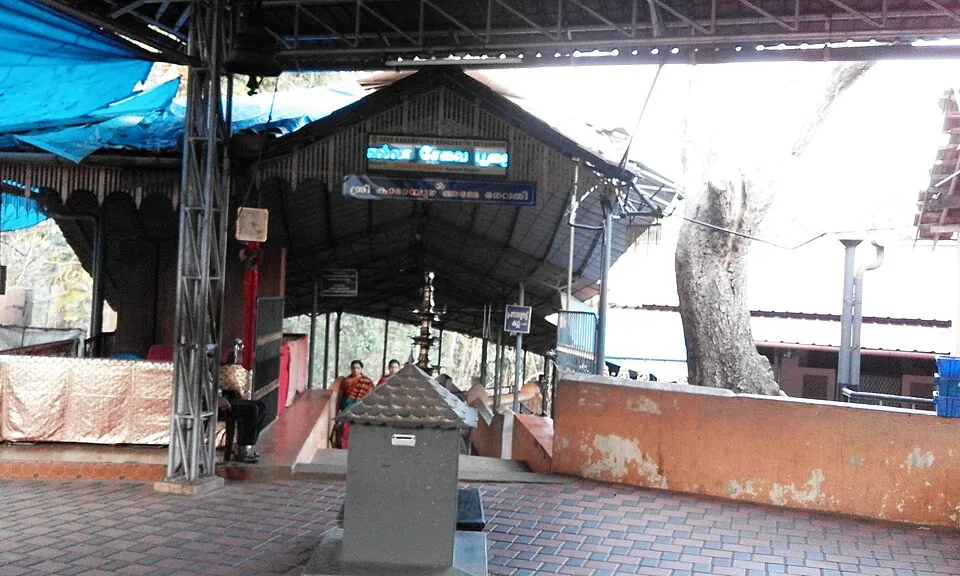
A stone parrot stands on a plinth under a canopy of its own on the grounds, large enough that a grown adult reaches its shoulder. Near it is the Saraswathi Mandapam, a granite pavilion on a raised platform with carved pillars and an open floor, which is the formal set-piece of the place and the one most photographs are taken of.
The rooms are the reason to give it two hours rather than twenty minutes. The literature museum lays out the growth of the language in clips, soundtracks, paintings and photographs, with cases of objects belonging to Kerala writers. The research library holds about fifteen thousand books and a hundred and twenty manuscripts and is recognised by the University of Calicut; the Grandhapura beside it is where the palm-leaf manuscripts are kept. A copy of the Adhyatma Ramayanam Kilippattu on palm leaf, with the iron stylus that scored it, is among the things on show — which is a useful thing to look at, because it explains why the letters of Malayalam are round: a straight stroke splits a palm leaf along its grain.
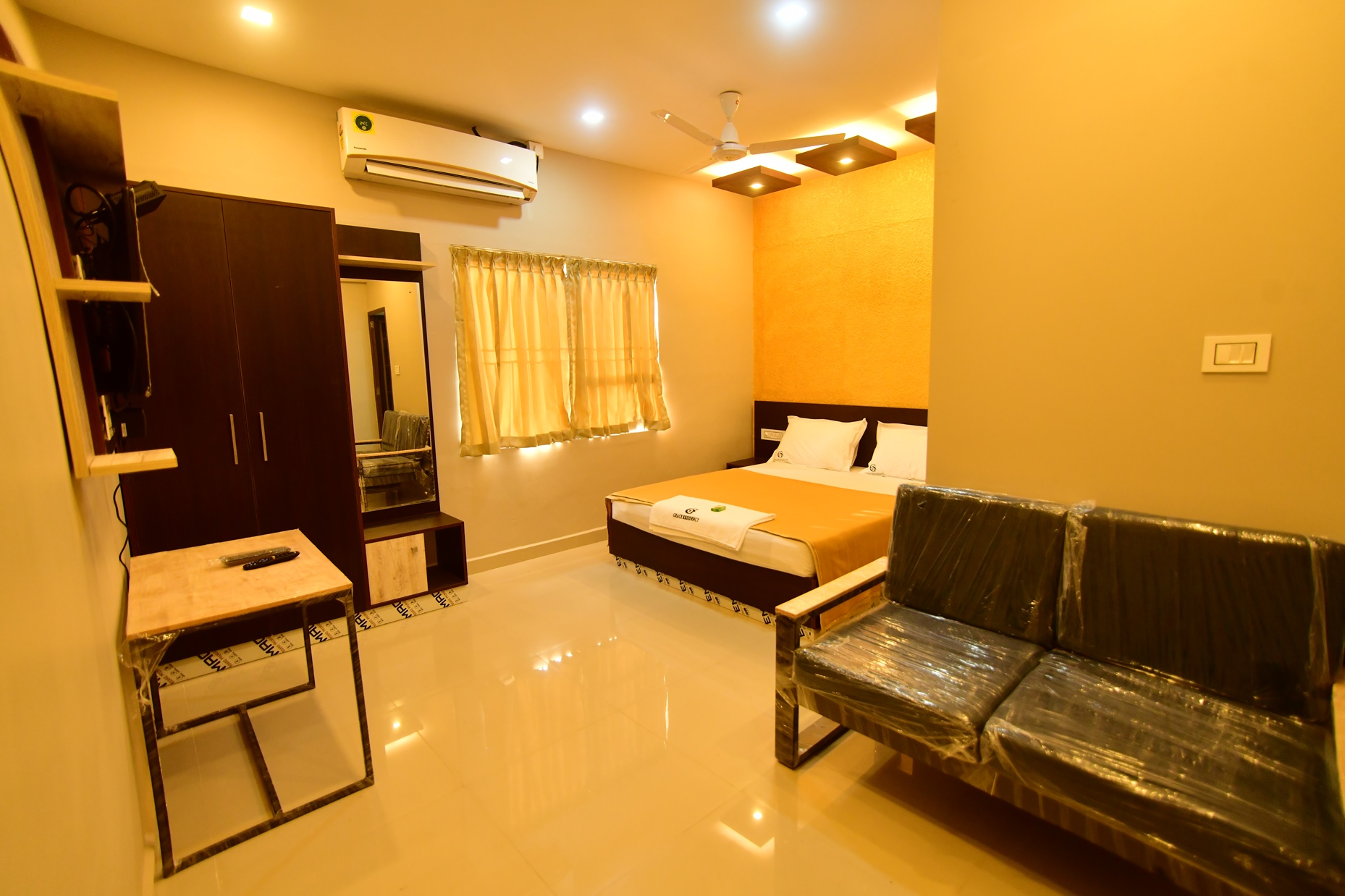
There is also a book house, the Pusthakapura, which sells the Trust's own publications and other publishers' Malayalam titles, and an auditorium and a mini hall that the Trust lets out. Guest rooms, a children's library and a conference room fill the rest of the four acres. The Trust reckons about three hundred students and two hundred other visitors come through on an ordinary day.
The iron stylus said to be the poet's own is kept here and does not stay in its case all year. At the Thunchan festival it is carried out in procession, and the festival around it runs to readings, seminars, music and dance across several days. The date is not fixed: the Trust held it on 27 February in 2025 and on 2 January in 2026.
The manuscript work is the part of this that nobody visiting for the tree would guess at. The National Mission for Manuscripts designated the Trust one of its Manuscript Resource Centres, and the centre began operating in June 2004 with a brief covering the manuscripts of north Kerala — finding them, describing them and getting them into electronic form. It has run 274 surveys across six districts and documented some 131,700 records, all of them also converted to digital. That is a working archive programme housed on a plot of ground remembered for a tree.
The rest of the four acres is arranged to be used rather than looked at. There is an auditorium seating about five hundred and an open-air stage, a conference room and a mini hall, cottages for guests and a dormitory, a dining hall, a children's library, and two ponds under the trees at the edge of the compound. The Trust lets the hall and the auditorium out under conditions. None of it is grand and all of it is in use, which is why the place reads as an institution having a working day rather than as a monument being visited.
Legend & myth
The tree is the first thing anyone tells you about. Ezhuthachan is said to have taught and composed under a kanjira — Strychnos nux-vomica, the strychnine tree, whose every part is bitter and poisonous, and which in Malayalam carries bitterness the way a stock phrase carries it in English. The tradition at Tirur is that this particular kanjira lost its bitterness, and that its leaves have been sweet ever since. Read as botany it is false and dangerous. Read as what it is, it is exact: the bitterest tree in the language stands over the man who made the language sweet, and the story simply refuses to let the two of them share a yard unchanged.
The sand is the second, and it is the one that fills the ground. By long tradition children are brought here at Vijayadashami, at the end of Navratri, for the Vidyarambham — the beginning of learning — and the letters are written in the sand of the compound rather than in a tray of rice. The sand is treated as sacred, and pilgrims walk round the kanjira once the writing is done. The local saying holds that a child who traced its Harisri in that sand went on to be somebody.
The act itself is small and very old. The child sits in an adult's lap; the adult's hand closes over the child's index finger and guides it to write ഹരിശ്രീ, Harisri, in the ground. The same word is then traced on the child's tongue with a gold ring. Ezhuthiniruthu is the other name for it — the seating for writing — and the age is usually about three. What makes it a public occasion here rather than a domestic one is that the guiding hand is often a writer's or a public figure's, invited for the morning.
The man himself is where the legend has done most of its work, and the disagreement starts at his name. Thunchan means the youngest; Ramanujan and Krishnan are both given as the name it was attached to. His community is claimed three ways, between the Ezhuthachan scribe caste, the Kaniyar astrologer-teachers and a Chakkala Nair family. His century is put anywhere from the fifteenth to the seventeenth, with 1495 to 1575 the estimate most often quoted. The Aithihyamala carries a story that he was a gandharva cursed into a low birth as the price of spreading the Adhyatma Ramayanam — a tale that reads as a later attempt to raise his ritual standing rather than as a memory of anything.
One thing this ground does not have is his grave. Ezhuthachan is held to have founded a hermitage at Chittur in Palakkad and to have died there, and his samadhi is on the bank of the Shokanashini a hundred and forty kilometres east of here. Tirur has the beginning of the life and the ground he worked on.
Read the full history of Thunchan Parambu 562 more words
History
The memorial as a built thing is younger than most visitors assume, and its dates are on its own walls. Two marble tablets inside record that the Chief Minister of Kerala, Pattom Thanu Pillai, laid the foundation stone on 29 December 1961, and that the memorial was opened on 15 January 1964 by Pattom A. Thanu Pillai — the same man, who by then had left Kerala and was Governor of Punjab. It is not often that the two ends of a building project are held by one person in two jobs.
That year the government put a twelve-member committee in charge of the ground. What the committee turned into over the next three decades was a cultural institution rather than a caretaking body, and the physical proof of the change is a second pair of dated stones. The foundation of the Thunchan Memorial Research Centre was laid on 24 October 1993 by E. T. Muhammed Basheer as Minister for Education, and the centre was opened on 24 May 1998 by Chief Minister E. K. Nayanar, with Muhammed Basheer — by then the local member of the legislative assembly — in the chair.
The novelist M. T. Vasudevan Nair became chairman in 1993, the year the research centre was begun, and the expansion of the grounds since then belongs to that tenure. In 2001 the government converted the committee into a trust with substantial autonomous rights, which is the body that runs the place now. The literature museum followed, opening in October 2008.
The poet's name has since been attached to two things beyond this ground. The Ezhuthachan Puraskaram, Kerala's highest literary award, was first given in 1993 to Sooranad Kunjan Pillai. And the Thunchath Ezhuthachan Malayalam University, inaugurated on 1 November 2012, teaches from a campus at Vakkad about four kilometres west of here.
The result of sixty years of that is a place with an odd double character. It is a pilgrimage — several thousand families a year bring a child here for one morning and think of it as sacred ground — and it is also an ordinary working institution with a payroll, a lettings policy and a digitisation programme. The Trust counts roughly three hundred students and two hundred other visitors on a normal day. Both halves are real, and a visitor who arrives expecting only one of them tends to be surprised by the other.
Why visit
It is the ground on which the Malayalam alphabet in use today was settled on, and it is still an institution rather than a monument.
The literature museum is the only museum of its kind for any Indian language, by Kerala Tourism's account, and it is built round the growth of a language rather than round objects.
A palm-leaf copy of the Adhyatma Ramayanam Kilippattu and the iron stylus that wrote in it are both here, and between them they explain the shape of the letters.
The kanjira tree and the sand under it carry two of the most-told stories in Malayalam, and one of them is acted out by several thousand families every Vijayadashami.
A research library of fifteen thousand books and a hundred and twenty manuscripts is open to readers, not sealed behind glass.
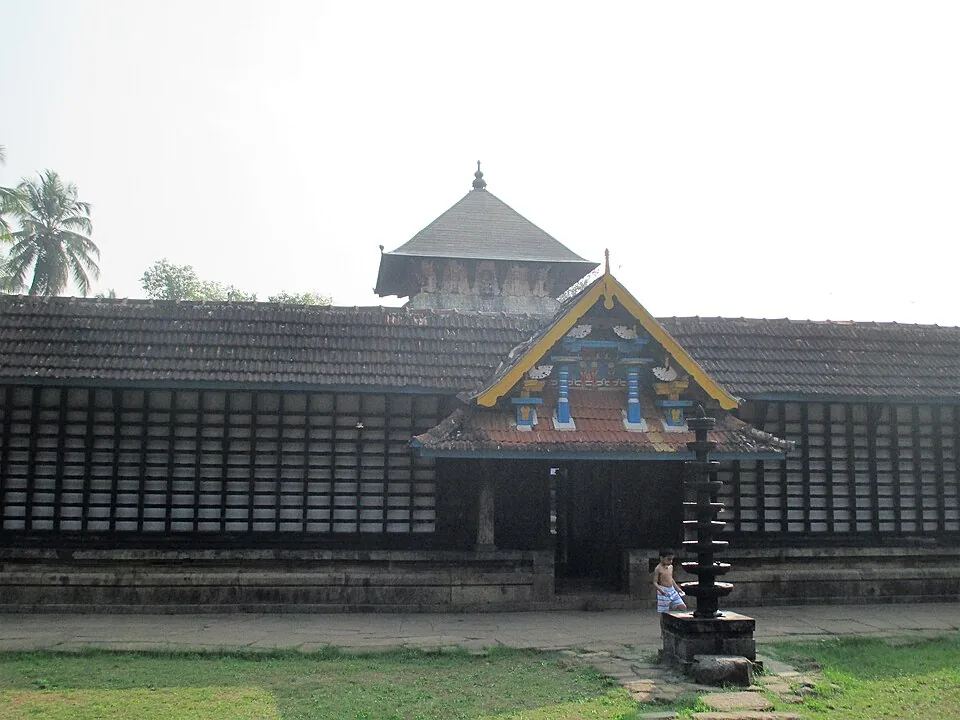
The Trikkandiyoor Mahadeva temple is a kilometre away and Tirur station a little under two, which makes the whole of it a morning without a car.