A revenue village of Coonoor taluk strung along the Ooty–Coonoor road, in the valley it is named after — a working place of vegetable terraces, tea, a needle factory and a hillside of boarding schools, with a World Heritage railway running through the middle of it.
Most people meet Ketti at forty kilometres an hour. It is the stretch of the Ooty–Coonoor road where the hills open out and there is suddenly a great deal of air on one side, and there is a lay-by with a rail and a telescope where the cars stop for ten minutes. The valley gets photographed, and then everyone drives on to Ooty. Almost nothing written about the place describes what is actually in it.
What is in it is a village of about twenty-four and a half thousand people — 24,465 at the 2001 census, the last figure published for the village as such — spread across the valley floor and up both slopes in hamlets. Three-quarters of them can read and write, which is above the national average, though the gap between men and women is wide: 83 per cent against 68. A tenth of the population is under six. It is a revenue village of Coonoor taluk, not a municipality and not a town panchayat, and it has no bus stand. Its front door is a railway platform.
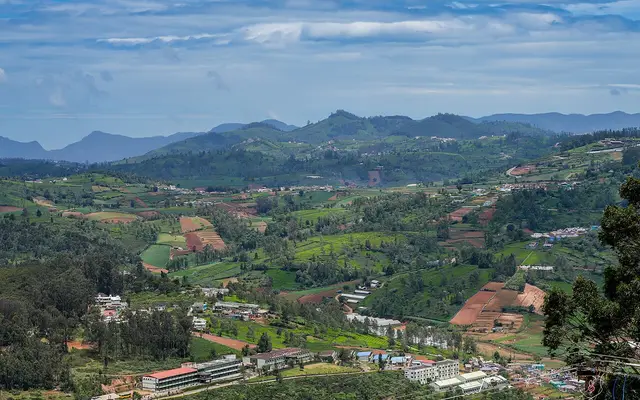
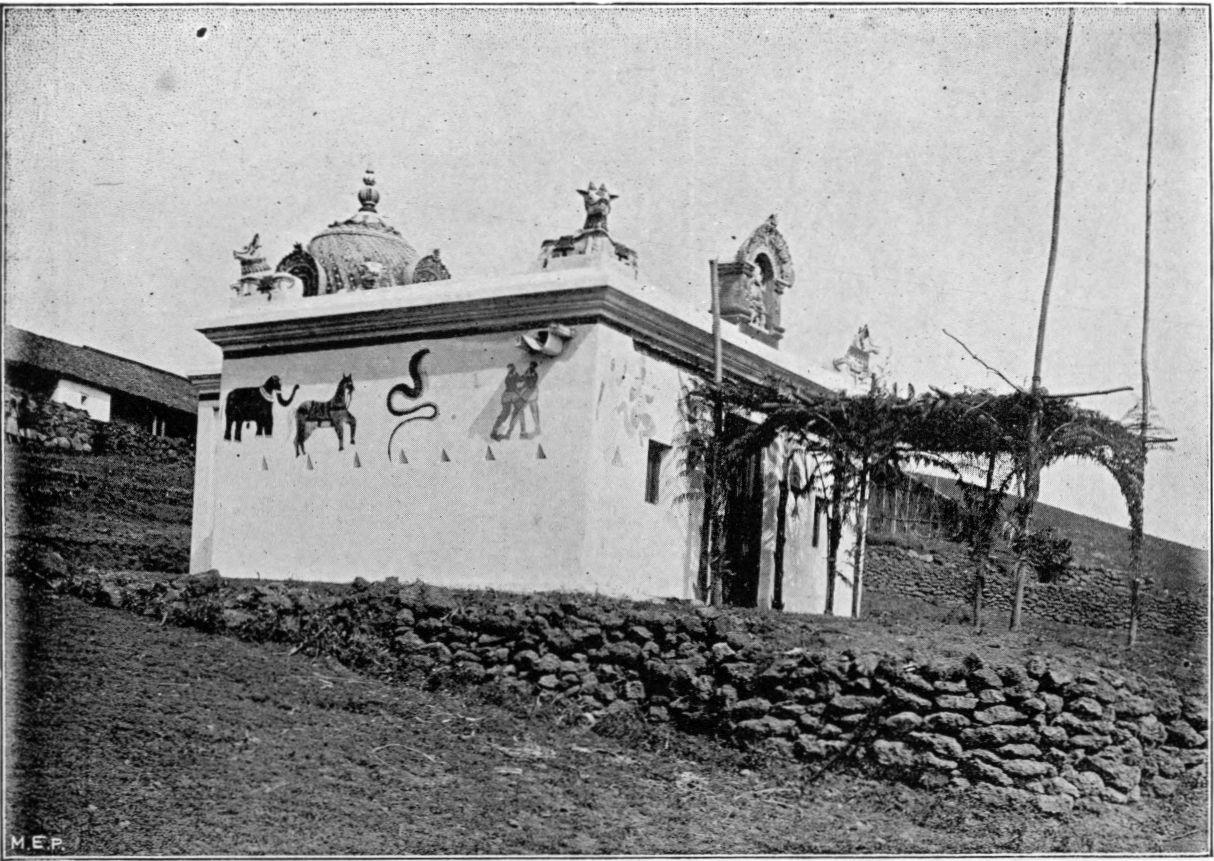
The valley is farmed, and that is the thing the viewpoint photograph does not tell you. Look down from the rail and the green is not scenery: it is carrot and cabbage and potato in terraces, cut into red earth, with tea on the steeper ground and polytunnels where the flowers are grown. The people doing the farming are mostly Badaga, who are the largest community in this valley and whose language is the one you will hear in the shops before you hear Tamil. Their shrine to Hethai Amman, the mother goddess, stands nine hundred metres from the station, and her festival falls in the cold months around December and January.
The second thing in the valley is a factory. Ketti is known, to the extent that it is known for anything besides the view, for making needles — Needle Industries on the valley floor a kilometre and a quarter east of the station, with further plants at Yellanahalli under the Pony Needle name. It is the largest industrial employer here, and it sits alongside a mushroom farm, a tea factory and the flower gardens as the reason this is a place where people work rather than a place people look at. It is also, as far as we can establish, the least photographed industry in the Nilgiris: not one picture of it exists in any image index we can reach, under any licence.
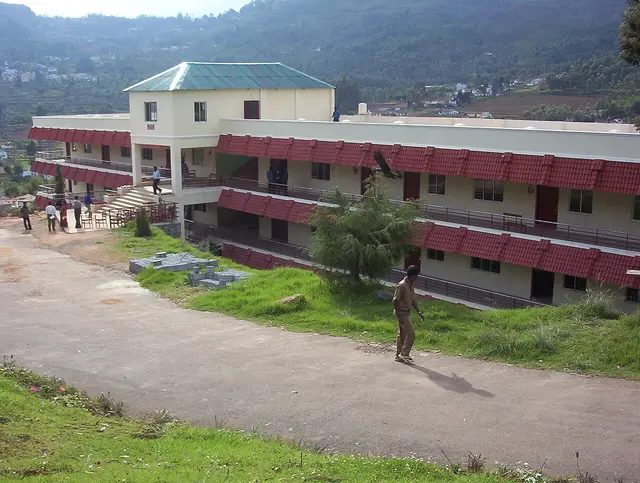
The third thing is education, and it is the most visible from the road. The southern slope carries a boarding institution on two hundred and twenty acres — St. George’s Homes, whose school is the Laidlaw Memorial School and Junior College — and further down the valley the CSI College of Engineering, founded in 1998 by the Church of South India’s Coimbatore diocese. Both are the residue of the same thing: Christian missions worked this valley hard from the early 1900s, and what they left behind was not congregations so much as classrooms. The long red-roofed block you can pick out from the viewpoint is the engineering college.
St. George’s began somewhere else and as something else. It was an orphanage, founded by John Breeden with money given by Robert Laidlaw, a Glasgow-born draper who had made a fortune in Bombay, and it started in Kodaikanal before it came to these hills. When exactly it reached Ketti is a question the published record does not answer consistently: the school dates itself to 1914, the standard reference account says the institution moved here from Kodaikanal in 1922, and we have found no source that reconciles the two, so both are printed. In 1941 its headmaster was M. A. Wynter-Blyth, better remembered outside the school as the naturalist who wrote the standard book on the butterflies of the Indian region.
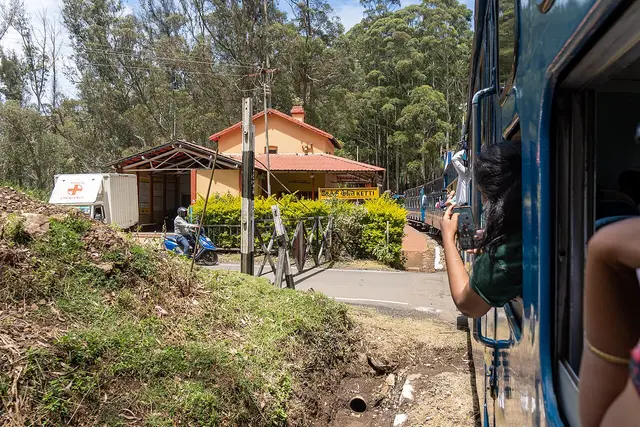
And the railway runs through all of it. Ketti station — code KXT, an NSG-6 halt in the Salem division of Southern Railway — is one stop below Lovedale and two below Ooty on the Nilgiri Mountain Railway, which is part of the Mountain Railways of India World Heritage Site. The platform sits directly on the village road, so you can stand at it without travelling on it, and the station building has been photographed often enough that you can watch it change: blue and white in 2010, orange with red tile by 2025, the same yellow board reading கேத்தி, केत्ती and KETTI through both.
One thing that is said about Ketti everywhere should be said about carefully. Guidebooks, travel sites and a good deal of Indian tourism copy state that this is the second largest valley in the world, or the largest in Asia, or one of the largest gorges on earth. We can find no measurement, no survey and no official or scholarly source behind any version of it, and the versions contradict each other, which is usually what a claim looks like when it has been copied rather than checked. It is a wide, deep, thoroughly inhabited valley and it does not need the superlative. We have taken it off this page rather than repeat it.
What can be documented about the weather here is stranger than the superlative anyway. On 8 November 2009, as the system that became Cyclone Phyan crossed, Ketti recorded 82 centimetres of rain in twenty-four hours — beating the previous twenty-four-hour rainfall record for the whole of Tamil Nadu. Eight hundred and twenty millimetres in a day, on a hillside of terraced red earth. That is the fact worth carrying away about this valley, and nobody puts it on a signboard.
Legend & myth
The shrine nine hundred metres from Ketti railway station is a Hethai Amman shrine, and it is not quite the small Hindu temple a visitor takes it for. The Badaga — the largest community in this valley, and the one whose language you will hear in its shops before you hear Tamil — worship their seven founding ancestors under the name Hethappa, or Hetha. A Hethai shrine is a community worshipping the people it believes it descends from.
Their own tradition says those seven were siblings. It holds that the Badaga came up from the plains of Mysore, and that the founding lines descend from seven brothers and sisters who had been living in the Thalaimalai hills until they fled a ruler who tried to rape their sister; scattering into different corners of the Nilgiris, each became the ancestor of a line. The story follows one brother in particular, Hethappa: while he was away working, two Todas assaulted his wife and took his goods, and he got help from two men of the Bayaluru who agreed on the condition that they marry his daughters. It is oral tradition rather than history, recorded by outsiders, and it has the shape origin stories usually have — a flight, a wrong, a bargain, and a scattering into the places people now live. The anthropologist Paul Hockings, who spent nearly six decades on Badaga ethnography, put the question the other way about: the community, he wrote, is as indigenous to the Nilgiris as the English are to Britain.
One practice from the early 1900s says more about how seriously this was held than any description could. The most solemn Badaga oath was sworn at the Sri Mariamman temple, and the form was exact — you bathed, brought a coconut and fruit, killed an animal and laid its head on the shrine step, then from seven feet away walked to that step and put out the lamp burning before the idol. Extinguishing the light was the oath. British judges knew of it and used it, sending a witness off to perform it with a court official watching, and taking that as the measure of whether the witness was telling the truth. The reverence has not gone: every April the Badaga still pull a car carrying the image of Sri Mariamman through Ooty to their own music and dancing.
The Hethai festival falls in the cold months around December and January. It is a living village shrine and not a monument — opened by the community rather than kept open. Ask before you go in, and ask before you photograph anybody.