Kasaragod is Kerala's northernmost municipality — about fifty-four thousand people on sixteen and a half square kilometres of laterite, spread along the north bank of the Chandragiri river where it meets the Arabian Sea. It has been a district headquarters only since 1984, and it is a town most travellers pass through on the way to Bekal, Madhur or the backwaters. That is a pity, because three things here belong to nowhere else. It gives its name to a handloom saree with its own geographical indication, now woven by a co-operative of thirty-five people, all of them women. It sits on the classical line where Malayalam gives way to Tulu, and its ritual life changes with it. And it is the administrative seat of the endosulfan disaster, whose compensation orders are still being signed in 2026.
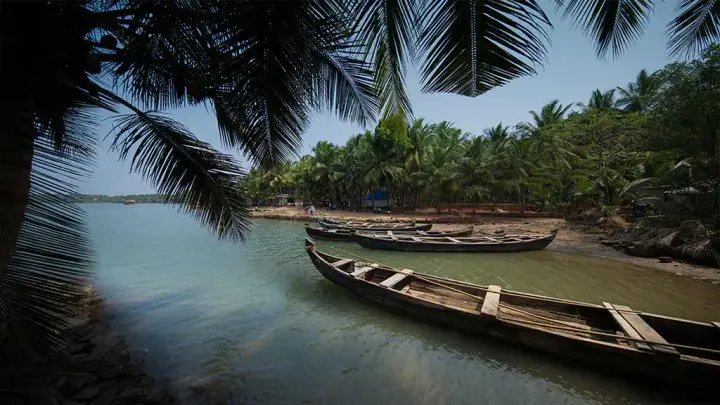
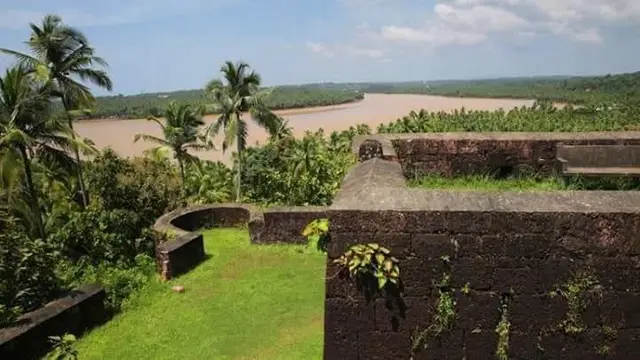
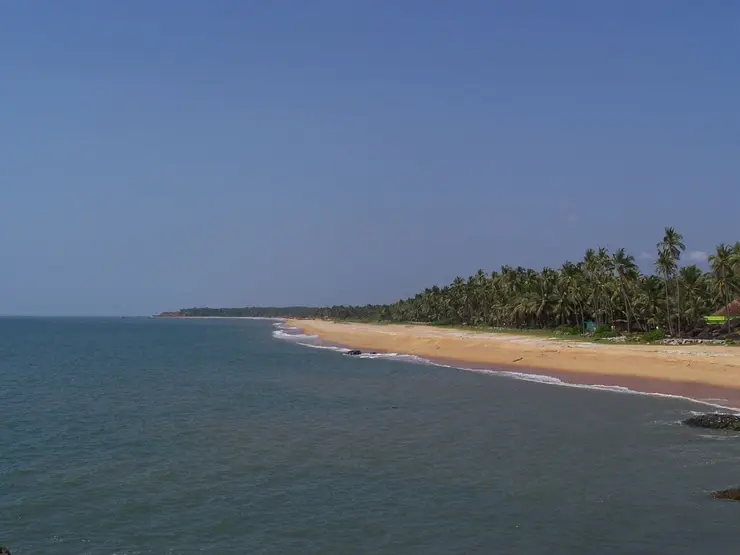
Start with the river, because the town is arranged around it. The district administration's own description is blunt about the geography — the municipal town is situated on the bank of the river Chandragiri — and the river reaches the sea just south of Thalangara, at the town's own edge. The Chandragiri runs about 105 km from the Western Ghats, and everything about Kasaragod's position, its trade and its politics follows from being the settlement at its mouth. The ground is laterite: rusty, iron-red, soft when cut and hard in the sun, and it shows in the road cuttings, the compound walls and the dust of every temple courtyard in town.
This is a frontier town in the most literal sense. The Chandragiri is the classical dividing line of this coast — the country north of it belonged to Tulu Nadu and the Kumbla dynasty, and the country south of it to Kolathunadu. Kasaragod town sits on the line itself, which is why it does not sound like the rest of Kerala. The census is specific: in Kasaragod taluk, Malayalam is spoken by 70.5 per cent, Tulu by 16.2 per cent, Kannada by 6.4 per cent, Marathi by 2.7 per cent and Konkani by 2.3 per cent. Sixty years earlier, in the 1951 census, the figures were 72.0 per cent Malayalam, 14.2 per cent Tulu and 6.3 per cent Kannada — a remarkably stable mixture for a district that changed states in between.
The town's own product is cloth. Kasaragod sarees are woven by families of the Saliya (Shaliya) weaving community, and the tradition is usually traced to the eighteenth century, when weavers moved down from the Karavali coast and pathmasaliya families came in from the Kingdom of Mysore. The technique has a signature that weavers here will demonstrate rather than describe: every thread is dipped in starch before it goes on the loom, so that where most cotton dulls with washing, a Kasaragod saree comes back brighter. The yarn is fine — counts of roughly sixty to a hundred — the body is plain or striped in dyed yarn, the borders are worked on jacquard or dobby attachments, and vat dyes are used because they hold.
The craft has a formal home and a formal name. The Kasargod Weavers' Co-operative Production and Sale Society Ltd was set up in 1938 and still works out of Udayagiri in Vidyanagar, on the town's inland side. The Government of Kerala applied for a geographical indication in 2009 and the Government of India granted it in 2010, under GI Registration No. 170; Kasaragod is one of only four GI-protected handloom clusters in Kerala, alongside Balaramapuram, Chendamangalam and Kuthampully. Sarees run from around ₹1,100 to ₹20,000 depending on the work. The sobering figure is the workforce: the Industries Department's own account puts thirty-five labourers under the society, and notes that all thirty-five are women, with younger people staying away from wages that do not match the labour.
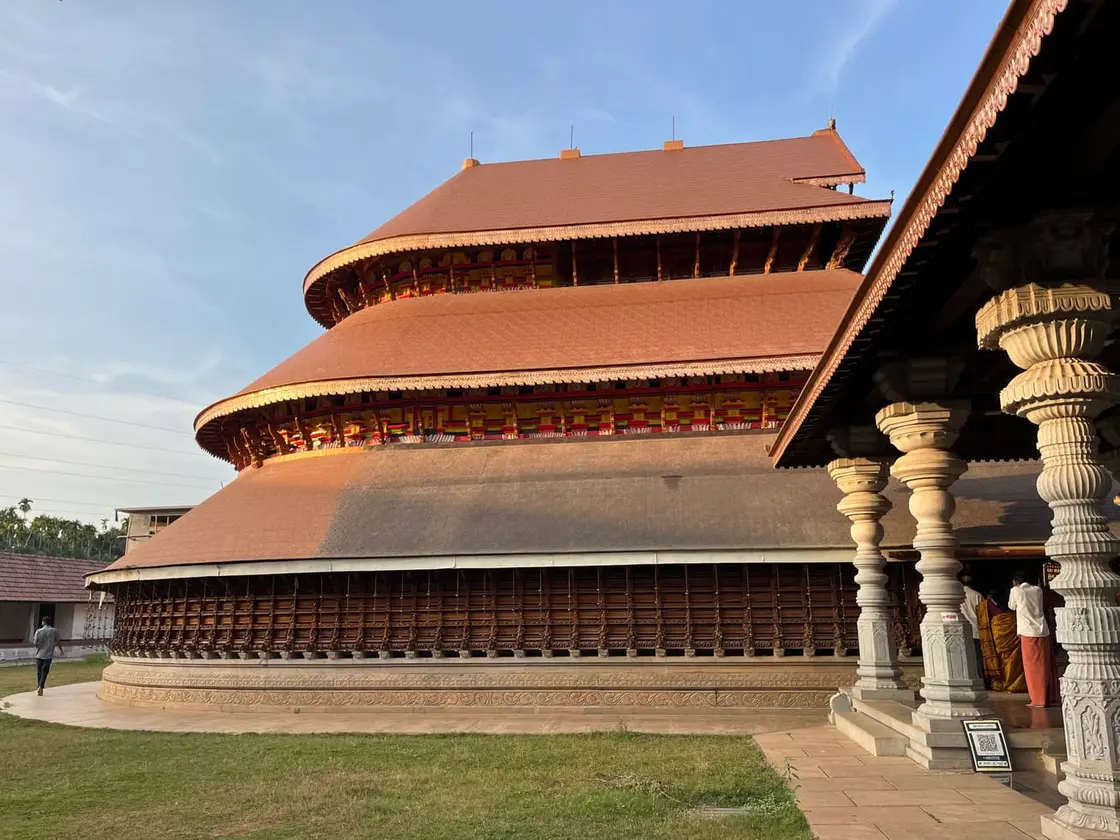
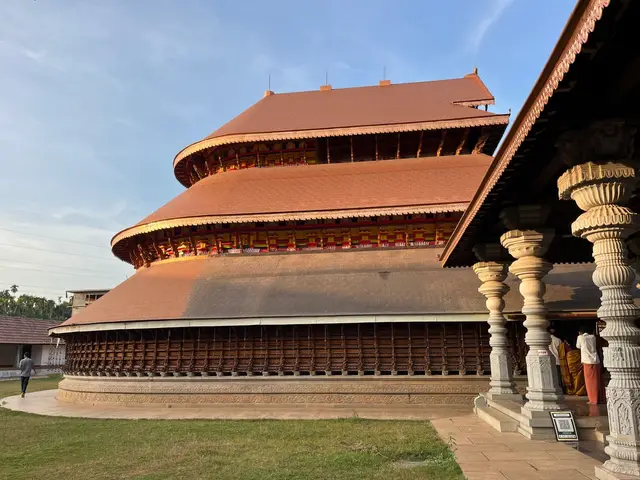
At the centre of the town is the Mallikarjuna temple, one of its oldest structures and the anchor of its calendar. It is dated to the seventeenth century and attributed to the Ikkeri kings, who are said to have built it so that warriors brought down from Karnataka would have somewhere to worship — a piece of frontier administration turned into a building. In 1977 the temple's land was acquired for the railway line and the site had to be shifted, the important structures being rebuilt afterwards by a renovation committee. The annual festival falls in the Malayalam month of Meenam (March–April) and runs five days; the concluding night is given to Yakshagana, which plays in the temple courtyard until daybreak. Yakshagana's origins belong to Kumbla, twelve kilometres north, and have their own page here.
Kasaragod is also where the state's response to the endosulfan tragedy is administered, and it deserves to be stated plainly rather than dramatically. From the late 1970s the Plantation Corporation of Kerala sprayed the pesticide endosulfan from helicopters over its cashew estates in this district, three times a year, across a belt covering eleven panchayats. Spraying was suspended in 1998 after sustained local opposition and banned in the state in 2001. Medical camps run in 2010, 2011, 2013 and 2017 identified 6,727 affected people in five categories; 6,600 remain on the official list. The Supreme Court ordered ₹5 lakh for each of them in January 2017. On 24 February 2026 the state sanctioned a further ₹48.85 crore so that 977 more people — among 1,031 excluded from earlier recognition — could be paid at the same rate, through the District Collector here. The full chronology, with its sources, is in the history section below.
For a small town it carries an unusual concentration of national institutions, and both of them grew out of the coconut. The Coconut Research Station at Kasaragod was established in 1916 by the then Government of Madras, taken over by the Indian Central Coconut Committee in 1948, and became the core of the Central Plantation Crops Research Institute when CPCRI was constituted under the ICAR in 1970; its campus is at Kudlu, just outside town. The Central University of Kerala, established in 2009, has its campus on the Periya hills inland. Together they mean that a good deal of India's palm and plantation science happens within a short drive of the Chandragiri bridge.
In October 2023 the district did something no other district in India had done: it declared its own official tree, flower, bird and species. The tree is the kanjiram, Strychnos nux-vomica — the tree the district is named after. The bird is the white-bellied sea eagle, Haliaeetus leucogaster, a Schedule I species that ranges along this coast. The flower is the Periya polathali, Crinum malabaricum, found in streams rising off the laterite hills here and nowhere else. The species is Cantor's giant softshell turtle, Pelochelys cantorii, known locally as bheemanama.
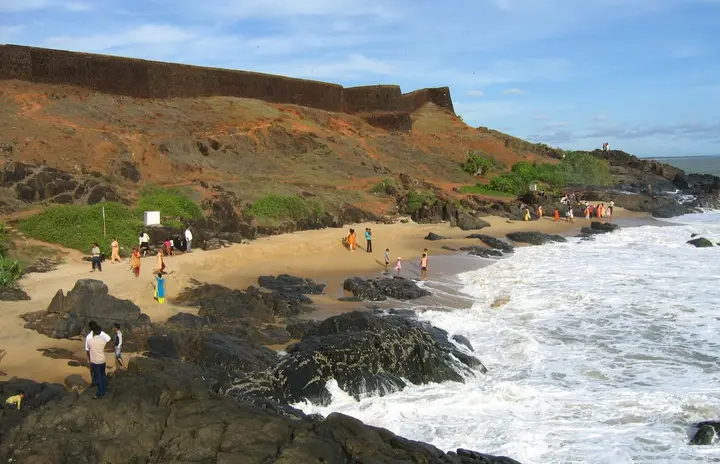
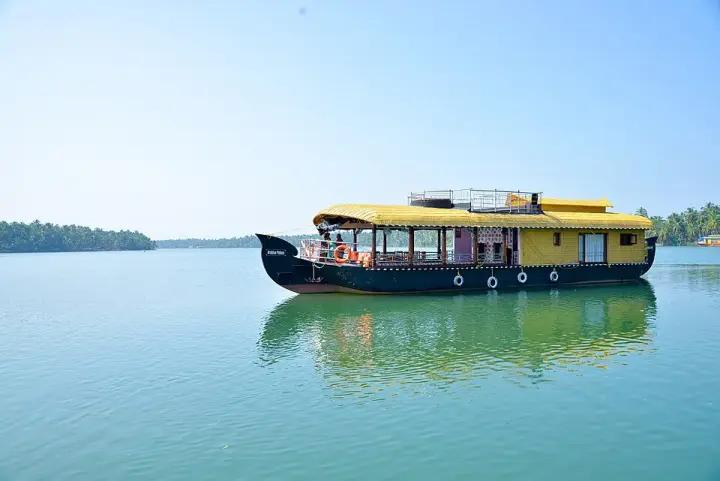
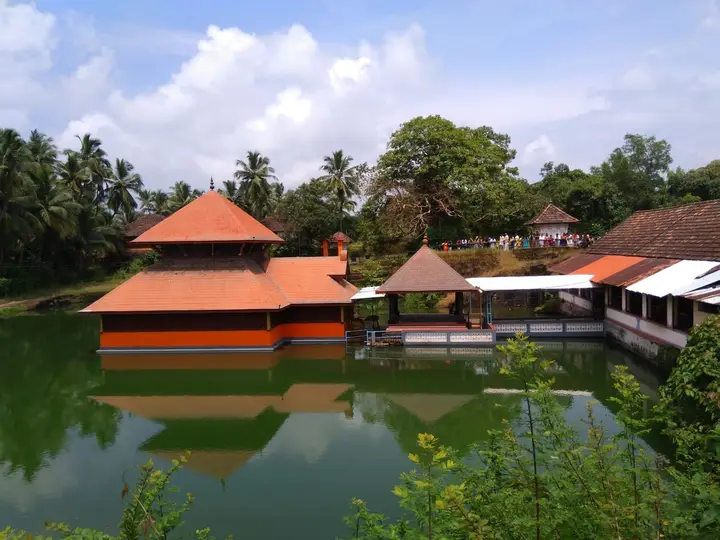
Be clear about what the town is and is not. It is a working district headquarters with a railway station, a bus stand, a hospital belt and a shopping street, not a resort. Almost everything a visitor comes north for is somewhere else: Bekal to the south, Madhur inland, Chandragiri Fort three kilometres across the river, Kumbla and the Ananthapura lake temple to the north, the Valiyaparamba backwaters beyond. All of them have their own pages here. What the town gives you is the thing those pages cannot — a place where the languages, the food, the ritual calendar and the cloth all change at once, within a few streets.
Legend & myth
The town's name is a plant, and the plant is a poison. The most-cited derivation takes Kasaragod from the Kannada kāsara, a name for Strychnos nux-vomica — the strychnine tree, the poison-nut — and gōḍe, a rampart or wall: the rampart of nux-vomica trees. The Malayalam form runs in parallel: the area was known as kāññirakkōṭŭ, the land of the kāññiram, which is the same tree under its Malayalam name. Malayalam Wikipedia gives a third route through the Kannada kusira koot, an arrangement or thicket of kusira trees, Malayalised to kanjirakkoot. The three explanations agree on the tree and disagree on the second half of the word, and we are not going to smooth that over. What is not in doubt is that the tree carried the meaning: in October 2023 Kasaragod became the first district in India to adopt official natural symbols, and the tree it chose was the kanjiram it is named after — a seed that is a poison in one dose and a medicine in another, made into a civic emblem.
The town's own temple keeps a small legend of its own. The Mallikarjuna temple in the centre of Kasaragod is dedicated to Shiva under the name Mallikarjuna — a name best known from Srisailam — and the tradition here holds that the image of Shiva in this temple was adorned by Arjuna, the Pandava of the Mahabharata. It is a brief, unelaborated claim rather than a developed cycle of stories, and it should be told as what it is. The documentary account sits beside it quite comfortably: the Ikkeri kings are said to have raised the temple in the seventeenth century so that the warriors they had brought down from Karnataka would have a shrine. A garrison temple with a Pandava attached to it is a very Kasaragod kind of building.
The living ritual of this town is not a legend told about the past but a figure who arrives at your door. In the Tulu month of Aati — Ashadha, the deep monsoon of July and August, when the fields are flooded and no agricultural work is possible — the Aati Kalenja comes through the villages. The performers belong to the Nalike community. The costume is made of what the season provides: tender coconut fronds interlaced with banana sheath, a long cap of areca-nut spathe, a headgear or mudi built on the stems of Ixora coccinea and dressed with flowers, and a parasol of leaves and flowers carried overhead. A tembare drum sets the rhythm and a folk song carries the words.
The belief attached to the Kalenja is precise about its job. It is held that the spirit comes down during Aati to protect people from disease at the very moment when disease is most likely — the weeks when standing water and heat make sickness certain. The blessing is understood to cover cattle against murrain and crops against pests, and to break the hold of spirits sent by sorcerers. At each house the Kalenja dances, blesses, and takes what is given: rice, coconut, turmeric, charcoal. Then it moves to the next house. Reporting from Kasaragod describes the practice as surviving on the edge — performed almost in every village of Tulu Nadu within living memory, and now sustained by a handful of families.
There is a hard irony in that, and it belongs on this page rather than in a footnote. The Aati Kalenja exists to keep sickness out of the crop and the household. In this same district, over roughly two decades, a pesticide was sprayed from helicopters onto the cashew crop three times a year, and the sickness came into the households anyway — documented, counted and eventually compensated by court order. Nothing about the ritual caused or prevented that. But it is worth noticing that Kasaragod holds both: a very old technology for warding harm off a crop, and a very modern one that put harm into it.
The town also sits on a ritual frontier as sharp as its linguistic one. South of the Chandragiri lies the Theyyam country of north Malabar, where a costumed and painted performer becomes the deity and is worshipped as such. North of it lies the Tuluva world of bhuta kola or daiva aradhane, addressed to spirit-deities in shrines called garodi; the Garodi Sri Brahma Baidarkala at Hosamane in Adukkathu Bayal is in this district. Scholars describe the two as equivalents of one another rather than as opposites, and the boundary is a convention of description, not a fence — both traditions are performed on both banks. But Kasaragod town is one of the few places in India where you can be in walking distance of the meeting of two entire liturgical systems.
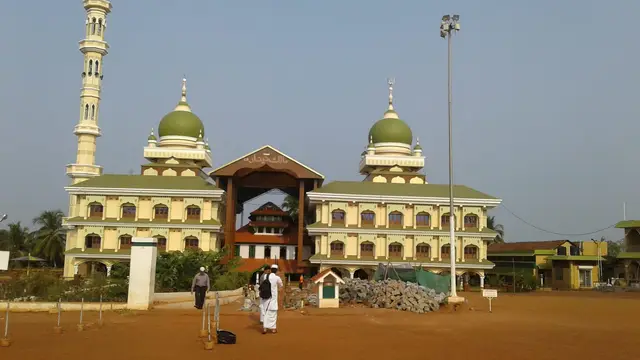
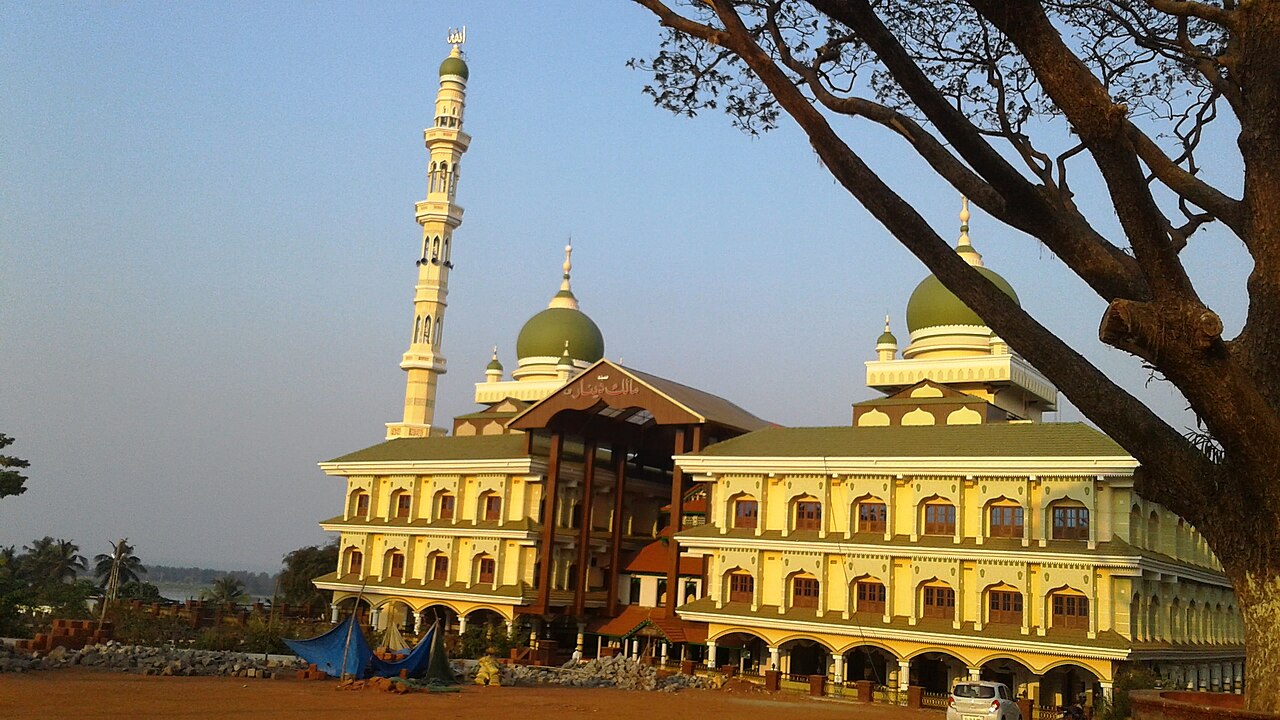
The Muslim shrine that belongs to this record is not the famous one. Nellikunnu, just outside the town, has the Muhyaddin Juma Masjid, dedicated to the saint Muhyiddin Abdul Qadir Jilani, and it houses the tomb of a saint remembered locally as Thangal Uppappa. His Uroos — the observance of a saint's death anniversary — draws pilgrims from well beyond the district, and the mosque is one of the principal pilgrimage centres of Kasaragod. The sources disagree on when it falls, and we print both: Wikipedia states that it takes place once every two years, usually in the month of Dhul Hijjah, while travel and district descriptions describe a week-long Nercha in November. We could not resolve which is current, and a visitor should ask locally rather than trust either.
One legend we are refusing outright, because it keeps being attached to this town and does not belong to it. Kanwatheertha — the natural sea pool on the beach whose name carries the sage Kanva — is at Manjeshwar, about 33 km north of Kasaragod town, and it is that beach's story, not this one's. Likewise, the two grandest religious traditions of this district — the Malik Ibn Dinar tradition at Thalankara and the Ganapathi legends of Madhur — have their own pages on this site, told there in full, and are deliberately left alone here.
More about Kasaragod town
History
In the earliest reckoning this coast formed part of Puzhinadu, the coastal belt running from Kozhikode to Mangalore, and politically it belonged to the Ezhimala kingdom; by the fourteenth century the successor Mooshaka kingdom was known as Kolathunadu, under rulers styled Kolathiris. The Chandragiri was the working boundary of that world — Tulu Nadu and the Kumbla dynasty north of it, Kolathunadu south. One literary claim for the district is large and worth stating with its hedge intact: Ramacharitam, often described as the oldest surviving literary work in Old Malayalam and dated to about the twelfth century, is thought to have been composed in this district, its manuscripts having been found at Nileshwaram.
The colonial record for the town begins to firm up around 1800, when Francis Buchanan travelled this coast and documented places including Bekal and Chandragiri. Political control had already changed hands: after the Treaty of Seringapatam in 1792 the British held the region. In 1862 South Canara was transferred to the Madras Presidency, and Kasaragod taluk replaced the older Bekal taluk in the administrative map — at which point Kasaragod was the second-most populated taluk in South Canara. That is the crucial administrative fact behind the town's later character: for most of the nineteenth and early twentieth centuries it was governed from Madras as part of a Kannada-and-Tulu-speaking district, not from Travancore or Cochin.
On 1 November 1956, at the linguistic reorganisation of the states, Kasaragod became part of Kerala — which is how a substantially Tulu- and Kannada-speaking population came to sit inside a Malayalam-speaking state. The district itself is recent: it was formed on 24 May 1984 under Government Order GO (MS) 520/84/RD of 19 May 1984, out of the Hosdurg and Kasaragod taluks of the undivided Kannur district. Two further taluks, Manjeshwaram and Vellarikundu, were added in 2013, bringing the district to four. Kasaragod town is governed by a municipality of 35 wards; the 2011 census recorded 54,172 people (26,319 male, 27,853 female) over 16.69 sq km, with a literacy rate of 94.76 per cent, and a religious composition of about 54.6 per cent Muslim, 43.6 per cent Hindu and 1.58 per cent Christian.
The endosulfan chronology, stated with the body that stated each fact. Cashew planting around Padre began in 1963–64; trial spraying was conducted in 1977–78 and aerial spraying began in 1978 after the Plantation Corporation of Kerala took over the plantations, applied from helicopters three times a year across estates in eleven panchayats including Enmakaje, Bellur, Kumbadaje, Pullur and Periye. Spraying was suspended in 1998 after public opposition and banned in 2001. The National Institute of Occupational Health, in its investigation of unusual illness at Padre, found traces of endosulfan in water and in blood samples from the village. On 31 December 2010 the National Human Rights Commission recommended that Kerala pay at least ₹5 lakh to the next of kin of those who had died or were fully bedridden, unable to move unaided or mentally disabled, and ₹3 lakh to those with other disabilities, with a panel of doctors to grade the categories. On 13 May 2011 the Supreme Court, on a petition by the Democratic Youth Federation of India, imposed an interim ban on the production, distribution and use of endosulfan in India; endosulfan was approved for global listing under the Stockholm Convention in April 2011.
The compensation history since is a matter of court orders and state accounts. On 10 January 2017 the Supreme Court directed that the balance of ₹5 lakh each be paid to affected persons within three months, irrespective of category. Medical camps in 2010, 2011, 2013 and 2017 had identified 6,727 people; 6,600 remain on the official list, and reporting states that disbursement to the 6,727 was completed in October 2022. The 2017 camp had separately flagged 1,905 suspected victims, and 1,031 people were left out of recognition; on 24 February 2026 the Social Justice Department sanctioned ₹48.85 crore, authorising the Kasaragod District Collector to pay ₹5 lakh each to 977 of them under the Kerala Social Security Mission's Comprehensive Package for Victims of Endosulfan. We give these figures as the state and the courts gave them and estimate nothing beyond them.
The town's two other institutional histories are quieter. The Coconut Research Station was established at Kasaragod in 1916 by the Government of Madras, passed to the Indian Central Coconut Committee in 1948, and was merged with the stations at Kayamkulam and Vittal to form the Central Plantation Crops Research Institute under the ICAR in 1970. The Kasargod Weavers' Co-operative Production and Sale Society was registered in 1938; Kerala filed for a geographical indication for Kasaragod sarees in 2009 and it was granted in 2010 under GI Registration No. 170. The Central University of Kerala followed in 2009.
Why visit
To buy a Kasaragod saree where it is made — GI Registration No. 170, woven at the 1938 co-operative in Vidyanagar by a workforce now down to thirty-five people, all of them women.
Because the languages change here: 70.5 per cent Malayalam, 16.2 per cent Tulu, 6.4 per cent Kannada, and Marathi and Konkani besides, all inside one taluk.
For the Mallikarjuna temple in the town centre, and for its five-day Meenam festival, whose last night runs on Yakshagana until daybreak.
For the Uroos at Nellikunnu, a pilgrimage that fills the town and belongs to a different shrine from the famous one at Thalankara.
Because it is the practical base for everything in the far north — Bekal, Madhur, Chandragiri Fort, Kumbla and the Valiyaparamba backwaters are all short drives, and all have their own pages here.
To see what a district headquarters looks like when it carries an environmental disaster on its books: the compensation for endosulfan is still being signed out of this town in 2026.