What to expect
Highlights
- Temple visit at Kottarakkara Sree Mahaganapathi Temple
- Kerala temple architecture and rituals
- Local food, shops and pilgrim services nearby
A large temple beside its own tank at Kottarakkara, where the central deity is Shiva but the sub-shrine to his son gives the place its name and its fame; the offering is unniyappam. The Kottarakkara Thampuran credited with Ramanattam, the immediate ancestor of Kathakali, is memorialised in the same town.
Check entry arrangements. Ask temple staff about visitor entry, dress requirements and access to the inner shrine before you travel, especially if you are visiting as a non-Hindu.
Dress respectfully and follow the institution’s admission and photography rules.
A large temple beside a big rectangular tank in the middle of Kottarakkara, about 26 km east of Kollam on the MC Road. Everyone calls it the Ganapathi temple, and the central deity is Shiva — the son's shrine has simply become more famous than the father's, which the temple's own foundational story predicted it would. The offering is unniyappam, and the town is also where the Thampuran credited with Ramanattam is remembered.
The first thing to get straight is the dedication, because the name of the place actively misleads. This is a Shiva temple. The main sanctum holds Shiva; the Ganapathi shrine is a sub-shrine. And yet nobody, including the temple's own signage in practice, calls it anything but the Kottarakkara Ganapathi temple — the Sree Mahaganapathi Kshethram — because the sub-shrine is what draws the crowds and what the town is known for across Kerala.
What is unusual is that the tradition here does not treat that as an embarrassment to be explained away. It treats it as prophecy fulfilled. The story attached to the founding of the Ganapathi shrine has the chief priest telling the sculptor, at the moment the idol was installed, that although the father is the main deity, the son will be the more famous one in this temple. Three hundred years or so later, that is simply a description of the situation. A temple whose own origin legend predicts that its principal deity will be upstaged is a rare thing, and it is the most interesting fact about the place.
The sculptor in the story is Perumthachan — the legendary master carpenter of Kerala tradition, to whom an enormous number of the peninsula's finest timber structures are attributed, generally without evidence and often across spans of time no single craftsman could have covered. Perumthachan is to Kerala building what a handful of names are to European cathedrals: a way of saying this is very good work, of the old kind. We record the attribution as tradition and leave it there.
It is Perumthachan, in the same tradition, who is said to have offered unniyappam to the Ganapathi here — and unniyappam is what you will be handed today. It is a small, dark, round sweet fried in ghee, made from rice with jaggery and banana, cardamom and coconut pieces, and it is prepared at this temple in volume. Of all the offerings in Kerala's temples this is one of the very few that has become a regional food in its own right; a great many Malayalis know the words Kottarakkara and unniyappam as a pair before they know anything else about the town.
Then there is the second story, the one that gets Kottarakkara into every account of Indian classical dance. In the seventeenth century a ruler of Kottarakkara — Veera Kerala Varma, remembered simply as the Kottarakkara Thampuran, with dates given as 1653 to 1694 — composed Ramanattam, a cycle of eight plays on the life of Rama. Ramanattam is very widely held to be the immediate ancestor of Kathakali.
The eight are named and they read as a syllabus: puthrakameshti, seetha swayamvaram, vicchinnabhishekam, kharavadham, balivadham, thoranayudham, sethubandhanam and yudham — the war. Taken together they are the Ramayana staged as a sequence, which was itself the innovation: not one episode performed as ritual, but a narrative arc built to be watched over successive nights.
Why he wrote it is where the story becomes a story. The standard telling is that the Zamorin of Calicut had composed Krishnanattam, a cycle on the life of Krishna, dated to 1657; that the Kottarakkara ruler asked to borrow the Zamorin's performers for an occasion of his own; and that the Zamorin refused, with a remark to the effect that the Kottarakkara court would not be capable of appreciating them. So Kottarakkara wrote his own cycle, on Rama rather than Krishna, and in the language of the people rather than in Sanskrit.
Our own page on Kathakali already says what needs saying about that: the elements are real — Krishnanattam and Ramanattam both existed, and Kathakali plainly descends from that milieu — but the snub itself is the kind of neat causal insult that oral tradition is extremely good at manufacturing, and the evidence for the exchange is thin. Political rivalry between chieftains turning into artistic rivalry makes a better anecdote than it does a citation. Take the rivalry as the frame the tradition chose for itself.
What the town can show you is more solid than the anecdote. Kottarakkara has a Kottarakkara Thampuran Memorial Museum of Classical Arts — a real institution, in the town, mapped and photographed, holding exhibits on the performing traditions the Thampuran is remembered for. If you have come for the Kathakali connection, that is the address for it, rather than a tree.
Because there is a tree in the story too. Tradition says the Thampuran wrote Ramanattam sitting beneath a banyan near the temple. It is a lovely image and we are not going to certify it. What we will say is that it is doing something specific: it is attaching a court's literary project to a temple's ground, and those are two different claims. That the Kottarakkara Thampuran composed Ramanattam is widely held. That he composed it at this temple is tradition, and it should be enjoyed as one.
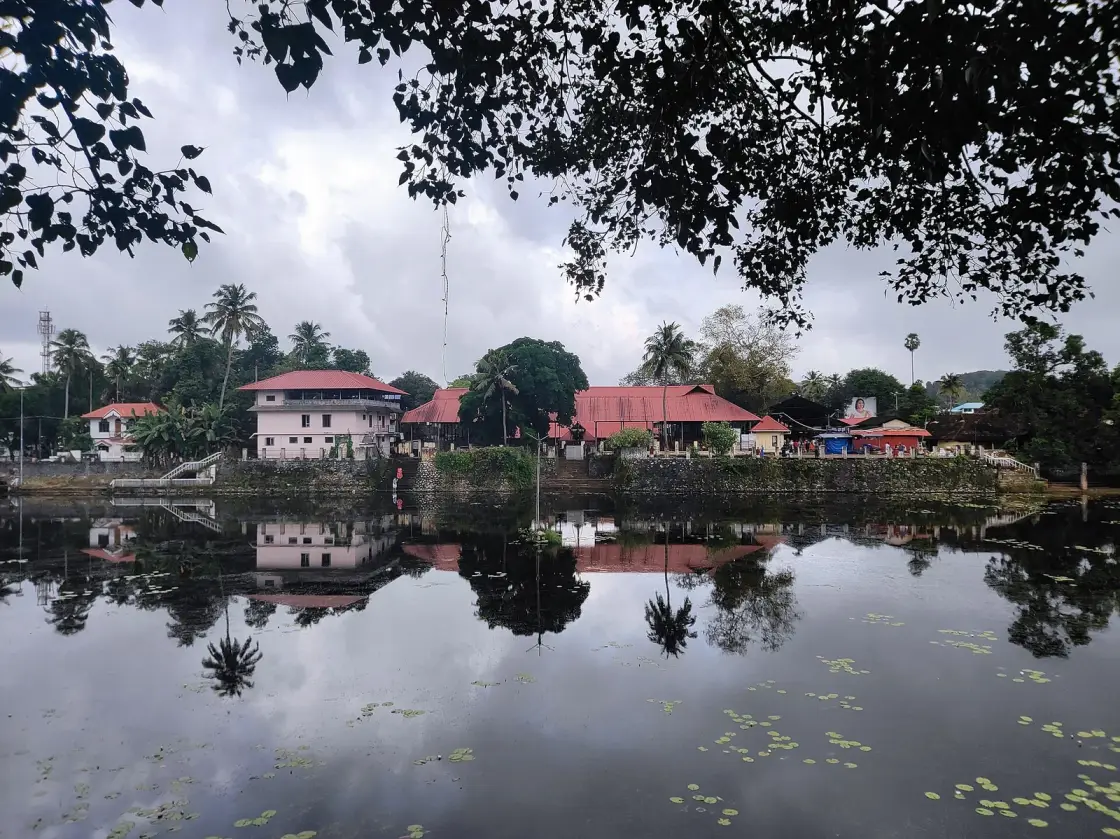
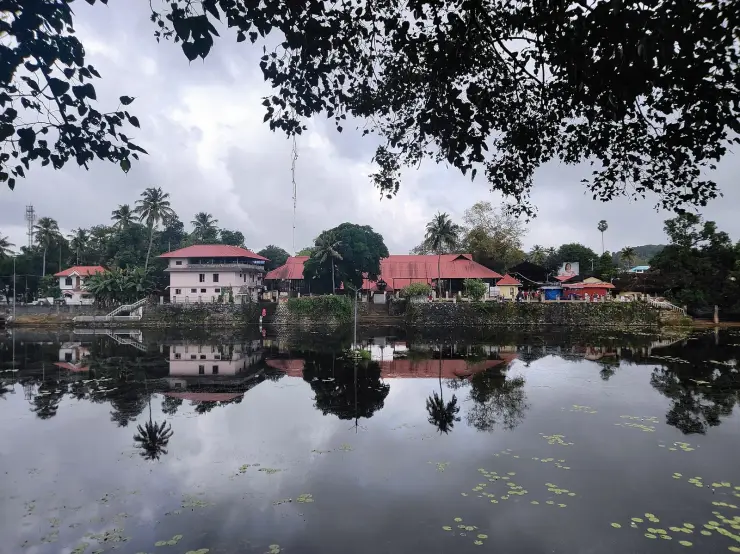
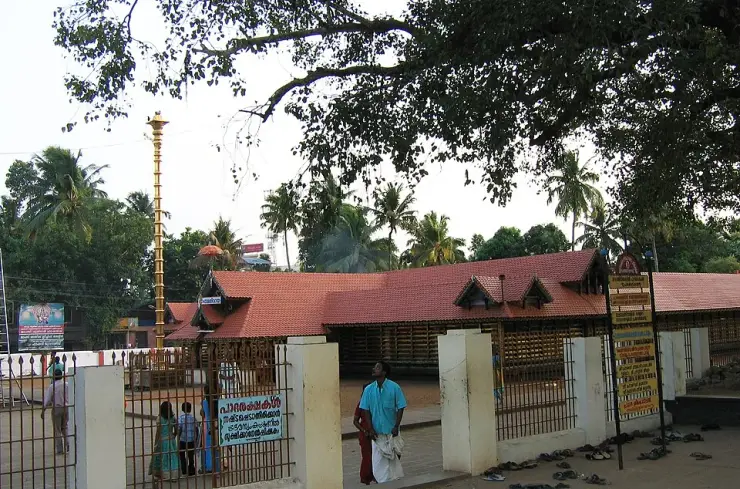
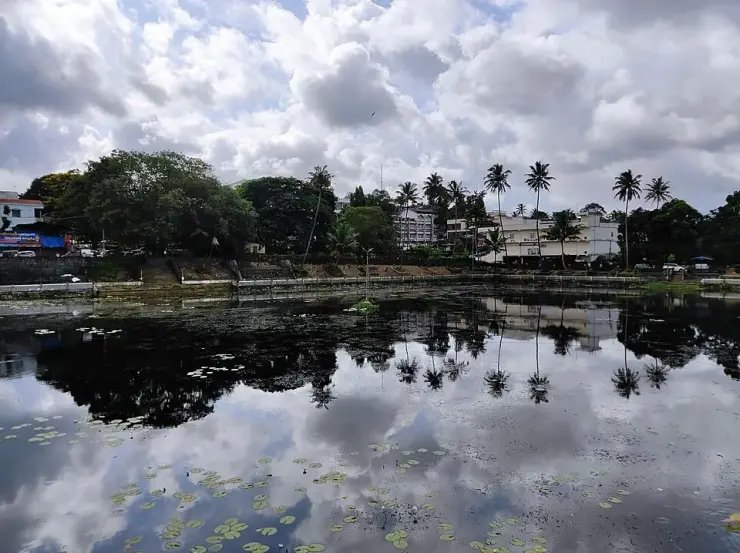
As a building the temple is straightforwardly, satisfyingly Kerala. Long ranges of tiled roof with gabled dormers and carved ends; walls of close-set timber slats above laterite; a tall gold-clad dhwajastambham standing in the forecourt; footwear left in rows outside the gate, because it is left outside the gate rather than at the sanctum door. Seen from across the tank at dusk the whole complex is a low red-roofed line with its own reflection under it, laterite retaining walls dropping straight into the water and lily pads across the surface. The tank is not scenery attached to the temple. In this part of Kerala it is part of the institution.
The first correction is the dedication, and it is the one that actually changes what you look at when you arrive. This is a Shiva temple with a famous Ganapathi sub-shrine, not a Ganapathi temple. Kerala Tourism's own page says it plainly: the main deity is Lord Shiva, with a sub-shrine dedicated to Lord Ganesha. Almost everything else written about the place, including its common name, inverts that. The inversion is not a mistake exactly — the sub-shrine really is the reason people come — but if you go in expecting the elephant-headed god in the main sanctum you will misread the whole layout.
The second is about the Kathakali claim, and we want to be careful in both directions because it is easy to overstate and easy to dismiss. What is widely held, and what our own Kathakali page already carries, is that a seventeenth-century ruler of Kottarakkara composed Ramanattam, and that Kathakali descends from it. What is tradition rather than record is the story of why: the Zamorin's refusal and the insult about the Kottarakkara court's inability to appreciate Krishnanattam. Our page on Kathakali calls that the kind of neat causal insult oral tradition manufactures, and we are not going to say something different here just because we are standing closer to it.
The third correction sits underneath the second and matters more than it looks. "Kathakali was born here" runs two separate claims together. One is that the Kottarakkara Thampuran composed Ramanattam — a claim about a person and a court. The other is that he did it at this temple, beneath a banyan tree in its grounds — a claim about a place. The first is widely held. The second is tradition only, and the two are frequently printed as though the second followed from the first. It does not. A raja's literary project belongs to his court before it belongs to his temple.
The fourth is a sourcing note that we would normally keep to ourselves, except that it changes how much weight the claim can carry. We had expected to find the Kathakali connection asserted on the Kerala Tourism page for this temple. It is not there. That page mentions the Shiva dedication, the Ganesha sub-shrine, the unniyappam and the location, and says nothing whatever about Kathakali, Ramanattam, the Kottarakkara Thampuran or Perumthachan. The state tourism department, writing about this temple, does not make the claim at all. That does not make the tradition false; it does mean it is a tradition rather than an official history, and we would rather you knew which you were being told.
The fifth is Perumthachan, and it is a general caution about a specific name. The master carpenter of Kerala legend is credited with a remarkable number of the region's finest timber buildings, across a span of time and geography that no individual craftsman could plausibly have covered. An attribution to Perumthachan is best read as the tradition's way of saying that this is very fine old work, in the manner of the great builders. It is not a construction record, and the idol-and-prophecy story attached to him here is a foundation legend, not a dated event.
The sixth point is chronology: no reliable founding date is published. The temple is described as centuries old and nothing more precise is available. The seventeenth-century material — Veera Kerala Varma, given as 1653 to 1694, and Krishnanattam dated to 1657 — belongs to the Ramanattam story, not to the building. Sources also differ on whether 1653 to 1694 are the Thampuran's regnal years or his lifespan, so the span is retained without assigning it either meaning.
The seventh is practical and small. Kottarakkara is a working taluk town, and the temple sits close to the civil station, the taluk office, the bus stand and the market. It is not a secluded shrine in a grove. The tank is the thing that gives it space and calm, and the walk around the tank is worth as much as the forecourt.
The temple is described as centuries old, and no founding date that we would rely on is available. Its foundational tradition concerns the installation of the Ganapathi idol, attributed to Perumthachan — the legendary master carpenter of Kerala, to whom a great many of the region's finest timber structures are ascribed — and the prophecy of the chief priest that although the father, Shiva, is the main deity, the son would become the more famous in this temple. That prophecy is a fair description of the temple's standing today.
The central deity is Shiva; the Ganapathi shrine is a sub-shrine, and it is the sub-shrine that has given the temple its popular name and its reputation across Kerala. The characteristic offering is unniyappam, a small ghee-fried sweet of rice with jaggery, banana, cardamom and coconut, traditionally said to have been offered here by Perumthachan. It is made at the temple in quantity and has become one of the very few Kerala temple offerings to establish itself as a regional food in its own right.
In the seventeenth century a ruler of Kottarakkara, Veera Kerala Varma — remembered as the Kottarakkara Thampuran, with dates given as 1653 to 1694 — composed Ramanattam, a cycle of eight plays on the life of Rama: puthrakameshti, seetha swayamvaram, vicchinnabhishekam, kharavadham, balivadham, thoranayudham, sethubandhanam and yudham. Ramanattam is widely held to be the immediate ancestor of Kathakali.
The tradition explains its composition as a response to a slight. The Zamorin of Calicut had composed Krishnanattam, dated to 1657; the Kottarakkara ruler is said to have asked to borrow his performers and to have been refused with an insult about his court's capacity to appreciate them. Our Kathakali record treats that exchange as the frame tradition chose rather than as an established event, and this page follows it. What is not in doubt is that Ramanattam was composed on Rama rather than Krishna and in Malayalam rather than Sanskrit, and that Kathakali as a distinct form emerged from that milieu, absorbing older Kerala performance traditions and later reshaped by reformers associated with Vettathu Raja and Kaplingadu Namboodiri.
Kottarakkara today is a taluk headquarters of Kollam district — the district's six taluks are Kollam, Kottarakkara, Pathanapuram, Karunagappally, Kunnathur and Punalur — and the town holds the Kottarakkara Thampuran Memorial Museum of Classical Arts, which commemorates the performing traditions the Thampuran is remembered for. The temple stands beside its tank close to the centre of the town, near the taluk office and the bus stand.
A temple whose own founding legend predicts that its principal deity will be upstaged by his son — and then was, which is the rarest thing here.
Unniyappam at its source: one of the very few Kerala temple offerings to become a regional food in its own right, made here in quantity.
The tank, which is the best of the site — laterite walls dropping straight into the water, lily pads, and the whole red-roofed complex reflected in it at dusk.
Classic Kerala temple building: long tiled roof-ranges with carved gabled dormers, close-set timber slat walls above laterite, and a tall gold-clad flagstaff in the forecourt.
The town of the Kottarakkara Thampuran, credited with Ramanattam — the eight-play Rama cycle from which Kathakali descends — with a memorial museum of classical arts in the same town.
An easy stop on the MC Road about 26 km east of Kollam, and a natural pairing with the Kottukal rock-cut cave temple in the same taluk.
Road km to Kollam; ghat roads and traffic vary — allow extra.
Morning or early evening is usually best; festival days can be powerful but crowded.
Live forecast loads in your browser.
Sun and moon are calculated for this location and shown in IST. Photography windows are the hour around sunrise and sunset; the sunset bearing is degrees clockwise from true north. Moon phase is accurate to about half a day.
Verified hotels, homestays, restaurants, experiences, sights, shops and rentals around Kottarakkara Sree Mahaganapathi Temple — commission-free, with direct contact. Filter by what you need.
KSRTC depot and bus station at the MC Road junction, with a booking counter. Office of the Assistant Transport Officer, KSRTC Kottarakkara, Kollam, Kerala 691534.
The 1904 station on the Kollam-Sengottai branch line, beside NH-744.
Ayurveda hospital at College Junction, Pulamon, with inpatient treatment. Sooraj Ayurveda Hospital, College Jn, Pulamon P.O, Kottarakkara, Kollam, Kerala 691531.
Book with the place itself. India’s cyber-crime coordination centre warned in April 2025 that convincing copies of hotel and pilgrimage booking sites are being pushed through sponsored search and social ads, taking payment for rooms the property never hears about. Every listing here links to the business’s own contact details and its own Google or Bing profile — we take no commission and sit in nobody’s payment path. If a booking page reached you through an ad, check the address bar against the property’s own site before you pay. Fraud can be reported on cybercrime.gov.in or on 1930.
Find food, accommodation and activities across Kottarakkara. Browse the guides for places to eat, stay and explore along your route.
Roampedia is commission-free — own or know a stay, eatery, guide or shop near Kottarakkara Sree Mahaganapathi Temple? List it and it appears here once verified.
Add a nearby businessEntry: Darshan is free. Vazhipadu offerings, including the unniyappam the temple is known for, are paid at posted rates at the counter.
Dress code: Traditional temple attire is expected — men customarily in mundu with the upper body bare or modestly covered, women in saree or salwar. Footwear is left at the outer gate, not at the sanctum door; there are rows of it outside the compound railing. Follow the notices at the entrance.
Festivals: Vinayaka Chaturthi is the natural high point for a temple known for its Ganapathi shrine. The temple and Kerala Tourism do not publish a formal utsavam programme or dates online, so obtain the current schedule locally or at the temple counter.
Photography: Photography is generally restricted inside the sanctum and may be limited elsewhere in the temple; the tank and the exterior are freely photographed. Ask staff and respect the signage.
If you are travelling by bus or ferry, check the return service with the operator before setting out. Leave time to reach the stop or jetty after your visit.
Ask at the bus stand for the time of the last service back, not the next one. If you miss it, an auto or app cab is the fallback — agree the fare before you get in.
If you need step-free access, contact the site before travelling. Ask about a level entrance, steps along the route, the nearest drop-off point, seating and accessible toilets.
Charge cap and free-transaction limits: Reserve Bank of India, in force since 1 May 2025.
These services are listed within about 1.2 km of Kottarakkara Sree Mahaganapathi Temple. Walking distances follow mapped routes; access and opening hours can change. Other services may be closer but are not included here.
Emergency numbers are verified against official government and state tourism sources. 112 works anywhere in India.
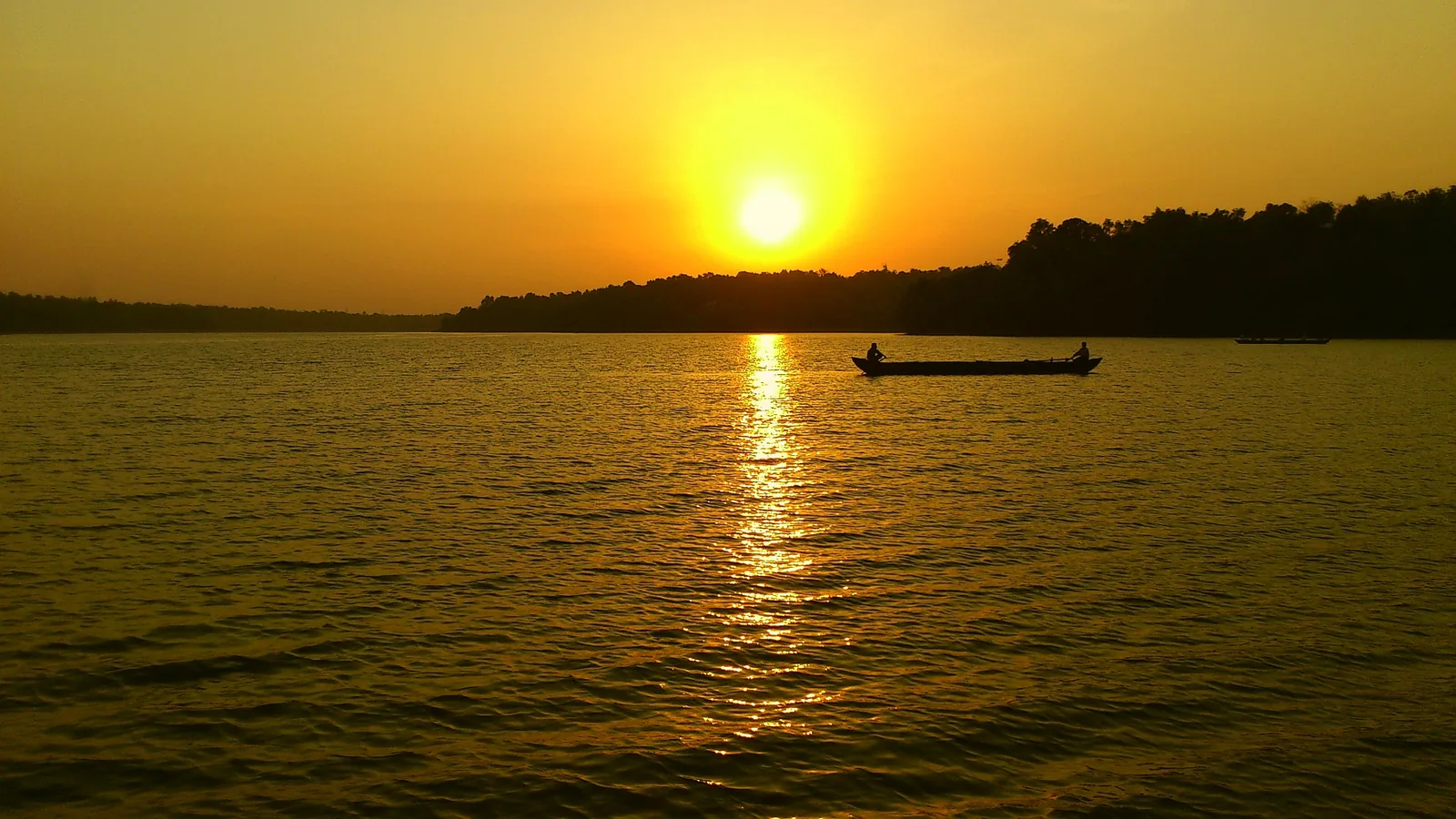
Kerala’s largest freshwater lake, a Ramsar wetland ringed by hills and a Sastha temple, north of Kollam.
15.1 km · ~25 min by cab · straight line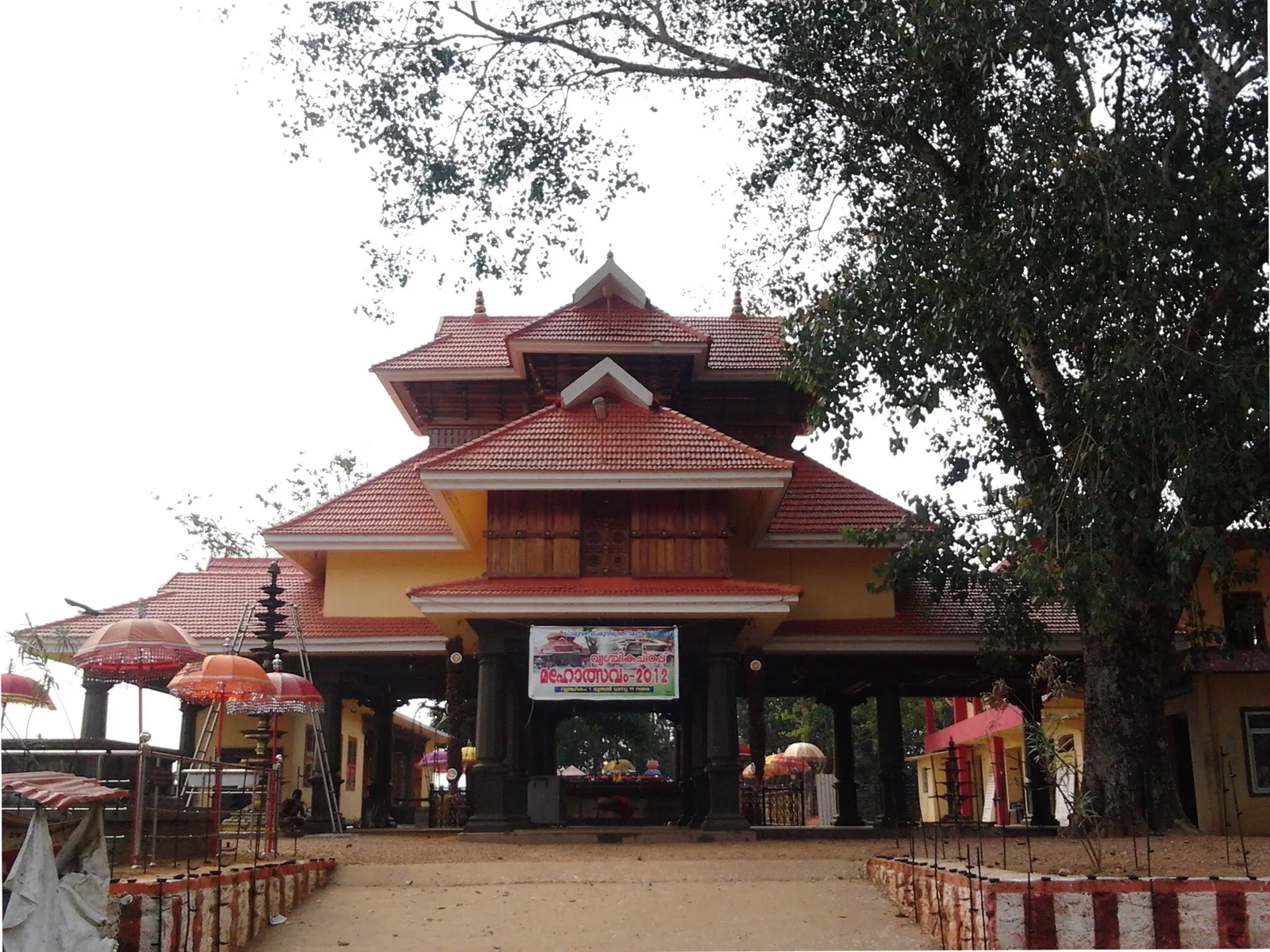
A temple with no idol and no sanctum — an open pillared mandapam over a raised platform, worshipped by sankalpam. The presiding figure is Mala Appooppan, the grandfather of the hill, conceived in the form of Duryodhana; the priest is the Oorali rather than a Brahmin, and toddy is the traditional offering.
16.7 km · ~28 min by cab · straight line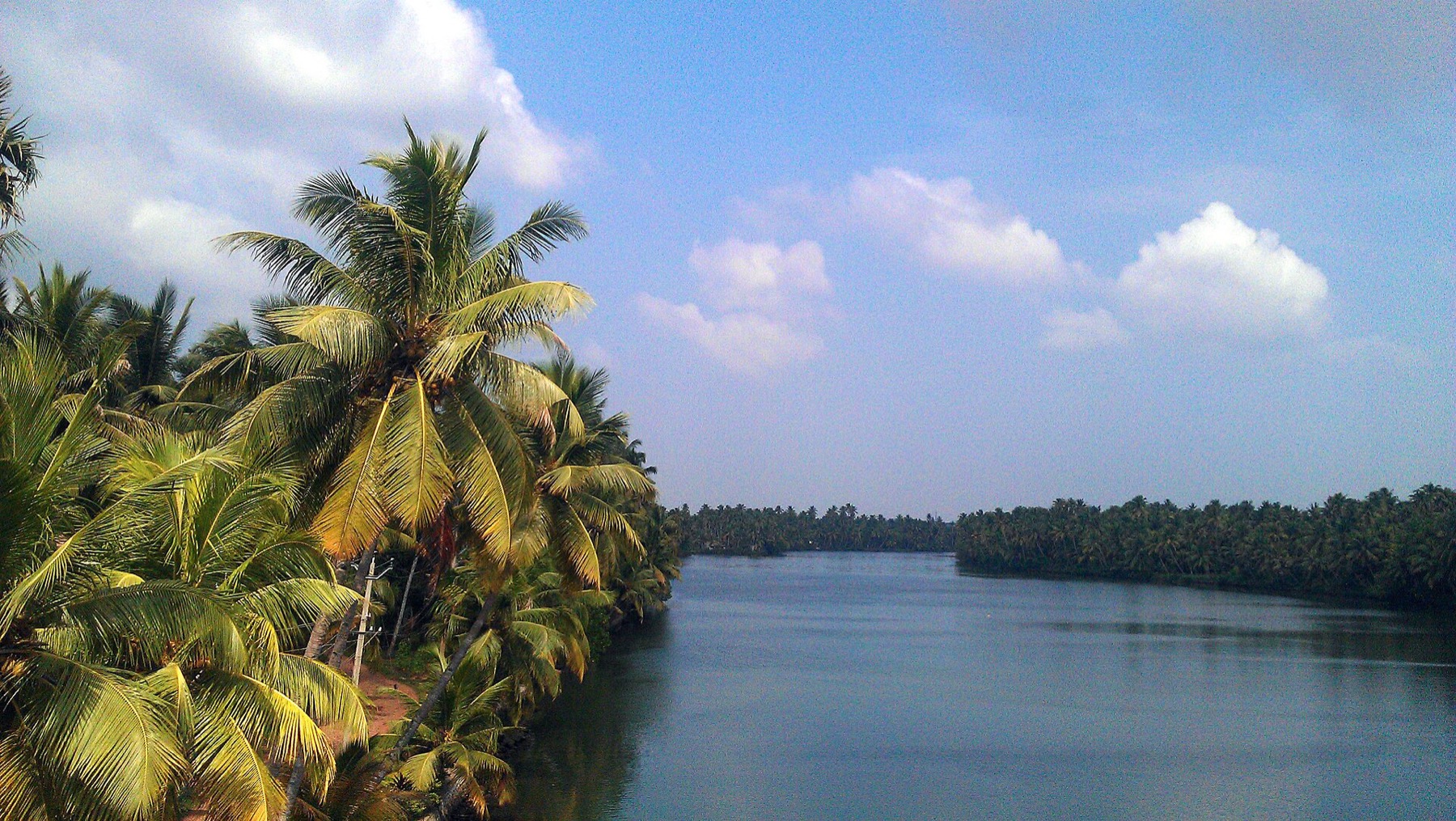
The river that rises in the Western Ghats behind Thenmala, is impounded at the Parappar dam, and reaches the sea through Ashtamudi past Munroe Island — the thread that connects the east of this district to the west.
17.0 km · ~28 min by cab · straight line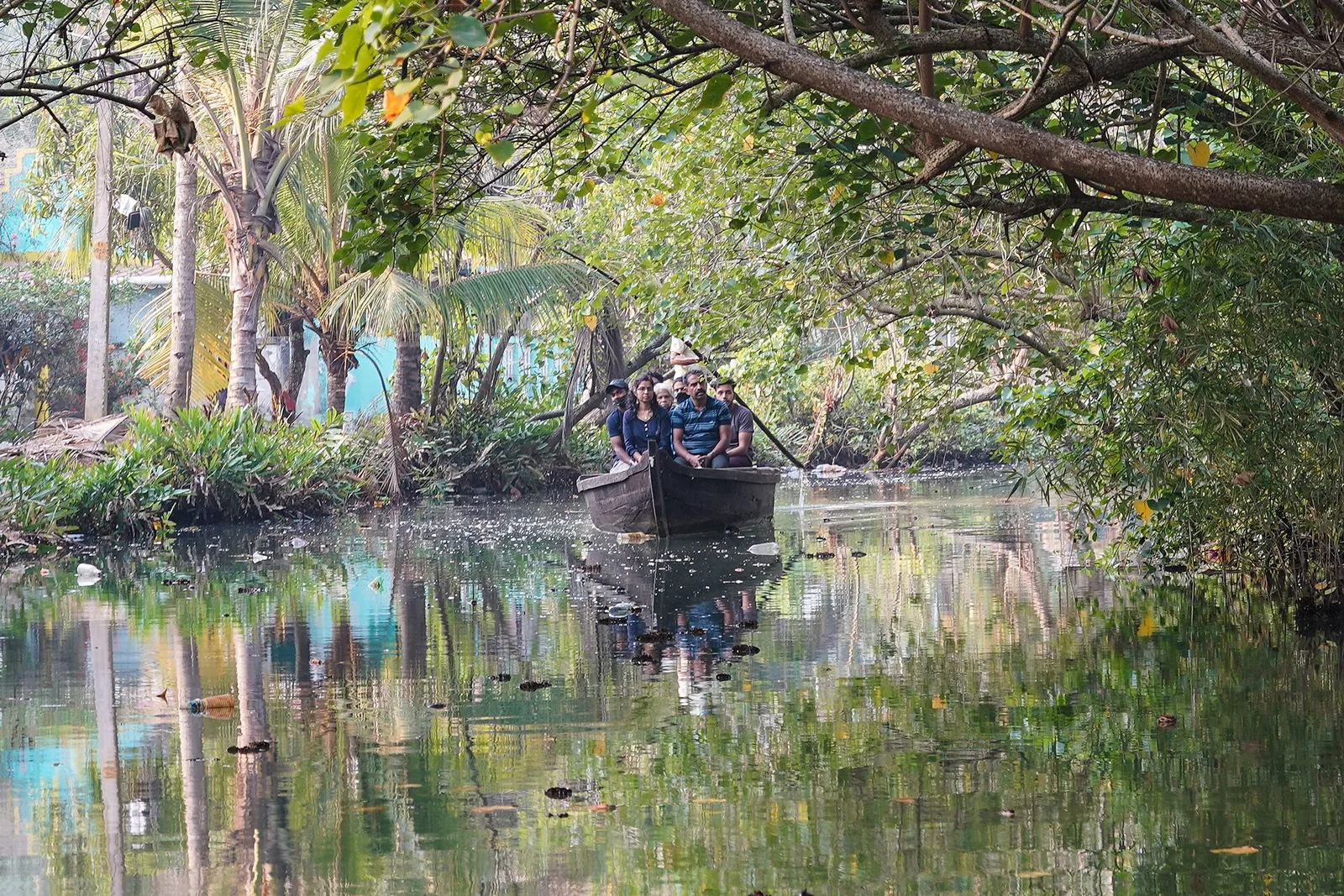
The narrow inland canal network threading Munroe Island, navigable only by small country canoe — the reason the island is visited at all, and a different waterway entirely from the open Ashtamudi lake.
17.2 km · ~29 min by cab · straight line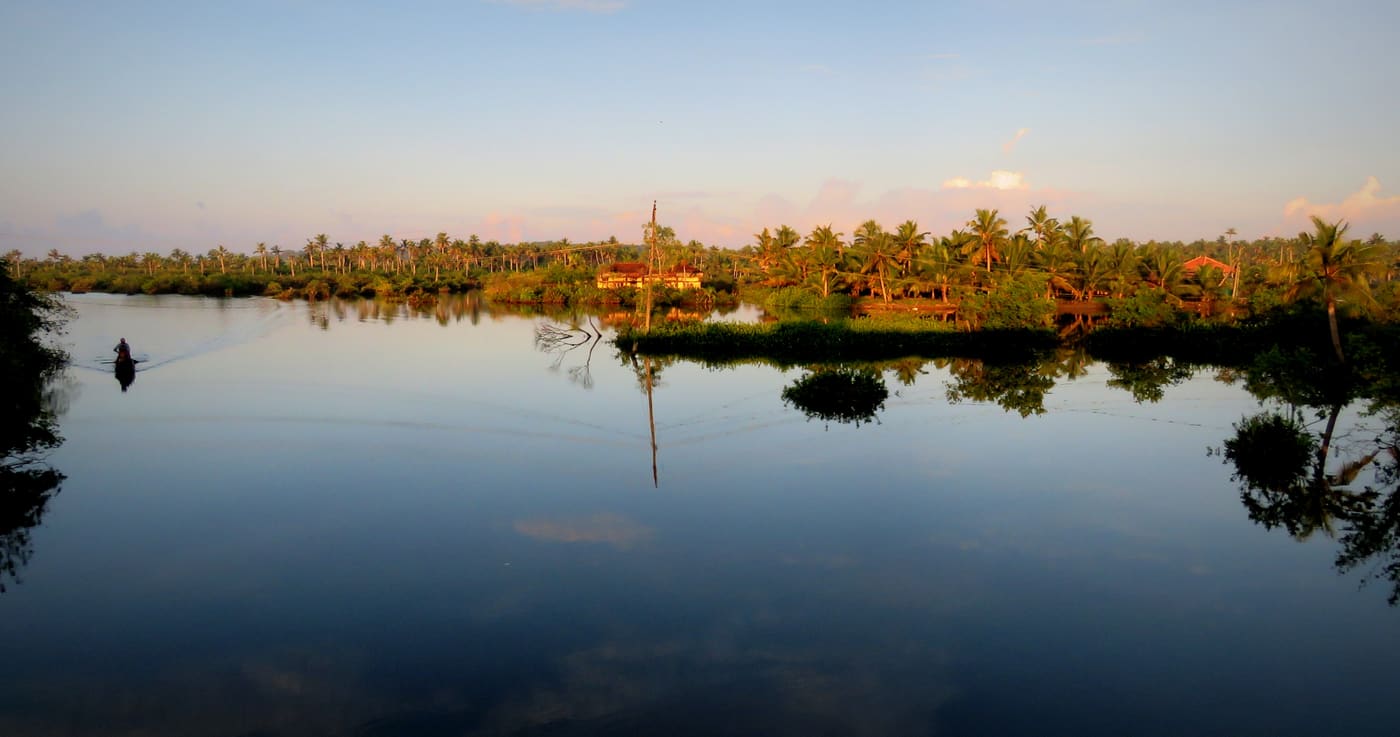
Canal village island known for canoe trips, coir work and slow backwater life.
17.2 km · ~29 min by cab · straight line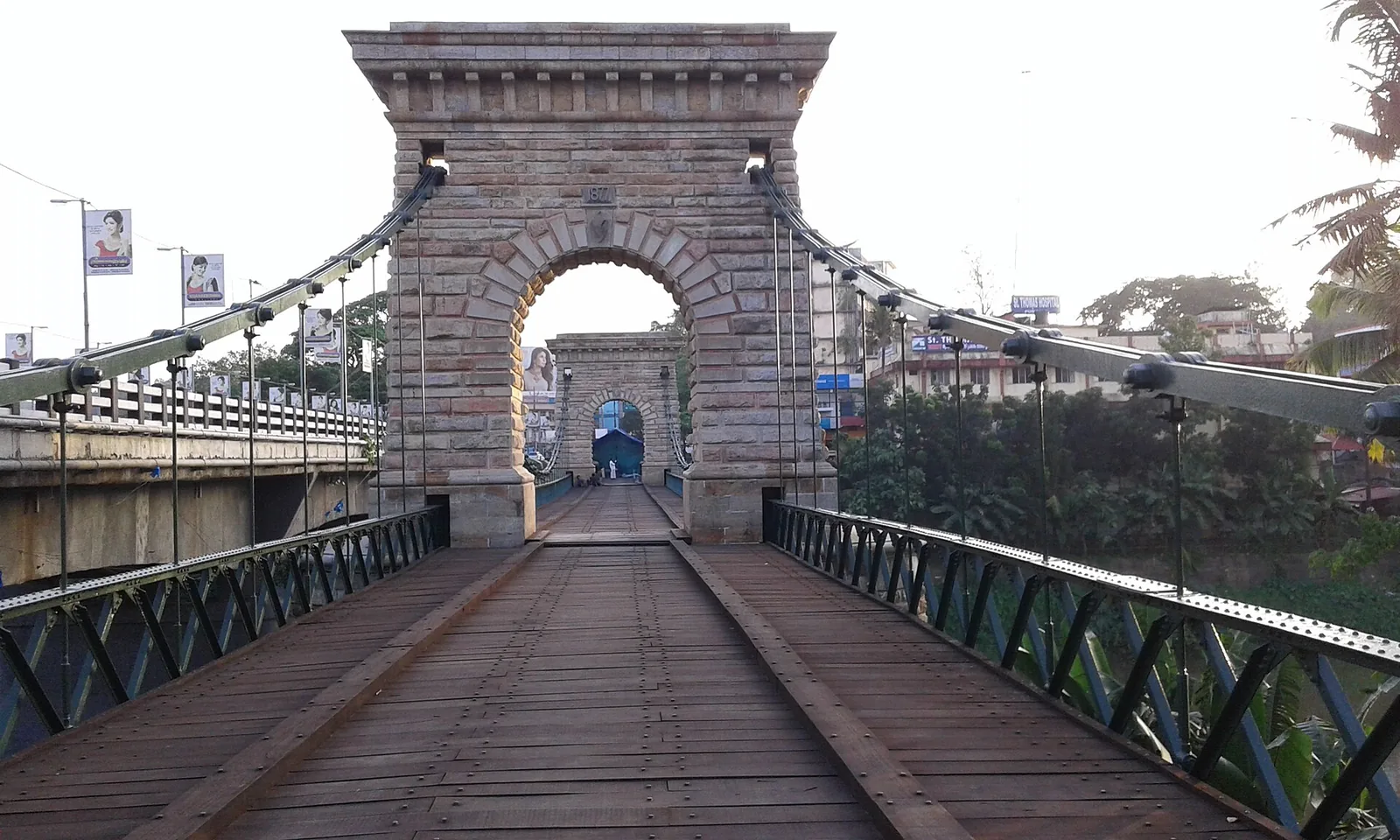
A rare 1877 Travancore-government suspension bridge over the Kallada river at Punalur, in east Kollam on the way to the ghats.
17.4 km · ~29 min by cab · straight line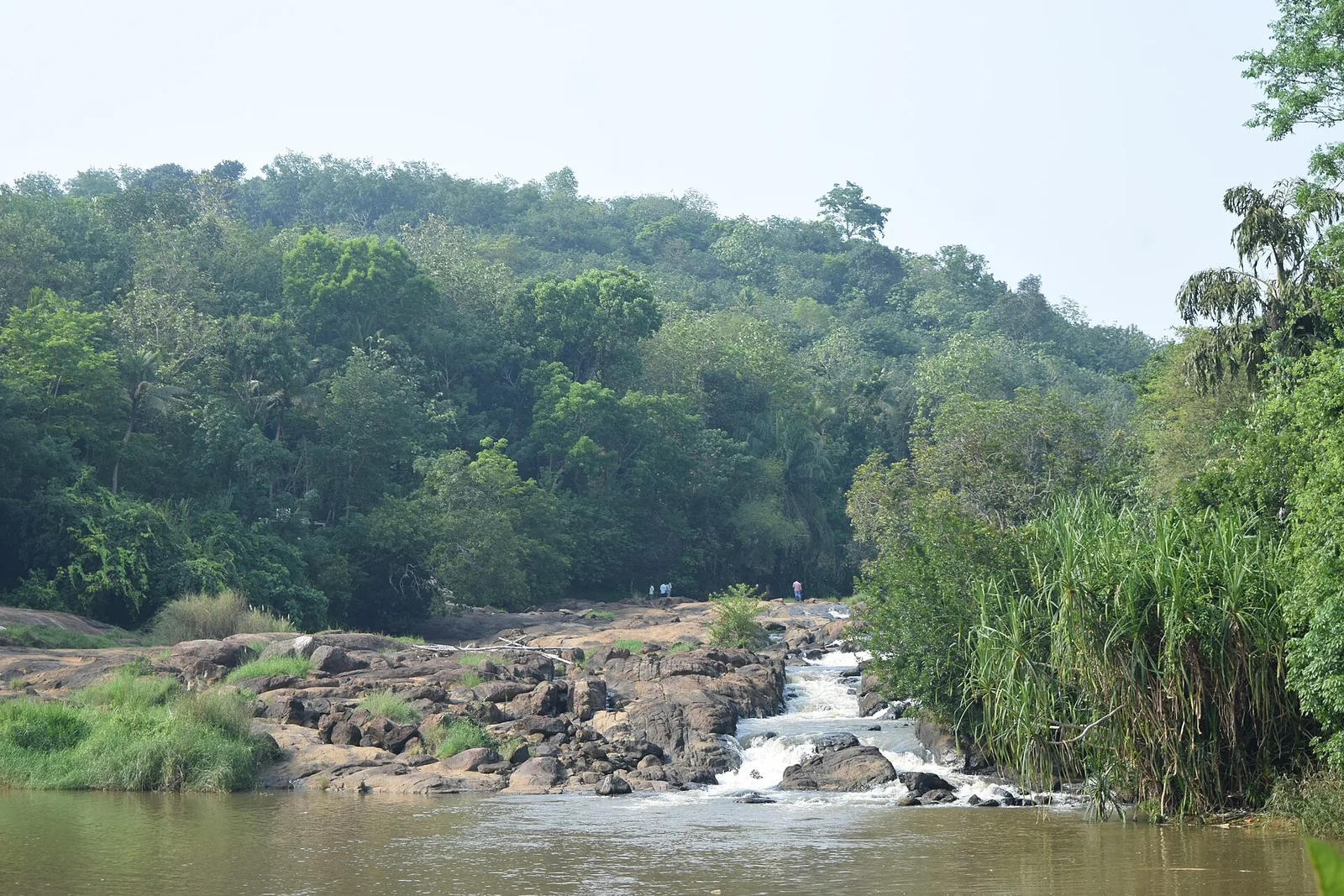
A wide rock apron on the Ithikkara near Kalladathanni, where the river slides and braids rather than plunges — DTPC Kollam’s own description is “a small waterfall that does not particularly fall”. Free, unstaffed and unsigned, about 200 m on foot through a rubber estate. ⚠ No lifeguard and no railings; the local name Vattakayam means the round deep pool.
17.5 km · ~29 min by cab · straight line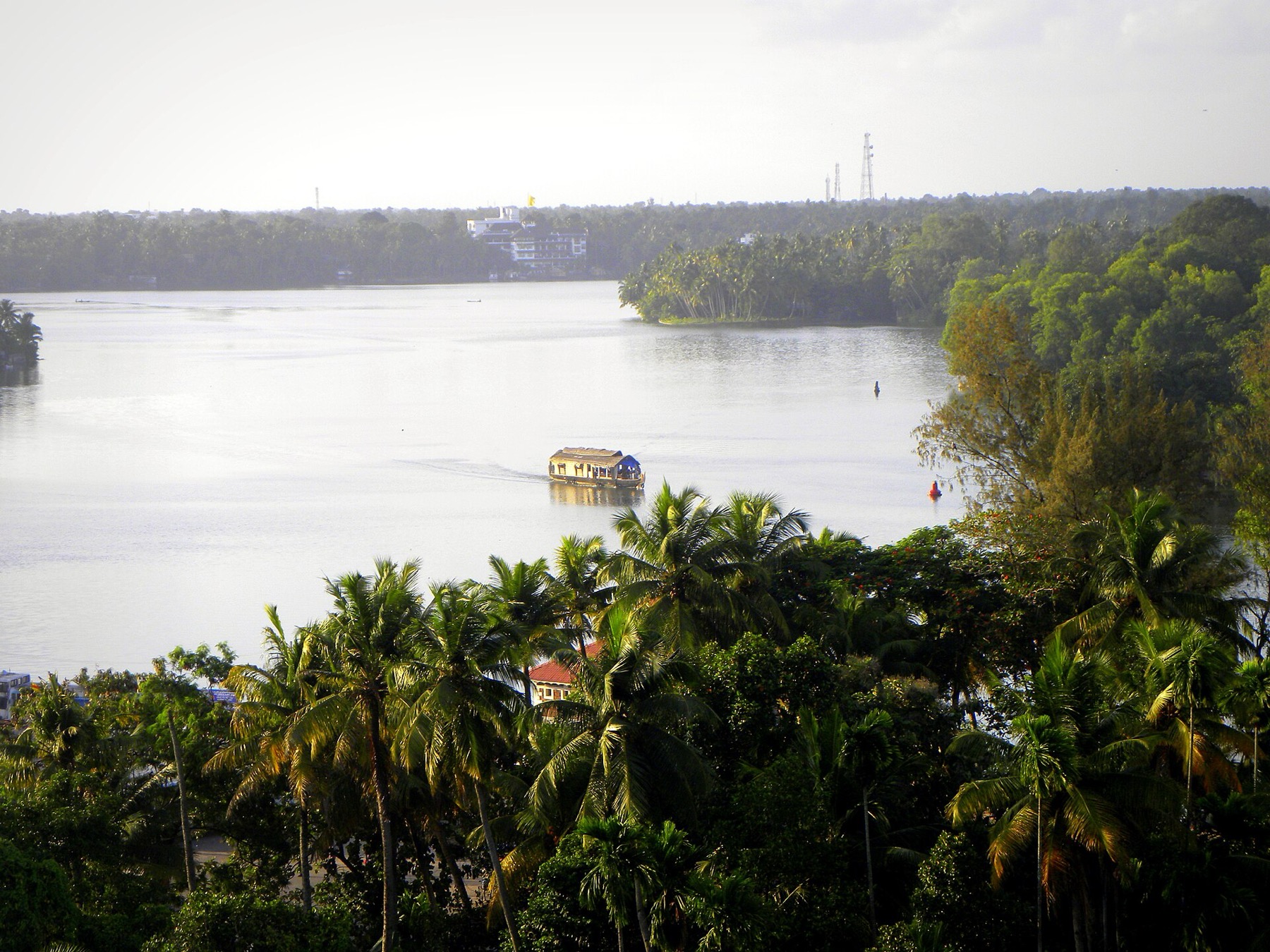
The open-water outlooks on the Munroe Island and Perumon side of Ashtamudi, where the lake widens out — the wide views the canal trips themselves do not give you.
17.8 km · ~30 min by cab · straight line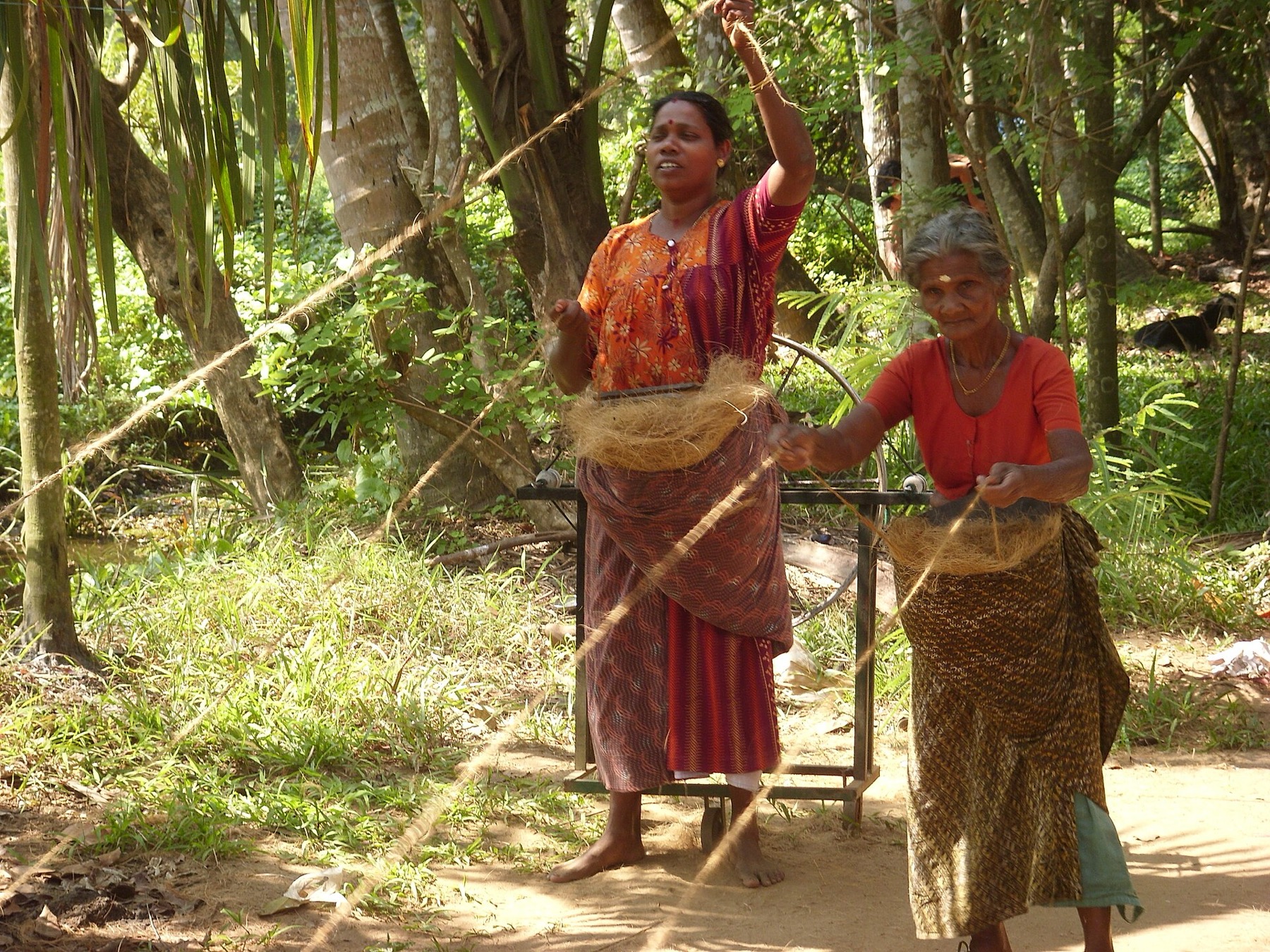
The coir-working settlements of Munroe Island, where coconut husk is retted in the backwater and spun into yarn — a working craft economy on the canal banks rather than a demonstration laid on for visitors.
18.0 km · ~30 min by cab · straight line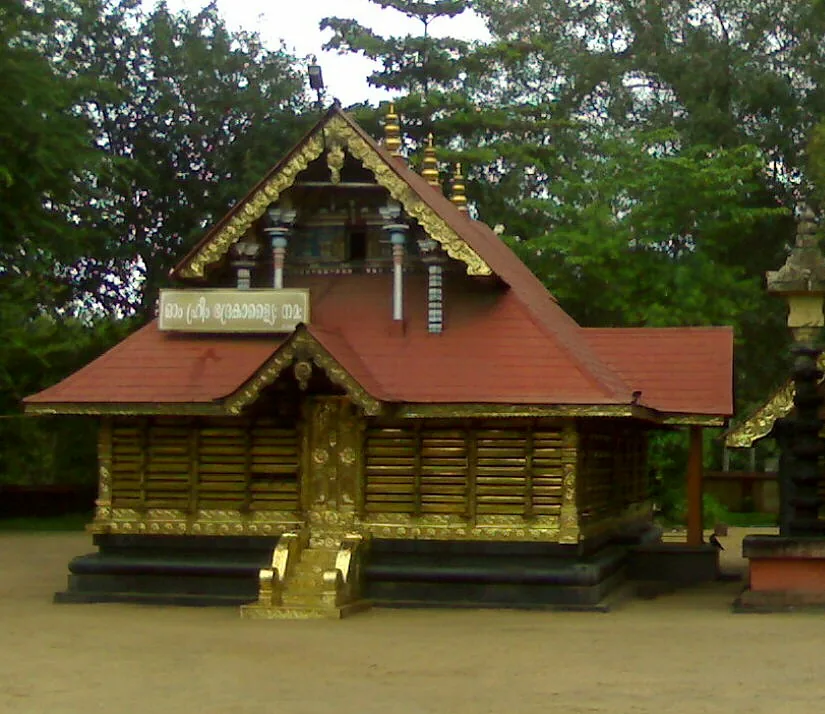
A short drive linking the named temples around Chadayamangalam: the Kottukkal rock-cut cave, the four-temple complex around one pond at Kadakkal, and the sacred groves, serpent shrine and kalari shrine of the surrounding belt.
18.0 km · ~30 min by cab · straight line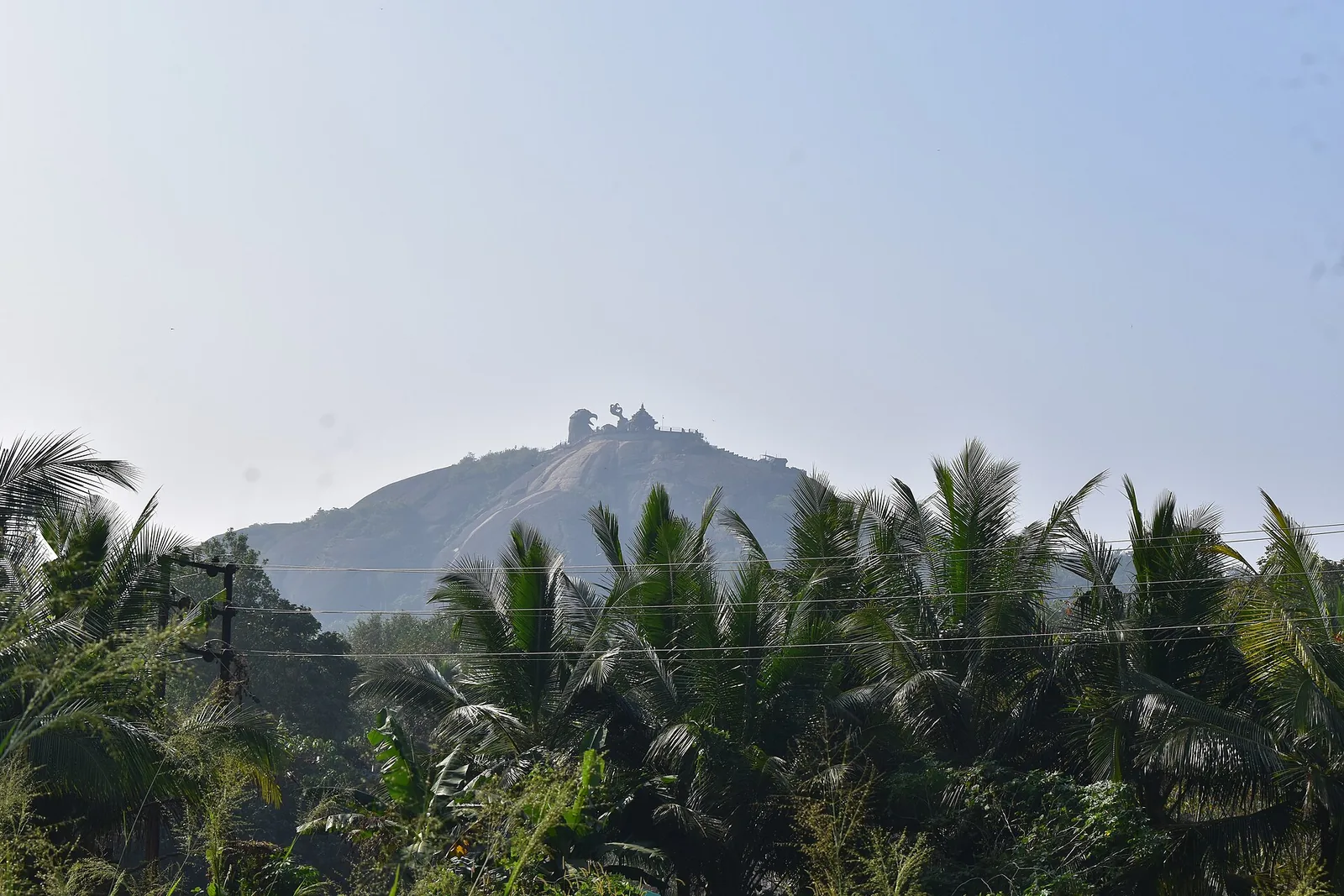
The rock outcrops and open high ground around Chadayamangalam, looking over the country between Kollam and the ghats — the landscape the Jatayu sculpture sits in, seen from ground level and without a ticket. The bare domes here are crystalline basement rock, not the laterite that mantles the ground between them.
18.2 km · ~30 min by cab · straight line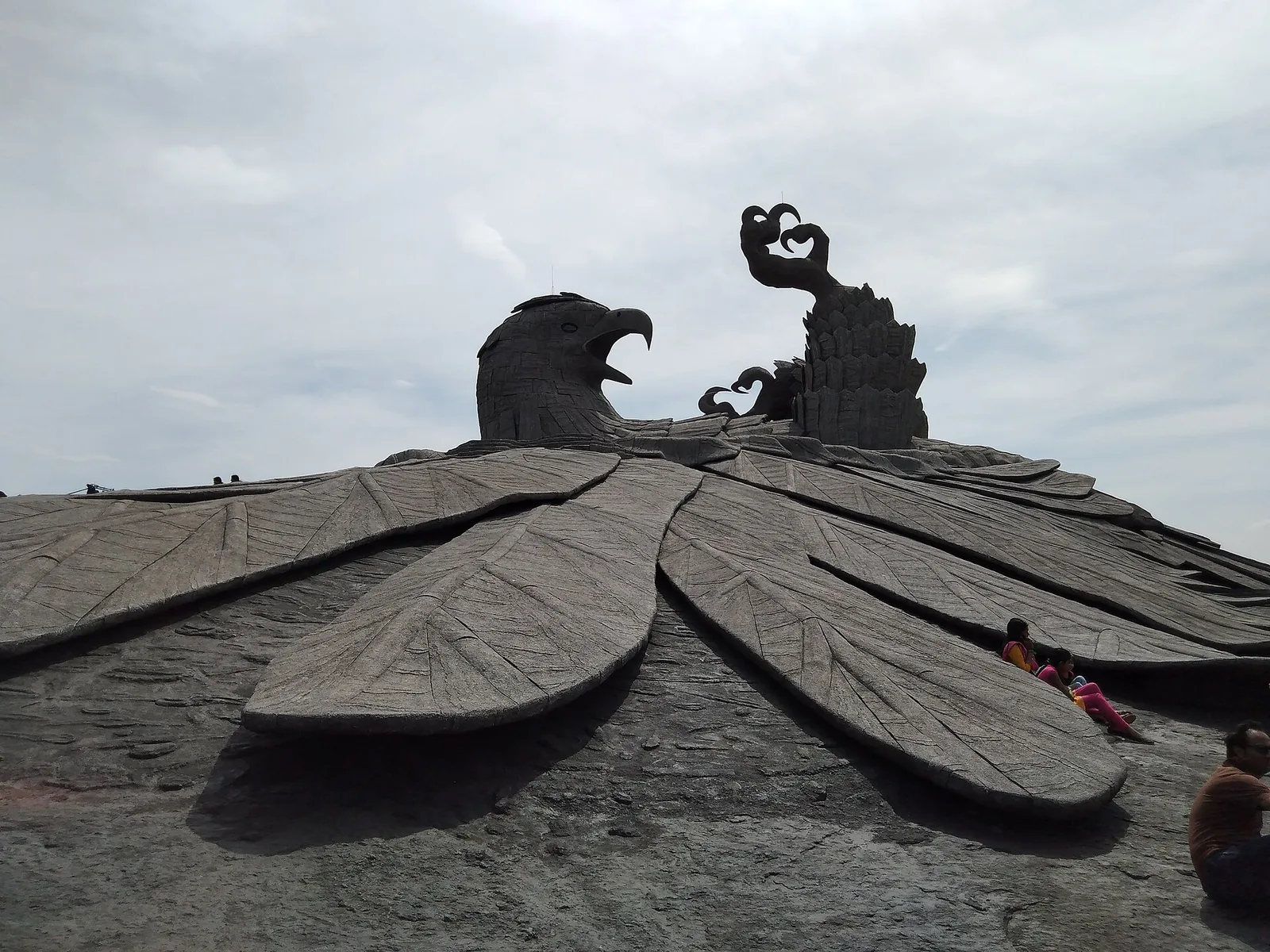
Hilltop sculpture park and viewpoint at Chadayamangalam, home to the world’s largest bird sculpture, reached by cable car.
18.8 km · ~31 min by cab · straight lineNearby toilets, pharmacies, ATMs, seating and vets are community-mapped and may be incomplete or out of date. Map data © OpenStreetMap contributors | Walking times © openrouteservice.org by HeiGIT
A Shiva temple with a famous Ganapathi sub-shrine. Kerala Tourism's own page states that the main deity is Lord Shiva, with a sub-shrine dedicated to Lord Ganesha — but the sub-shrine is what draws the crowds, and it has given the temple its popular name. The temple's own founding legend has the chief priest predicting exactly this.
Carefully: the Kottarakkara Thampuran, Veera Kerala Varma, is widely credited with composing Ramanattam, the eight-play Rama cycle from which Kathakali descends. That is a claim about a ruler and his court. The further claim that he composed it beneath a banyan tree at this temple is tradition only, and the two are often printed as one.
That is the traditional explanation and we treat it as tradition. Our Kathakali page describes the snub as the kind of neat causal insult that oral tradition is very good at manufacturing, with thin evidence for the exchange itself. Krishnanattam and Ramanattam both existed and Kathakali descends from that milieu; the insult is the frame the story chose.
Unniyappam — a small dark sweet of rice with jaggery, banana, cardamom and coconut, fried in ghee. Tradition credits the first offering to Perumthachan. It is made here in volume and is one of the few Kerala temple offerings that has become a regional food in its own right.
No founding date is available from any source we would rely on; it is described simply as centuries old. The seventeenth-century dates that circulate — Veera Kerala Varma at 1653 to 1694, Krishnanattam at 1657 — belong to the Ramanattam story rather than to the building.
The legendary master carpenter of Kerala tradition, credited with an enormous number of the region's finest timber buildings across a span no single craftsman could have covered. An attribution to Perumthachan is best read as the tradition's way of saying this is very fine old work, not as a construction record.
The Kottarakkara Thampuran Memorial Museum of Classical Arts, which is the practical address for the Ramanattam and Kathakali connection, and the temple tank, which is worth walking round. The Kottukal rock-cut cave temple is in the same taluk.
Morning or early evening is usually best; festival days can be powerful but crowded.
Entry: Darshan is free. Vazhipadu offerings, including the unniyappam the temple is known for, are paid at posted rates at the counter. Timings: Darshan is typically offered in a morning session from early morning to late morning and again in the evening, with the sanctum closed through the middle of the day, as at most Kerala temples. We could not find published timings from the temple itself, so treat any specific hours you see elsewhere with caution.
Base yourself in Kottarakkara or a nearby town in Kollam, then confirm the last-mile route locally before leaving. Check temple entry customs, dress rules and festival crowd conditions before arrival. If the visit depends on forest, temple, boat, ferry, weather or seasonal access, check the official/local rule on the day before travel.
45 minutes to 2 hours, longer during festival or queue periods.
Nearby you can pair Sasthamcotta Lake (15.1 km), Poruvazhy Peruviruthy Malanada (16.7 km), Kallada river (17.0 km), Munroe canals (17.2 km).
Use official counters for offerings/tickets where applicable. Keep footwear and valuables secure in crowded areas.
Written about Kottarakkara Sree Mahaganapathi Temple itself — its history, its legends and the arguments about them.
Route-level itineraries and practical guides for the rest of Kerala.
Photographs: Akhilan (CC BY-SA 4.0), Vinayaraj (CC BY-SA 3.0), Manukrishnan80 (CC BY-SA 4.0), Binupotti at English Wikipedia (Public domain). Wikimedia Commons.