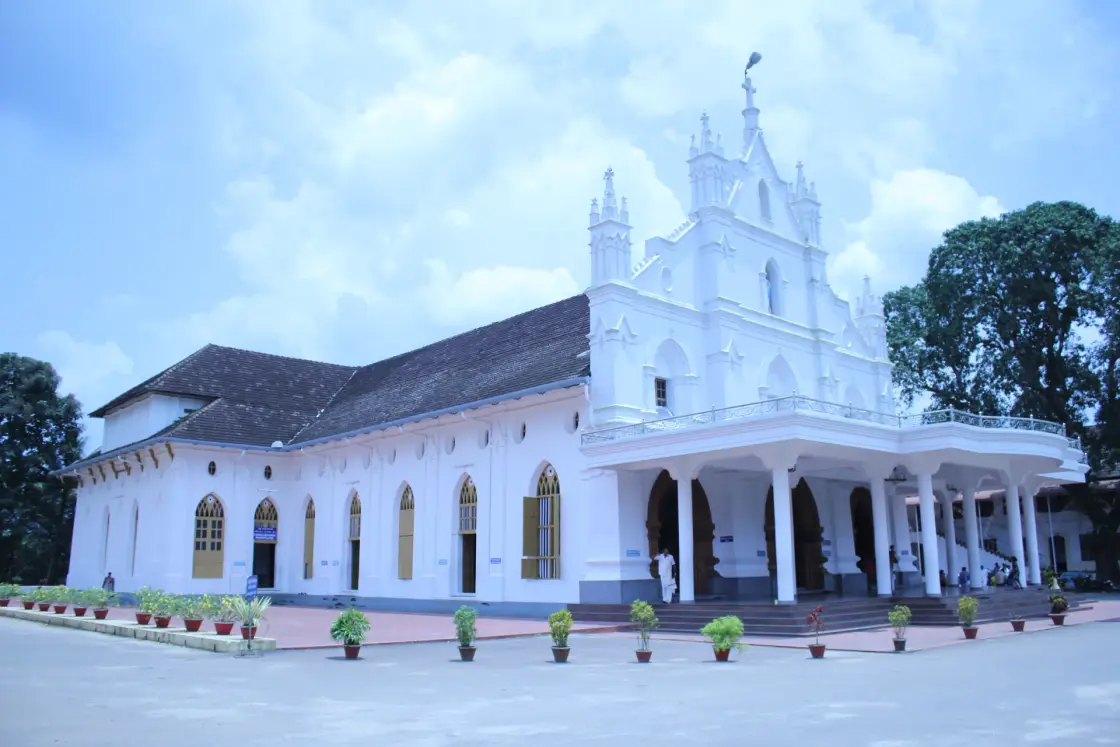
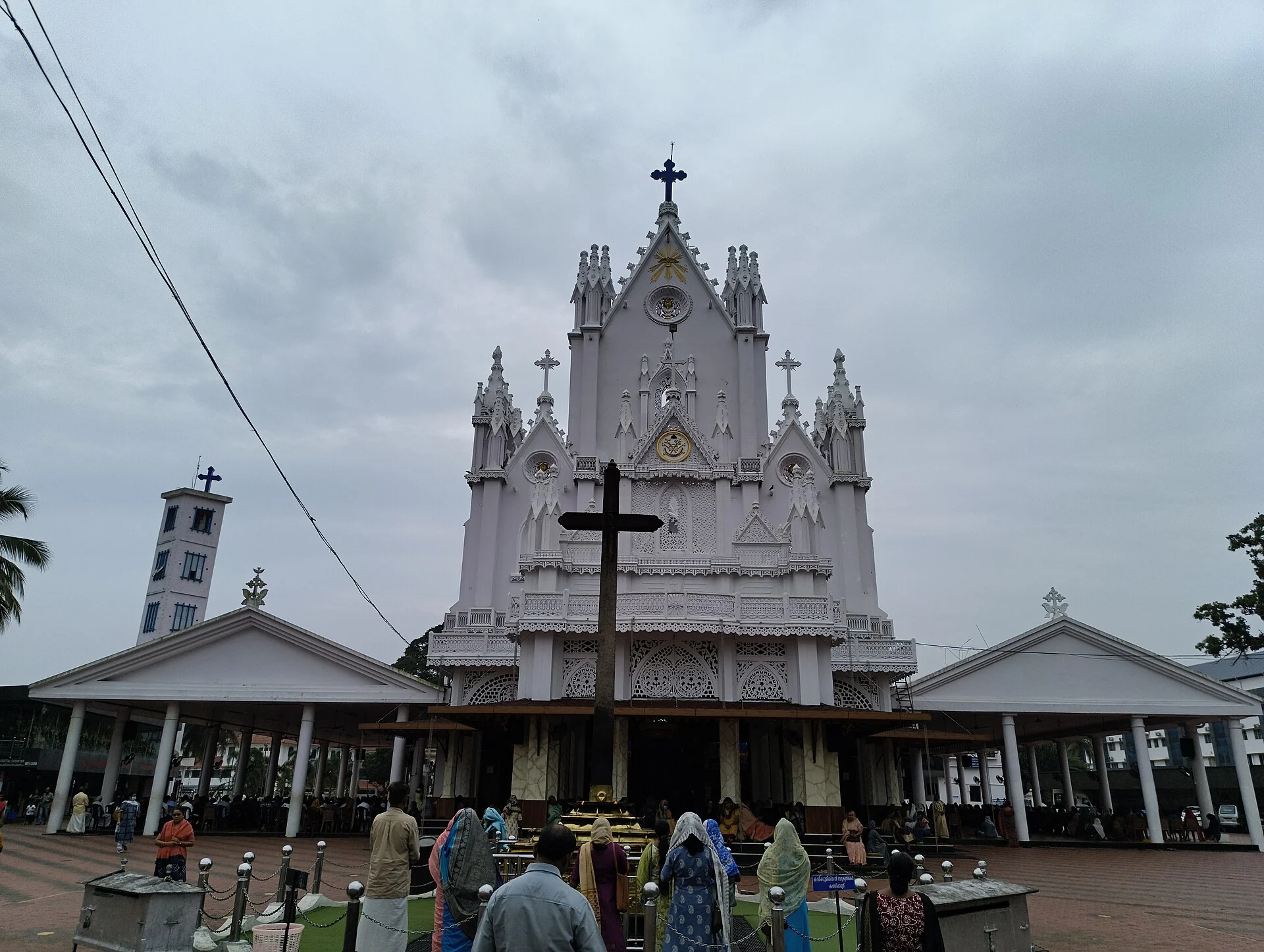
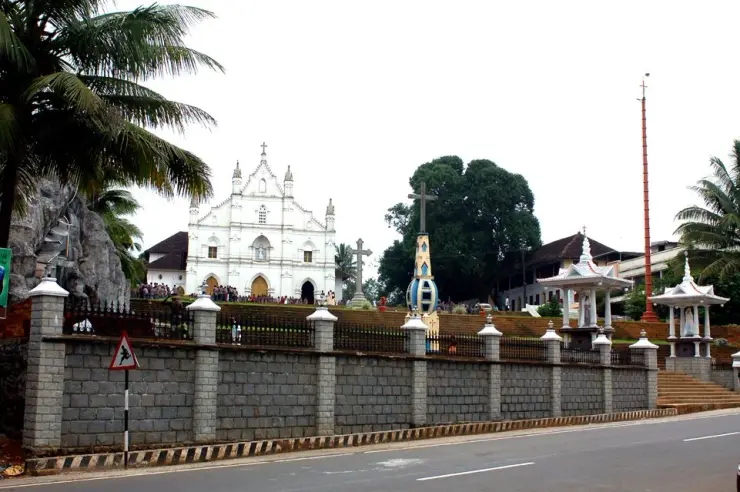
From the foot of the forecourt, the church reads as a sequence of thresholds: a weathered stone cross, a wide stair, a shaded porch and three tall entrances. Above them, the white front climbs through pointed niches and small pinnacles. Behind that ceremonial face stretches the parish nave, part of Bharananganam’s everyday life as well as its pilgrimage landscape.
The story of St Marys Forane Church
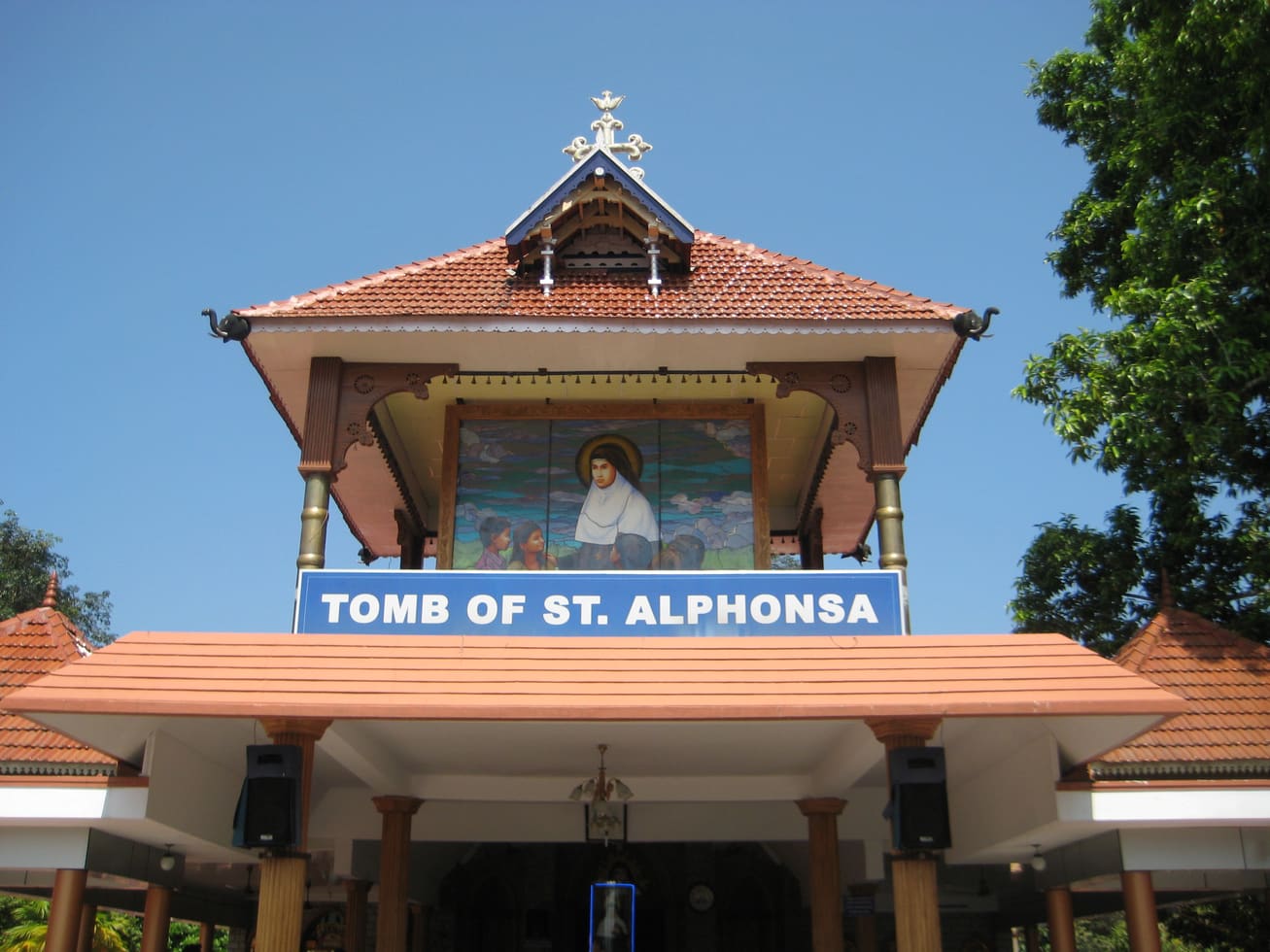
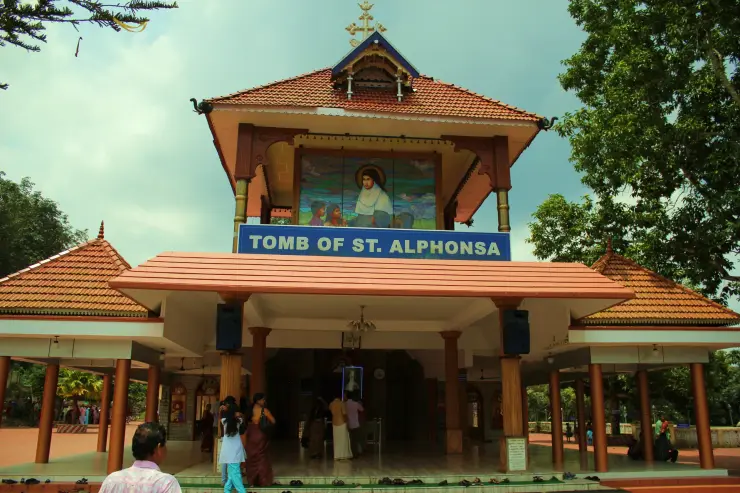
Bharananganam has two church buildings that visitors frequently compress into one address. St Mary’s is the parish church, dedicated to the Virgin Mary and belonging to the Syro-Malabar Diocese of Palai. St Alphonsa Shrine Church and Pilgrim Centre occupies the cemetery-chapel site to its north. The distinction is visible before reading a sign: the parish has a tall white ornamental facade, while the tomb shrine is a separate building. A visit to one does not automatically include the other.
The parish can be approached as architecture without treating it as an empty architectural exhibit. Its doors serve people arriving for Qurbana, family occasions and ordinary prayer. From the porch, the direction of the room is unmistakable: rows of seating lead towards the sanctuary. The central aisle carries both that visual line and the movement of worship. Standing back at the rear allows a visitor to understand the interior without interrupting that movement.
The front elevation rewards looking at more than the highest cross. Pointed arches recur at the door openings and niches, while horizontal mouldings divide the white surface into stages. Small pinnacles emphasise the rising outline. Circular openings sit beside the sharper forms. These are visible features of this church; their presence does not establish a medieval construction date or identify an overseas architect. The church’s institutional history and the appearance of its present facade answer different questions.
Below the upper facade, a projecting porch changes the scale. Slender supports, statues beside the entrance and shaded wooden doors bring the building down to the height of a person approaching it. Look along the side as well as straight ahead: the nave extends behind the decorative front under a pitched roof, with repeated tall windows along its white wall. The side view makes the relationship between a congregation-sized room and a ceremonial frontage easier to understand.
The stone cross in the forecourt is a separate object, not the small cross crowning the roof. Its broad arms, dark surface and stepped base give the open space a focus of its own. Seen from below, it stands against the brighter church rather than disappearing into it. The different material and position make it a useful starting point for reading the ensemble. A precise age should not be inferred from weathering alone, and the base should be treated as a devotional object rather than a platform for a photograph.
The bell tower also stands apart from the principal facade. Its open stages allow the sky to show through, in contrast with the broad white wall of the church front. A visitor who frames only the gable misses this separation of functions: the cross anchors the forecourt, the bell tower projects a presence outside the nave, and the porch gathers people at the doors. Together they explain why the church feels larger than its enclosed worship room.
The raised setting matters on a rainy day as much as in a photograph. The main stair gives a broad ceremonial approach but introduces a real change of level. The official parish photographs also show an upper paved forecourt extending beside the building. That is useful evidence of the layout, but it does not prove a continuous accessible route from a public drop-off. Someone using a wheelchair needs the actual side-entry arrangement confirmed, including the last threshold into the nave.
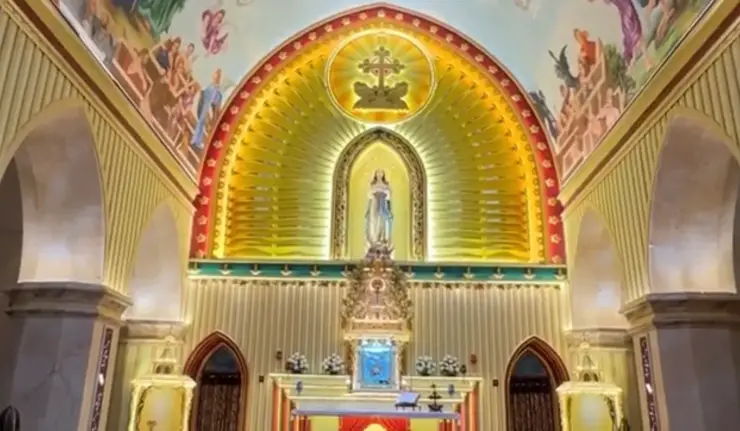
Inside, the sanctuary and its decoration should be read from the space where visitors are permitted to stand. The diocese’s altar photograph shows a Marian figure within a pointed central niche, a bright radiating background, an arched painted surround and flanking architectural elements. These belong to the devotional focus of this particular parish. An older photograph on the shrine’s parish page shows a red curtain behind the altar; photographs from different dates are not a promise that every fitting will look identical today.
This is a useful place to slow down because the detail changes with viewing distance. From the road the dominant impression is white wall and a steep outline. In the forecourt the stonework, stair and porch separate into individual elements. At the entrance the timber doors, seating and sanctuary become legible. Following that progression gives an architectural visit a natural order without walking repeatedly through a service or turning every part of the building into a photography position.
Bharananganam’s setting is the Meenachil midlands, with rising ground, a commercial street and institutions gathered around a river town. The parish is not an isolated church in a tea estate or an attraction on the coastal backwaters. Its connection with Pala helps explain the traffic, local buses and services outside. For a visitor travelling onward towards Erattupetta, the church belongs to that midland road journey rather than to a waterfront excursion.
A useful distinction when reading a map is between a parish campus and a pilgrimage circuit. The campus contains the church and spaces that serve its congregation. A wider Alphonsa visit may include the separate shrine, convent-related locations and museum. Those destinations share a local story, but their purposes and access arrangements differ. School and convent spaces should not be entered merely because they lie close to an open church forecourt.
The parish’s own identity remains Marian even when most people in a tour group have arrived because of Alphonsa. Looking at the dedication in the sanctuary, the church’s name and the parish calendar restores that balance. Alphonsa’s association adds a twentieth-century chapter to a much older congregation. It does not replace the congregation’s patron, nor does it make every feast held in Bharananganam a feast of the same institution.
The parish’s two named feast entries give the sanctuary a useful interpretive frame. Mother Mary Immaculate is the Marian dedication listed by the diocese; St Sebastian has a separate entry in the same parish calendar. Neither should disappear behind the town’s better-known Alphonsa association. For someone visiting without a pilgrimage background, the practical point is to look at the name of the church and the focus of its sanctuary before assuming which saint a particular image or celebration represents.
The Marian figure in the diocesan sanctuary photograph is placed high within a pointed architectural niche. Around it, the gold rays create a focus that is different from the darker timber seating and long lines of the nave. The surrounding painted arches and flanking details extend that central composition. These are features one can study visually without identifying every painted person or assigning an unsupported date to the work. During worship, the appropriate viewing position is the congregation’s side of the room, not a close approach to the altar for inspecting its decoration.
The porch is worth seeing from the side because its depth explains the arrival sequence. The upper forecourt gives way to shade under the projecting roof, then to the timber doors and the enclosed nave. The long side wall repeats its windows at regular intervals, whereas the front concentrates ornament above and around the entrances. Comparing those two elevations makes the church’s proportions clearer than looking only at its highest point. Remain in the public circulation space while making that comparison, since adjacent doors also serve the parish’s daily work.
The cemetery precinct north of the parish introduces a different scale of memorial. Rows of individual grave slabs occupy paved ground, while the Alphonsa tomb draws a concentrated devotional visit. That contrast helps explain how a parish burial landscape became part of an international pilgrimage without ceasing to be a place of remembrance for local families. Photographs of grave rows, a votive-light stand or a grotto belong to that wider precinct. They are contextual views, not alternative interiors of the white parish church.
A devotional grotto and a church sanctuary also organise viewing differently. The grotto presents a sculpted scene within a rock-like recess, often approached through a garden path or stair. The sanctuary belongs to the directional space of the nave and its liturgy. In Bharananganam’s wider church-and-shrine neighbourhood, both forms can appear within a short visit. Naming the feature in front of you prevents a sequence of photographs from turning into an undifferentiated album of “the church”.
For a group with different interests, the parish forecourt offers a useful common starting point. Those looking at architecture can begin with the cross and side elevation; those attending worship need the service entrance and a quiet place in the nave. A later shrine visit can then be agreed explicitly. This arrangement follows the actual division of the site and avoids having people search between two buildings while a driver waits at an unspecified church entrance.
Read the full history of St Marys Forane Church 750 more words
History
The Diocese of Palai records the parish’s establishment in 1004. The official Alphonsa pilgrimage centre’s parish account connects that foundation with Parelpally and places construction of the large present church in the early decades of the twentieth century. These records support a long institutional history while distinguishing it from the age of the building now visited. They do not justify calling every wall or ornament a thousand years old.
Local civic history supplies another strand. Bharananganam Grama Panchayat records that an English school opened in 1897 in a building constructed on the church’s initiative and handed over to the government. This is a specific connection between the parish and public education, rather than a general claim about Kerala churches. It gives the surrounding educational landscape historical context without implying that every present school building dates to that year.
The Franciscan Clarist congregation’s Bharananganam province dates the erection of Sacred Heart Convent here to 27 October 1910. The convent and parish are neighbouring institutions with different functions. Their proximity explains how Alphonsa’s religious life, teaching and worship became attached to this small town. It should not be read as permission for unrestricted entry into a living convent.
The Vatican’s canonisation biography records Alphonsa’s arrival as a student in Bharananganam in May 1927 and her reception of the religious habit during the bishop’s visit in May 1930. It also describes her work as an assistant teacher and catechist. These ordinary roles are an important part of the local connection: her life here included a classroom, a religious community and parish work before the later international pilgrimage developed.
The pilgrimage centre explicitly associates Alphonsa’s triple vows with the parish church. Her tomb, however, belongs to the cemetery-chapel site. The two connections should be retained separately: one is a place in her religious life, the other a place of burial and subsequent devotion. This is why an itinerary that stops only at the tomb has not necessarily visited the parish church itself.
The Diocese of Palai was established in 1950, much later than the parish foundation. Its historical milestones include Bharananganam among the original forane centres, under the name Anakallu. The older congregation therefore became part of a newer diocesan organisation. “Forane” describes that ecclesiastical role; it does not mean cathedral, and the parish should not be presented as the bishop’s cathedral church.
The diocesan profile makes the forane’s wider role concrete by listing parishes under Bharananganam. They include St John’s at Amparanirappel, St Joseph’s at Choondachery and Edappady, and another St Mary’s at Plassanal. These names describe an ecclesiastical network across several localities, not extra chapels within the Bharananganam forecourt. The Plassanal dedication is especially useful to notice when checking a church address: even within this forane, St Mary’s alone does not identify a single building.
The same profile separately lists St George Chapel at Chittanippara among the wayside chapels. That is a named chapel associated with the parish, rather than another name for the bell tower, porch or Alphonsa tomb shrine. Together, the parish list and chapel entry show how one prominent church relates to a wider inhabited landscape. A visitor following a family parish connection or a particular devotional destination needs that locality as well as the saint’s name.
The town’s best-known July pilgrimage commemoration belongs to Alphonsa’s death anniversary. The parish profile separately lists Mother Mary Immaculate and St Sebastian in its feast calendar. Keeping these entries distinct avoids a common error in travel descriptions: transferring the shrine’s annual programme to the parish and leaving out the parish’s own patronal life.
Why visit
To see a complete church ensemble rather than only an altar: the freestanding stone cross, bell tower, ceremonial stair, porch and nave can be understood in relation to one another from the public approach.
To place an Alphonsa pilgrimage in its local setting. The parish shows the congregation and institutions around her life; the separate tomb shrine explains the later focus of devotion. The short distance between them makes that distinction easy to understand on foot when conditions permit.
To follow a documented connection between a church and a town’s schooling. The panchayat’s 1897 school account gives Bharananganam a civic history alongside its devotional reputation, without needing to borrow a general narrative about Christianity in Kerala.
To make a focused heritage stop on the Pala–Erattupetta side of Kottayam. The visit is strongest when it leaves time to look at the exterior and, if open between services, sit quietly inside instead of treating the facade as a quick roadside photograph.