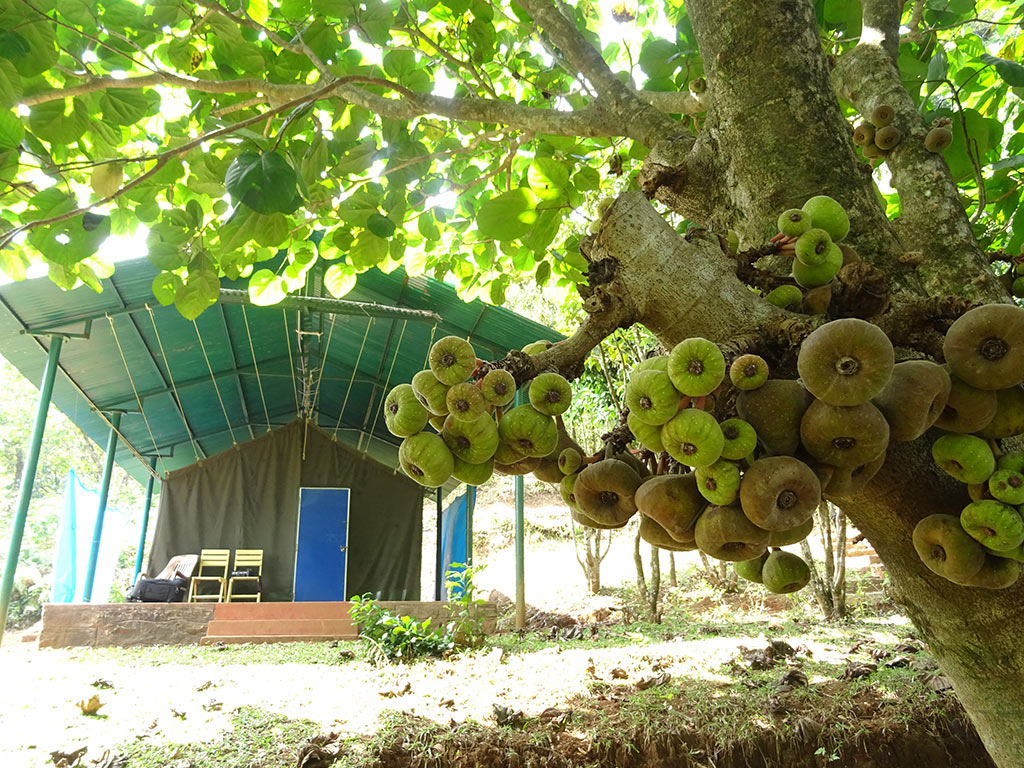
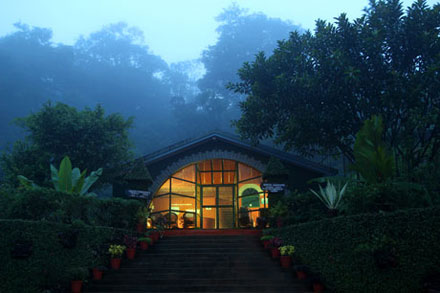
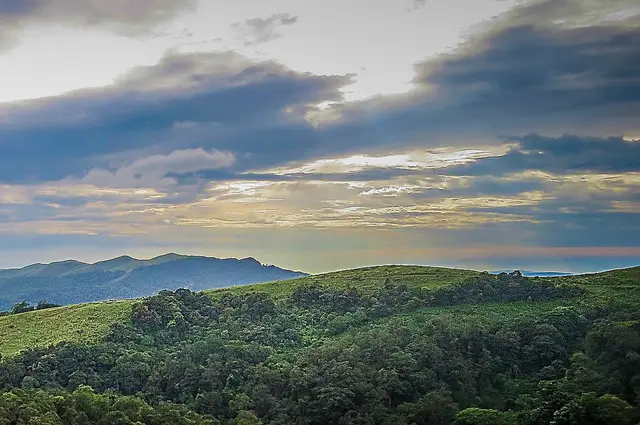
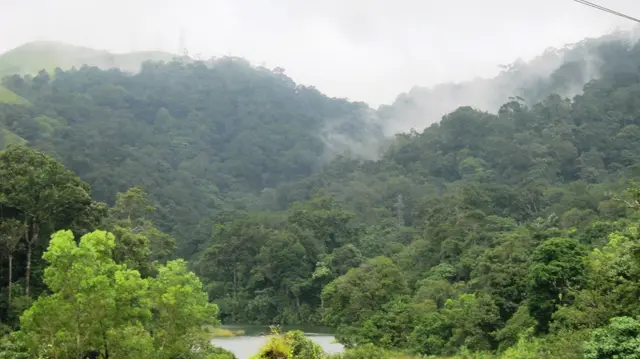
Gavi is a hill settlement at about 1,036 metres inside the Periyar Tiger Reserve, one of the thirteen wards of Seethathodu grama panchayat in Pathanamthitta district. It is not an old village. It was cut out of evergreen jungle in the second half of the twentieth century as a cardamom estate, and the people who cleared and worked it were Tamils repatriated from Ceylon under the Sirima–Shastri Pact of 30 October 1964 — families who left one country as stateless labour and arrived in another to a line of estate quarters in a tiger reserve. Everything a visitor sees at Gavi today, from the Kerala Forest Development Corporation lodge to the boat on Kochu Pamba, sits on that history. This record is about the settlement rather than the scenery, and about what the access rules actually are.
Gavi has no temple square, no bazaar and no old landlord families, because it was not founded in the ordinary Kerala way. It is a plantation settlement inside a protected reserve, and the plantation came first. The Kerala Forest Development Corporation, incorporated on 24 January 1975, holds Gavi as one of its six divisional headquarters alongside Thiruvananthapuram, Punalur, Munnar, Thrissur and Mananthavady, and the corporation’s cardamom is grown at Gavi, Munnar and Nelliyampathy. The estate is the reason there are houses here at all.
The people came under an agreement between two prime ministers. On 30 October 1964, Sirimavo Bandaranaike of Ceylon and Lal Bahadur Shastri of India signed what was formally the Agreement on Persons of Indian Origin in Ceylon. Of roughly 975,000 people counted in 1962 as Indian by Ceylon and stateless by India, 525,000 were to be repatriated to India and 300,000 given Ceylonese citizenship over fifteen years; the status of the remaining 150,000 was left to be settled later. These were the descendants of the Tamil labourers taken to Ceylon’s tea and rubber estates under British planters. Kerala took a share of the repatriates, and Gavi is where a number of them were put to work.
Exactly when the first families reached Gavi is not settled, and our sources disagree. The South First, reporting from the settlement in 2023, frames the arrivals as part of the boats that began leaving Ceylon after the 1964 pact. Malayala Manorama, reporting in January 2020, quotes a resident who came as a woman of twenty-three or twenty-four in the late 1970s. The Malayalam Wikipedia article on Gavi puts the arrival of the Tamil workers in the early 1980s. All three can be true of different people: repatriation ran in waves for two decades, and Gavi was not the first place many of them were sent. We print the disagreement rather than pick a date.
What they were given was work, not land. Families were housed in estate quarters and put on the cardamom. The South First records that each evicted family received ₹20,000 in cash compensation at the time, and that most households have never held title deeds to the ground they live on — a fact that now governs everything about their future. Malayala Manorama found in 2020 that residents do hold Indian identity cards, Aadhaar cards, family cards and ration cards, and that earlier difficulties over caste certificates had been resolved, so the citizenship question that frightened the settlement during the Citizenship Amendment Act debate is not the same as the land question that still hangs over it.
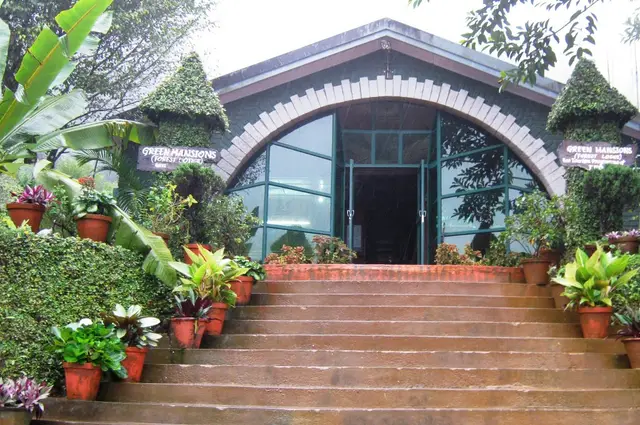
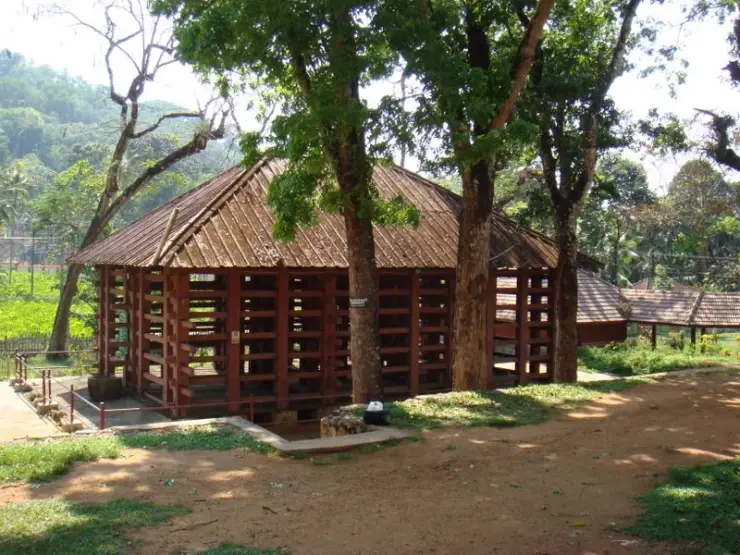
Then the cardamom failed. The Malayalam Wikipedia article records wages going unpaid for three and four months at a stretch as the crop and the corporation’s finances went wrong. The corporation’s answer was to turn the estate into a controlled tourism operation, which is why the Green Mansion lodge, the boats and the guided programmes exist: they were a way of keeping people employed on an estate that could no longer pay them for cardamom. It is unusual for an eco-tourism project to have that as its origin story, and it explains why the guides, cooks and boatmen at Gavi are so often from the settlement itself.
The work has not made the settlement prosperous. In 2023 The South First reported a full day’s work on the tourism project paying ₹450, quarters that had seen no repairs in over three decades, a defunct primary school, and “hardly 183 families left, spread across the Gavi, Meenar and Pamba estates” of the corporation. Manorama had counted “around 150 families” at Gavi itself in 2020. About half the original households are said to have gone, mostly to Tamil Nadu. Whichever figure is right, the direction is the same: this is a shrinking settlement.
The state now proposes to move them out. Navakiranam, the Kerala Forest Department’s voluntary relocation scheme announced in 2019, offers ₹15 lakh to a couple holding up to two hectares with title deeds; 601 non-tribal forest families had been relocated under it by 2023, with 894 more listed to follow, Gavi among them. The Gavi repatriates have asked for at least ₹25 lakh a unit, and the title-deed condition is exactly the thing most of them cannot meet. So a community brought here by one intergovernmental agreement is being asked to leave under a state scheme written for people with papers it never gave them.
The other landholding on this road belongs to a different history altogether. Pachakkanam, a cardamom estate of about 600 acres on the way in, is described as the only privately owned estate inside the reserve; the account most often repeated locally, which we have found only on personal and travel writing rather than in an official record, is that the Karimpanal family of Kanjirappally bought it from an Irish planter who left for Ireland in 1947. Treat that as estate tradition until a land record confirms it. It does at least mark the point: the whole Gavi basin is a colonial-era planting frontier that the tiger reserve was later drawn around.
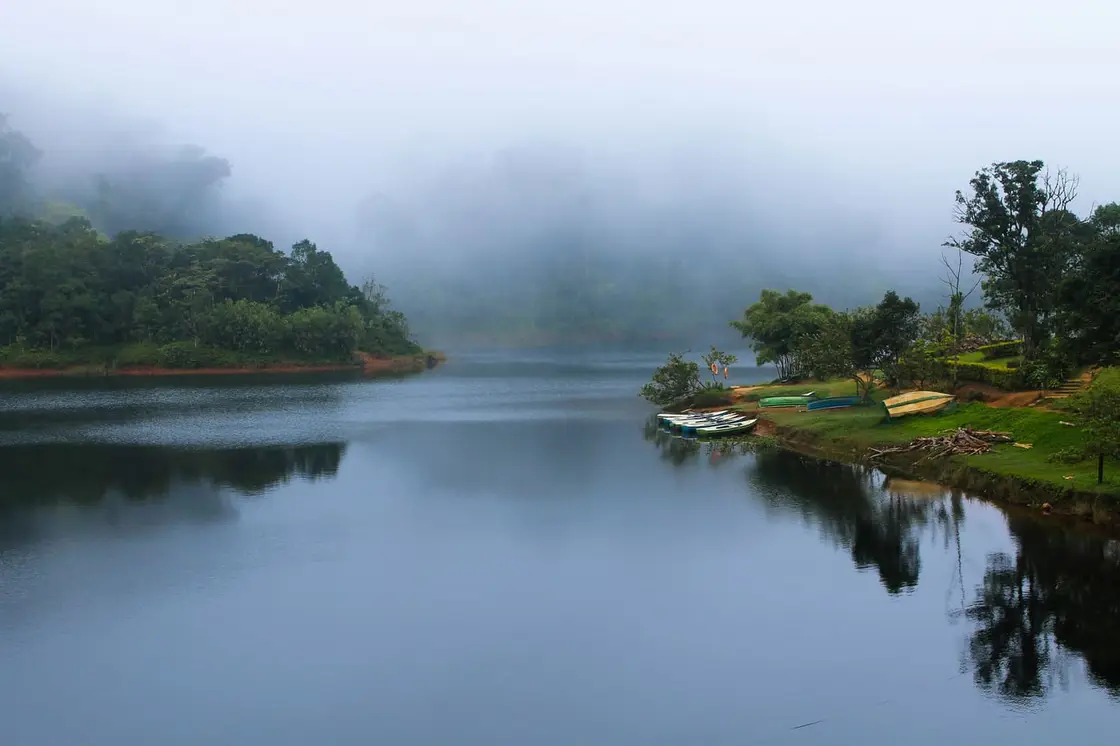
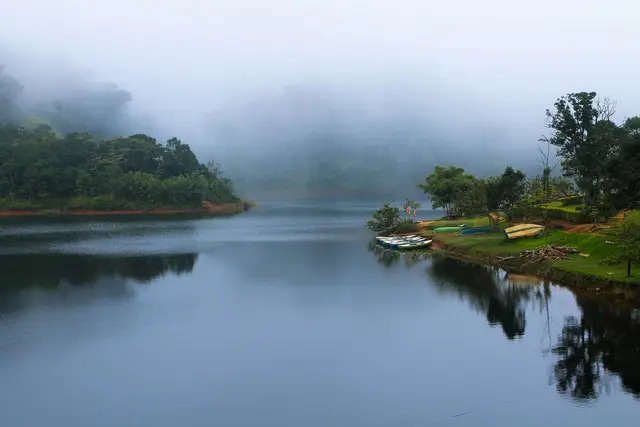
The engineering arrived alongside the estates. The Sabarigiri hydro-electric project, Kerala’s second largest at 340 MW, was commissioned on 28 August 1967, and its dams and weirs are scattered through this country — Pamba, Kakki, Anathode, the Gavi dam and the Kochu Pamba weir, with Kullar–Gavi and Meenar I and II as augmentation reservoirs feeding the Pamba reservoir. The Gavi dam itself is a masonry gravity structure 17.07 metres high and 113 metres long across the Gaviar, completed in 1990 and operated by the Kerala State Electricity Board, holding 2.78 million cubic metres at full reservoir level and sending water by tunnel to Meenar-I. The lake the boats go out on is not a natural lake.
Legend & myth
Gavi is too young for old legend, and it is more honest to say so than to borrow one. There is no ancient temple here, no sarpakkavu and no festival calendar of its own: the settlement is roughly sixty years old, the country around it is a protected reserve, and the households are Tamil-speaking estate families whose ancestral shrines are in Tamil Nadu and in the Ceylon hill country. We searched in Malayalam for a Gavi ക്ഷേത്രം, ഐതിഹ്യം and ഉത്സവം, and through the Seethathodu panchayat one administrative level up, and found none recorded. What Gavi does have instead is a small body of modern legend, and it is unusually well documented.
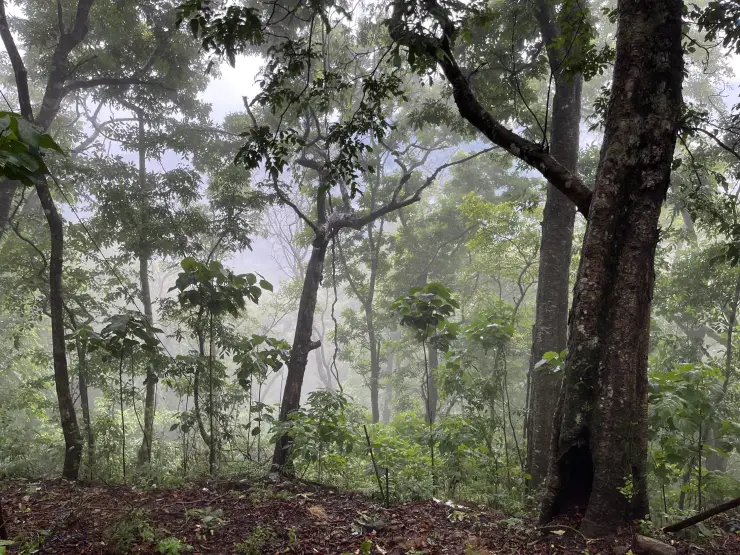
The strangest of it grows on a tree. In the woods between Kochu Pamba and Gavi, in the Pachakkanam and Urani sections of the Goodrical Range, stands a conifer that Malayalam calls നിറംപല്ലി — nirampalli — and that Kerala has for years called the gopher tree of the Book of Genesis. Genesis 6:14 has Noah build the ark of gopher wood. “Gopher” is a Hebrew word that occurs once in the entire Bible and has never been securely translated; scholars mostly guess at cypress on the grounds of durability. The Kerala tree is a podocarp, catalogued as Podocarpus neriifolius and under the older name Podocarpus wallichianus, and it is a genuine botanical rarity in these forests. Whether it is Noah’s timber is not a question botany can answer.
The legend nevertheless took hold, and it is not hard to see why. Central Travancore is one of the oldest Christian landscapes in the world, the Pathanamthitta midlands are thick with Syrian Christian planter families, and the idea that the wood of the ark was still standing on their own ground was irresistible. Newspapers reported it as fact. The Malayalam Wikipedia article repeats a claim that one specimen exceeds 100 metres in height with a girth of about 150 centimetres — figures we do not believe, because no podocarp approaches that height and the two numbers are wildly out of proportion to each other. We record the claim and decline to repeat it as fact. The story carries a second, quieter exaggeration too. Gavi is routinely said to hold the only two gopher trees in India. Forest Department officers themselves have qualified this: the fully grown tree near the path is the only one sighted at the periphery of the jungle, and more may well be standing in the interior of the Periyar Tiger Reserve where nobody has counted them. The department protects the known trees, cutting fire lines around them before the summer. That is the real story — a rare conifer given careful protection — and it is more interesting than the ark.
The second body of legend at Gavi is cinematic, and it changed the place materially. Ordinary, released on 17 March 2012, was the debut feature of the director Sugeeth, with Kunchacko Boban and Biju Menon as the conductor and driver of the Kerala State Road Transport Corporation bus that runs from Pathanamthitta to Gavi. Made for about ₹3.3 crore, it grossed roughly ₹20 crore, ran over 150 days and was remade in Tamil as Jannal Oram and in Telugu as Right Right. Before it, Gavi was a name known to foresters and birdwatchers. After it, as the English Wikipedia article puts it plainly, Gavi became a major tourist destination.
What followed is the part usually left out of the romance. The rush of visitors disturbed the animals and their cover, and the authorities responded by tightening access. The permit regime that visitors now grumble about at the Vallakkadavu check post is in large part the reserve’s answer to a film. A Malayalam comedy thriller is an odd thing to credit with a conservation policy, but that is what happened, and it is the clearest case in Kerala of a screen image rewriting the rules of a real reserve. Gavi had been filmed before — parts of Ponnapuram Kotta were shot here in 1973 — without any of this following.
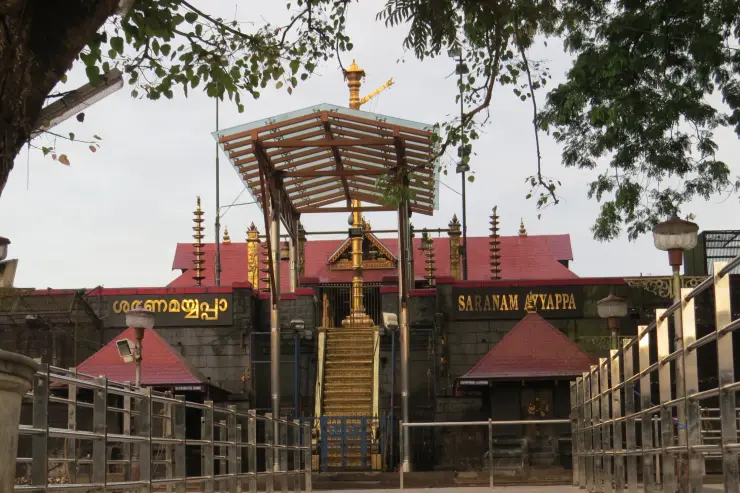
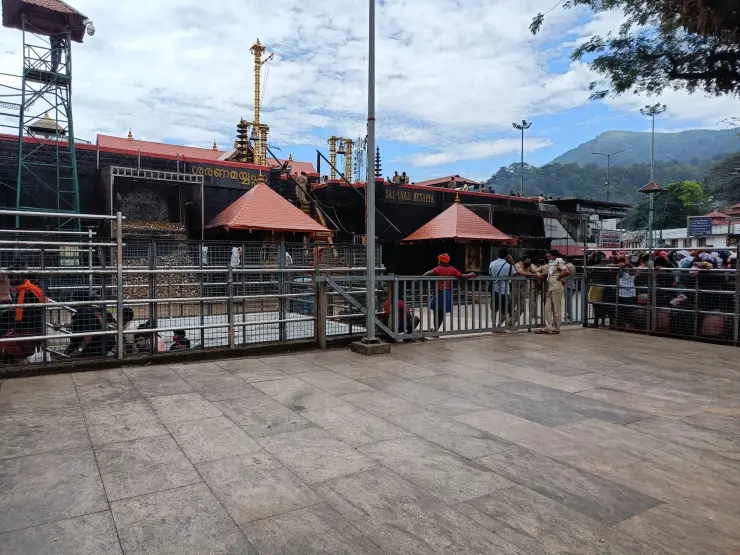
There is a third layer, older and not local, that we should name and refuse. Gavi looks across at Sabarimala, and the walk to the Sabarimala viewpoint is on every programme sold here, so it is tempting to pull the Ayyappa story into a Gavi page. We do not. That legend belongs to Sabarimala and to the Pamba, and it is told where it belongs. The same applies to the Ramayana naming that surrounds this ward: the panchayat is called Seethathodu, “Sita’s stream”, and one of its wards is Seethakkuzhi, “Sita’s hollow”. The toponyms are real and they are on the official ward list. We searched in Malayalam and in English for a published legend explaining them and found none, so we report the names and stop there rather than inventing the story they imply.
The lore Gavi genuinely owns is the settlement’s own memory, and it is oral rather than written: the crossing from Talaimannar, the paperwork, the first sight of jungle where a village had been promised, the years the cardamom wage did not come. It is told in Tamil, in a Malayalam-speaking district, by people who are Indian citizens on paper and landless in practice. No folklorist has collected it. If you take a guide from the settlement and they choose to talk, you are hearing the only tradition that is actually native to Gavi, and it is younger than the tiger reserve around it.
One last name deserves recording, because it is the only thing in the world named after this place. In 2011 a team of herpetologists — Dinesh, Biju, Van Bocxlaer, Mahony, Radhakrishnan, Zachariah, Giri and Bossuyt — described a new Western Ghats amphibian and called it Nyctibatrachus gavi, the Gavi night frog. It is endemic, it has never been formally assessed by the IUCN, and almost nothing is published about its habits. A settlement that has spent sixty years struggling to be recorded has, at least, put its name permanently into the scientific literature.
More about Gavi
History
Administratively Gavi is a ward of Seethathodu grama panchayat in Pathanamthitta district — one of thirteen, alongside Kottamampara, Angamuzhi, Campi Line, Seethakkuzhi and the rest. The panchayat is enormous and nearly empty: 651.94 square kilometres, a 2001 census population of 18,222, and a density of 28 people per square kilometre against a Kerala average many times that. Ninety per cent of it is reserve forest, in the Goodrical Range. Gavi is the far eastern end of it, hard against the Idukki district line.
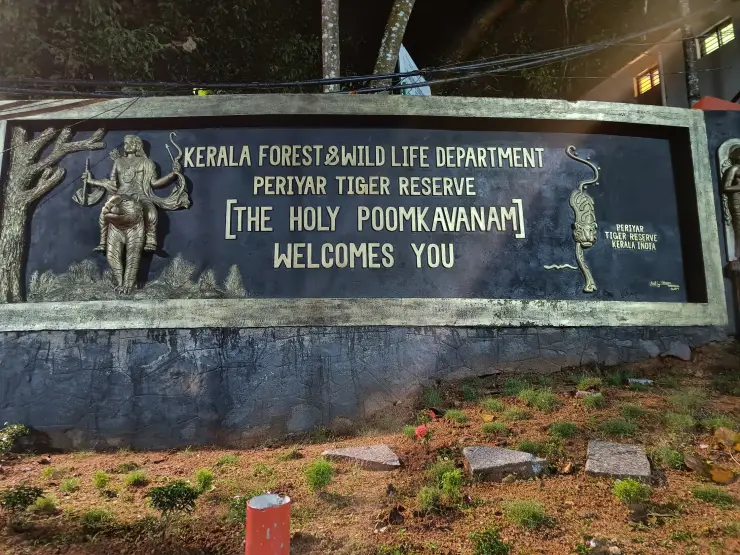
The reserve itself was protected long before the settlement arrived. Periyar was declared a sanctuary under Travancore and became a tiger reserve in 1978 under Project Tiger; the Pathanamthitta flank, including Gavi, is inside it. That is the single most important fact about visiting: Gavi is not on the edge of a tiger reserve, it is in one, and the rules that follow are not tourism-industry inconvenience but wildlife protection law.
The estates were carved out before the reserve boundary hardened around them, which is why an operating cardamom plantation and a workers’ settlement sit inside a protected area at all. That anomaly — an inhabited, cultivated enclave in a tiger reserve — is what the Navakiranam relocation scheme is trying to unwind, and it is why every proposal for Gavi’s future is really a proposal about who leaves.
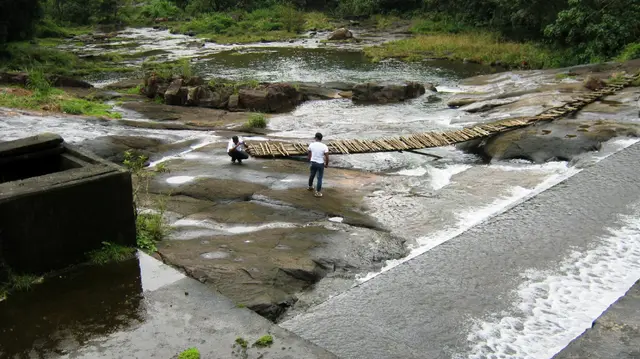
Water engineering shaped the map next. The Sabarigiri project, commissioned in August 1967, threw a series of dams and weirs across the headwater streams: the Gavi dam of 1990 on the Gaviar, the Kochu Pamba weir on the Pamba — a concrete gravity structure only 3.65 metres above the river bed and 52.45 metres long, with an ungated ogee spillway — and the Meenar reservoirs. The Malayalam Wikipedia article counts eight lakes in the Gavi landscape as a result. The scenery visitors come for is, in large part, a power scheme.
Road access came late and remains conditional. The route in from the Idukki side runs from Vandiperiyar on the Kumily road; the route in from the district’s own side runs from Pathanamthitta through Angamoozhy, Moozhiyar, Kochu Pamba and Pachakkanam, and the Vallakkadavu check post issues the gate passes for onward travel. The Kerala State Road Transport Corporation has run a scheduled bus over the whole 130-odd kilometres for years, and added a second service in September 2022 after the Forest Department cleared it, using small buses because of the gradients and curves.
The corporation’s own numbers explain why the bus matters. Before the second service, Malayala Manorama reported around a hundred passengers a day crowding into a single small bus. Gavi is the rare Indian protected-area destination reachable on an ordinary state transport ticket, which is precisely what the 2012 film was about — and it is also why the Forest Department is careful about what bus passengers may and may not do once they are inside the reserve.
Why visit
It is one of very few settlements you can visit inside a tiger reserve, and the history of how it got there is genuinely unusual.
The KFDC eco-tourism programmes are run largely by people from the settlement, so the guide, the boatman and the cook are usually local residents.
The Kochu Pamba and Gavi waters are quiet, engineered reservoirs of the Sabarigiri scheme rather than tourist lakes, and they behave like it.
Birdlife is exceptional — published counts run from 250 to over 320 species — and the great pied hornbill is a realistic sighting.
The Pathanamthitta–Gavi–Kumily bus is one of the most striking scheduled road journeys in Kerala, six hours through the reserve for an ordinary fare.
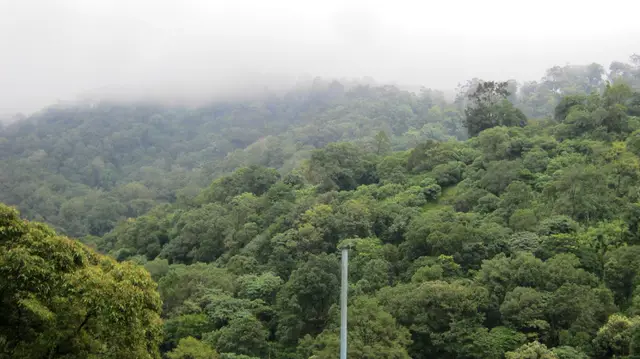
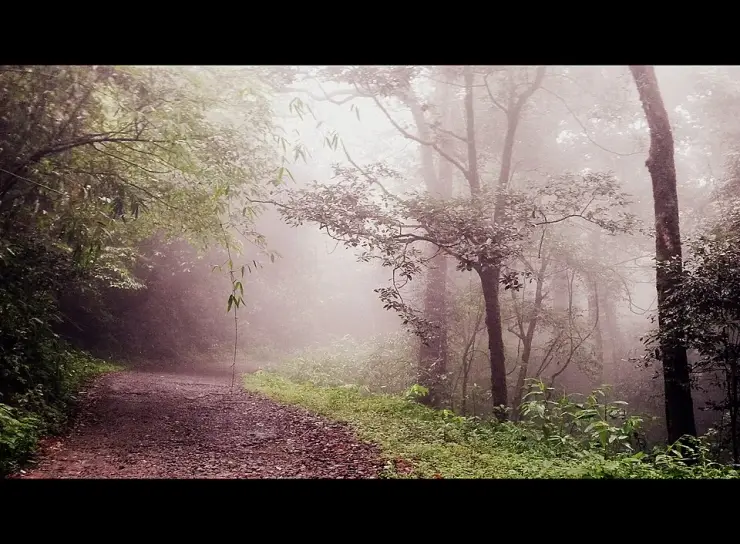
The grasslands and shola around Gavi sit at just over a thousand metres, so mornings are genuinely cold in a way lowland Kerala never is.