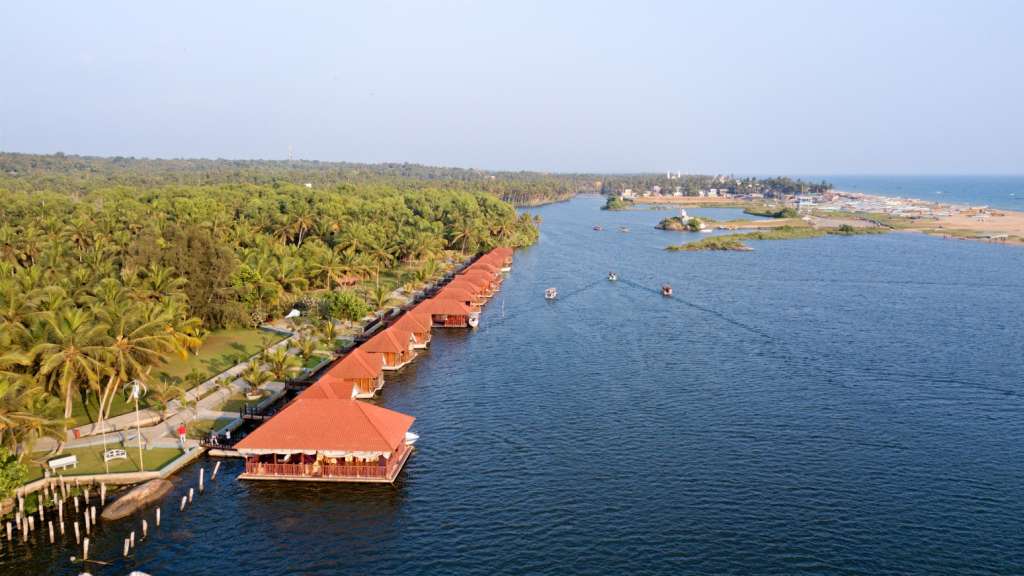
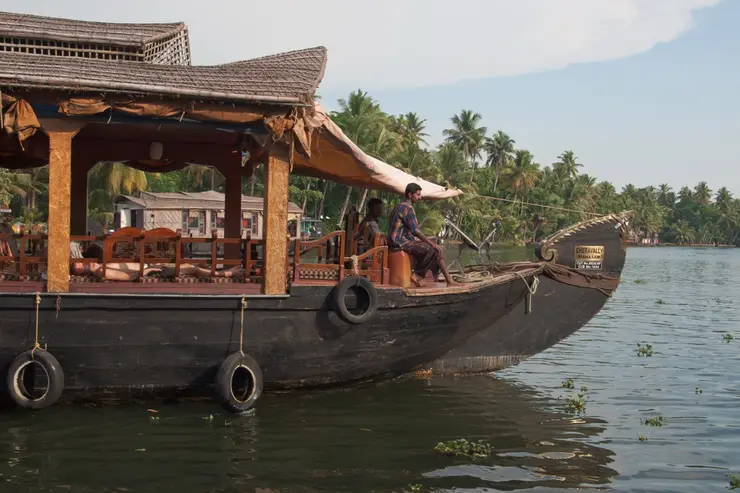
At the very southern tip of Thiruvananthapuram district, where the Neyyar river slips quietly into the Arabian Sea, Poovar is a coastal village of estuary, lagoon, mangrove and sandbar all folded into one small stretch of coast. It is famous for a secret golden-sand beach reachable only by boat, for slow backwater cruises through tangled mangroves, and for floating cottages that hover over still water — a gentler, quieter alternative to nearby Kovalam.
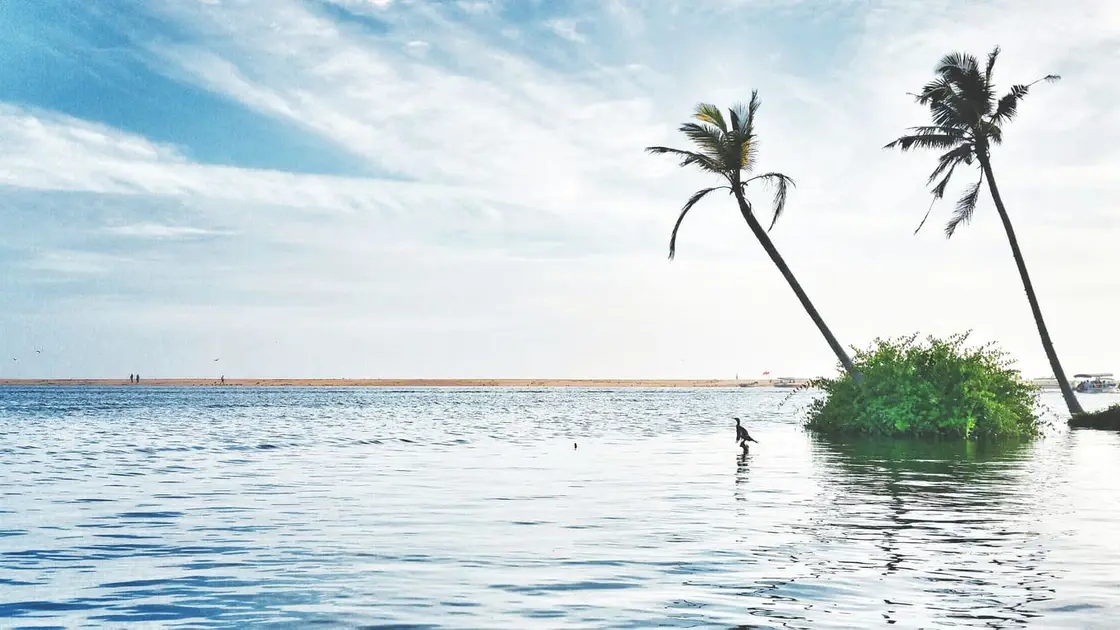
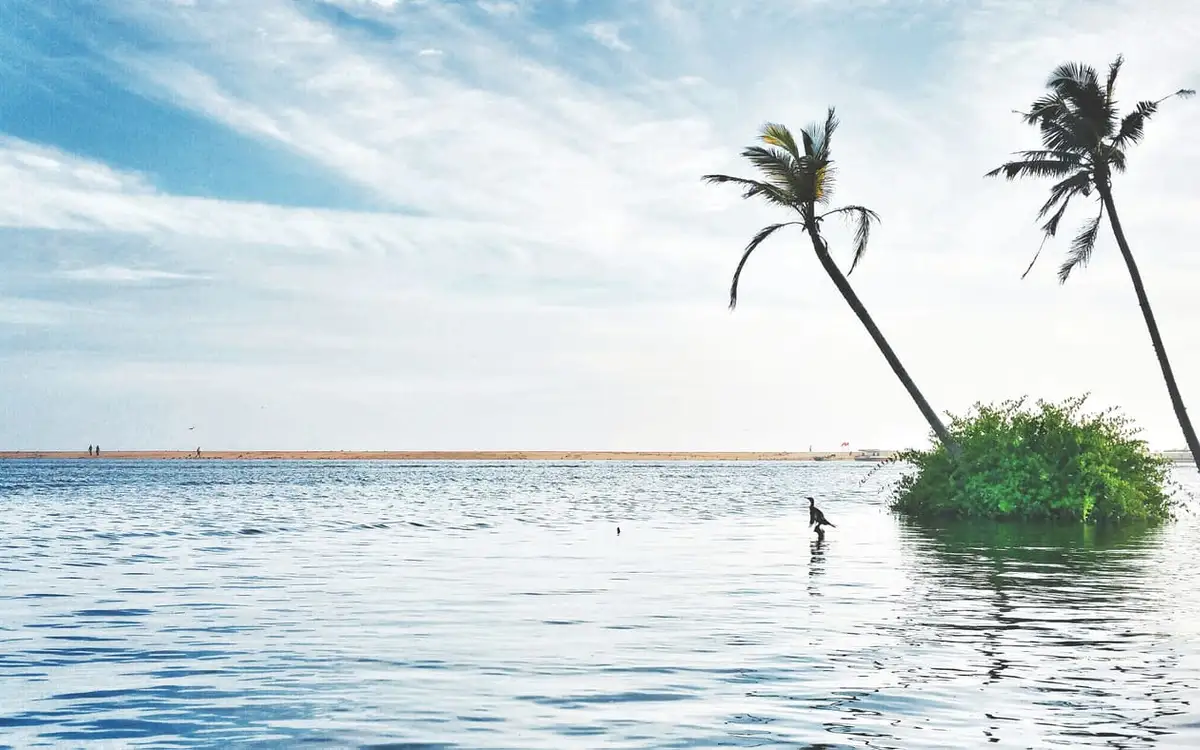
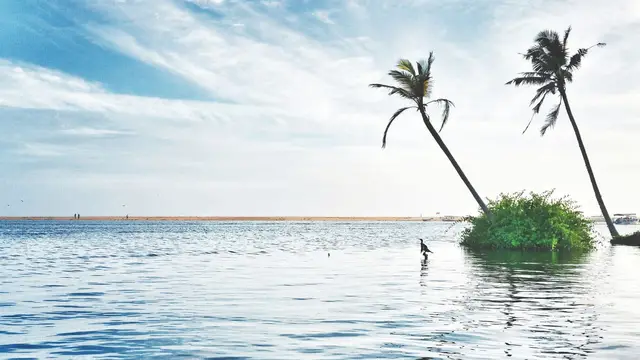
Poovar sits at one of those rare places where four landscapes meet at once — river, lagoon, sea and land. The Neyyar, having tumbled down from the Western Ghats and past Neyyattinkara, spreads out here into a broad, glassy backwater before finally breaching a thin ribbon of sand to join the Arabian Sea. The result is an estuary of extraordinary calm, its surface mirroring coconut palms and the low green wall of the mangroves that fringe the water.
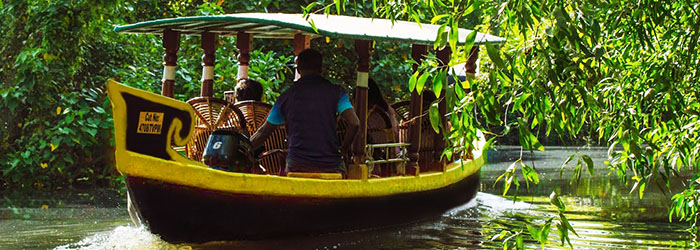
The village’s signature experience is the boat cruise. Country boats and small motor craft set out from the jetties, threading narrow channels where the mangrove roots arch overhead and kingfishers dart between the branches. Guides point out the fishing hamlets along the banks, the nets drying in the sun, and the tidal creeks where the freshwater river and the salt sea trade places twice a day. For many visitors this two-hour glide through the backwaters — unhurried, shaded, and often shared with only a handful of other boats — is the whole reason to come.
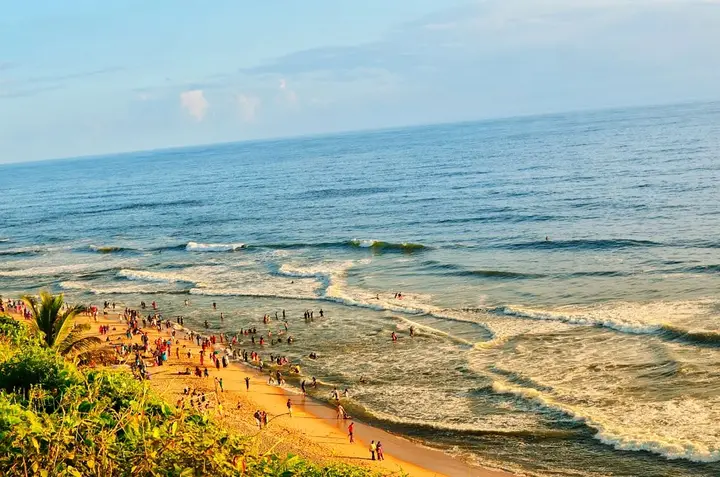
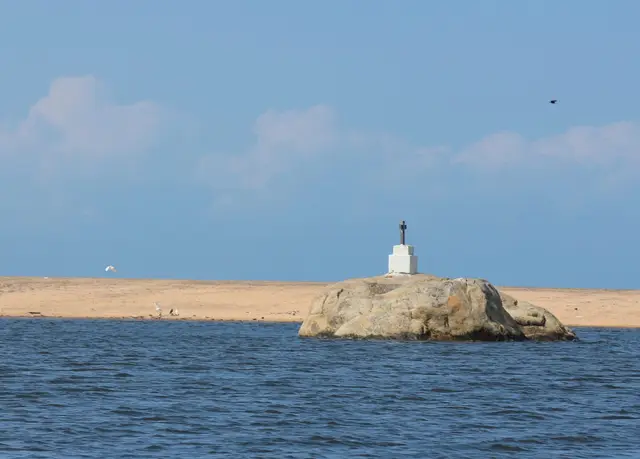
The cruise almost always ends at Poovar’s celebrated golden beach. This is not a beach you can walk to: it is a long sandbar that separates the lagoon from the open ocean, and the only way across is by water. Boats nose up onto the estuary side and passengers step out onto fine, warm sand that genuinely glows amber in low light, with the calm backwater lapping one shore and the surf of the Arabian Sea pounding the other, just metres away.
Poovar remains, at heart, a working fishing village. Away from the resorts the rhythm of the place is set by the tides and the day’s catch, and much of the community still lives from the sea or, increasingly, from tourism. This blend gives Poovar its particular character — luxurious floating cottages and jacuzzi villas on one bank, weathered fishing canoes and net-menders on the other, the two coexisting along the same quiet waterway.
The mangroves are more than scenery. They are a nursery for fish and crab and a magnet for birds, which makes Poovar a favourite of birdwatchers and photographers. Cruises drift past herons stalking the shallows, cormorants drying their wings on stakes, and Brahminy kites wheeling overhead, and the relative quiet of the backwater — fewer boats than Kerala’s busier lagoons — means the wildlife is easy to watch undisturbed.
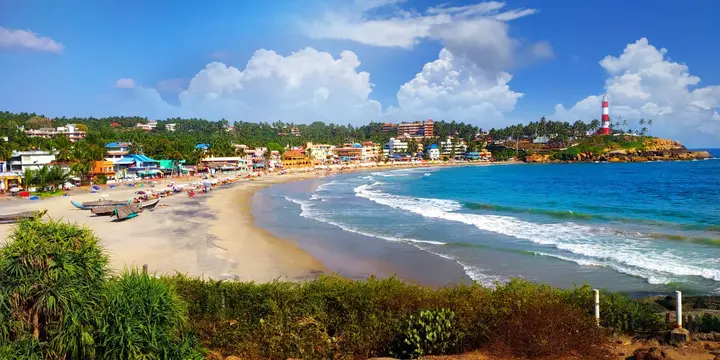
Because it lies about 18 kilometres beyond Kovalam and close to the Tamil Nadu border, Poovar is often folded into a southern-Kerala coastal itinerary. Yet it manages to feel a world apart: where Kovalam is lively and crowded, Poovar is hushed, low-rise and green, a place people come to slow down, take a boat, and watch a river become a sea.
Legend & myth
Poovar’s very name carries a legend. Tradition holds that it comes from the words Poo-Aar (also rendered as Poovin Aaru) — the river of flowers. The story goes that the Neyyar’s banks were once lined with flowering trees whose blossoms fell into the water and drifted downstream in such numbers that the river seemed to carry a carpet of petals to the sea. This flower-strewn river, so the tradition says, gave the village its name.
The naming is tied by local lore to Marthanda Varma, the 18th-century king who forged the kingdom of Travancore. As legend recounts, while fleeing his rivals the king reached this coast in the flowering season and was so struck by the sight of red blossoms floating down the Neyyar like a scarlet carpet that he christened the river Poo-Aar. Older tradition adds that the settlement was earlier known as Pokkumoosapuram, after a local merchant.
A companion tradition holds that Poovar sheltered Marthanda Varma during his years as a fugitive. As the story is told, during the internal revolts of Travancore and his flight from the powerful Ettuveetil Pillamar — the Lords of the Eight Houses — the young king was given refuge in the home of a Poovar merchant, remembered as Pokku Moosa Maraikkar. These accounts are cherished local tradition woven around a real historical king, and are best enjoyed as legend rather than documented fact.
We had been presenting those last two as separate traditions, and on rereading them that is the wrong way round: they are one story in two halves, and they only make sense in sequence. If the village was already called Pokkumoosapuram after the merchant Pokku Moosa Maraikkar, and if that merchant is the man who hid the fugitive prince, then the flower-river name is not an original naming at all. It is a renaming — the guest, once king, replacing his host's name on the place with a poetic one of his own. Told that way the two legends stop competing and become a single narrative with a beginning and an end, which is both more satisfying and rather more pointed about how places get renamed. The historical frame is at least real: Marthanda Varma reigned from 1729 to 1758 and his struggle with the Ettuveetil Pillamar is documented history, whatever the status of his stay here.
The port history needs a firmer hand than it usually gets. Descriptions commonly link Poovar to trade in the era of the Chola dynasty, and that phrasing — some accounts say — does a lot of quiet work. There is no primary record we can find placing a working port here in any specific dynasty's period, and a dating that cannot be sourced is not worth passing along. What is reasonable to say is narrower: this is a sheltered natural estuary on the spice coast, estuaries of this kind were used, and local tradition consistently remembers timber, sandalwood, ivory and spices moving through. That is an oral tradition about a plausible activity, not a documented chronology, and the honest version says so.
Two smaller things repeated everywhere about Poovar are worth setting straight. First, Poovar is not an island. The phrase Poovar Island is a resort brand, and it has been echoed so widely that visitors arrive expecting to reach the village by boat; the village is on the mainland and you drive to it. The only water crossing here is out to the sandbar. Second, the distance to Kovalam. This page said barely 15 kilometres and our backwaters page said 30 — a disagreement of a factor of two between two pages of the same site. The figure in general circulation is about 18 km, or roughly thirty to forty-five minutes by road, and that is what we now use throughout.
More about Poovar
History
Long before it was a resort destination, Poovar was a port. Its sheltered estuary made it a natural harbour on the spice coast, and historians describe it as an old trading centre dealing in timber, sandalwood, ivory and spices carried down the Neyyar from the interior and shipped out along the coast.
Local histories trace maritime activity here back a very long way, and the estuary is said to have functioned as a working port. Attempts to pin that to a named dynasty should be treated with caution — we have found no primary record fixing a period, and the Chola dating sometimes quoted is not one we can source. Its position near the southern extremity of the Malabar coast placed it on the sea lanes that connected the pepper-and-spice hinterland of the south-western coast to wider maritime networks.
By the 18th century Poovar lay within the orbit of the rising kingdom of Travancore, consolidated by Marthanda Varma. The village’s trade in timber and forest produce continued, and traditional accounts describe it as having commercial links reaching to international markets during this period — a small but useful port on Travancore’s southern flank.
The wider coast here shares in the long history of European engagement with Kerala’s spice trade, from the Portuguese arrival on the Malabar coast onwards. Poovar itself, however, is remembered less for grand monuments than for its quiet continuity as an estuary settlement of merchants and, above all, fishing families — a livelihood that still shapes the village today.
In recent decades Poovar’s fortunes have shifted from cargo to tourism. The same estuary, mangroves and golden sandbar that once served trade now draw travellers, and land-and-water resorts, floating cottages and backwater cruises have made this once little-known fishing village one of southern Kerala’s distinctive coastal getaways.
That shift is more recent and less complete than the resort brochures imply. Poovar was a fishing and farming village well into the late twentieth century, and its emergence as a destination follows the growth of Kovalam up the coast rather than preceding it. The fishing has not gone: canoes still work off the bar and nets still dry on the estuary bank, a few hundred metres from jacuzzi villas. It is a village doing two jobs at once, and the second one is only a few decades old.
Why visit
The golden beach is genuinely special: a sandbar you can reach only by boat, with the calm lagoon on one side and the open Arabian Sea crashing on the other — a rare place to stand between a river and an ocean at once.
The backwater cruise through the mangroves is the classic Poovar experience — a slow, shaded glide past fishing hamlets, tidal creeks and birdlife, usually far less crowded than Kerala’s busier lagoons.
It is a birdwatcher’s and photographer’s delight, with kingfishers, herons, cormorants, egrets and Brahminy kites regularly seen along the mangrove-lined channels.
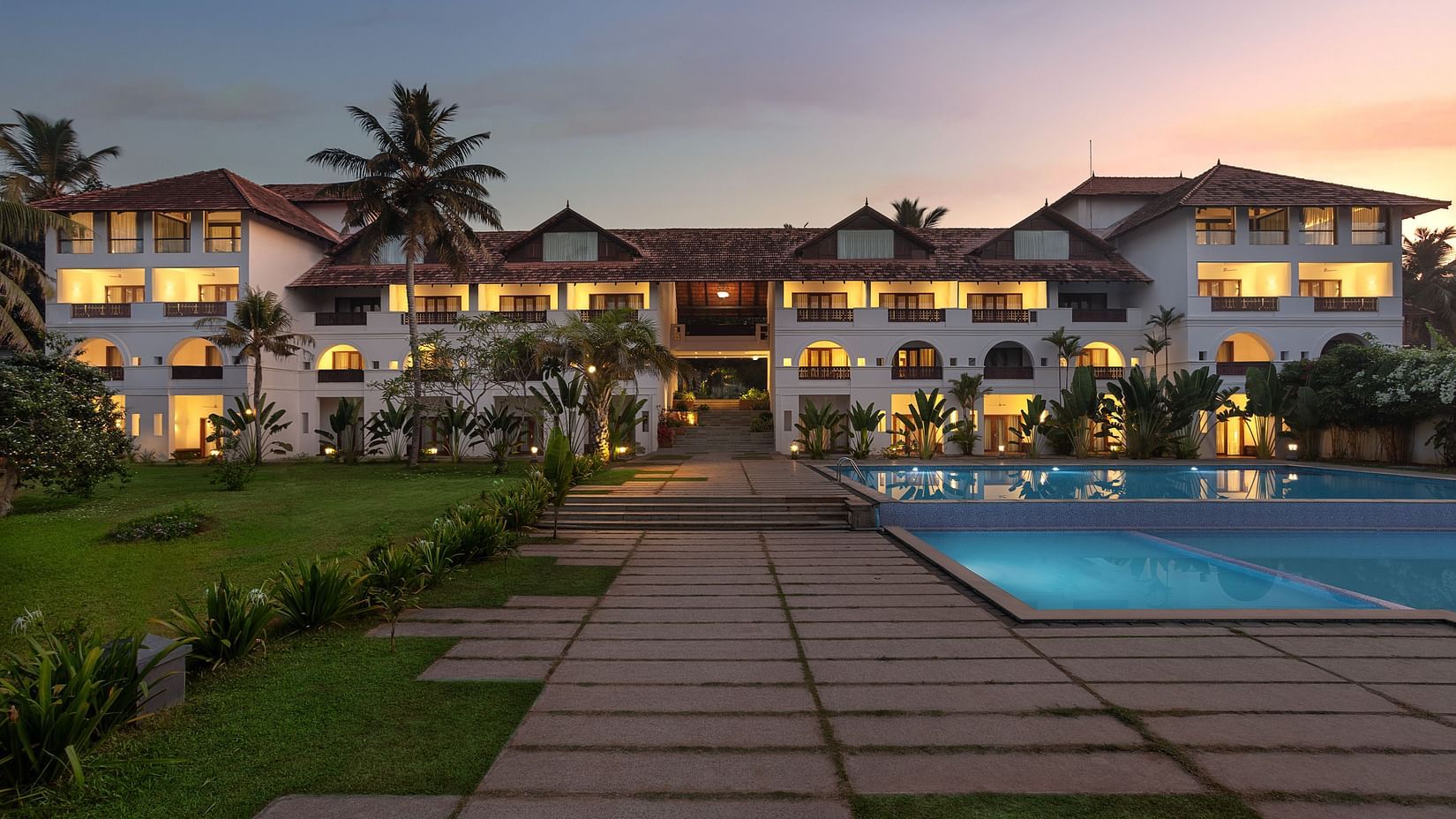
The floating cottages and land-and-water resorts let you sleep almost on the water, an atmospheric and unusual stay just south of Kovalam.
Poovar offers the calm that Kovalam has lost — low-rise, green and quiet — making it ideal for honeymooners, families and anyone wanting to slow right down.
Its location near the Tamil Nadu border and about 18 kilometres from Kovalam makes it an easy, rewarding add-on to any southern-Kerala coastal trip.