Places to Visit in Thiruvananthapuram city

Temple, museum, palace and airport base for South Kerala.

Thiruvananthapuram city
Practical guide

Plan Thiruvananthapuram city

Who's going?Tailor Thiruvananthapuram city to your trip
DistrictThiruvananthapuram
RoleCapital base
Time neededThree days for the city
Places to visit8Listed businesses75
What to expect

Highlights

  • Kilimanoor Palace — The ancestral palace compound associated with Raja Ravi Varma at Kilimanoor; visitor access concerns the working family estate and must be confirmed before travel.
  • Beemapally Mosque — A major coastal Muslim pilgrimage landmark south-west of the city centre, known for the Beemapally Uroos and the tombs honoured within the shrine complex.
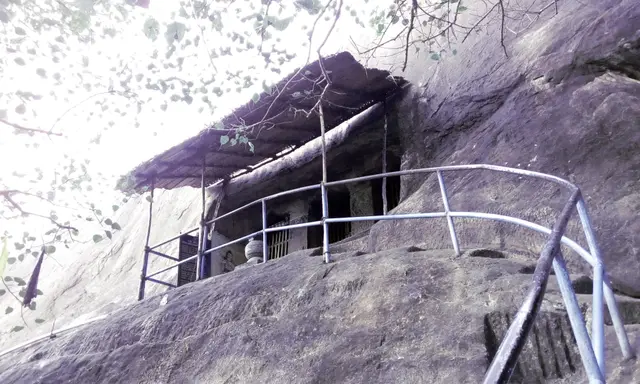
  • Madavoorpara — Madavoorpara combines a rock-cut Shiva shrine with a rocky hill landscape on Thiruvananthapuram’s northern edge. The temple and the climb offer different reasons to visit, and both deserve time.
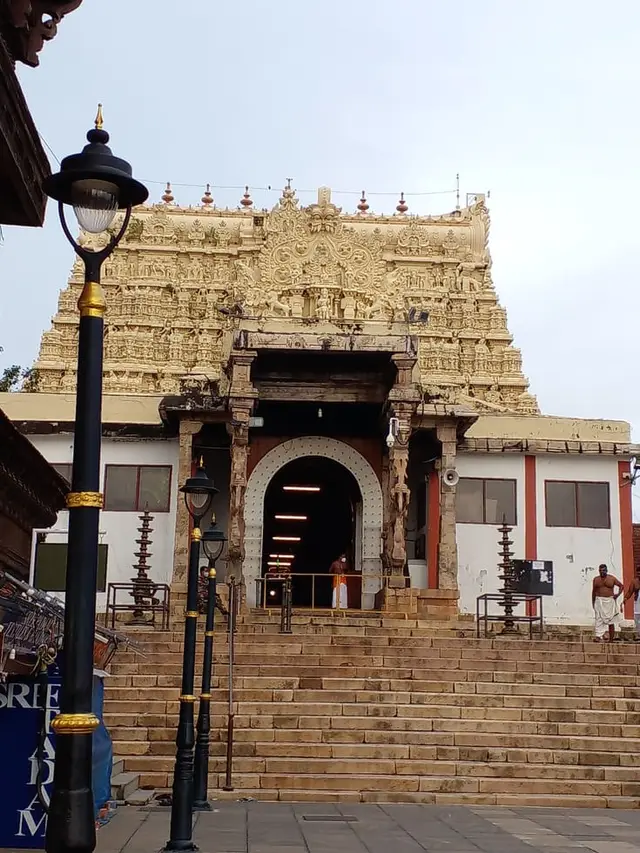
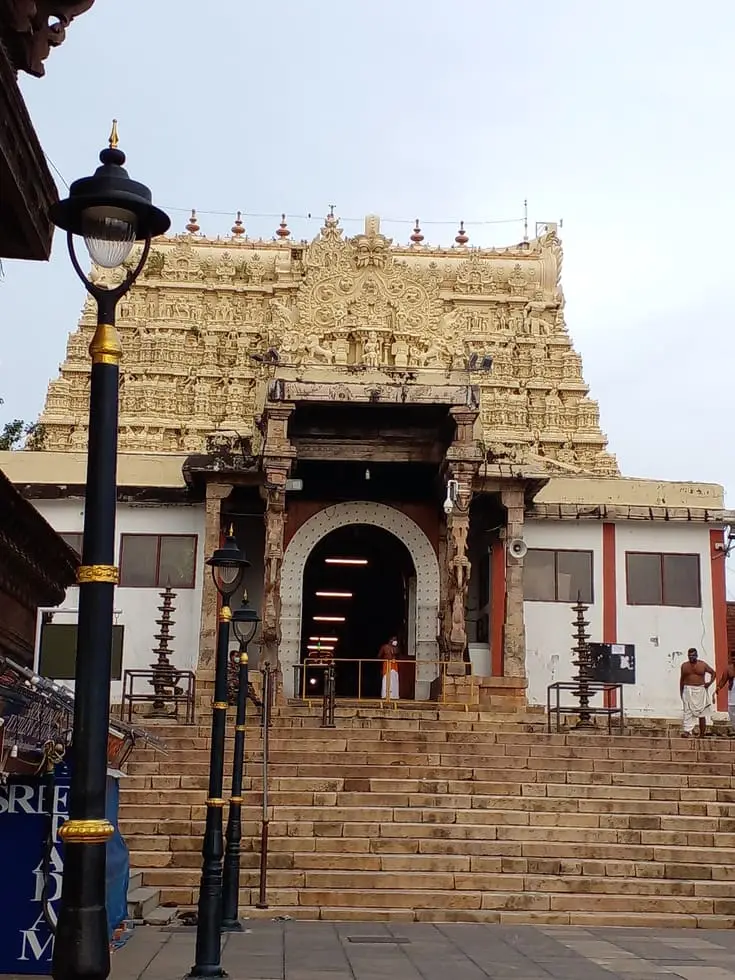
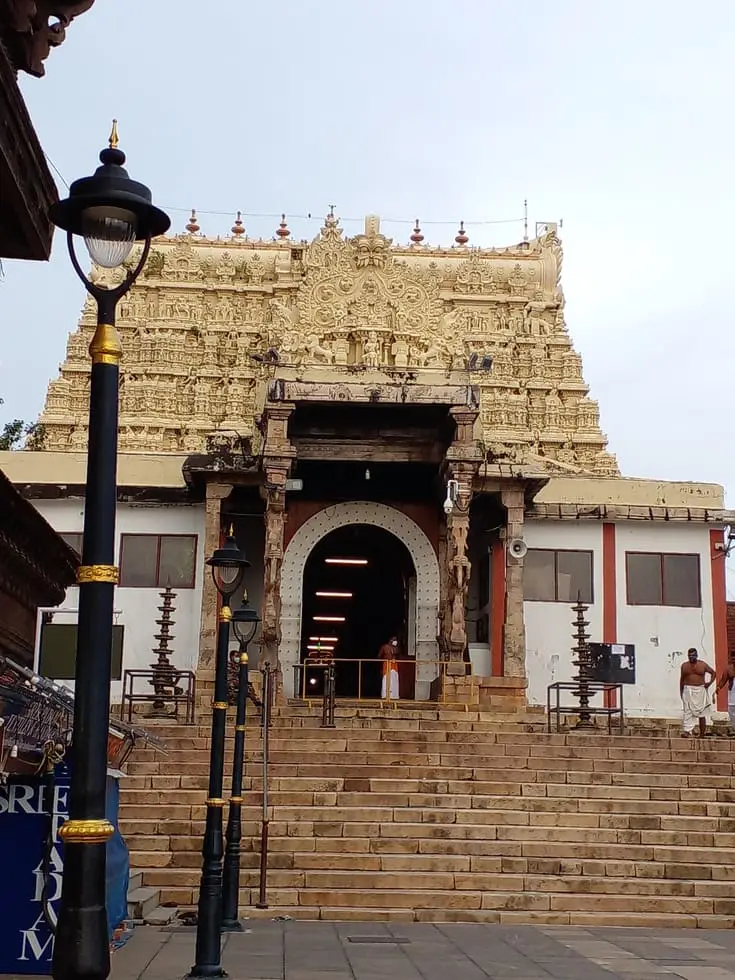
  • Sree Padmanabhaswamy Temple — Major Vishnu temple and one of Kerala’s most important pilgrimage landmarks; strict entry and dress rules apply.
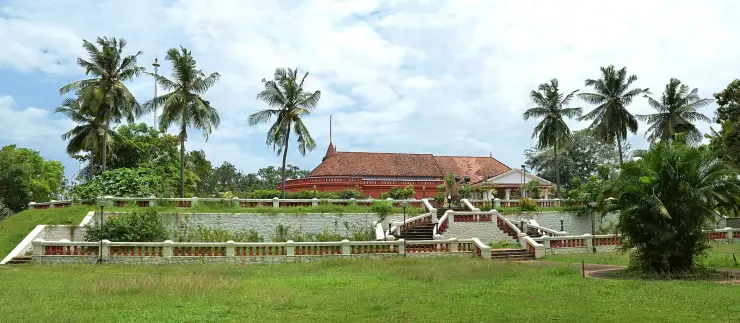
  • Napier Museum — Robert Chisholm’s 1880 Indo-Saracenic museum in the Museum Park — a polychrome landmark holding Chola and Kerala bronzes, ivories and temple carts, with the Sree Chitra Art Gallery alongside it.
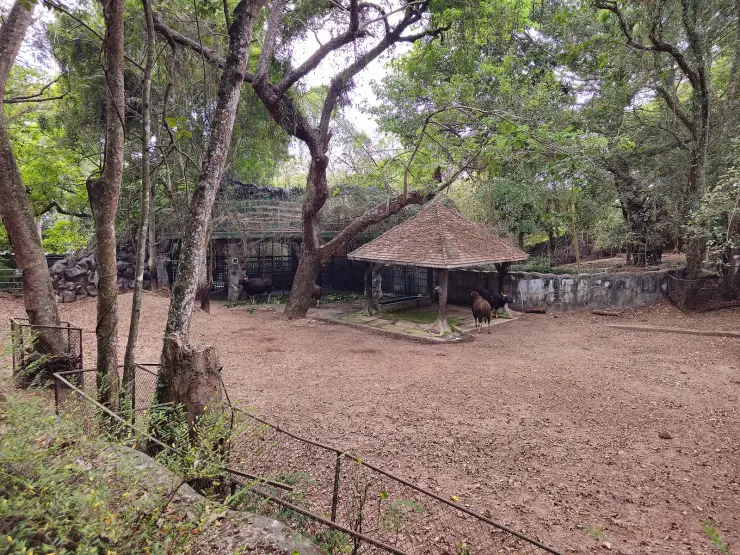
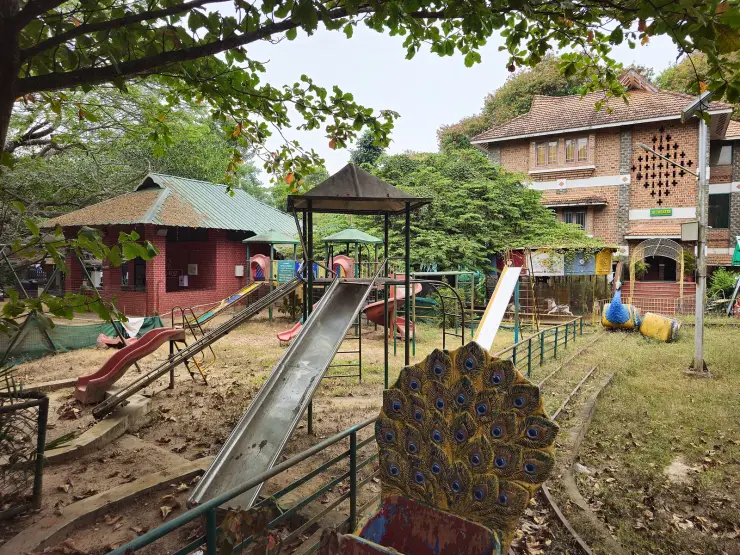
  • Thiruvananthapuram Zoo — Old trees, winding paths and animal enclosures share the Museum Park at Thiruvananthapuram Zoo, also known as Trivandrum Zoo. Allow time for the garden as well as the collection, with the Napier Museum close by.
Getting there

How to visit

  • Nearest airport: Trivandrum (TRV), in-district
  • Rail gateway: Thiruvananthapuram Central (TVC)

Distance by road

  • Kochi213 km
  • Madurai309 km
  • Coimbatore388 km
  • Kozhikode396 km
  • Mysuru546 km
  • Mangaluru624 km

Road distances measured on real routed roads to Thiruvananthapuram city itself, not to the district headquarters, on 22 August 2026. Driving time is deliberately not published: free-flow routing badly understates a Kerala ghat road, so allow more than the distance suggests.

Timing

Best time to visit Thiruvananthapuram city

October to February is dry and walkable. March and April are hot but carry the biggest festivals. June to September is the south-west monsoon — heavy, but this is the greenest the city gets and the museum quarter is at its best in rain. Attukal Pongala (Makaram–Kumbham, February–March) fills the whole southern half of the city and accommodation goes early.

Weather in Thiruvananthapuram citySeasonal guide

Live forecast loads in your browser.

Today at Thiruvananthapuram city
Sunrise6:12 am
Sunset6:21 pm
Golden hour best light5:21 pm–6:21 pm
Blue hour after sunset6:21 pm–6:46 pm
Sun sets toward compass bearingW · 272°
Moon tonight🌓 First quarter · 52%
South-west monsoon. June to September is the south-west monsoon in Kerala. Expect heavy showers, mostly in bursts rather than all day — carry rain cover, allow extra time for getting around, and note that ferries and open-air sites are the first things affected.

Sun and moon are calculated for this location and shown in IST. Photography windows are the hour around sunrise and sunset; the sunset bearing is degrees clockwise from true north. Moon phase is accurate to about half a day.

Visitor notes

  • Four stations in this city are called Thiruvananthapuram something. Check whether your ticket says TVC, TVP, TVCN or NEM before you get into an auto — they are up to 10 km apart.
  • The museum-and-zoo compound closes on Mondays and on Wednesday mornings. It is uphill from the centre; do not walk up to the gate to find that out.
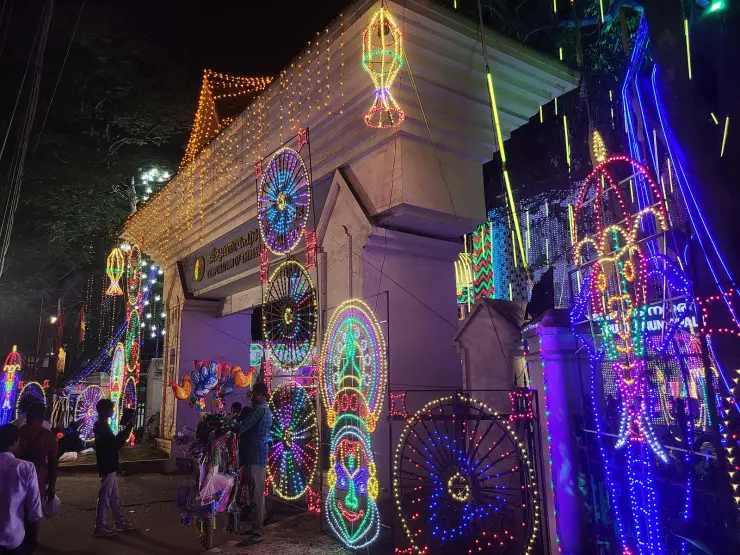
  • Attukal Pongala fills the southern half of the city for a day and rooms go early. If you are not there for it, avoid that week rather than arrive in the middle of it.
The story

The story of Thiruvananthapuram city

Thiruvananthapuram is the only Indian state capital that was once, in law, the property of a god. On 3 January 1750 Marthanda Varma made over the kingdom of Travancore to Padmanabhaswamy and ruled thereafter as Padmanabhadasa, the deity’s servant — and every Travancore sovereign after him governed on the same terms. The city you walk through is what that arrangement built: a temple at the dead centre of a walled quarter, a two-kilometre bazaar laid out to feed it, a palace beside it, and then, ring by ring, the apparatus of a small state that decided institutions were the point — a public library in 1829, an English school in 1834, an astronomical observatory in 1837, a general hospital in 1839, a museum and a zoo in the 1850s. It has since added a rocket range and India’s first technology park, and both of those are on the same thread.

Start with the shape, because the shape is the argument. Almost every old Kerala town grew along a river, a backwater or a trade road. Thiruvananthapuram grew in rings around a shrine, inside a wall, on ground chosen for a temple rather than for a harbour or a ford. The Sree Padmanabhaswamy temple sits at the centre; the fort ran round it on all four sides; the palace quarter, the tank, the ceremonial routes and the market street were laid against it. Everything that has happened to the city since — the Secretariat, the university, the airport, the rocket range, the software park — has happened outside that ring and has arranged itself around it. Nowhere else in Kerala can you read a state’s constitution off its street plan.

The wall is still there, and most visitors miss it because they are looking for a fort and it is not one. East Fort — Kizhakkekotta, the eastern gate — is now the busiest bus and shopping node in the city, and the fortification survives as fragments: a long run of massive dressed stone blocks beside the road, protected as a monument, and a pair of gateways. The white classical gate with the pediment and the colonnaded pavilion is the one every photograph shows. Behind it, on the road that cuts through the line of the wall, stands a red brick Gothic-revival gatehouse with twin crenellated towers, the Travancore conch set in white on its parapet and the year picked out beside it in numerals a metre high: 18 91. It is a Victorian insertion into a much older enclosure, and it dates itself, which is more than most of the buildings around here do.

Running east from that gate is Chalai. It is a straight two kilometres of bazaar from Killipalam to East Fort, and it is the oldest continuously working commercial street in the city — established at the end of the eighteenth century by Raja Kesavadas, Dewan of Travancore, as the central supply point for the kingdom. Kesavadas is better known for what he did on the other coast, where he opened the port of Alappuzha in 1762, and this is the same instinct applied to a capital: put the goods where the government is. The Killi and the Karamana rivers brought produce in. The street still does what it was built to do — vegetables, hardware, textiles, spices, gold — and at Onam more than ten thousand kilograms of flowers pass through it for the floor-designs. Most shops keep roughly nine in the morning to eight at night and close on Sunday; the crowd is heaviest in the last two hours.

It became the capital late. Travancore’s seat was at Padmanabhapuram, forty-odd kilometres south in what is now Tamil Nadu, and the administration moved north to Thiruvananthapuram in 1795, under Karthika Thirunal Rama Varma, the Dharma Raja. That is a generation and a half after the dedication of 1750 — the god had the kingdom before the government had the city — and it explains a peculiarity of the place: the ritual centre is genuinely old, and the administrative city around it is not. Almost everything that looks historic here, outside the temple compound and the fort, was built between about 1830 and 1900.

That seventy years is the interesting part, and it is not a story about architecture. Under Swathi Thirunal Rama Varma, who ruled from 1829 to 1846, a state with a population smaller than a modern Indian city built a public library in 1829, the Raja’s Free School in 1834 — the first government English school, which survives as University College at Palayam — and an astronomical observatory in 1836–37. A general hospital followed in 1839. The observatory was not decorative: the maharaja’s cousin, Raja Rama Varma of Mavelikara, was a working astronomer and a member of the British and Canadian astronomical societies, and he wrote to the Resident proposing it. John Caldecott, who had been running a private observatory at Alappuzha, was appointed royal astronomer; Lieutenant W. H. Horsley of the Madras Engineers designed the building; it went up on the highest ground in the city, opposite the palace. Caldecott began meteorological readings in July 1837 and a Travancore Almanac appeared in 1838.

The programme did not stop with him. The museum institution was founded in 1855 and opened in 1857, the zoo followed in 1859, and the whole walled compound on the northern high ground became the city’s second centre — the Napier building, the art gallery, the botanical grounds and the animal collection all have their own records on this site and their own arguments about dates. What matters at the scale of the city is the pattern: for most of the nineteenth century Travancore spent on institutions the way other princely states spent on palaces, and the result is a capital that reads as a campus.

The most consequential thing that ever happened in this city happened in a fishing village at its northern edge. Thumba sits close to the Earth’s magnetic equator, which makes it an exceptional place from which to fire instruments into the ionosphere, and in 1962 it was chosen as India’s rocket range. The land — some six hundred acres of it — was a working coastal parish. The Bishop of Trivandrum, Rev. Peter Bernard Pereira, agreed to give it up, and gave up more than land: the prayer hall of St Mary Magdalene church became laboratory and workshop space, and the bishop’s own room became Vikram Sarabhai’s office. The first rockets were assembled in the former St Louis High School, which now holds a space museum. On 21 November 1963 a two-stage Nike-Apache, American-built, went up from Thumba; it was India’s first launch. TERLS was formally dedicated to the United Nations by Indira Gandhi on 2 February 1968, and after Sarabhai’s death on 30 December 1971 the Thumba establishments were renamed the Vikram Sarabhai Space Centre. None of it is open to casual visitors, and that is the point to make plainly rather than to leave people to discover at a gate.

The fourth layer is software. Technopark was conceived by the Government of Kerala in March 1990 as India’s first technology park, its foundation stone was laid on 31 March 1991, it opened for business in 1994 and was formally dedicated to the nation by Prime Minister P. V. Narasimha Rao in November 1995. It grew building by building — Park Centre, Pamba and Periyar first, Nila in 1997, Thejaswini in 2007 — and it is now the largest single source of employment in the state, with hundreds of companies and a workforce in the tens of thousands. Seen from the air it is not a business district at all: office blocks scattered through heavy tree canopy on the ridges north of the city, which is roughly how the nineteenth-century museum quarter was laid out too.

Walking it, the city divides into three easy days without much planning. The fort quarter — temple, palace, the wall, Pazhavangadi, Chalai — is one compact morning on foot, and the only part of the city where you can genuinely stay off buses. The museum quarter on the northern high ground is a second, and it is uphill from the centre. The coast at Shanghumugham and Veli, and the backwater behind it, is a third. Everything else — Neyyar, Ponmudi, Varkala, Kovalam — is a day trip, and the bus and rail hub for all of it is a single intersection at Thampanoor, where Thiruvananthapuram Central station faces the central bus station across the road.

Legend & myth

The name first, and then a refusal. Thiruvananthapuram is Thiru-Anantha-puram, the sacred city of Anantha — the thousand-hooded serpent on which Vishnu reclines — and the city is named for its deity rather than the other way round. The legend of how the god came to be here, the sage who wanted a vision, the child who defiled the worship and fled into the forest, the form so vast it had to be shrunk before human eyes could hold it, belongs to the Padmanabhaswamy temple and is told properly on that record. It is one of the finest origin stories in South India and we are not going to tell it twice. What belongs to the city rather than to the temple is the consequence: an entire capital took its name from a posture of sleep.

Underneath Chalai there may be a university, and this is the city’s genuine unsolved question. Kanthalloor Sala was a celebrated centre of learning under the Ay rulers — sometimes called a southern Nalanda — where Vedanta, tarka, vyakarana, Mimamsa, priestly practice and weapons training were all taught, and where even Lokayata, the materialist school, was on the syllabus. The historian T. Gopinatha Rao and others identified it with Valiyasala and the Chala quarter of modern Thiruvananthapuram, citing ninth-century references to a Kanthalloor Salai Mahadeva. K. V. Subramanya Iyer placed it seven miles off, near Neyyattinkara. Others have argued for Chendamangalam, or for somewhere near Vizhinjam. Nobody has settled it.

What is not in doubt is that the Cholas kept attacking it. Rajaraja Chola I recorded around 988 CE that he had done something to Kanthalloor Sala described by the verb kalamaruthu; Rajendra Chola I took both Kanthalloor and Vizhinjam around 1019 CE and renamed the port Rajendra Chola Pattanam; Kulothunga attacked it later still. Even the verb is contested — kalamaruthu has been read as destroying ships, as cutting off the students’ food supply, and as defeating the scholars in debate, which are three rather different events. Read the Chala bazaar with that in the back of your mind and the street changes character: it may be running over the site of an academy that a Tamil emperor thought worth boasting about twice.

The dedication of 1750 attracts a story that the record does not support. It is often told as expiation — that Marthanda Varma, having destroyed the Ettuveettil Pillamar and executed a great many of their families in the course of forcing his succession after 1729, gave the kingdom away to be rid of the blood on it. That reading is popular, it is old, and it may even be partly true, but it is not what the sources set out. The act itself is precisely dated: 3 January 1750, the fifth of Makaram in the year 925 of the Kollam era. The purposes given for it are political — to detach sovereign authority from ordinary civil dispute, to formalise a new distribution of power, and to bind a fractured society under a single emerging authority. A ruler who has just broken the aristocracy and needs the settlement to hold has an excellent secular reason to make rebellion into sacrilege. Both readings can be held at once; only one of them is documented.

Three different years circulate for the move of the capital, and travel writing picks whichever it met first. Malayalam Wikipedia’s city article gives 1745. The article on Raja Kesavadas says Chalai thrived after the capital shifted in 1786. English Wikipedia’s articles on the city, on Padmanabhapuram Palace and on Travancore all give 1795, and the last of those names the ruler: Karthika Thirunal Rama Varma, the Dharma Raja. We print 1795 because it is the best-attested and because three independent articles agree on it, and we say the others exist rather than pretending the question is clean. Part of the confusion is probably real history: a court does not move in an afternoon, and the sovereign, the treasury and the offices need not have arrived in the same year.

Now the coincidence, which is the best fact about this city and is almost never told. The observatory of 1837 was sited here partly because the magnetic equator at that time passed through Thiruvananthapuram, and its second director, John Allan Broun, was interested enough in the Earth’s field to plant a second station on the peak of Agasthyamalai and to publish the Thiruvananthapuram Magnetic Observations in 1874. One hundred and twenty-six years after Caldecott’s appointment, Thumba was selected as India’s rocket range for exactly the same property — proximity to the magnetic equator, which is where the equatorial electrojet runs and where ionospheric physics is best measured. The same invisible line chose this coast twice, for a maharaja’s telescope and for a national space programme, and neither choice had anything to do with the harbour, the climate or the politics.

Thumba itself is named after a flower, and the flower is the one Kerala cannot do without. Thumba is Leucas aspera, a small white-flowered herb of the mint family that comes up through the monsoon on waste ground and paddy bunds, and it is the flower at the centre of the Onam pookkalam — a garland or a floor-design without thumba was traditionally reckoned incomplete. India’s first rocket therefore went up from a village named after a weed that flowers for the harvest festival. We can find no legend attached to the village itself; Malayalam Wikipedia has an article on the plant and its uses in Ayurveda, and a short one on the settlement, and no ഐതിഹ്യം for either. That absence is worth stating: this was a small Latin Catholic fishing parish, and its recorded story starts in 1962.

Two things about Thumba get told wrong. The first is that India’s space programme began in a church. It began beside one: the prayer hall of St Mary Magdalene was used as workshop and laboratory space and the bishop’s room became Sarabhai’s office, but the rockets themselves were put together in the former St Louis High School, and it is that building, not the church, which now houses the space museum. The second is the bishop’s part in it, which is usually flattened into a sentence about a church being handed over. Rev. Peter Bernard Pereira persuaded a coastal parish to give up around six hundred acres of the ground it lived on, with the Belgian priest Vincent Victor Dereere and the district collector Madhavan Nair; the fishing families moved. That is a heavier thing than a building.

One superlative to leave at the door. Technopark is routinely described as the largest IT park in Asia, and English Wikipedia’s own article manages both that claim and the more modest “largest in India” within a few paragraphs of each other. The defensible statements are that it was India’s first technology park, conceived in 1990, and that it is the largest single employer in Kerala. Neither needs a continental league table, and nobody has published the arithmetic that would settle one.

More about Thiruvananthapuram city

History

Long before Travancore, this coast belonged to the Ay chieftains, and the learning centre of Kanthalloor Sala — which several historians place at Valiyasala and Chala inside the modern city, though the identification is disputed — was attacked by Rajaraja Chola I around 988 CE and taken with Vizhinjam by Rajendra Chola I around 1019 CE. Foreign traders knew the place under names that have not survived: Rótorá to the Portuguese, Uttere to the Dutch, and Trivandrum to the English, which stuck until the city was officially renamed in 1991.

The decisive act is dated. On 3 January 1750 — 5 Makaram 925 of the Kollam era — Marthanda Varma dedicated the kingdom of Travancore to Sree Padmanabhaswamy and thereafter ruled as Padmanabhadasa, the deity’s servant. Every subsequent Travancore sovereign held the state on the same footing. The temple’s own account of that act, and of the treasure it accumulated, is on the temple record; what concerns the city is that its central shrine was for two centuries the legal proprietor of the state around it.

The administrative capital moved from Padmanabhapuram to Thiruvananthapuram in 1795, under Karthika Thirunal Rama Varma, the Dharma Raja. His Dewan, Raja Kesavadas (1745–1799), laid out the Chalai bazaar at the end of the eighteenth century as the kingdom’s central supply market — the same official who had opened the port at Alappuzha in 1762. The fortified quarter around the temple, with its four sides and its eastern gate at Kizhakkekotta, defined the city’s core; a long section of its wall survives beside the road as a protected monument, and a brick gatehouse carrying the date 1891 stands where a later road was cut through the line.

The nineteenth century made it an institutional city. A library was founded in 1829 under Swathi Thirunal, opened to the public in 1898 and rehoused in 1900 in the Gothic building raised by Sree Moolam Thirunal for Queen Victoria’s Diamond Jubilee; the Raja’s Free School of 1834 became H. H. The Maharaja’s College in 1866 and University College in 1942; the observatory was established in 1836–37 with John Caldecott as royal astronomer and Lieutenant W. H. Horsley as its architect; the general hospital followed in 1839. The museum institution was founded in 1855 and opened in 1857, and the zoo in 1859. The original observatory was later demolished to make room for a water tank and rebuilt nearby, which is the building open to visitors today.

On 12 November 1936, on the eve of his twenty-fourth birthday, Maharaja Chithira Thirunal Balarama Varma issued the Temple Entry Proclamation from this city, opening Travancore’s state-controlled temples to communities previously excluded — the first such measure in any princely state or in British India. Gandhi wrote to him that he had “in reality become a ‘Mahatma’ … by your proclamation at this young age.” It is the last great act of the arrangement begun in 1750, and it was made possible by it: a sovereign who governed as the deity’s servant could reorder the deity’s temples by proclamation.

The modern city was made by three arrivals. The railway terminus at Thampanoor was inaugurated on 4 November 1931, with the central bus station opposite it. The airport, Kerala’s first, was established in 1932 and upgraded to international status on 1 January 1991. And the space programme came to Thumba in 1962, launching India’s first rocket on 21 November 1963 and becoming the Vikram Sarabhai Space Centre after Sarabhai’s death in 1971. Technopark, conceived in 1990 and dedicated in November 1995, added the fourth. The Corporation of Thiruvananthapuram now covers about 215 square kilometres, and the city’s literacy rate, at around 93.7 per cent, runs far above the national figure — the long tail of a state that started building schools in 1834.

Why visit

It is the only Indian state capital whose street plan is a constitutional document — a temple at the centre, a fort around it, and every later institution arranged outside the ring.

The fort quarter is genuinely walkable: temple, palace, the surviving wall, the Pazhavangadi shrine and two kilometres of working bazaar, all within one compact morning and no bus.

Chalai is a market that has been supplying a capital since the 1790s and has never been converted into anything for visitors — go at seven in the evening and it is entirely itself.

The observatory on the high ground, the library of 1829 and University College at Palayam are the physical remains of a small state that spent on institutions rather than palaces.

Thumba, fifteen kilometres north, is where India’s space programme began in 1963 in a fishing parish that gave up its land — and it is named after the flower without which an Onam pookkalam is incomplete.

Almost everything in southern Kerala is a day trip from the same intersection at Thampanoor: Kovalam, Varkala, Ponmudi, Neyyar and the Agasthyamala foothills.
Before you go

Thiruvananthapuram city — at a glance

HoursOpen at all hours as a city. Chalai shops keep roughly 9 am to 8 pm and close on Sunday. The museum-and-zoo compound closes on Mondays and on Wednesday mornings; the temple keeps its own darshan hours and a strict dress code.

Entry: No charge for the city itself — the fort quarter, the surviving wall, Chalai bazaar and the Palayam and Thampanoor streets are all open ground. The temple, the palace museum, the Napier compound and the zoo each charge separately and have their own pages.

Getting here

How to reach Thiruvananthapuram city

  • ✈︎ By air Thiruvananthapuram International Airport (TRV) is 5.8 km from the centre, about twelve minutes on a clear routed run — Kerala’s first airport, opened in 1932 and international since 1 January 1991. It is close enough that traffic, not distance, decides the journey. Cochin International (COK) is 236 km away and is not a practical alternative for this city.
  • 🚆︎ By train Thiruvananthapuram Central (TVC) at Thampanoor is 700 m from the centre — a walk rather than a drive. It was inaugurated on 4 November 1931 and has five platforms. Thiruvananthapuram Pettah (TVP) is 2.4 km out, Thiruvananthapuram North (TVCN) 7.4 km and Nemom (NEM) 10.2 km south. Four stations here are called Thiruvananthapuram something: read the code on your ticket, not the city name.
  • 🚗︎ By road Kochi is 213 km, Madurai 309 km, Coimbatore 388 km and Kozhikode 396 km, all measured on real routed roads. Inside the corporation the fort quarter is walkable and East Fort is the busiest interchange; between roughly 9am and 11am and again after 5pm, Palayam, Statue and East Fort are among the densest traffic points in Kerala.
  • 🚌︎ By bus The KSRTC central bus station at Thampanoor is 500 m from the centre and faces the railway terminus across one road — the long-distance services for the whole of southern Kerala and for Tamil Nadu leave from there. East Fort, 800 m away, is the city-bus interchange, and Enchakkal at 2.1 km takes some western routes.
  • ⛴︎ By boat There is no passenger ferry to Thiruvananthapuram city, and we would rather say so than imply one. The nearest mapped ferry crossing is at Murukkumpuzha, 22 km north. The water people actually take here is at Veli, west of the city, and at Poovar to the south — backwater trips rather than transport, and both are separate journeys from the city centre.
Getting around

Getting around Thiruvananthapuram city

Thiruvananthapuram moves like the capital it is — metered autos everywhere, city and long-distance buses from the central stands, taxis at the station and the airport. The sights come in walkable pockets (East Fort and the temple streets, the museum quarter) joined by short rides along the MG Road spine.

  • 🚕︎ Online taxis They work here. Uber and Ola run cabs and autos across the city, Rapido does bike and auto hops, and this is the home city of Kerala Savaari — the state government’s own ride app, running full-scale in Thiruvananthapuram and Kochi on government-fixed fares. Expect longer waits on peak-season weekends. The private apps price dynamically and every app shows the price before you book, so we print no fares. Rapido’s bike-taxi arm faces legal disputes in Kerala and can be disrupted; its auto and cab bookings are unaffected.
Getting back

Check your return bus or ferry with the operator before setting out. Leave time to reach the stop or jetty after your visit, and arrange a return vehicle in advance for a remote outing.

Ask at the jetty or the stand for the time of the last service back, not the next one. If you miss it, an auto or a taxi is the fallback — agree the fare before you get in.

Do

Things to do in Thiruvananthapuram city

  • Walk the fort quarter at first light — the temple, the palace, the surviving fort wall and Pazhavangadi stand within a few hundred metres of each other.
  • Go through Chalai bazaar on foot rather than past it; it is the longest market street in the state and the only part of the capital that still trades the way it always did.
  • Give the Napier compound a whole morning: the museum, the gallery and the zoo share one park and none of them rewards a rushed hour.
  • Climb the observatory ridge for the height, then take the coast at Shanghumugham for the sunset.
  • Find Kanayi Kunhiraman's 26.5-metre mermaid on the Shanghumugham sand — halted mid-build as obscene by a district collector, finished after the chief minister intervened, and made for no fee.
  • Walk down to Attukal, the temple whose Pongala fills the city — Guinness certified 1.5 million women at it in 1997 and 2.5 million in 2009, the largest gathering of women on record.
  • Take the evening at Veli, where the lagoon meets the sea, or at Thiruvallam, where the Parasurama temple sits at the confluence of the Karamana river.
  • Ride out to the Vizhinjam and Kovalam headlands, or inland to Ponmudi, on a day trip that starts and ends at Thampanoor.
  • Eat in the city rather than at the beach — Karamana and East Fort keep the older kitchens.
Plan

Good to know

  • Do the fort quarter before nine in the morning. The temple, the palace, the surviving fort wall, Pazhavangadi and the top of Chalai are all within a few hundred metres of each other, and by ten the East Fort junction is one of the densest traffic points in Kerala.
  • The city is three quarters — the fort, the museum compound on the high ground, the coast — each genuinely walkable inside itself and none walkable to the next. The single most common planning error here is booking near the airport for the beach and then commuting into the fort quarter twice.
  • Chalai is a working market that has supplied this capital since the 1790s, and it has never been converted into anything for visitors. Go at about seven in the evening, when it is busy, lit and entirely itself — in the middle of a hot afternoon you will wonder what the fuss was. It is a genuine shopping district: go for what you actually need and it will repay you.
  • Do the museum compound at opening time — the walled park is far better before the heat arrives — and plan around its closures: Mondays, and Wednesday mornings.
  • The airport is 5.8 km from the centre and genuinely inside the city, minutes from Shanghumugham — and that sounds like nothing and is not. Traffic decides that journey, not distance; leave the margin you would leave for a 30 km transfer somewhere else, and keep the airport day loose.
  • The Padmanabhaswamy treasure has never been officially valued. Five vaults were opened in 2011 and inventoried in counts, not currency — the trillion-rupee and twenty-billion-dollar figures circulating since are press estimates, nobody's official valuation. Knowing that saves you repeating the internet's favourite wrong number in the queue.
  • It is the most under-visited state capital in south India because the airport is a door to somewhere else. Basing here and running day trips out — Kovalam, Varkala, Ponmudi, Neyyar — is usually cheaper and less tiring than moving hotels every night.
  • Kovalam is 13 km away and is not this city. Staying there and calling it Thiruvananthapuram means an hour of your day in each direction; stay in town for the town and go out to the coast deliberately.
  • What the capital lacks: no backwater — the houseboat country is three to four hours north, and a day trip to it is mostly car. No old harbour front to walk, because the port at Vizhinjam is industrial. And Ponmudi is a modest, lovely hill, not Munnar.
  • Everything in southern Kerala leaves from one intersection. Thampanoor puts the railway terminus and the KSRTC central bus station on opposite sides of the same road, so Kovalam, Varkala, Ponmudi, Neyyar and Kanyakumari can all be done as day trips without moving your base.
  • The three days that work: day one, the fort quarter in the morning and Chalai in the evening, with the middle of the day spent indoors or asleep; day two, the museum compound early, the observatory and Kanakakkunnu after it, and Shanghumugham for sunset; day three, north to Thumba and the coast beyond it, or up the road to Ponmudi and back down in the afternoon.
Facilities

On site

  • The fort quarter, the surviving fort wall, Chalai bazaar, the Palayam and Thampanoor streets and the seafront at Shanghumugham are open public ground — no ticket, no closing time.
  • The practical-things list further down this page is OpenStreetMap data routed on foot from the city centre. It is what is mapped, not a survey: absence there means nobody has mapped it, not that it is not there.
  • Deliberately not guessed, because we have not checked it: parking charges anywhere in the city, current auto and taxi fares, whether Shanghumugham has any lifeguard cover, and the condition and opening hours of public toilets. We would rather publish the gap than a number that is wrong at your expense.
  • We have not re-surveyed step-free access anywhere in the city. Where a step-free distance appears below it is routed over OpenStreetMap’s mapped network, which is thin in Kerala, and it is not a statement that the route is usable in a wheelchair.
Stay safe

Safety

  • This is a working capital, not a resort town. The Secretariat, the courts and the government offices are in the middle of it, and weekday mornings and evenings around Palayam, Statue and East Fort are genuinely congested rather than merely busy.
  • Shanghumugham is an open Arabian Sea beach on a surf coast. We hold no verified information on lifeguard cover, so treat it as unpatrolled: stay in the shallows and do not swim at dusk.
  • The Sree Padmanabhaswamy temple admits Hindus only and enforces its dress code at the gate rather than politely mentioning it. Men wear a mundu and go bare-chested; women wear a saree or set-mundu.
  • Neither TERLS nor the Vikram Sarabhai Space Centre at Thumba is open to casual visitors. Plan around that rather than turning up at a gate.
Getting around Thiruvananthapuram city

If you need step-free access, contact the site before travelling. Ask about a level entrance, steps along the route, the nearest drop-off point, seating and accessible toilets.

If you need help at Thiruvananthapuram city
112All emergencies (police · fire · medical)The single number to call in any emergency (ERSS).

Emergency numbers are verified against official government and state tourism sources. 112 works anywhere in India.

Practical things near Thiruvananthapuram city
ToiletsPublic toilet 482 m · 6 min walkMapped Jul 2026DirectionsDrinking waterDrinking water 445 m · 5 min walkMapped Jul 2026DirectionsBus stopsOverbridge Bus stop140 m · 2 min walkMapped Apr 2026DirectionsTaxi & auto standsThampanoor Taxi / auto stand390 m · 5 min walkMapped Jul 2026DirectionsParkingTVC Gate 2 Parking 546 m · 7 min walkMapped May 2010DirectionsFuelIndian Oil Fuel station518 m · 6 min walkOpen 24 hoursMapped Jul 2026DirectionsPharmacyShobha Medicals Pharmacy711 m · 9 min walkMapped Jun 2025DirectionsHospitalGovt. Homeopathic Hospital 546 m · 7 min walkMapped May 2020DirectionsClinicCGHS Dispensary No.3 Clinic803 m · 10 min walkMapped Nov 2019DirectionsPolice stationRPF Aid Post 636 m · 8 min walkMapped Aug 2016DirectionsATMATM 244 m · 3 min walkMapped Jul 2023DirectionsBankBank 57 m · 1 min walkSurveyed Jan 2025DirectionsWater & snacksKerala State Beverages Corporation Outlet - Supermarket 412 m · 5 min walkMapped Nov 2019DirectionsGroceries & bakeryLachus chips and snacks Bakery250 m · 3 min walkMapped Nov 2019DirectionsBarber & salonCentral Saloon Barbershop 560 m · 7 min walkMapped Jul 2023DirectionsBookshopChandra Books Retail Store 240 m · 3 min walkMapped Sept 2020DirectionsPost officeParcel Office Post office211 m · 3 min walkMapped Jul 2026DirectionsSomewhere to prayAyyappa Temple 358 m · 4 min walkMapped Mar 2020DirectionsPark or gardenSammathi Park 1.3 km · 16 min walkMapped Nov 2023DirectionsPublic art & memorialsPonnara G Sreedhar Statue656 m · 8 min walkMapped Feb 2021Directions
What the cash actually costs
  • Withdrawing from a bank that is not your own is free for a set number of times a month, then costs up to ₹23 plus GST — about ₹27 a withdrawal. This is not one of the RBI’s six metro centres, so the allowance here is the higher one: at least five free other-bank withdrawals a month, and at least five at your own bank.
  • That free allowance belongs to Indian bank accounts. On a card issued abroad your own bank’s international withdrawal and exchange charges apply instead. If the machine offers to bill you in your home currency, choose rupees — the conversion rate on that offer is set by the machine, not by your bank.
  • Choose a well-lit ATM, preferably at a bank branch. Shield your PIN, avoid help from strangers and use your bank’s support number if a withdrawal fails or the machine retains your card.

Charge cap and free-transaction limits: Reserve Bank of India, in force since 1 May 2025.

These services are listed within about 1.2 km of Thiruvananthapuram city. Walking distances follow mapped routes; access and opening hours can change. Other services may be closer but are not included here.

In the district

Where Thiruvananthapuram city sits in Thiruvananthapuram district

District HQThiruvananthapuram
LandscapeState capital — coast & low hills

Thiruvananthapuram district is known for: The capital, Kovalam beaches and the Padmanabhaswamy Temple.

Kovalam BeachPadmanabhaswamy TempleNapier Museum
Stay · eat · do · rent · see · shop

Places in Thiruvananthapuram city

Every verified place in Thiruvananthapuram city — filter by what you’re after.

Sree Padmanabhaswamy Temple — Historic Vishnu temple in Thiruvananthapuram city
Top pick Verified
Historic Vishnu temple · Thiruvananthapuram city
Sree Padmanabhaswamy Temple

Sree Padmanabhaswamy Temple anchors East Fort with its monumental entrance and Travancore associations. Worship entry follows admission, dress and device rules; the vaults are not a public exhibition.

DirectionsView guide
Kanakakkunnu Palace — Cultural palace venue in Thiruvananthapuram city
Top pick Verified
Cultural palace venue · Thiruvananthapuram city
Kanakakkunnu Palace

Kanakakunnu Palace and its grounds add a green pause to a museum-side city outing. Cultural events follow their own programme; this is not a walk-in royal collection museum.

DirectionsView guide
Hilton Garden Inn Trivandrum — Central business hotel in Thiruvananthapuram city
Top pick Verified
Central business hotel · Thiruvananthapuram city
Hilton Garden Inn Trivandrum

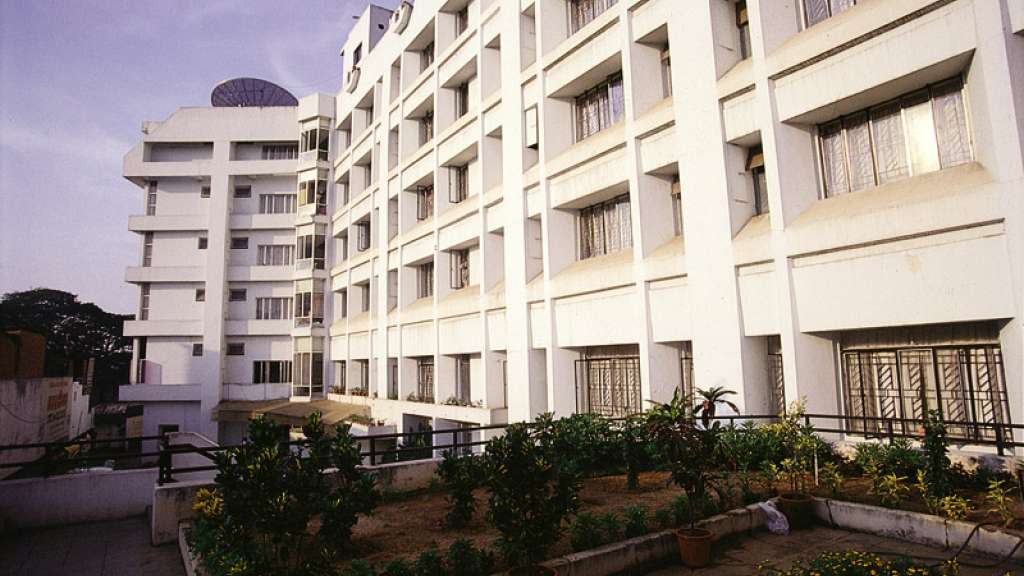
Hilton Garden Inn Trivandrum is a hotel on Punnen Road, with an outdoor pool, fitness centre and on-site dining. Its central setting suits sightseeing and business trips; Kovalam is a separate coastal outing. Compare room rates and breakfast inclusions for your dates.

Directions Commission-freeView details
Hyatt Regency Trivandrum — Luxury city hotel in Thiruvananthapuram city
Top pick Verified
Luxury city hotel · Thiruvananthapuram city
Hyatt Regency Trivandrum

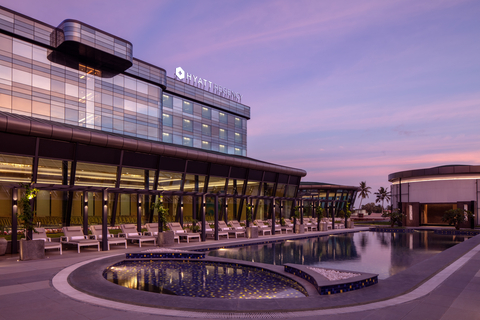
Hyatt Regency Trivandrum is a city hotel on CV Raman Pillai Road at Thycaud, with accommodation, dining and event spaces. Arrange coastal or hill outings separately from your room booking.

Directions Commission-freeView details
Villa Maya Thiruvananthapuram — Heritage restaurant in Thiruvananthapuram city
Verified
Heritage restaurant · Thiruvananthapuram city
Villa Maya Thiruvananthapuram

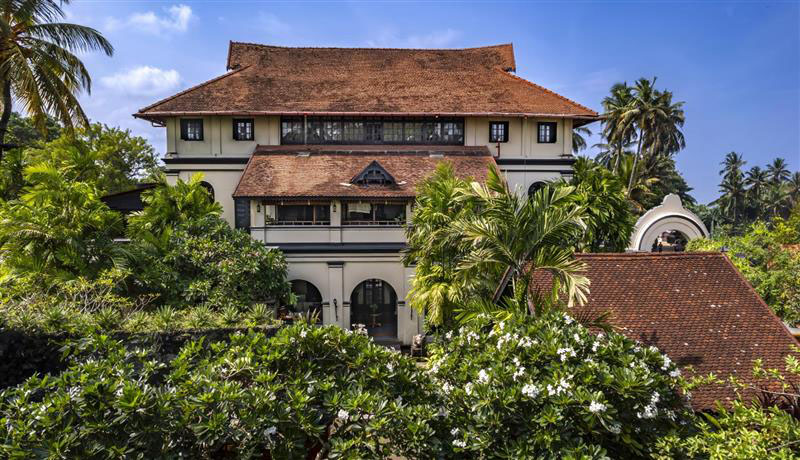
Villa Maya on Airport Road at Vallakkadavu combines a heritage-house setting with Kerala-influenced international dining. Reserve ahead for a planned dinner; the restaurant is a separate journey from the museum precinct.

Directions Commission-freeView details
Vivanta Thiruvananthapuram — Palayam city hotel in Thiruvananthapuram city
Verified
Palayam city hotel · Thiruvananthapuram city
Vivanta Thiruvananthapuram

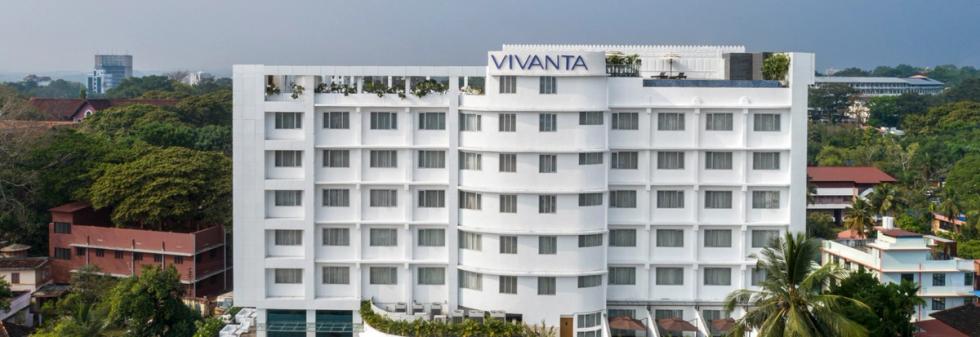
Vivanta Thiruvananthapuram is a hotel on Extra Police Road at Palayam. Choose the central address for city outings, comparing room packages and onward transfers for your dates.

Directions Commission-freeView details
Thiruvananthapuram International Airport — Airport in Thiruvananthapuram city
Verified
Airport · Thiruvananthapuram city
Thiruvananthapuram International Airport

Thiruvananthapuram International Airport serves the city and southern Kerala’s coast. Match your airline’s terminal to your pickup point when booking an airport-side stay or meeting a driver.

Directions Commission-freeView details
Mango Cabs Trivandrum — Taxi, airport transfer and rental service in Thiruvananthapuram city
Verified
Taxi, airport transfer and rental service · Thiruvananthapuram city
Mango Cabs Trivandrum

Mango Cabs arranges taxi journeys, airport transfers and vehicle hire around Thiruvananthapuram. Request a quote covering the route, waiting time and return before booking.

Directions Commission-freeView details
Mothers Veg Plaza Thiruvananthapuram — Vegetarian restaurant in Thiruvananthapuram city
Verified
Vegetarian restaurant · Thiruvananthapuram city
Mothers Veg Plaza Thiruvananthapuram

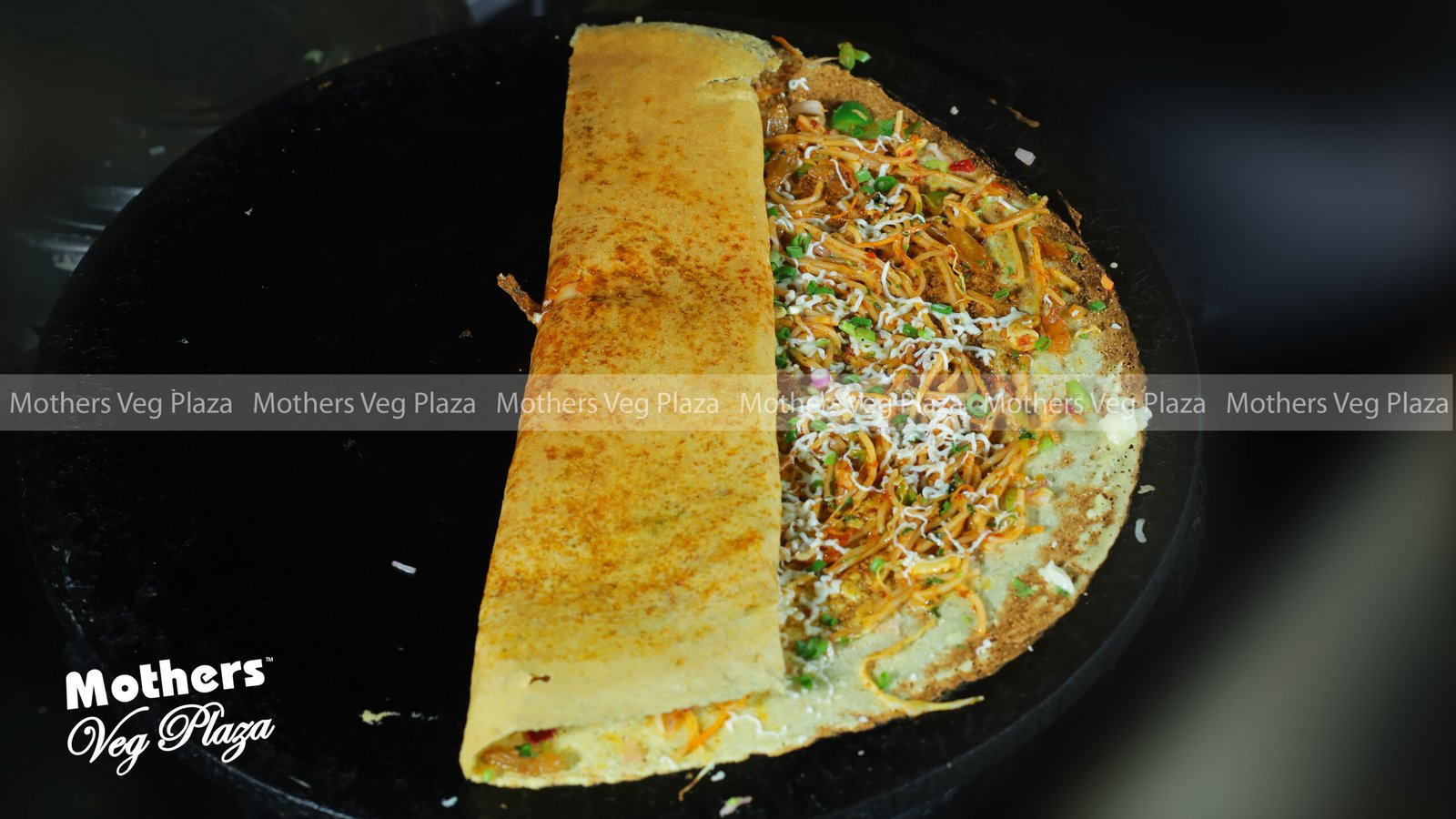
Mothers Veg Plaza at Bakery Junction offers vegetarian South Indian food, Kerala sadya and a wide dosa selection. Ask about the sadya serving session when planning a banana-leaf lunch.

Directions Commission-freeView details
P
Padmatheertha Pond
Nature
Waterfront · Thiruvananthapuram city
Padmatheertha Pond

The temple tank beside Sree Padmanabhaswamy at East Fort — a ritual bathing tank in active use, not a park pond. Conduct and dress expectations apply this close to the temple.

DirectionsView guide
Kanakakkunnu Palace — Park in Thiruvananthapuram city
Park · Thiruvananthapuram city
Kanakakkunnu Palace

The palace and grounds on the museum-compound hill, used for festivals, fairs and evening walks. The gardens are the everyday reason to come; events decide the rest.

DirectionsView guide
S
Shankhumugham Beach
Nature
Beach · Thiruvananthapuram city
Shankhumugham Beach

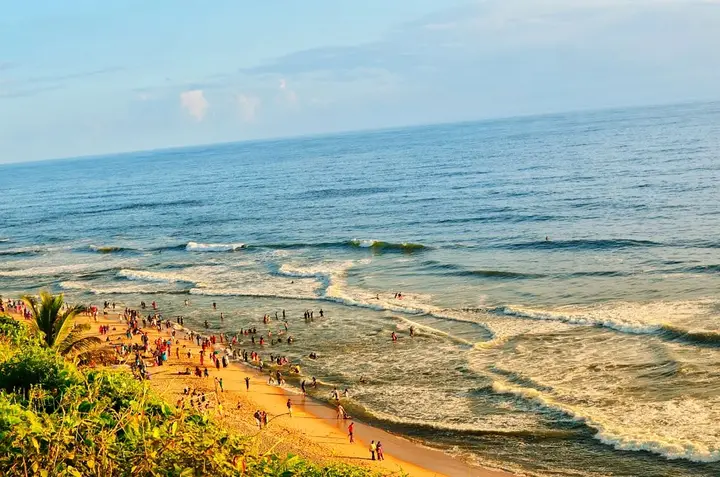
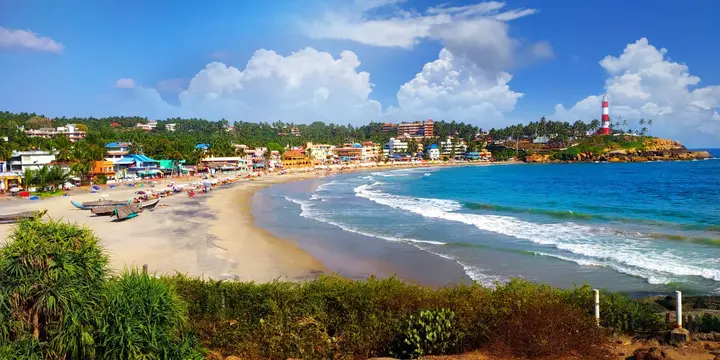
The capital’s own evening beach, minutes from the airport, with Kanayi Kunhiraman’s 26.5-metre Jala Kanyaka mermaid sculpture at one end. An open Arabian Sea shore — treat it as a sunset walk, not a swimming beach.

DirectionsView guide
Anies Garden Homestay Thiruvananthapuram — Homestay (Kerala Tourism approved) in Thiruvananthapuram city
Verified
Homestay (Kerala Tourism approved) · Thiruvananthapuram city
Anies Garden Homestay Thiruvananthapuram

Kerala Tourism-approved family homestay in a quiet garden setting at Peroorkada, Ambalamukku, in the northern part of Thiruvananthapuram city. The resident hosts offer air-conditioned guest rooms and traditional home-cooked Kerala meals in a homely, green atmosphere, a personal alternative to a city hotel.

Directions Commission-freeView details
Hotel Chaithram KTDC Thiruvananthapuram — Budget hotel (KTDC) in Thiruvananthapuram city
Verified
Budget hotel (KTDC) · Thiruvananthapuram city
Hotel Chaithram KTDC Thiruvananthapuram

KTDC’s Grand Chaithram is a Thampanoor city stay opposite Thiruvananthapuram Central. Choose it for rail and bus access, comparing the current room category and meal package directly with KTDC.

Directions Commission-freeView details
Hotel Pankaj Thiruvananthapuram — 3-Star city hotel in Thiruvananthapuram city
Verified
3-Star city hotel · Thiruvananthapuram city
Hotel Pankaj Thiruvananthapuram
3-star

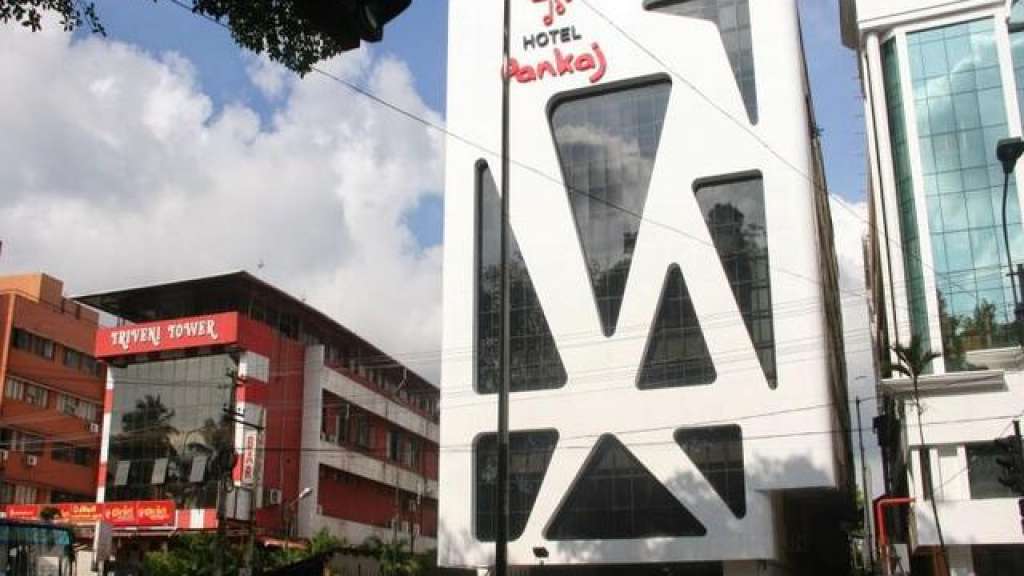
Hotel Pankaj is a city accommodation option on MG Road opposite the Government Secretariat. Ask about current room availability and dining arrangements before planning a stay around this central address.

Directions Commission-freeView details
Hotel Horizon Thiruvananthapuram — 3-Star business hotel in Thiruvananthapuram city
Verified
3-Star business hotel · Thiruvananthapuram city
Hotel Horizon Thiruvananthapuram
3-star

Hotel Horizon on Aristo Road at Thampanoor offers a city base for rail arrivals and sightseeing. Compare room categories and dining inclusions, allowing separately for the journey to Kovalam.

Directions Commission-freeView details
N
Napier Museum Thiruvananthapuram
Sight
Top pick Verified
Museum and heritage attraction · Thiruvananthapuram city
Napier Museum Thiruvananthapuram

Napier Museum combines a distinctive landmark building with art and historical collections in Museum Park. Give the galleries their own visit; zoo and art-gallery tickets are separate.

DirectionsView guide
M
Mascot Hotel, KTDC Thiruvananthapuram
Place to stay
Verified
KTDC heritage business hotel · Thiruvananthapuram city
Mascot Hotel, KTDC Thiruvananthapuram

KTDC’s Mascot Hotel offers a heritage setting and spacious grounds within Thiruvananthapuram city, with the museum precinct a useful sightseeing focus. Compare the room category, meal plan and total rate with KTDC before booking.

Directions Commission-freeView details
Z
Zam Zam Restaurant Palayam
Where to eat
Verified
Palayam restaurant · Thiruvananthapuram city
Zam Zam Restaurant Palayam

Zam Zam’s Palayam restaurant is opposite the MLA Hostel. Use this branch’s menu and contact for a city meal or group booking; the chain has other locations.

Directions Commission-freeView details
S
Smart Taste of Travancore
Where to eat
Restaurant · Thiruvananthapuram city
Smart Taste of Travancore
Open · till 3:00 pm regional

Restaurant (regional) on Kuttikad Lane in Thiruvananthapuram City.

Directions Commission-freeView details
K
KTDC Grand Chaithram
Place to stay
Hotel · Thiruvananthapuram city
KTDC Grand Chaithram

A government-run KTDC hotel opposite Central Railway Station in Thampanoor. A long-standing budget city stay with 88 rooms.

Directions Commission-freeView details
A
Ambrosia
Where to eat
Café · Thiruvananthapuram city
Ambrosia
Bakery / European

Trivandrum bakery with 24+ years of heritage that also runs Atelier by Ambrosia, a European fine-dining restaurant.

Directions Commission-freeView details
I
Imperial Kitchen
Where to eat
Restaurant · Thiruvananthapuram city
Imperial Kitchen
regional, north indian

Restaurant (regional, north indian) on Venpalavattom, Near Lulu Mall in Thiruvananthapuram City. Regional, North Indian, AC.

Directions Commission-freeView details
R
Russian Cultural Center
Sight
See · Thiruvananthapuram city
Russian Cultural Center

See on S.Roerich Road, University P.O, in Thiruvananthapuram City.

DirectionsView guide

Book with the place itself. India’s cyber-crime coordination centre warned in April 2025 that convincing copies of hotel and pilgrimage booking sites are being pushed through sponsored search and social ads, taking payment for rooms the property never hears about. Every listing here links to the business’s own contact details and its own Google or Bing profile — we take no commission and sit in nobody’s payment path. If a booking page reached you through an ad, check the address bar against the property’s own site before you pay. Fraud can be reported on cybercrime.gov.in or on 1930.

Ranked

The best of Thiruvananthapuram city, ranked

Nearest to the centre of Thiruvananthapuram city, on foot

Ordered by a real routed walk from the town centre — a different question, and the one that decides what you can do before lunch. Straight-line distance understates a real walk by about half again, so these are walking-network figures, not lines on a map.

Everything around Thiruvananthapuram city, by distance

Every place we hold for Thiruvananthapuram city, ordered by a real routed drive from the town centre. Times are free-flow and a real road rarely is, so read them as the floor rather than the estimate — anything that routed over ninety minutes is left out rather than published as a number we do not trust.

Places to visit

The places themselves, around Thiruvananthapuram city

The best tourist places to visit in Thiruvananthapuram city — temples, viewpoints, lakes, heritage and nature, each with a full guide, how to reach it and what to see nearby.

Sree Padmanabhaswamy Temple, Thiruvananthapuram city
PlaceSree Padmanabhaswamy Temple

Major Vishnu temple and one of Kerala’s most important pilgrimage landmarks; strict entry and dress rules apply.

Open guide →
Napier Museum, Thiruvananthapuram city
PlaceNapier Museum

Robert Chisholm’s 1880 Indo-Saracenic museum in the Museum Park — a polychrome landmark holding Chola and Kerala bronzes, ivories and temple carts, with the Sree Chitra Art Gallery alongside it.

Open guide →
Thiruvananthapuram Zoo, Thiruvananthapuram city
PlaceThiruvananthapuram Zoo

Old trees, winding paths and animal enclosures share the Museum Park at Thiruvananthapuram Zoo, also known as Trivandrum Zoo. Allow time for the garden as well as the collection, with the Napier Museum close by.

Open guide →
Kuthiramalika Palace, Thiruvananthapuram city
PlaceKuthiramalika Palace

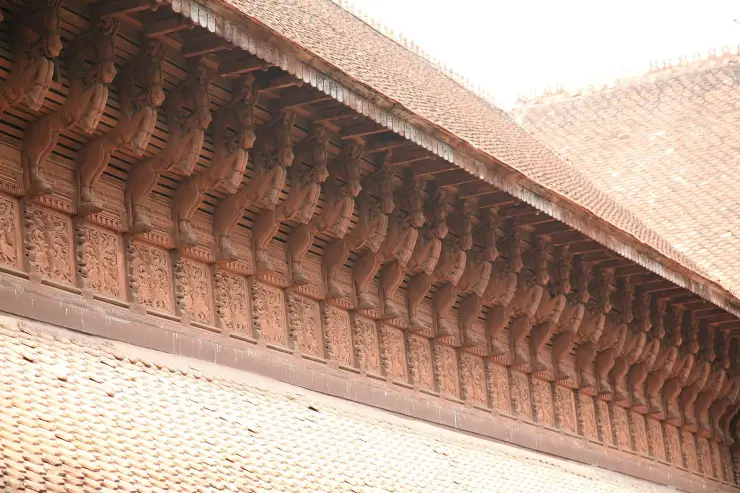
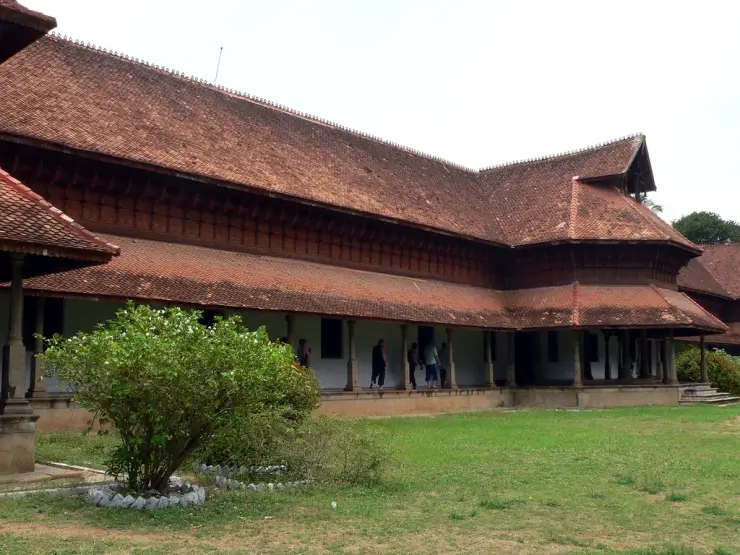
A row of carved wooden horses gives Kuthiramalika its name. Beside Sree Padmanabhaswamy Temple, this Travancore palace museum brings timber craftsmanship and royal collections into one compact visit.

Open guide →
Shanghumukham Beach, Thiruvananthapuram city
PlaceShanghumukham Beach

Shanghumukham is Thiruvananthapuram’s evening shoreline: an open sea horizon, airport-side access and Kanayi Kunhiraman’s reclining mermaid sculpture. Come for a coastal walk and the changing light.

Open guide →
K
Kilimanoor Palace
No photograph yet
PlaceKilimanoor Palace

The ancestral palace compound associated with Raja Ravi Varma at Kilimanoor; visitor access concerns the working family estate and must be confirmed before travel.

Open guide →
B
Beemapally Mosque
No photograph yet
PlaceBeemapally Mosque

A major coastal Muslim pilgrimage landmark south-west of the city centre, known for the Beemapally Uroos and the tombs honoured within the shrine complex.

Open guide →
Madavoorpara, Thiruvananthapuram city
PlaceMadavoorpara

Madavoorpara combines a rock-cut Shiva shrine with a rocky hill landscape on Thiruvananthapuram’s northern edge. The temple and the climb offer different reasons to visit, and both deserve time.

Open guide →
For hotels, homestays and local businesses

Get listed in Thiruvananthapuram city for free

Roampedia is commission-free. Travellers discover your business, book directly and contact you through official details. Basic listings are free, while Gold and Platinum package upgrades can be requested from the owner dashboard after approval.
List your business — free
Read before you go

Thiruvananthapuram city guides, stories & itineraries

Stories & history of Thiruvananthapuram city

Written about Thiruvananthapuram city itself — its history, its legends and the arguments about them.

Around Thiruvananthapuram city

These are written about individual places you can reach from Thiruvananthapuram city, rather than about the town as a whole.

Planning a trip to Thiruvananthapuram city

The practical half — what is actually here, in what order to see it, and how to arrive.

Kerala-wide guides & itineraries

Route-level itineraries and practical guides for the rest of the state.

See all 129 Thiruvananthapuram guides & stories →

Map

Where things are in Thiruvananthapuram city

FAQ

Thiruvananthapuram city travel FAQs

What was the Trippadidanam, and why does it matter to the city?

On 3 January 1750 — 5 Makaram 925 of the Kollam era — Marthanda Varma made over the kingdom of Travancore to Sree Padmanabhaswamy and ruled thereafter as Padmanabhadasa, the god’s servant. Every Travancore sovereign after him governed on those terms. For the city it is the reason the temple sits at the exact centre of a walled quarter with the palace beside it: the shrine was not a monument in the capital, it was the proprietor of the state.
When did Thiruvananthapuram become the capital of Travancore?

1795, under Karthika Thirunal Rama Varma, the Dharma Raja, when the seat moved from Padmanabhapuram. You will also meet 1745 and 1786 in circulation; we print 1795 because the English Wikipedia articles on the city, on Padmanabhapuram Palace and on Travancore agree on it and the last names the ruler. A court does not move in one year, which may be where the other dates come from.

What is East Fort, and is there actually a fort?

East Fort is Kizhakkekotta, the eastern gate of the fortification that once enclosed the temple quarter on all four sides. There is no intact fort. What survives is a long run of massive dressed stone wall beside the road, protected as a monument, a white classical gateway with a colonnaded pavilion, and a red brick gatehouse carrying the Travancore conch and the date 1891. The name now mostly means the bus and shopping node.

Is Chalai market worth going to, and when?

Yes, if you want the city rather than its sights. It runs two kilometres from Killipalam to East Fort, was laid out at the end of the eighteenth century by Dewan Raja Kesavadas as the kingdom’s supply market, and still sells vegetables, hardware, spices, textiles and gold. Most shops keep roughly 9 am to 8 pm and close on Sunday. Evenings are busiest; the Onam weeks are extraordinary, with more than ten thousand kilograms of flowers passing through.

Can you visit Thumba or VSSC?

Not casually. TERLS and the Vikram Sarabhai Space Centre are working ISRO facilities and access is controlled; the space museum in the former St Louis High School has its own arrangements and is the only part most visitors will see. Check current rules with ISRO or VSSC before travelling out there, and do not plan a day around it.

Why was Thumba chosen for India’s first rocket launches?

Because it lies close to the Earth’s magnetic equator, which is the best place to measure the equatorial electrojet and the ionosphere above it. The same property had helped put the Trivandrum Observatory here in 1836–37, when the magnetic equator passed through the city — the coast was selected twice, 126 years apart, for a feature of the Earth’s field.

How much time does the city need?

Three unhurried days: one for the fort quarter on foot, one for the museum and zoo compound on the northern high ground, one for the coast at Shanghumugham and the backwater at Veli and Akkulam. Add a day for each excursion — Kovalam, Varkala, Ponmudi, Neyyar — all of which leave from the same hub at Thampanoor, where the railway station faces the central bus station.

What are the best places to visit in Thiruvananthapuram city?

Top places to visit in Thiruvananthapuram city include Sree Padmanabhaswamy Temple, Napier Museum, Thiruvananthapuram Zoo, Kuthiramalika Palace, Shanghumukham Beach, Kilimanoor Palace, and more — each has a full guide with how to reach it and what to see nearby on this page.

How do I reach Thiruvananthapuram city?

The nearest airport to Thiruvananthapuram city is Trivandrum (TRV), in-district. The rail gateway is Thiruvananthapuram Central (TVC).

What is the best time to visit Thiruvananthapuram city?

October to March is the driest and most comfortable season to visit Thiruvananthapuram city and the rest of Kerala. The June–September monsoon is lush and green but wet, and often brings lower low-season prices.

Photographs: sabu-mampallil-kottayam (CC BY-SA 3.0), Sugeesh (CC BY-SA 4.0), Manukrishnan80 (CC BY-SA 4.0), Shyamal (CC0), Sudheeshnairs (CC BY-SA 3.0). Wikimedia Commons.

Image credits