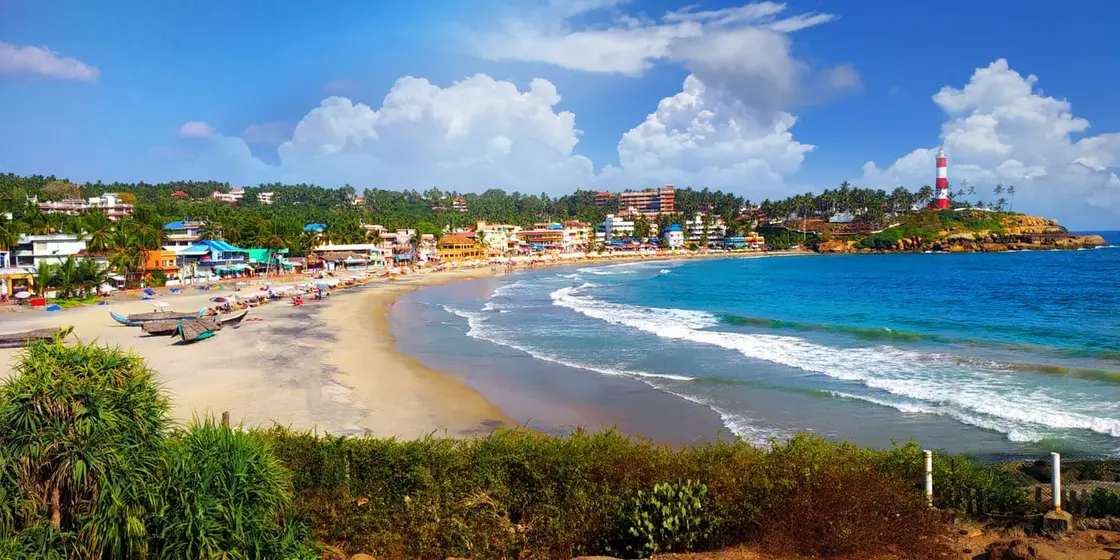
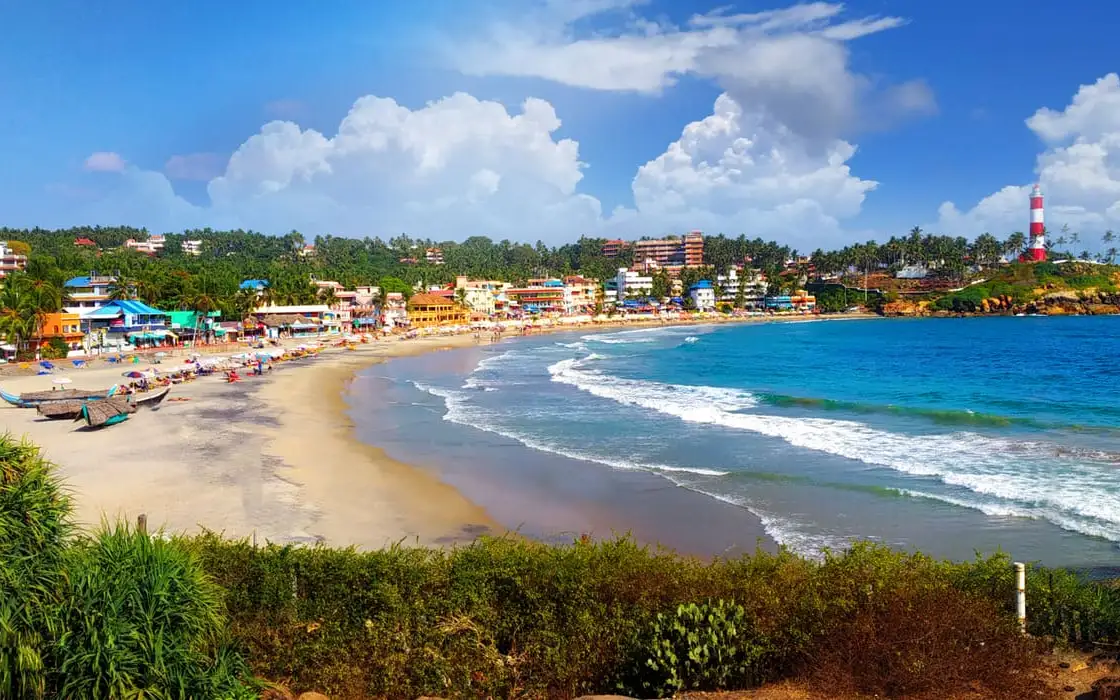
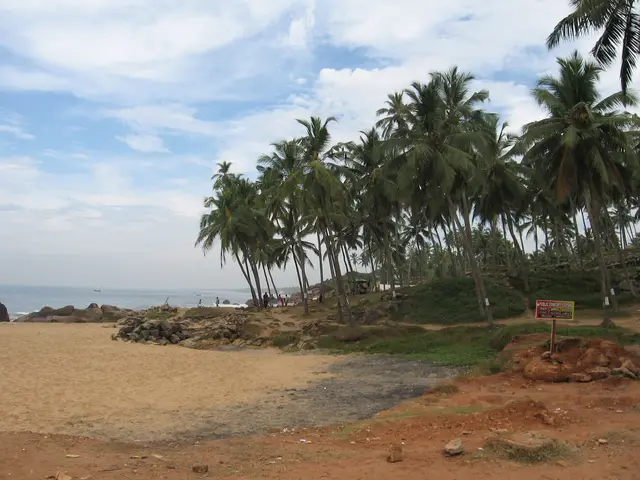
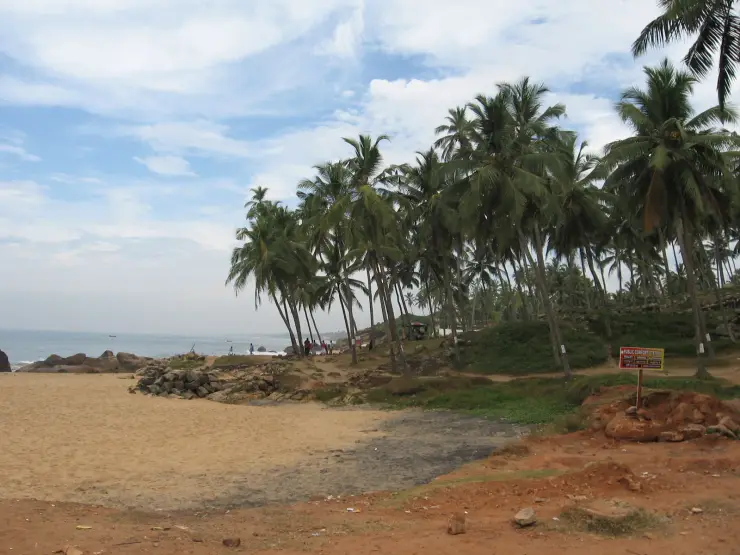
Kovalam is Kerala's original beach town — a run of three shallow, palm-fringed crescents on the Arabian Sea just south of Thiruvananthapuram, watched over by a candy-striped lighthouse and famous for its sunsets, surf, seafood shacks and Ayurveda retreats. The name is often read as 'a grove of coconut trees', and that is still the picture: catamarans drawn up on the sand, resorts terraced into the cliff, and a promenade that comes alive after dark.
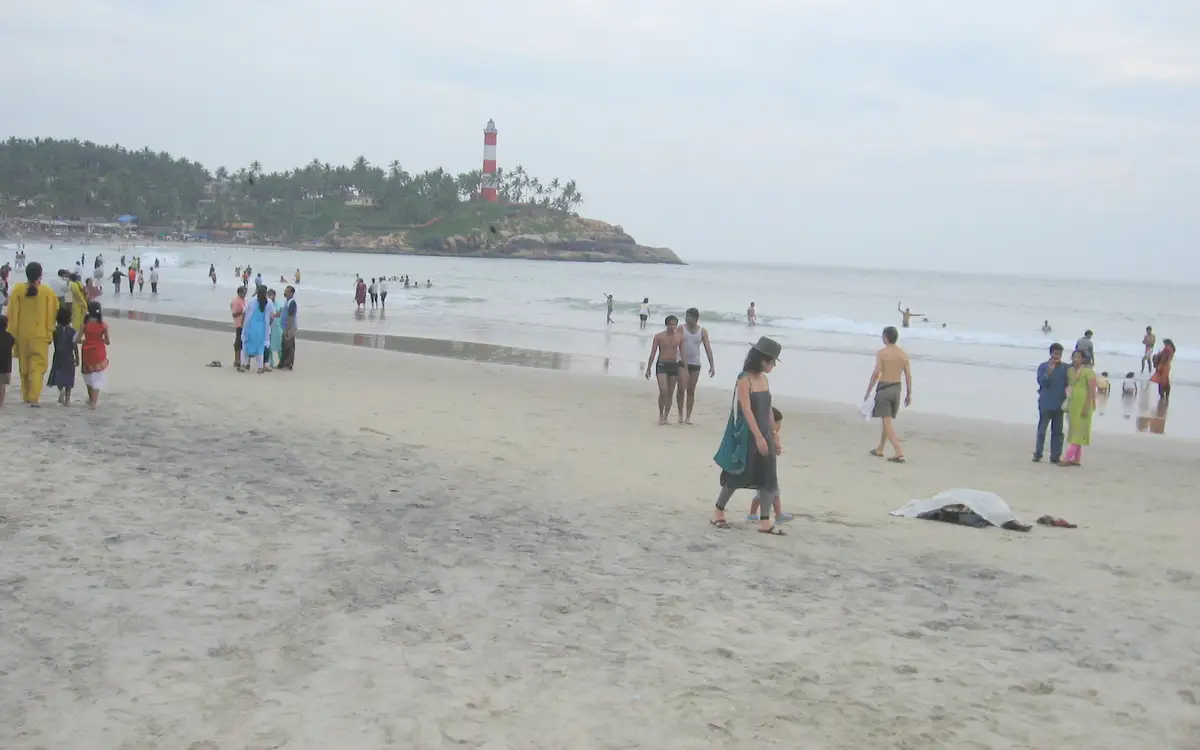
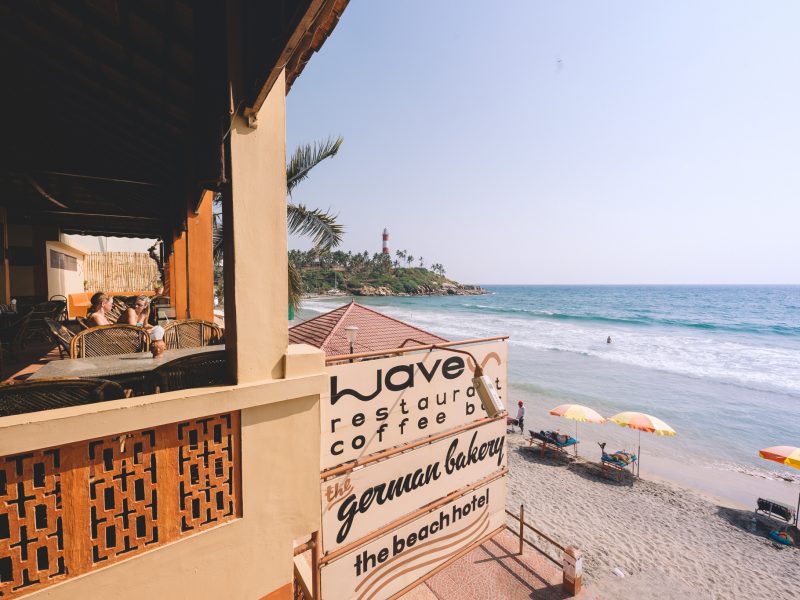
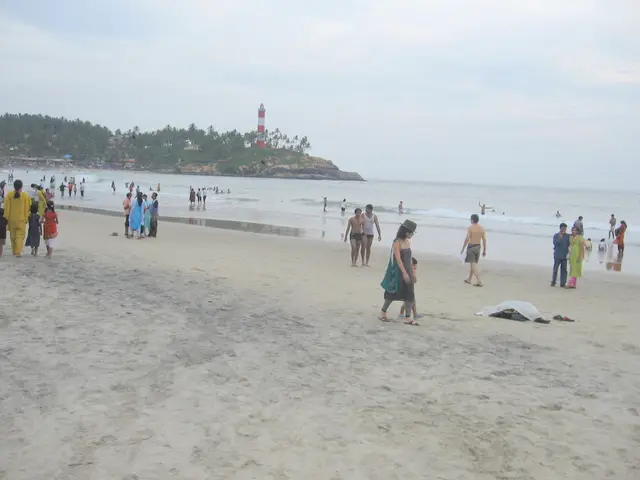
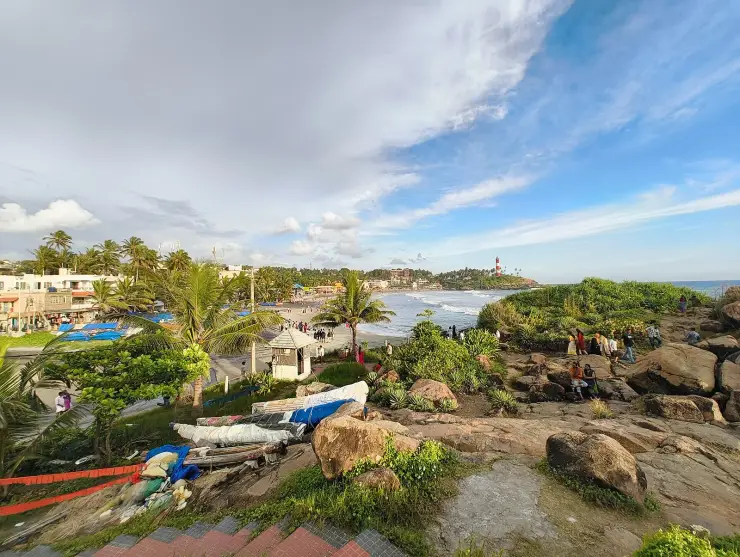
Kovalam is really three beaches strung one after another along a couple of kilometres of coast. Lighthouse Beach, in the south, is the liveliest — a wide golden crescent backed by cafés and shops and closed off at one end by the rocky Kurumkal headland. North of a small promontory lies Hawa Beach (the 'breezy' one), a gentler middle crescent, and beyond that quiet Samudra Beach, ringed by wellness resorts and largely left to fishermen and early-morning walkers. Together they give the town its unmistakable scalloped shoreline.
The town takes its identity from the red-and-white Vizhinjam lighthouse that rises on the Kurumkal promontory above Lighthouse Beach. Painted in bold bands and visible for miles, it is the single image most visitors carry away from Kovalam. When it is open, a climb up the spiral stair rewards you with a sweeping view over all three crescents, the fishing harbour at Vizhinjam and the long line of the coast fading into haze.
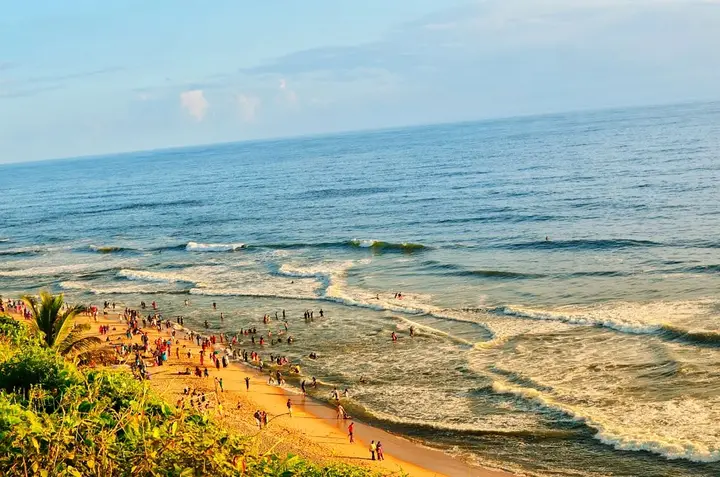
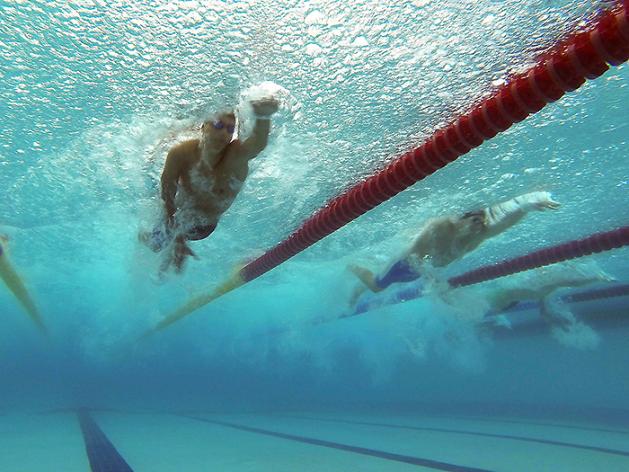
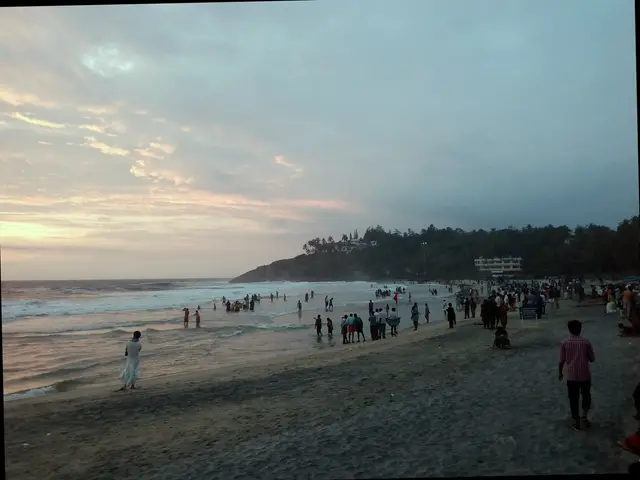
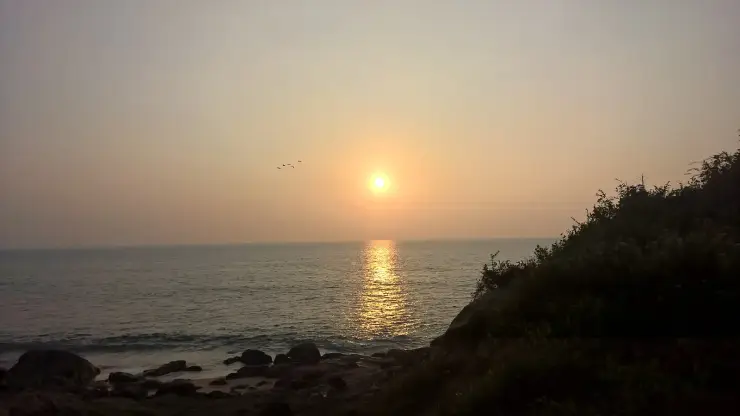
Kovalam is built around its surf and its sunsets. The Arabian Sea rolls in here with real energy, and the town has become one of South India's early surfing spots, with schools that rent boards and give lessons to beginners. Swimming, though, calls for care: the seabed shelves steeply in places and rip currents form, so heed the lifeguards and the coloured warning flags, stay between them, and treat a red flag as a firm 'don't go in'. As the day ends the whole promenade turns to face west for the sunset over the water.
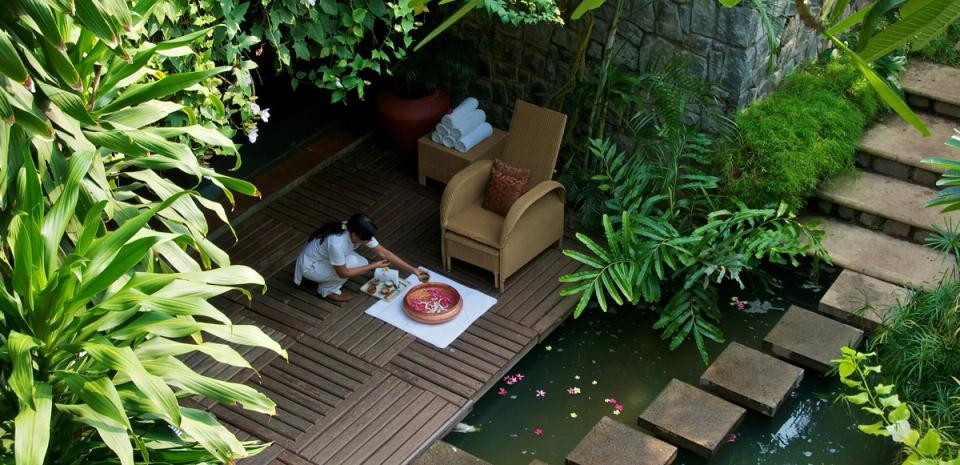
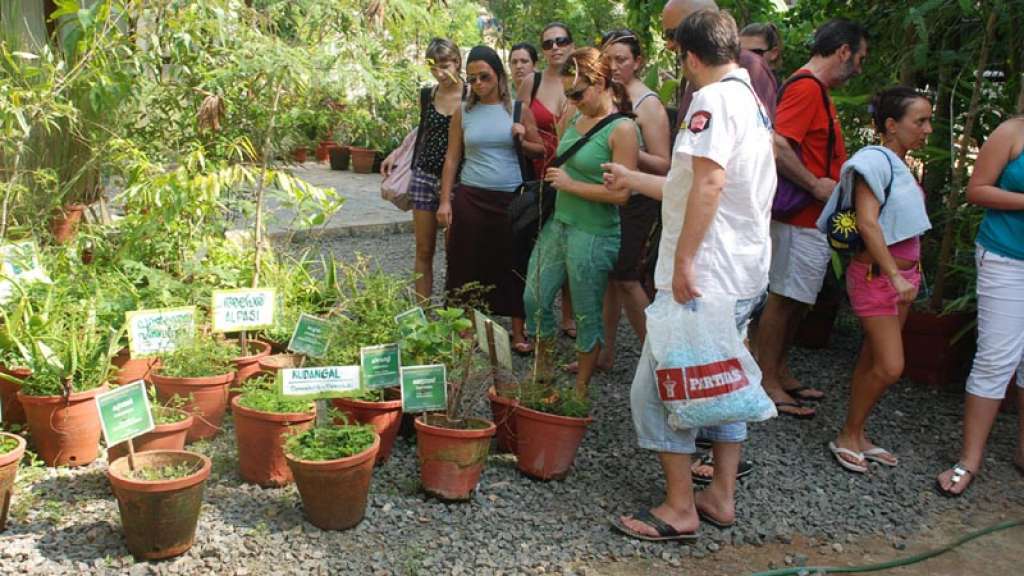
Food and Ayurveda are as much a part of Kovalam as the sand. Along Lighthouse Beach the shacks lay out the day's catch on ice — kingfish, prawns, squid, lobster — and grill your choice to order with Kerala spices while you watch the sea. Behind the beach, spas and resorts offer Ayurvedic massage and treatment courses, a tradition that draws long-stay visitors through the cooler months and gives Samudra Beach in particular its calm, retreat-like feel.
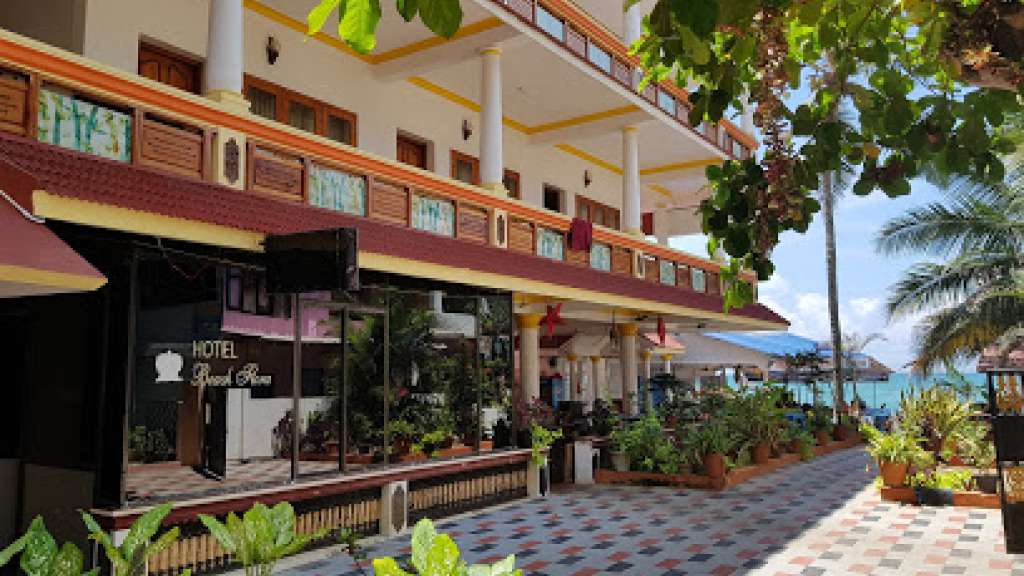
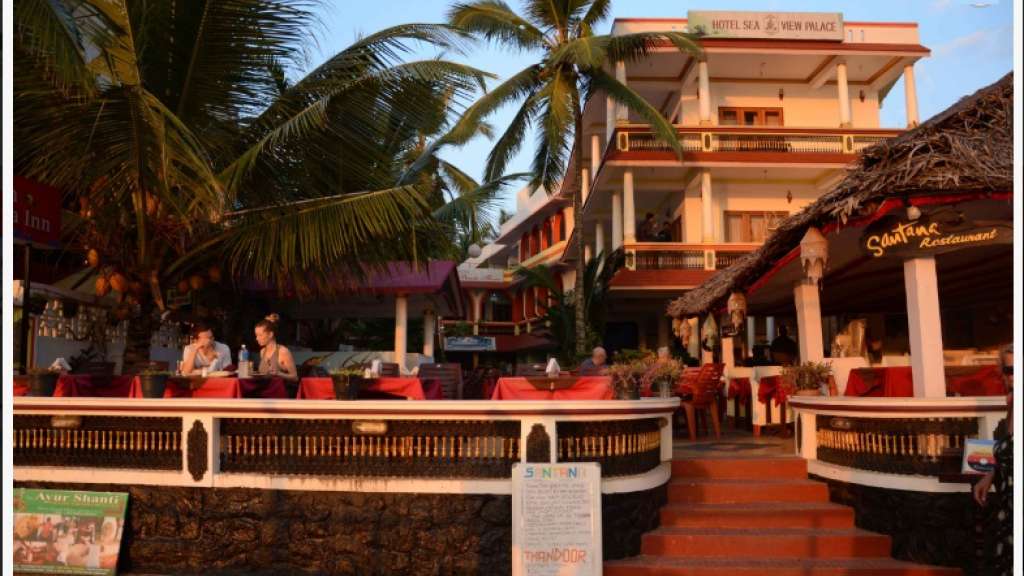
The Lighthouse Beach promenade is the social heart of town — a paved walk lined with seafood restaurants, cafés, tailors, souvenir stalls and small guesthouses, lit up and busy into the night. It is an easy, walkable strip where travellers linger over long dinners by the water, and it is what gives Kovalam its relaxed, sociable, slightly bohemian character.
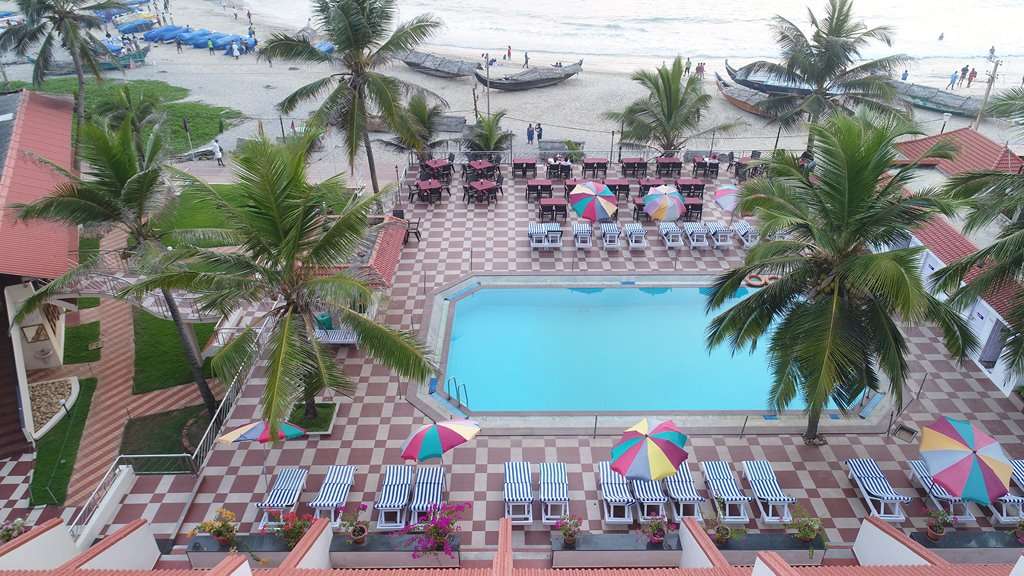
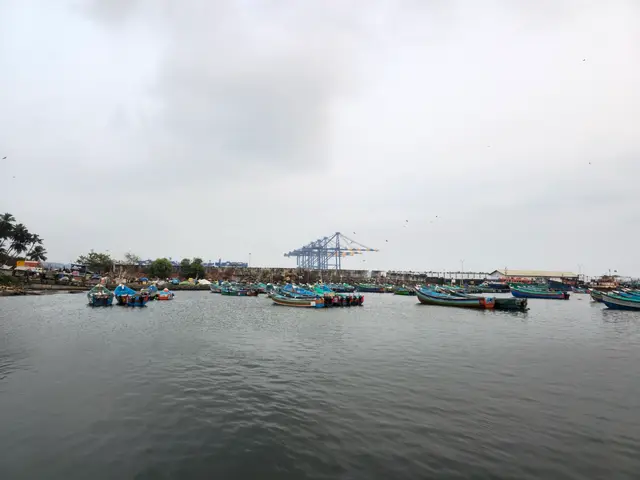
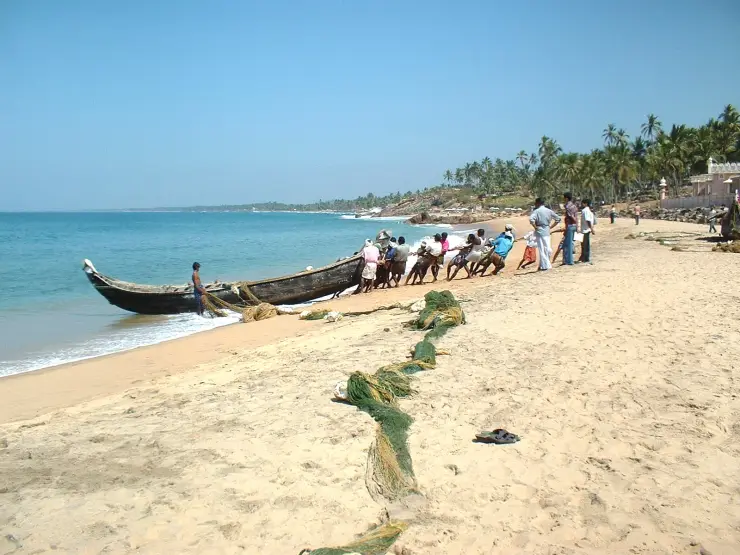
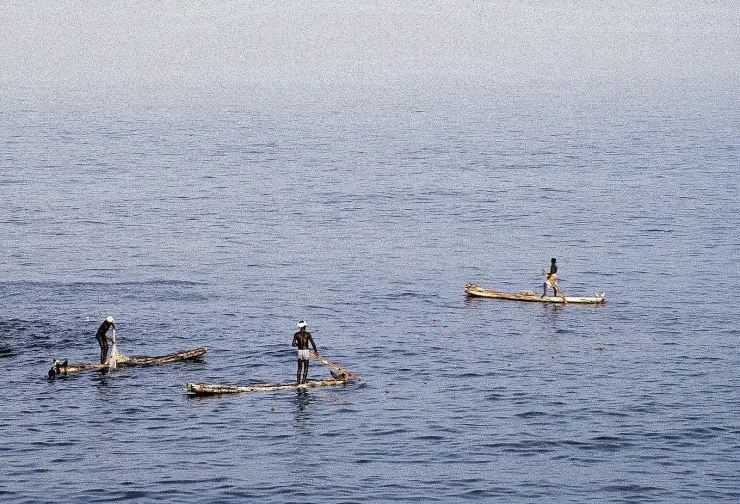
For all the tourism, Kovalam remains a working fishing coast. Wooden catamarans and small boats are pulled up on the sand, and at dawn you can watch crews haul nets and land the night's catch. This everyday rhythm — fishermen at one end of the sand, sunbathers at the other — is part of what has kept Kovalam feeling like a real place rather than a resort strip.
Legend & myth
Kovalam is described almost everywhere as India's first beach resort. The documented claim is narrower and more interesting than that. What the record supports is that the Kovalam Ashok was India's first INTEGRATED beach resort — a single planned complex of accommodation, restaurants and grounds designed together for a coastal site — and, separately, that it was the first five-star hotel in Kerala. Neither is the same as being the first place in India where anyone built a hotel by the sea, which is what the shorter phrase implies and which would be very hard to defend. It is a real distinction worth keeping, because the thing Kovalam actually pioneered was planning, not proximity to sand.
The second thing usually left vague is what happened to that resort, and our own page carried the vaguest version of it — that the property 'later became the clifftop hotel now run as The Leela Kovalam', hedged as unconfirmed. The chain is traceable and it is a good deal more tangled. ITDC ran the Kovalam Ashok Beach Resort until 2002, when it went in the central government's disinvestment programme. M-Far Hotels bought it. Captain Krishnan Nair's Leela Group acquired it from M-Far in 2005. In 2011 the RP Group of Dr B. Ravi Pillai bought the property for a reported ₹500 crore — but Leela did not walk away, taking a 30-year contract to keep managing it. Which is why the hotel trades today under the slightly confusing name The Leela Kovalam, a Raviz Hotel: one company owns it, another runs it.
There is also a date that does not agree with itself. Halcyon Castle was built in 1932 by Sri Rama Varma Valiya Koil Thampuran, consort of the Regent Maharani Sethu Lakshmi Bayi — that much is firm. What is not firm is when it left the family. Our own page has said the castle was sold to the Government of India in 1964; other accounts have the government taking it over in 1962 and handing it to the union tourism ministry in 1970. We have not been able to settle which is right, so both are recorded here rather than one being quietly chosen. The 1969 date for ITDC taking over the castle and about 48 acres around it is separately attested, and later acquisitions took the estate to roughly 65 acres.
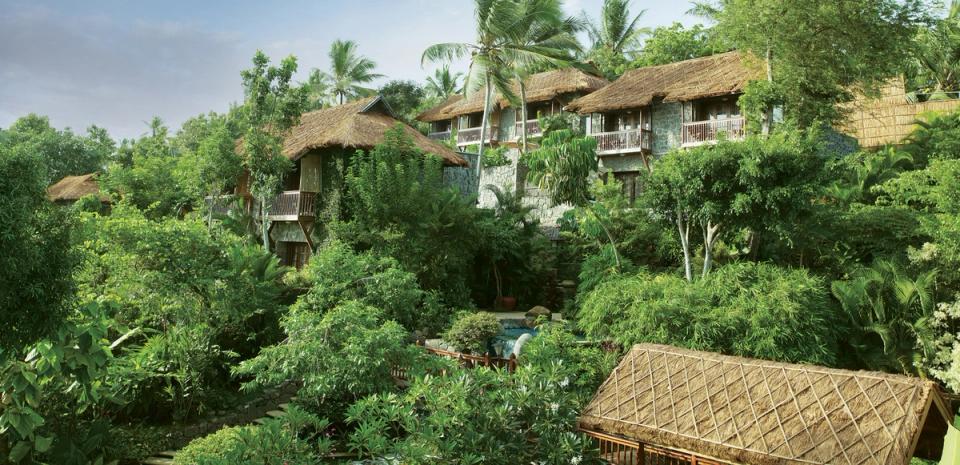
The best-remembered thing about the resort is not a date but a rule. Charles Correa is recorded as saying, on his first visit to the site, that he would not build anything here above the level of a coconut tree. He kept to it. The scheme was terraced down the slope in three kinds of accommodation — kudils on the sand with their own cooking space, a layer of hotel rooms above them facing the sea, and detached units in between — so that the hillock was never cut into and every room kept its view. That self-imposed ceiling is why Kovalam did not end up with the wall of high-rise that later coastal resorts elsewhere in India acquired, and it is the reason the project is taught as architecture rather than remembered as a hotel.
More about Kovalam
History
Kovalam's story as a retreat begins with the royal house of Travancore. Around the end of the 1920s the Regent Maharani Sethu Lakshmi Bayi is said to have built a seaside residence, Halcyon Castle, on the Kovalam cliffs. Through the 1930s Travancore's rulers brought European guests to this coast, and their accounts helped spread Kovalam's name in travel circles well before mass tourism arrived.
For decades afterwards Kovalam stayed a quiet fishing village. Its modern fame dates from the late 1960s and 1970s, when it became a stop on the overland 'hippie trail' to India. Backpackers drawn by cheap living, empty beaches and an easy pace put down roots, and by the mid-1970s local families were running small guesthouses and open-air cafés along what is now Lighthouse Beach — the seed of today's promenade.
The Vizhinjam lighthouse that gives Lighthouse Beach its name began operating on 30 June 1972. Standing about 36 metres on Kurumkal Hill and painted in its distinctive red-and-white bands, it has guided Arabian Sea shipping past this coast ever since and quickly became the town's defining landmark.
The state's push into planned coastal tourism took shape here in the same era. ITDC took over Halcyon Castle and about 48 acres around it in 1969, and between then and 1974 the architect Charles Correa designed the Kovalam Beach Resort — a low-rise scheme terraced down the headland around the old castle, and an early, influential example of India developing a coastal resort with serious design ambition.
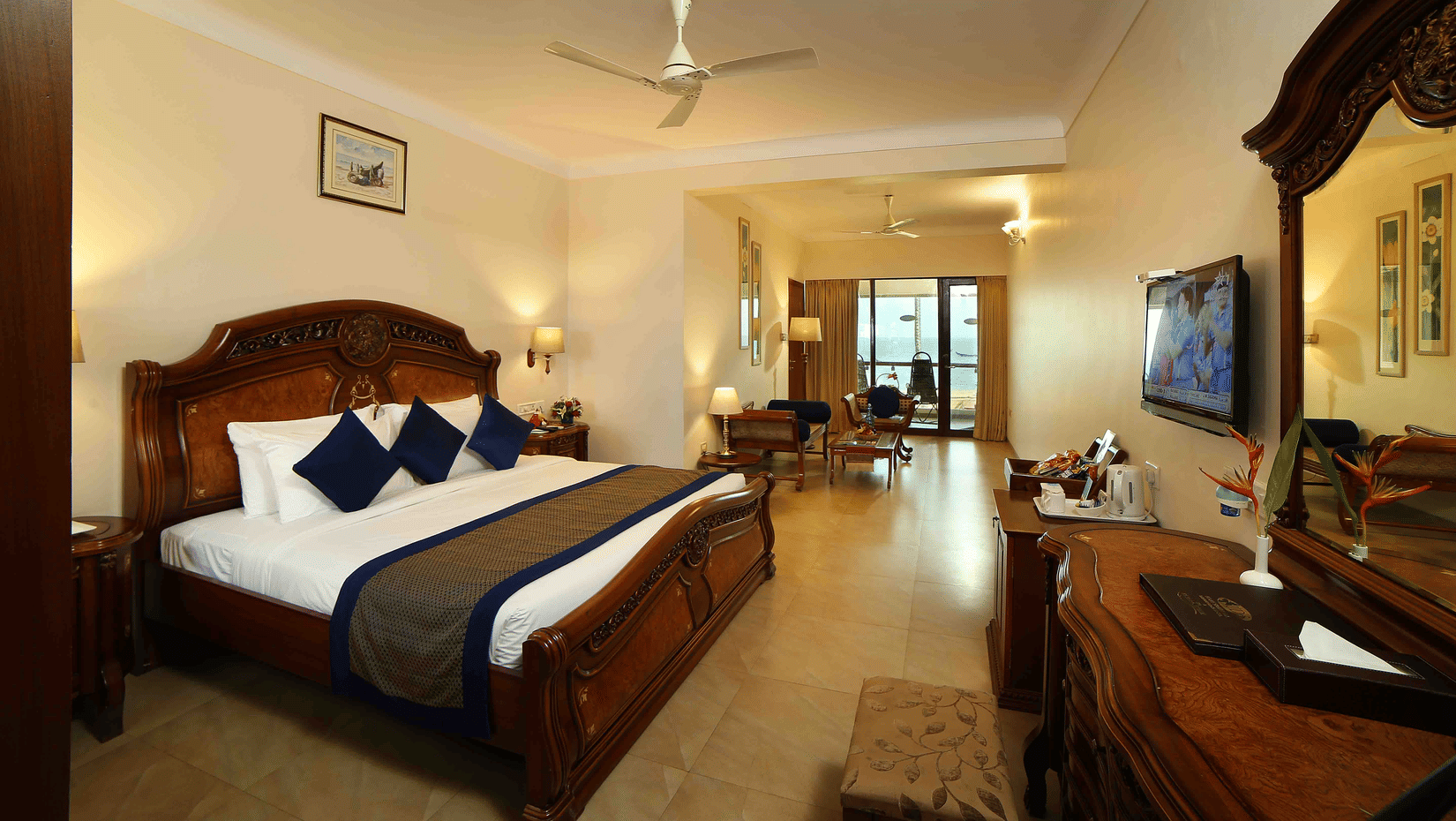
It opened in stages. The Grove Cottages were inaugurated on 17 December 1972 by Dr Karan Singh, then Union Tourism Minister; the second phase followed in 1976, opened by the Union Tourism Minister Raj Bahadur with Kerala's Chief Minister C. Achutha Menon present. The build was funded under the Fourth Five Year Plan with an allocation of ₹221 lakhs, and the finished property carried 134 rooms — 42 Grove Cottages, 72 sea-view rooms, 16 detached cottages and 4 royal suites — on an estate that grew to roughly 65 acres.
The hotel's later life is a chain rather than a single handover. ITDC ran it as the Kovalam Ashok Beach Resort until 2002, when it passed out of government hands in the central disinvestment programme and was bought by M-Far Hotels. The Leela Group acquired it from M-Far in 2005. In 2011 Dr B. Ravi Pillai's RP Group bought the property for a reported ₹500 crore while Leela stayed on under a 30-year management contract, which is why it trades today as The Leela Kovalam, a Raviz Hotel.
From these beginnings Kovalam grew into one of India's best-known seaside destinations and a flagship for Kerala's wider tourism drive. What started with a royal castle and a scatter of hippie-era guesthouses is now a full resort town of hotels, Ayurveda centres and seafood restaurants, still anchored by the same three crescents and the lighthouse above them.
Why visit
Three connected crescent beaches — lively Lighthouse, breezy Hawa and quiet Samudra — so you can pick your mood, from busy café strip to near-empty sand.
The iconic red-and-white Vizhinjam lighthouse, a landmark to photograph and, when open, to climb for a sweeping coastal view.
Some of South India's most accessible surf, with beginner-friendly surf schools and board hire right on the sand.
Fresh-off-the-boat seafood grilled to order at the shacks along the Lighthouse Beach promenade, right beside the sea.
A deep-rooted Ayurveda and wellness scene, with spas and retreat resorts offering massage and treatment courses, especially around Samudra Beach.
Kerala's classic west-facing sunsets over the Arabian Sea, watched from the promenade with the whole town turned toward the water.