Chalakkudy is a municipal town of 25.23 sq km on the south edge of Thrissur district, straddling National Highway 544 about 47 km north of Kochi and 30 km south of Thrissur city, with Cochin International Airport 19 km away at Nedumbassery. It is the headquarters of Chalakkudy taluk, created in 2013 out of Mukundapuram, and it became Kerala’s twenty-sixth municipality on 1 April 1970. Almost everyone who arrives is on their way somewhere else: State Highway 21 begins here and runs 86 km east to the Tamil Nadu border at Malakkappara, and the waterfalls on that road are what the town is known for. The town underneath the traffic is older and more interesting than the traffic — a market that Sakthan Thampuran seeded with traders, the coastal end of the Cochin State’s timber railway, and India’s first plywood factory.
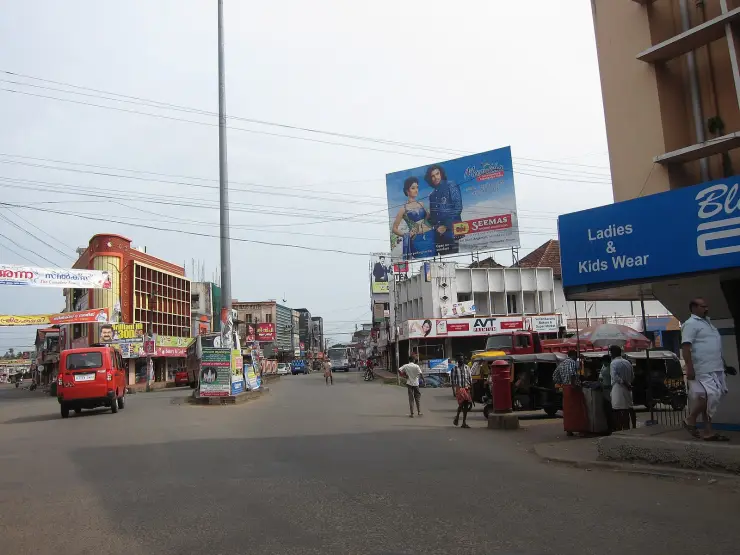
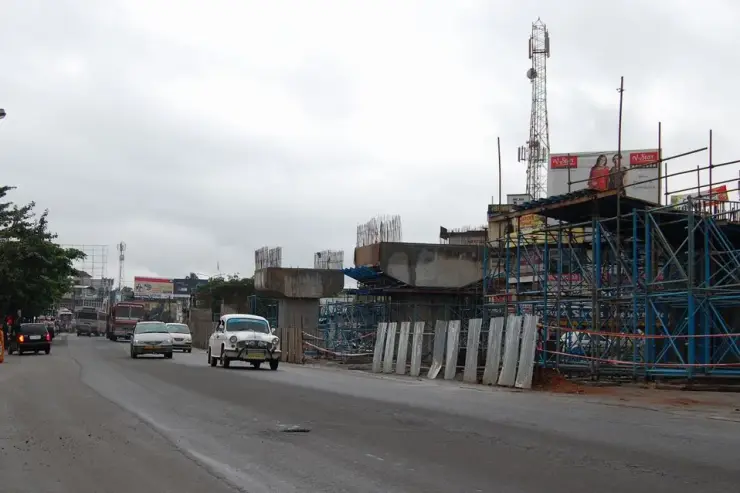
The town has a legible shape, and it is worth learning before you try to move through it. The built-up strip runs from Anamala Junction at the north end to the Chalakudy bridge at the south, with two centres between them. South Junction, under and around the National Highway flyover, is where both the KSRTC stand and the private bus stand are. North Junction is where the market is. The railway station sits about 1.8 km west of that spine on Mala Road, which is far enough that arriving by train and expecting to walk into the town centre is a mistake people make regularly.
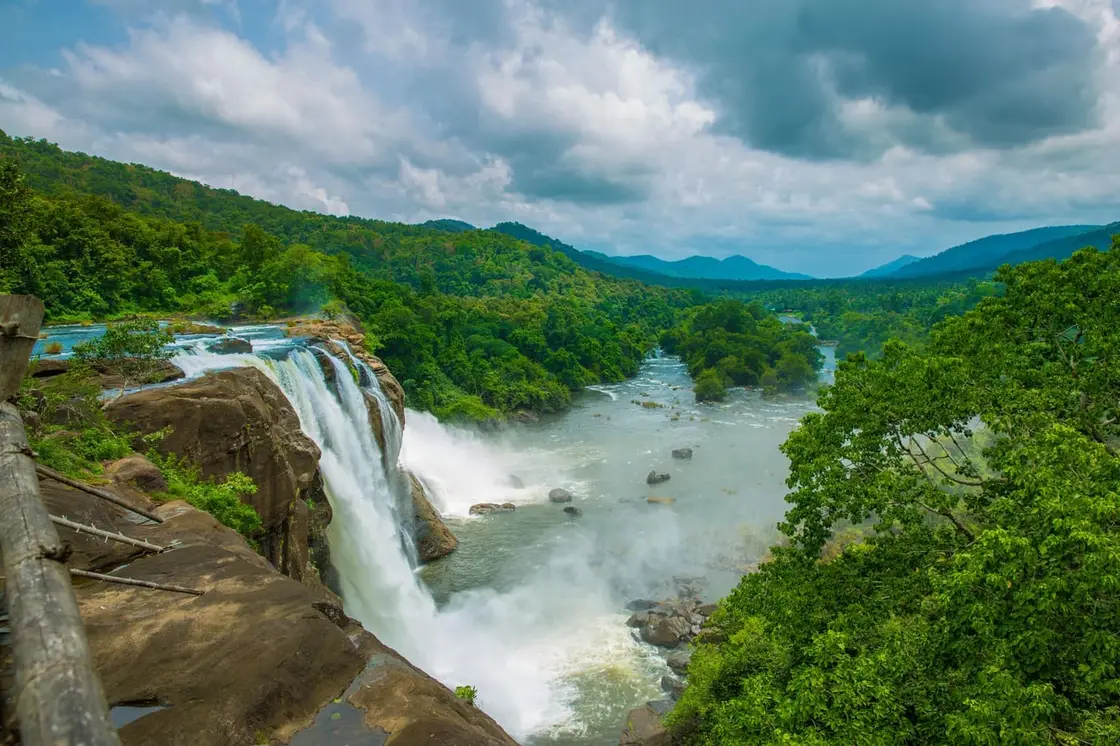
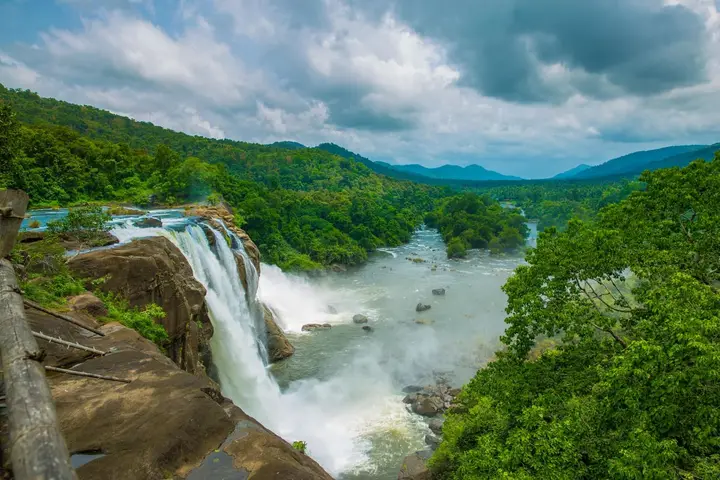
State Highway 21 is the reason the town matters to visitors. It starts at Chalakkudy and ends 86.0 km later at the Tamil Nadu state boundary at Malakkappara, and 50.1 km of that — well over half — runs through fully protected forest. It is routinely listed among the most scenic drives in India, and it is also a road with rules: forest checkposts, timed gates, and no casual stopping along much of the protected stretch. KSRTC runs services from Chalakkudy up the road to Athirappilly and Malakkappara, and an interstate service continues to the hill town of Valparai in Tamil Nadu. The private stand serves the lowland side — Irinjalakuda, Aloor, Kodakara, Kodungallur, Mala, Ashtamichira, Puthenvelikkara, Meloor, Koratty, Angamaly — which is a fair summary of the town’s working catchment.
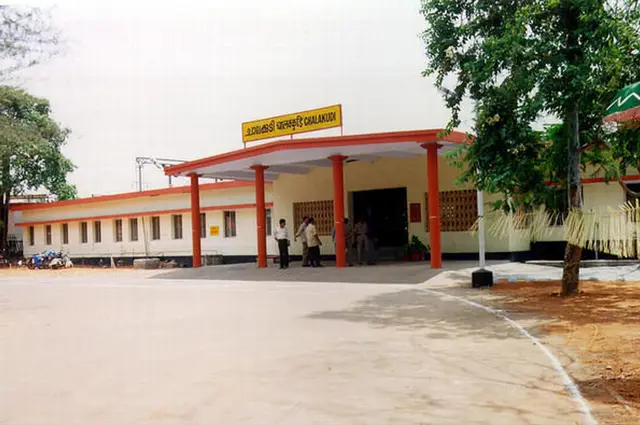
The railway station is Chalakkudi, code CKI, on the Shoranur–Cochin Harbour section, in the Thiruvananthapuram division of Southern Railway. It has three platforms and six tracks, and the timetable carries roughly nineteen express and mail services plus a handful of MEMU suburban runs. English-language sources describe it as the second-busiest station in Thrissur district after Thrissur itself; that is a district-level ranking rather than a published passenger figure, so treat it as the local claim it is. The single-storey station building with its yellow trilingual nameboard is unchanged in character from the photographs of a decade ago.
The market is the oldest continuously working thing in the town. It was known as Kunnathangadi Chantha, and it owes its scale to Sakthan Thampuran of Cochin, who set up a pandikasala — a wholesale depot — here and settled Syrian Christian traders around it to work the hill-produce trade. In his time it was one of the major markets in Kerala. Road development in the twentieth century pulled trade away from it; a new market complex was built in 1928 to arrest the decline, and the traditional weekly markets still convene on Tuesdays and Fridays. The commodities have not changed much either: hill produce and spices are still what the town buys and sells.
Chalakkudy’s industrial history is unusually concentrated for a Kerala town of this size, and almost all of it is past tense. The first plywood manufacturing unit in India was set up here in 1943 by V. K. Menon as the Standard Furniture Company; it was later acquired by United Plywood, which still runs the factory and exports from it. Alongside it, at various points, stood Travancore Tanneries, Cochin Potteries, the tram workshop, Cochin Rubber Works, Cochin Chemicals, Tapioca Products of India, Srinivas Timber Products and a plywood factory. Only a handful of industrial establishments survive. Eddy Current Controls, founded in 1971 with about forty workers making dynamos and batteries and supplying government orders, is credited with developing India’s first electric car; it shut in 1987 after a labour dispute and reconstituted itself in Bengaluru, with only limited activity left here.
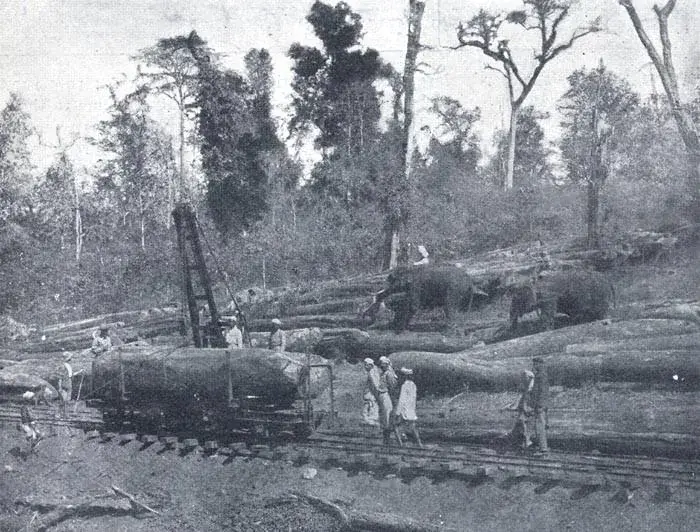
The timber trade is what tied all of that together, and its physical trace is still under your wheels. Chalakkudy was the coastal terminus of the Cochin State Forest Tramway, which brought teak and rosewood down from the Parambikulam forests; the timber yard and the workshop were here, and the line itself is documented on our Parambikulam record rather than this one. What survives in Chalakkudy is the alignment. The old tramway route is still called Tramway, the rails have simply been tarred over, and a working model of the tram is displayed at the Thrissur museum and zoo. Woodcraft and furniture workshops descended from that trade are still scattered through the town, and the furniture unit run by the Chalakkudy–Kunnathunad Technical Co-operative Society continues to trade profitably.
The river gives the town its water table and its evenings. Local access points along the Chalakudy river — the Koodappuzha check dam, Arangali Kadavu, Urumbunkunnu — are where people actually go at the end of a working day, and none of them are ticketed or organised. The river also carries the town’s clearest environmental grievance. Malayalam sources record that sustained sand mining lowered the bed by something like five metres, after which wells in the surrounding neighbourhoods stopped recharging and summer water shortages became normal; bank collapse followed. Two citizens’ bodies grew out of this — the Chalakudy Puzha Samrakshana Samithi and the Chalakudy River Protection Forum — and their arguments have run into the wider fights over the river upstream. The river’s extraordinary fish diversity is a real and separate story, and it belongs to the Vazhachal stretch, not to the town reach.
Two claims about the town’s consumption habits get repeated constantly, and they need separating. The first is well documented: Chalakkudy has for years recorded the highest foreign-liquor sales in Kerala, with ₹63,85,290 taken over a three-day Christmas period in 2023 and a state-topping figure again over Christmas 2008. The second, that the town ranked first among Indian towns in 1994 for spending exceeding per-capita income, comes from Malayalam Wikipedia without a citation and should be read as local lore rather than statistics. I could not find a documented culinary speciality attached to Chalakkudy itself in either English or Malayalam sources — no signature dish, no named sweet, no historic eating house — and the town’s food reputation, as far as the record goes, is a reputation for trade and for drink rather than for a cuisine of its own.
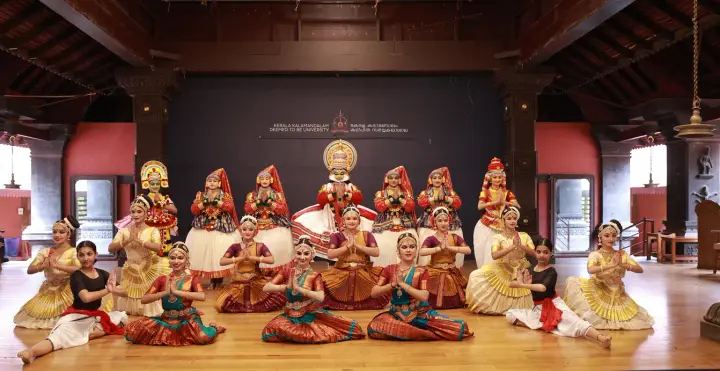
For a town of this size Chalakkudy has produced an implausible number of performers. Kalabhavan Mani was born here on 1 January 1971, worked as an autorickshaw driver in the town, and went on to act in more than 250 films across four languages while almost single-handedly building a commercial market for nadan pattu, Kerala’s folk song; he died on 6 March 2016, aged 45, after being admitted to hospital in Kochi, and the circumstances went to a CBI investigation. A nadan pattu competition is held in the town every year in his memory. The screenwriter and director A. K. Lohithadas, the actor Jose Pellissery and the director Lijo Jose Pellissery are all from here, as are the singer Madhu Balakrishnan and the investor Porinju Veliyath.
The literary and theatre record is older than the film one. In 1926 a high-school teacher in Chalakkudy named G. Sankara Kurup — later the first recipient of the Jnanpith Award — published a magazine here called Sopanam. The Naduvam poets lived in the town. Malanad Varika, a Kathakali monthly and a political magazine called Chenkathir were all published from Chalakkudy. On stage, M. A. Antony’s Maralika Theatre is credited with reviving Malayalam theatre in its period, and Sarathi Theatre’s production Five Star Hospital ran to 416 performances. Carmel Stadium in the town has a long association with Kerala football, and Chalakkudy has hosted the state school athletics meet more than once.
Legend & myth
No one agrees on what the town is called after, and the four surviving explanations are so different from one another that the disagreement is itself the most interesting thing about the name. The first works from a text: the Jyothishasamhita is said to refer to the place as Shaladhwajam, or Shalakkodi, and the reasoning is that many yagas — Vedic fire sacrifices — were performed on the banks of the Chalakudy river, so that the yagashala, the sacrificial hall, gave the settlement both its name and its sanctity. The second works from housing. Between roughly AD 800 and 1100, students came to the famous Moozhikkulam yagashala at nearby Angamaly to learn scripture and arms, and were lodged in dwellings along the Chalakudy river; a Namboothiri teaching hall was a shalai, a lodging was a kudi, and shalai-kudi is said to have worn down to Chalakkudy. A variant of the same idea places the school in the town itself, at Chukkikulam, in the second Chera period, drawing students from outside Kerala to study the Vedas and Kalaripayattu.
The third derivation is the one that changes the picture. Chalakkudy is remembered in Malayalam sources as a significant Buddhist centre. The Buddha established the practice of the rains retreat — vassa in Pali — during which monks stopped travelling, gathered in one place, and settled to study; buildings and gardens were raised for the purpose, and the first such complexes, at Jetavana, were called gandhakuti. The claim is that the sangharama that existed in Kerala was at Chalakkudy, that there was a shala here too, and that the town’s name descends from that monastic settlement rather than from any Brahminical school. The fourth explanation ignores all of this and follows the water: the historian V. V. K. Valath took Sholayar, one of the sources of the river, through Cholayar to Cholakkudi, the village on its bank, and so to Chalakkudy. Set against all four is a small orphan fact worth keeping — in the earliest references the river itself is called not Chalakudy but Pennai.
The best local etymology is not about the town at all but about the village on its eastern edge. Sakthan Thampuran, the Cochin raja who reorganised this country at the turn of the nineteenth century, built a summer residence at what is now Pariyaram and used it as a hunting base. He kept a fixed hour there for hearing petitions, and the tradition is that everyone who came away from it came away with a remedy — a pariharam. The place was called Pariharam for that reason and the word softened into Pariyaram. It is folk etymology, not documentary history, but it is folk etymology with a named ruler and a specific practice attached, which is more than most such stories carry.
Once a year the Chalakudy river stops being the town’s river and becomes a temple’s. The deity of the Koodalmanikyam temple at Irinjalakuda — a shrine whose own celebrated story is told on our Koodalmanikyam pages and is not retold here — is brought out for the aarattu, the ritual bathing that closes the festival. The tidambu is carried in procession on elephant-back with hundreds of people walking alongside, and in alternate years, after the parayeduppu at Koodappuzha Mana in Chalakkudy, it is bathed at the aarattukadavu at Koodappuzha on the Chalakudy river; in the other years the bathing happens at the aarattukadavu on the Karuvannur, a tributary. What is served afterwards is the part people remember: kanji and muthira puzhukku, rice gruel and steamed horse gram, ladled into bowls made from the spathe of the areca palm. It is called palakkanji, and it is served to everyone.
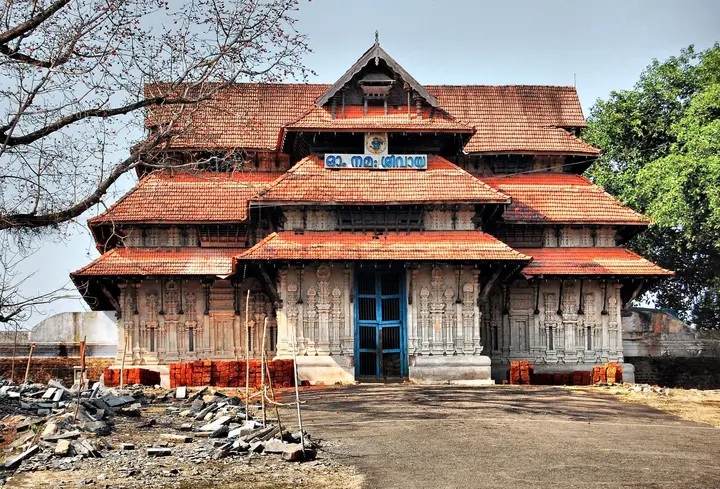
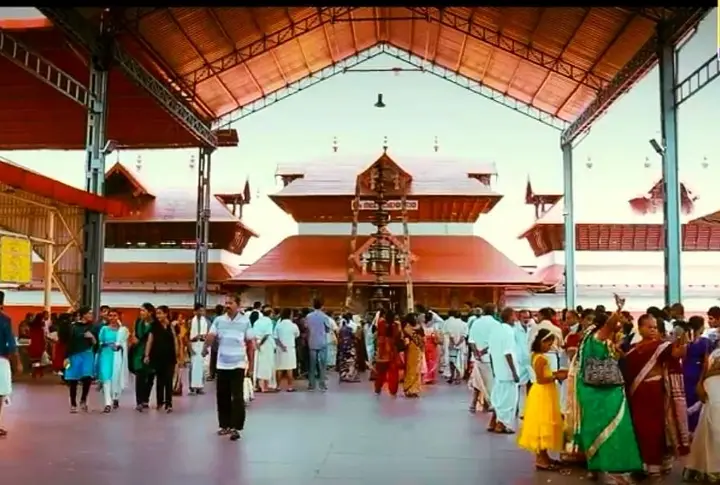
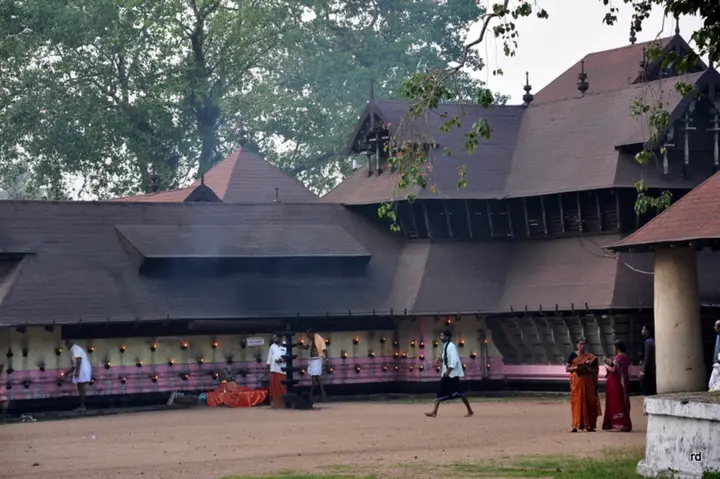
The town’s own temples carry two unusual arrangements. Thrippeppilly temple stands on the bank of the Chalakudy river in East Chalakudy, near the government hospital, and its ooraima — its hereditary trusteeship — belonged to the Kodassery Karthas, the chieftains who ran this country before the Cochin state absorbed them. It is one of the small number of Kerala temples in which Shiva and Vishnu are given genuinely equal standing rather than one being the host of the other; Parvathi and Sastha are also prominent, Hanumad puja is performed, and Ganapathi, Ayyappan and Bhadrakali are the subsidiary deities. The Shiva-bhutaganas, the god’s attendant host, are held to dwell there as well. At Koodappuzha, the Subrahmanya temple’s kavadi festival on the fifth of Makaram works the town rather than the temple: kavadi troupes from three parts of Koodappuzha converge on the temple at noon, then all of them go together to South Junction in the evening and process through the streets before returning to the shrine at night. Kannampuzha Bhagavathy temple keeps its festival in February and its thalappoli on the Aswathi asterism in Dhanu, with a seveli of seven elephants.
Two hill rituals draw people out of the town. Aareshwaram Dharmasastha temple sits on a hilltop, and its punarjani — the rebirth crawl through a natural rock tunnel — is the reason most people climb to it. Elsewhere in Kerala the punarjani is reserved to those keeping the Sabarimala vratham, but at Aareshwaram anyone who has kept the full forty-one-day fast may attempt it, and the belief is that the devotee who comes out the far side has left every previous sin behind and emerges a new person. Kanakamala, about five kilometres north-north-east, carries a kurishumudi — a hill of crosses — that local devotion ranks with Malayattoor. Fourteen crosses mark a kilometre-long path of bare sheet rock from the parish church on the plain to a chapel at about 310 metres, and the belief is that praying there after climbing past all fourteen wipes out the sins one has committed. April is when the hill is busiest. Our Kanakamala Kurishumudi page carries the climb, the 1940 vision that began the pilgrimage, and an honest comparison with Malayattoor.
The town’s festival calendar crosses its religious lines with a consistency that is itself part of the local self-description. The ambu thirunal at St Mary’s Forane Church is kept by people of all communities, and the same is said of the Assumption and ambu feasts at the Rosary church at Karoor on 25 and 26 January, and of the ambu thirunal at the Perpetual Help church in West Chalakkudy on the last weekend of January. The Kombadinjamakkal Juma Masjid, more than two hundred years old, holds the tomb of Sultan Badaruddin Pasha, and its chandanakkudam falls on the fifteenth of Makaram. Malayalam Wikipedia states flatly that Chalakkudy has never had a communal disturbance; that is a claim about an absence and I record it as the town’s own account of itself rather than as verified fact.
Two famous stories that circle this town belong to other places and I am refusing both by name. Pambumekkattu Mana, the serpent house at Vadama about eight kilometres away near Mala, is the great snake shrine of this part of Thrissur — a sarpakkavu where living snakes, and not only stone images, are venerated, where noorum-palum is offered on the first of Vrischikam and again on the Ayilyam asterism in Kanni, and where the mana was simply Meykkat until the serpents were held to have made themselves felt there. It is Mala’s, not Chalakkudy’s. So is Koratti Muthy, the Blessed Virgin of Koratty six kilometres off, called the worker of wonders, whose feast pulls crowds from across Kerala regardless of religion. Both are close enough to be annexed and neither should be.
More about Chalakkudy
History
In the Sangam period this stretch formed part of a village called Adavur and was inhabited by the Pulayar. The river did the work that the highway does now: Chalakkudy had a water connection to Muziris, the great early port of the Kerala coast, and timber cut in the Chalakkudy forests was floated down the river to reach it. From about the fifth century AD until the seventeenth or eighteenth the country here was known not as Chalakkudy but as Kodassery Nadu.
Kodassery was one of five provinces into which the Kingdom of Cochin’s territory was divided in the seventeenth century — Talappilly, Thrissivaperur, Mukundapuram, Aluva and Kanayannur — governed by chieftains known as the Anchikaimals. The family that held Chalakkudy were the Kodassery Karthas, and their origin story is a migration: they had lived near Lokanarkavu, a Buddhist site close to Thalassery in north Malabar, fell out with the Kadathanad raja, and resettled on the hill margin east of Chalakkudy, giving the tract its name. They dealt directly with the Dutch and the Portuguese, converting forest produce into cash, and they held the power of life and death in their own country. That independence made them a problem for Cochin. When the imprisoned raja of Ambalappuzha escaped Marthanda Varma’s custody he went to the Kodassery Karthas, the Koratty Kaimal and Paliath Achan to plot against Travancore; the war went the other way and Marthanda Varma took the Kartha prisoner. When Sakthan Thampuran later abolished the rule of the naduvazhis and desavazhis, in Kollam year 977 — 1801 to 1802 — the Karthas were reduced from petty princes to landlords and vassals.
The British ichthyologist Francis Day, who wrote a book on Cochin, records the Kodassery division and Chalakkudy within it. The Kaimal had acknowledged the suzerainty of the Zamorin until 1706 and kept a small palace here. Day’s account gives the division 125 candies of pepper and reckons the best cardamom and the best wax in Cochin came from this country. Kodassery had thirteen subdivisions and Chalakkudy was the principal one. Under the British the country east of the town was opened up: dams were built at Sholayar and Malakkappara, tea estates were established at Malakkappara and coffee planted alongside, and Athirappilly was developed as somewhere to visit rather than merely somewhere the river fell.
The tramway is the town’s largest single piece of industrial history and the sources disagree about its beginning. Malayalam Wikipedia dates its construction to 1901 and credits an engineer it names R. V. Hatfield, describing gravity working — a loaded tram descending the hill hauling an empty one up on the other end of a rope, with no fuel used at all. English-language sources have the construction inaugurated on 3 October 1905, the line opened in 1907, and the first tramway engineer named R. E. Haffield. The two accounts are plainly about the same man and the same railway; the dates and the spelling are not reconcilable from the material available, and both are set down here. The ending is not agreed either, and this record used to say it was. Three dates are published: English Wikipedia’s Cochin State Forest Tramway article has it abolished in 1963 after fifty-six years; the Malayalam article on the town says only that the tram survived “until the 1960s”; and the Malayalam encyclopedia’s own dedicated article on the line, ട്രാം പാത (ചാലക്കുടി), states that it was decommissioned on 24 April 1951 — twelve years earlier. That is the same encyclopedia we are already citing for the beginning, so it cannot be waved away. What is not in dispute is what is left: the alignment through Chalakkudy is still called Tramway, with the rails buried under tar, and a section of the tram is on display at the Thrissur museum.
The town assembled its own government slowly. Under the Cochin Village Panchayat Act of 1914 the four villages here worked as two group panchayats — West Chalakkudy with Annallur and Thazhekkad, and East Chalakkudy with Potta and Perambra. A town committee constituted on 11 April 1941 achieved nothing. The panchayat was reorganised in 1948 and constituted afresh in 1950 under the Travancore–Cochin Panchayat Act with ten wards; taxation followed in 1953. A panchayat committee resolution of 1966 finally carried, and on 1 April 1970 Chalakkudy, then a first-grade panchayat, was raised to become the twenty-sixth municipality in Kerala; the chief minister C. Achutha Menon made the announcement at the Chalakkudy vocational higher secondary school. It is a Grade II municipality today, covering 25.23 sq km in 36 wards. Chalakkudy Lok Sabha constituency was carved out of Mukundapuram in January 2008, and Chalakkudy taluk followed in 2013.
The political record of the twentieth century is unusually well marked on the ground. Mahatma Gandhi visited Chalakkudy in 1929 and spoke on Harijan upliftment; the municipal office now stands on the spot. In 1947 the third annual conference of the Praja Mandalam was held at Abdul Rahiman Nagar in the town, attended by V. V. Giri, then a minister in the Madras presidency and later President of India, and by Dr Rajendra Prasad, a minister in the British interim government and India’s first President. Panampilly Govinda Menon, who became a union minister, was born here. After the Second World War the forested tract at Pariyaram east of the town was allotted to ex-servicemen, and what was jungle then is settled countryside now.
Why visit
It is the only town on the 86 km Chalakudy–Malakkappara road, and everything you need before a forest drive — fuel, cash, food, a working bus stand — is here and nowhere further east.
The Tuesday and Friday markets are a genuine working hill-produce chantha with a documented line back to Sakthan Thampuran, not a heritage reconstruction.
The alignment of the Cochin State Forest Tramway runs through the town and is still called Tramway, with the rails tarred over rather than lifted.
Koodappuzha kadavu and the check dam give you the Chalakudy river at ordinary town level, free, unticketed and without the crowds of the falls.
St Mary’s Forane Church is a substantial Marian pilgrimage centre in its own right, and its ambu thirunal is kept across community lines.
It is the closest real town to Cochin International Airport on the northern side — 19 km — which makes it a practical first or last night rather than a detour.