History
The Nilgiris entered British records in 1819, when John Sullivan, then Collector of Coimbatore, went up to investigate what the East India Company’s order called "the origin of the fabulous tales that are circulated concerning the Blue Mountains". What he reported back was a temperate plateau inside the tropics, and what he proposed was a sanatorium — somewhere sick Europeans could be sent instead of home. Coonoor, being the first level ground above the Mettupalayam ghat, is where a good deal of that traffic stopped first: there was an inspection bungalow here by the 1830s, and the town grew as a resting place on the way to Ootacamund before it grew as anything else.
Three kilometres up the road the army arrived in the 1850s. The place was called Jakkatalla; Sir Richard Armstrong proposed renaming it after the Duke of Wellington in 1852 and the name took formally in 1860, by which time the barracks — begun in 1852 — were finished. The Madras Regimental Centre has occupied them since February 1947. The Defence Services Staff College, founded at Deolali in 1905 and moved to Quetta, came to Wellington after partition and ran its first course here in April 1948; by 1950 it was training officers of all three services together. Wellington is a Class II cantonment of about twenty thousand people, and the bridge over the Mynala below it dates from 1878, when it was built of wood.
The medicine came in 1907 and it came because of one death. A young Englishwoman, Lily Pakenham Walsh, died of hydrophobia in 1902 without having been able to reach antirabies treatment in time. The American philanthropist Henry Phipps had given Lord Curzon fifty lakh rupees for medical institutions in India, and one lakh of it was set aside to found the Pasteur Institute of Southern India. Coonoor was chosen for its cool and equitable climate rather than for anything else about it. The institute began work on 6 April 1907 and was formally opened on 25 April by Sir Arthur Lawley, Governor of Madras, on sixteen acres above the town. It has made antirabies vaccine every year since, added the DPT group in 1982, and became the autonomous Pasteur Institute of India on 10 February 1977.
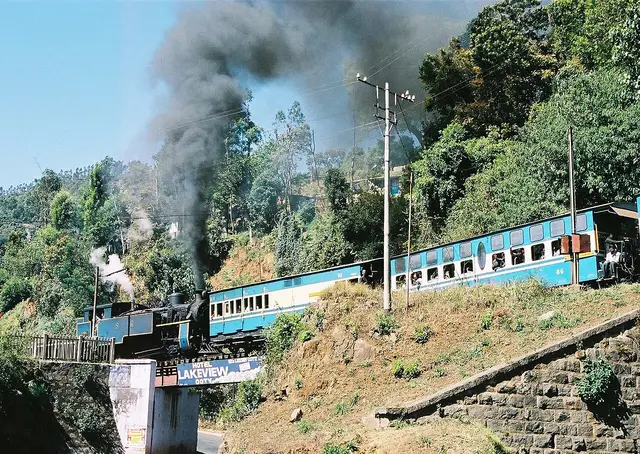
The railway took forty-five years to argue into existence. The first plans for a mountain line from Mettupalayam were drawn in 1854; the case was carried largely by Major Morant of the Royal Engineers, district engineer in the Nilgiris, who published Mountain Railways for the Nilgiri Hills and other papers through the 1870s. The line opened as far as Coonoor on 15 June 1899. The extension from here to Ootacamund followed on 15 October 1908 — eleven and three-quarter miles on the same gauge at a cost of Rs 24,40,000 — and it was built without a rack, because above Coonoor the ground no longer demands one. Morant left the town two other things: the Anglican church at Wellington and the Roman Catholic one, which the Cantonment Board records him building in 1885 and 1888.
Coonoor was made a municipality and has stayed one; it and Udhagamandalam are the only two in the district, which itself was constituted on 1 February 1882. The most recent thing most people know about the town is the worst. On 8 December 2021 an Indian Air Force Mi-17 came down in the hills a few kilometres from the centre. Thirteen of those on board were killed at once and Group Captain Varun Singh, the sole survivor of the crash itself, died of his injuries seven days later.
Why visit
For the railway, from the one station where it makes sense. Coonoor is where the Abt rack from Kallar ends and the plain track to Ooty begins, and the shuttles that work the upper half run several times a day against the through train’s once — the same line and the same scenery, without the ninety-day scramble for a seat.
For the tea, which is not scenery here but the local industry with a market attached. The first Nilgiri trials were made beside this town in the 1830s, the first estate was planted in 1854, and the auction that thirty thousand smallholders sell through still sits in it. Highfield is 4.7 km from the bus stand and Brooklane 9.5 km, and both are working factories.
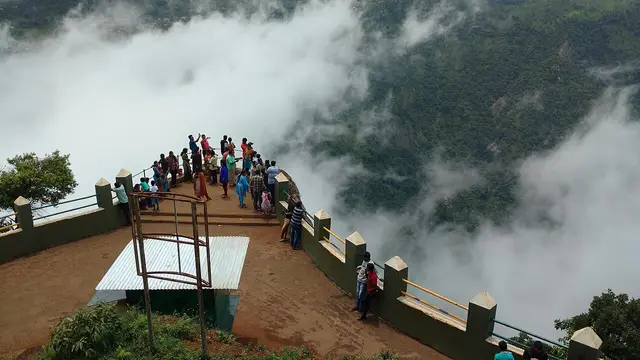
For two viewpoints that do the one thing the high downs cannot. Lamb’s Rock at 7.4 km and Dolphin’s Nose at 13.6 km stand on the edge of the escarpment rather than on top of the plateau, so what you are looking at is the Coimbatore plain two thousand metres below and the gorge wall opposite with Catherine Falls on it.
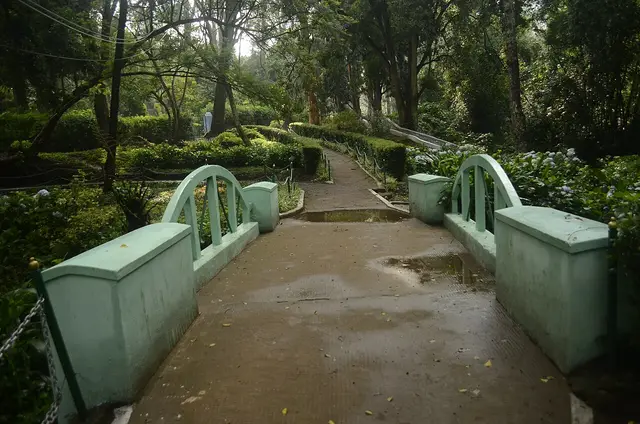
For a garden with a slope in it. Sim’s Park has been laid out since 1874 on ground steep enough that the paths switch back, holds over a thousand plant species across twelve hectares, and has none of the crowds of the two big Ooty gardens.
And for the three hundred and fifty metres. Coonoor is the lower hill station, which makes it the warmer one in the evening, the cheaper one to sleep in, and half an hour from everything in Ooty — which is a better arrangement than the reverse and almost nobody uses it.