Fort Kochi is the old harbour quarter of Kochi. Its neighbour Mattancherry lies a short ride to the east. Between them, a few square kilometres hold five centuries of Portuguese, Dutch, British, Jewish and Kerala history. Almost all of it is close enough to see on foot.
This guide lists fifteen things to do in Fort Kochi and Mattancherry. Each one has its own Roampedia page with more detail. We have grouped them into three parts: the Fort Kochi walk, a morning in Mattancherry, and the water. Follow the groups and you can see most of the old town in one or two days.
The Fort Kochi walk
The first group sits within a short walk of the seafront. Start at the nets in the early morning, move inland to the churches and museums, and come back to the beach for sunset. End the day at a Kathakali show.
1. Watch the Chinese fishing nets at work
The Chinese fishing nets stand in a row where the harbour channel meets the sea. In Malayalam they are called cheenavala, which means Chinese net. Kerala Tourism calls them a hallmark of Fort Kochi and one of the most photographed sights in the city.
Come in the early morning or the early evening, when the fishermen lower and lift the nets. Watch from the walkway at Vasco da Gama Square. See our Chinese fishing nets page and the story of the nets.
2. Walk the seafront at Fort Kochi Beach
Fort Kochi Beach is the seafront of the old town. Kerala Tourism describes a granite walkway shaded by trees, with Vasco da Gama Square, seafood stalls and the fishing nets along it. Cargo ships pass close by on their way into the harbour.
Walk it at sunset, when local families come out and the nets turn black against the sky. The seafood stalls along the walk make an easy evening meal. Our Fort Kochi Beach page has the full layout.
3. Stand at Vasco da Gama's first grave in St Francis Church
St Francis Church is a plain white church on a quiet green. Kerala Tourism calls it one of the oldest churches built by Europeans in India. Portuguese friars started it in 1503. Vasco da Gama was buried here after he died in Kochi in 1524.
His body later went back to Portugal, but the spot in the floor is still marked. Look at the old tombstones on the walls and the cloth punkah fan. Read more on our St Francis Church page.
4. Look up at the painted ceiling of Santa Cruz Basilica
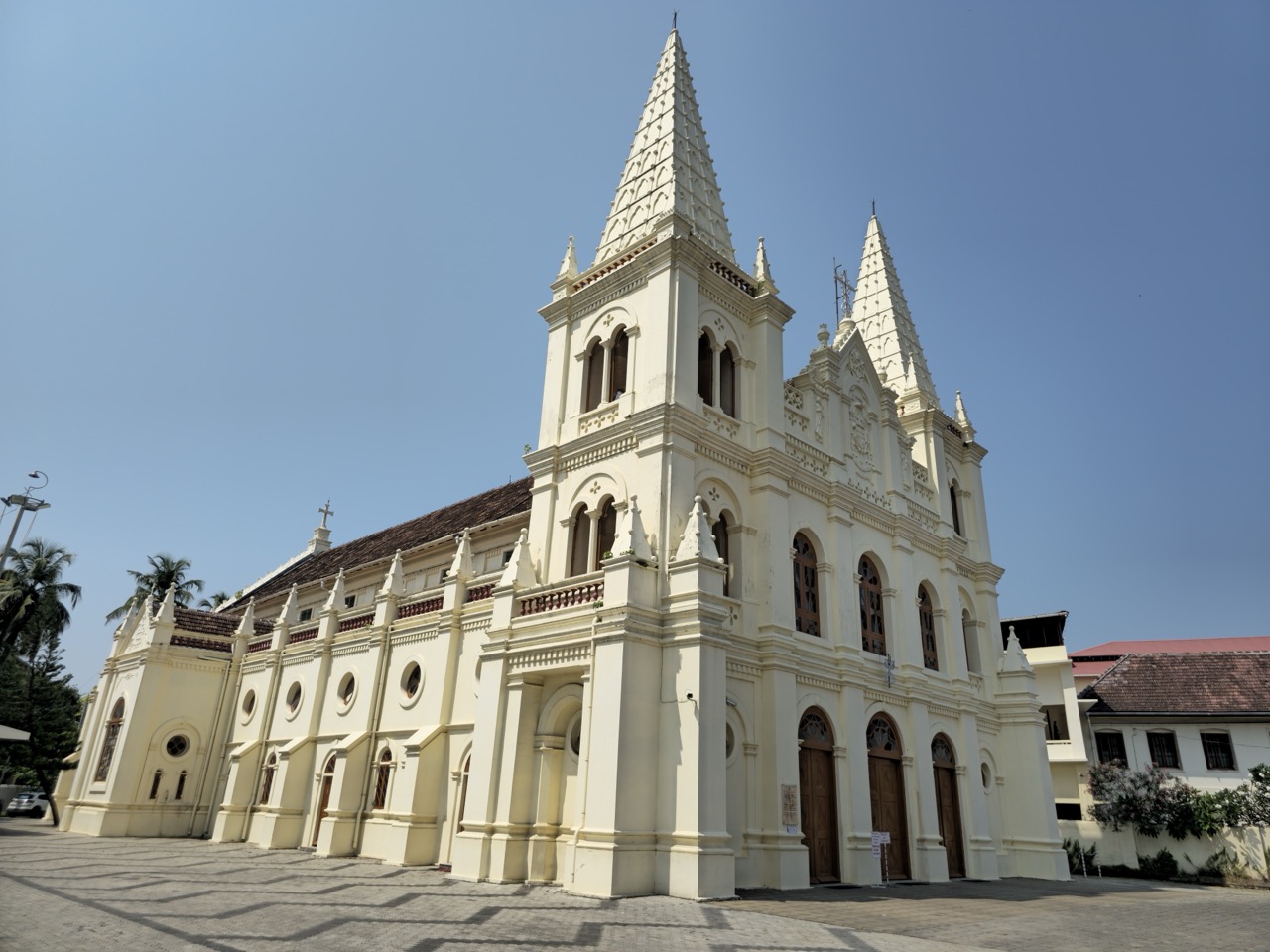
Santa Cruz Cathedral Basilica has a pale front and two tall spires. The Portuguese founded a church on this site in 1505. The building you enter today was consecrated in 1905.
Inside, the nave is washed in pastel colours and the ceiling is painted from end to end. Sit for a while and take it in, then walk up to the altar. It is a working cathedral, so dress modestly. See our Santa Cruz Basilica page.
5. Read the 1724 pillar at the Dutch Cemetery
The Dutch Cemetery is a small walled burial ground on the road beside the beach. Kerala Tourism says it was consecrated in 1724, and the year is cut into the entrance pillar. Low tombs of grey granite and red laterite fill the ground inside.
The gate is usually kept shut, and St Francis CSI Church opens it on request. Even from outside, the dated pillar and the rows of tombs make a good stop. Our Dutch Cemetery page tells who lies there.
6. See the altars and fort ruins at the Indo-Portuguese Museum
The Indo-Portuguese Museum sits in the garden of the Bishop's House. Dr Joseph Kureethara, a former Bishop of Kochi, started the idea. The Calouste Gulbenkian Foundation of Lisbon gave many of its sculptures and silver pieces.
Spend about an hour with the altars, crosses and robes. Then go down to the basement to see remains of Fort Immanuel, the Portuguese fort that gave Fort Kochi its name. Visit our Indo-Portuguese Museum page.
7. Visit a Dutch house turned gallery at David Hall
David Hall is a low white bungalow on the edge of the Parade Ground. Kerala Tourism dates it to around 1695 and credits it to the Dutch East India Company. It takes its name from a later owner, David Koder, a Jewish businessman.
Today it is an art gallery with changing shows and a garden café behind it. Come for an hour of art and shade between other stops. Read more on our David Hall page.
8. See the Kochi-Muziris Biennale at Aspinwall House
Aspinwall House is a long, sea-facing compound on the road to Mattancherry. The English trader John H. Aspinwall founded Aspinwall and Company here in 1867. Pepper, coir and timber passed through its godowns.
Since 2012 it has been the main site of the Kochi-Muziris Biennale. During an edition, give it several hours. See our Aspinwall House page and the story from pepper to Biennale.
9. Watch hand washing at the Dhobi Khana
The Dhobi Khana is a working community laundry on Veli Street, beside Veli Ground. Families of the Vannar, a Tamil-speaking washer community, wash, dry and iron clothes here by hand. Rows of wash pens and drying lines fill the yard.
Come in the morning and keep to the edges, because this is a workplace. Close photographs of people need their permission. Our Dhobi Khana page and Dhobi Khana story tell its history.
10. End the day with Kathakali
Kathakali is the classical story play of Kerala. The actors never speak. They tell the story with their hands, their eyes and their painted faces, while singers and drummers carry the words.
The Kerala Kathakali Centre puts on short evening shows in the old town. Learn a few hand signs before you go and sit near the front. See our Kerala Kathakali Centre page.
A morning in Mattancherry
Mattancherry is the old trading quarter east of Fort Kochi. Its palace, synagogue, spice street and temples sit close together. Go in the morning, when the godowns are busy and the streets are cooler.
11. See the Ramayana murals in the Dutch Palace
The Dutch Palace, also called Mattancherry Palace, stands on Palace Road. The Portuguese built it in 1555 for the Raja of Kochi. The Dutch later repaired it, and the name stuck.
From the street it looks plain. Save most of your time for the murals upstairs, where one room holds the Ramayana painted wall to wall. See our Dutch Palace page and the Dutch Palace story.
12. Walk Jew Town and its antique shops
Jew Town is one narrow street with the Dutch Palace at one end and the synagogue at the other. Old colonial buildings line both sides. Most are now shops full of carved furniture, brass lamps and old photographs.
Walk it slowly and look up at the old upper floors. The street tells the story of a Jewish community that lived here for centuries and then left for Israel. Our Jew Town page covers it in full.
13. Step onto the tiles of the Paradesi Synagogue
The Paradesi Synagogue stands at the end of a lane in Jew Town. Spanish-speaking Jews built it in 1568 on land given by the king of Cochin. A white clock tower stands beside the small doorway.
Inside, you walk barefoot over hand-painted Chinese tiles. Glass chandeliers hang above, and a carved teak ark holds the Torah scrolls. The visiting days are on our Paradesi Synagogue page.
14. Smell the spice godowns of Bazaar Road
The Mattancherry spice market is a street of old warehouses along Bazaar Road. Kerala Tourism says Jew Town is still an important centre of the spice trade. Pepper, ginger, cardamom and turmeric still come in by truck and leave in sacks.
Walk it on a weekday morning, when workers dry, sort and pack the spices by hand. Small shops near Jew Town sell spices to visitors. See our Mattancherry spice market page.
15. Visit the Jain temple and the Gosripuram temple
The Dharmanath Jain Temple on Gujarati Road is a white marble temple in the Gujarat style. The temple trust says it was built in 1904. Close by stands Cochin Thirumala Devaswom, the main temple of the Gowda Saraswat Brahmin community.
Come to the Jain temple just before noon, when hundreds of pigeons fly in to be fed. Then see the great bronze bell at Thirumala Devaswom. Read our Dharmanath Jain Temple page and Cochin Thirumala Devaswom page.
The water: getting there by boat
The best way into Fort Kochi is across the harbour. The Kochi Water Metro started its Fort Kochi service from the High Court terminal in Ernakulam on 21 April 2024. Its terminal list also includes Mattancherry.
Take the boat in one direction and watch the port, the islands and the fishing boats go past. Our Kochi harbour ferries guide covers the routes. For a ready route on land, use our Kochi heritage walk.
Frequently asked questions
What are the top things to do in Fort Kochi?
Watch the Chinese fishing nets, walk Fort Kochi Beach at sunset and visit St Francis Church and Santa Cruz Basilica. In Mattancherry, see the Dutch Palace murals, the Paradesi Synagogue and the spice godowns. End with a Kathakali show.
How many days do you need for Fort Kochi and Mattancherry?
One full day covers the main sights if you start early. Two days let you add the museums, David Hall, the Dhobi Khana and a slow evening at the beach.
Can you walk around Fort Kochi?
Yes. The nets, beach, churches, Dutch Cemetery, museum and David Hall all sit within a short walk. Mattancherry is a short ride east, and its sights sit close together on foot.
What is the best time of day to see the Chinese fishing nets?
Early morning and early evening, when the fishermen work the nets. Sunset gives the best light from Vasco da Gama Square.
How do you get to Fort Kochi from Ernakulam?
Take the Kochi Water Metro from the High Court terminal, which has run to Fort Kochi since April 2024. State ferries also cross the harbour. See our harbour ferries guide for routes.
What is there to do in Fort Kochi at New Year?
Fort Kochi Beach hosts the Cochin Carnival on New Year's Eve. At midnight the town burns the Pappanji, a giant figure of an old man. Our Pappanji story explains the custom.