Highlights
- Kerala's largest lake and the main setting for Kumarakom and Alleppey backwater trips.
- Houseboats, bird sanctuary access, ferry routes, lake resorts and paddy-country views.
- Local services run to boat operators and lakefront stays.
Vembanad Lake is Kerala's largest lake and the heart of the central backwaters, linking Kumarakom, Alappuzha and several canal-and-paddy landscapes. For travellers, it is not one viewpoint but a water system: houseboats, ferries, birding, resort stays, fishing villages and Kuttanad edges all sit around it.

Plan Vembanad through a base, not as an abstract lake. Kumarakom is the calm resort/birding side, Alappuzha is the busy houseboat hub, and Kottayam gives rail access. Route clarity matters because a "Vembanad cruise" can mean very different experiences.
Vembanad is the vast, shimmering heart of the Kerala backwaters — widely described as the longest lake in India and the largest in the state, a labyrinth of brackish water, palm-fringed islands and below-sea-level paddy that stretches roughly 96 km through three districts. From the quiet resort village of Kumarakom on its eastern shore, you meet the lake at its gentlest: houseboats drifting past drooping coconut palms, kingfishers diving into still canals and a horizon that dissolves where water meets sky.
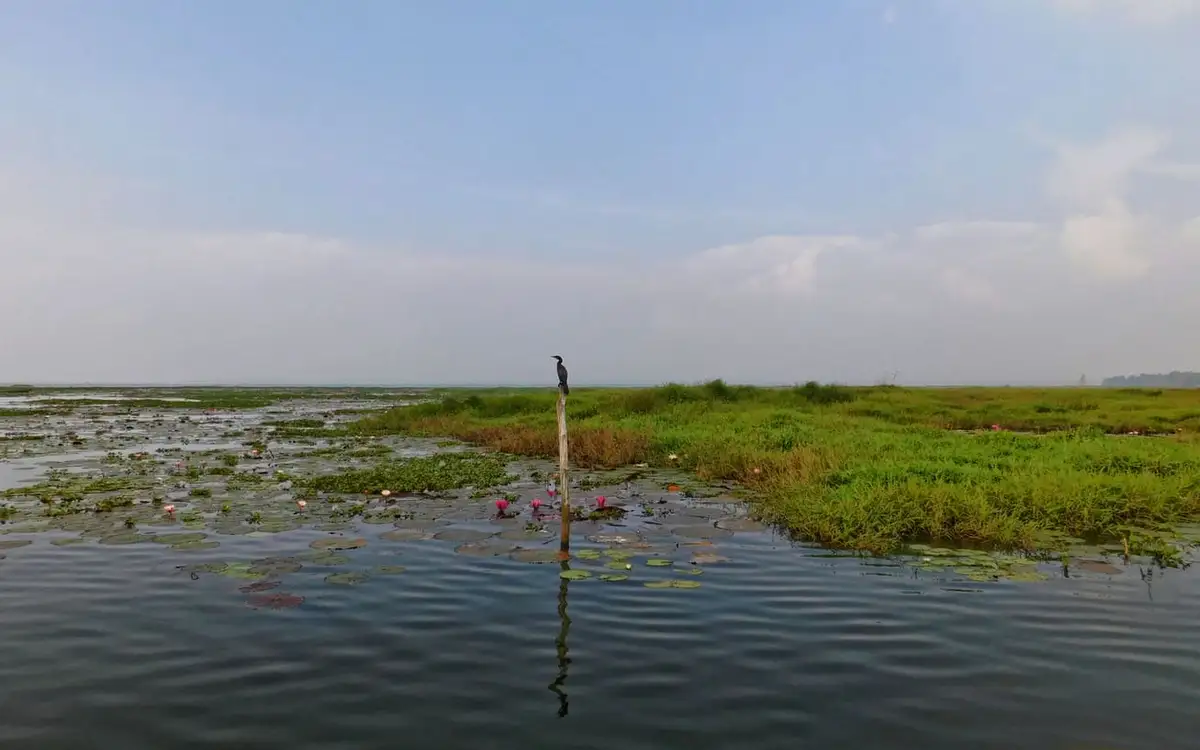
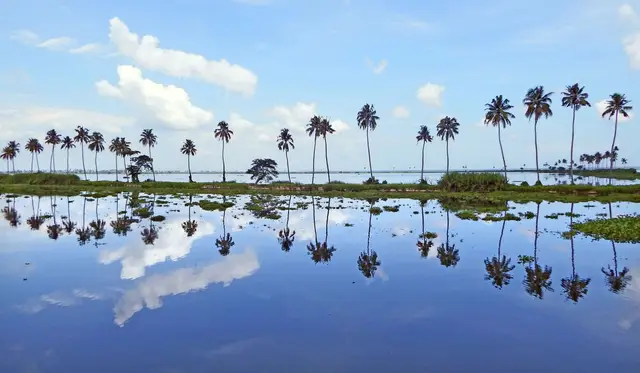
Seen from Kumarakom, Vembanad does not announce itself with drama so much as with immensity. The land simply runs out — paddy bund, coconut grove, a fisherman’s stilt — and then there is water, wide enough that the far bank melts into haze and you could believe you were looking at the sea. This is the great backwater lagoon of Kerala, a shallow sheet fed by rivers and flushed by tides, and Kumarakom sits on its eastern edge like a green thumb pressed into the blue.
The lake wears different names along its length. Here in Kottayam it is Vembanad Kayal; down towards Alappuzha the same water is called Punnamada; at its northern mouth in Kochi it becomes the Kochi Lake before spilling into the Arabian Sea. Four rivers and more — the Meenachil, Pampa, Manimala and Achankovil among them — pour their monsoon load into it, so the water is fresh after the rains and turns saltier towards the coast, a shifting balance that shapes everything from the fish to the farming.
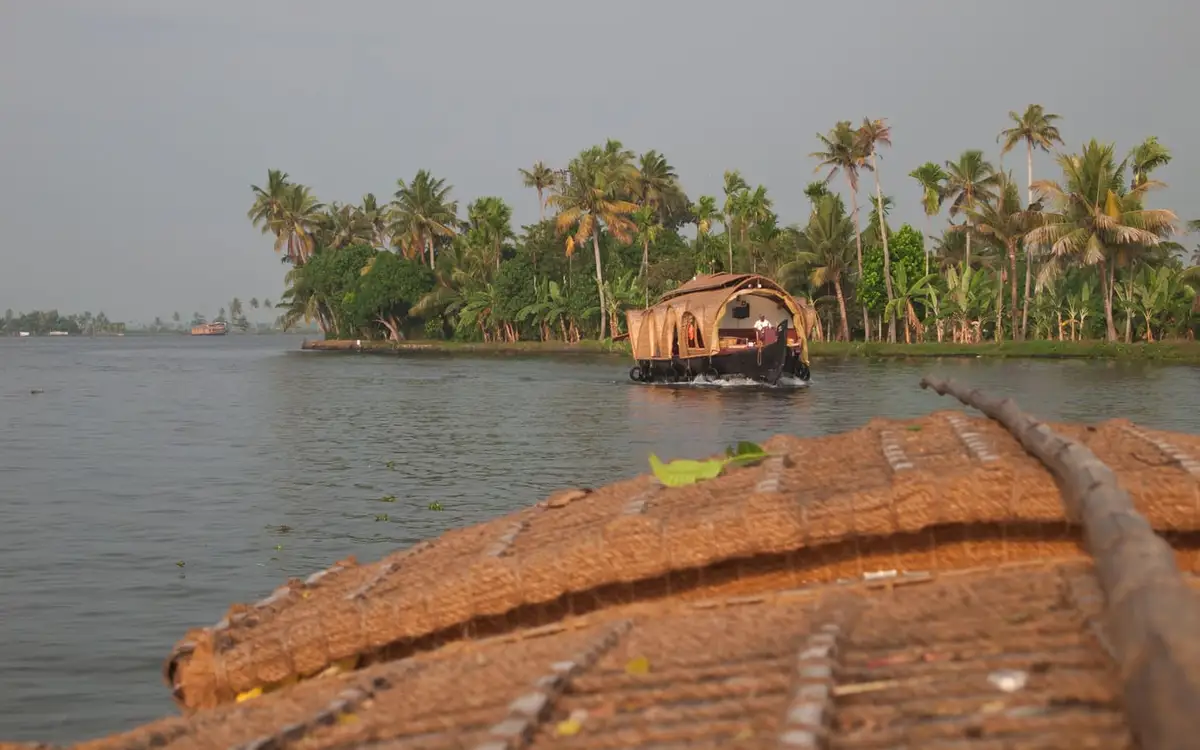
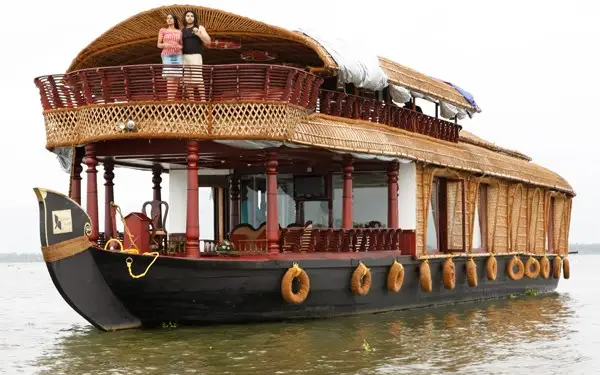
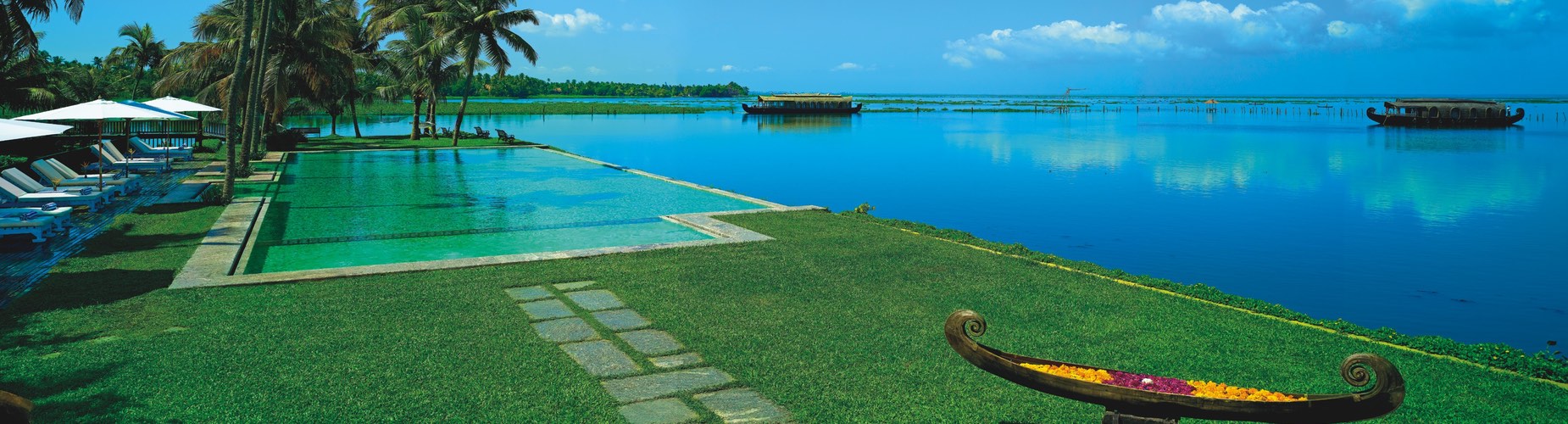
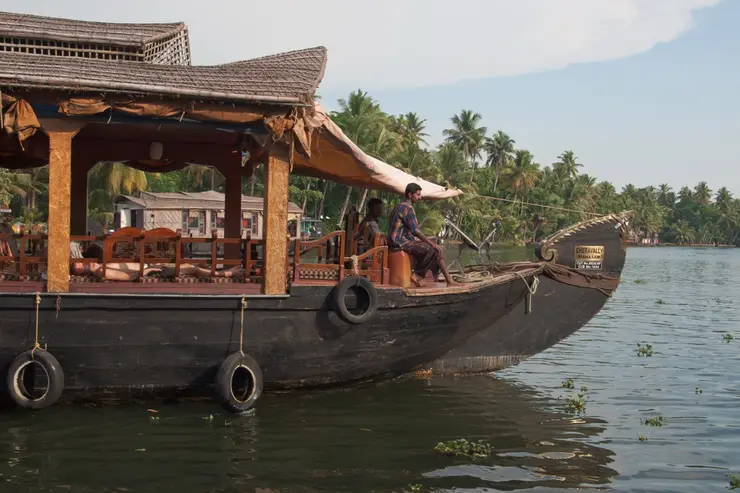
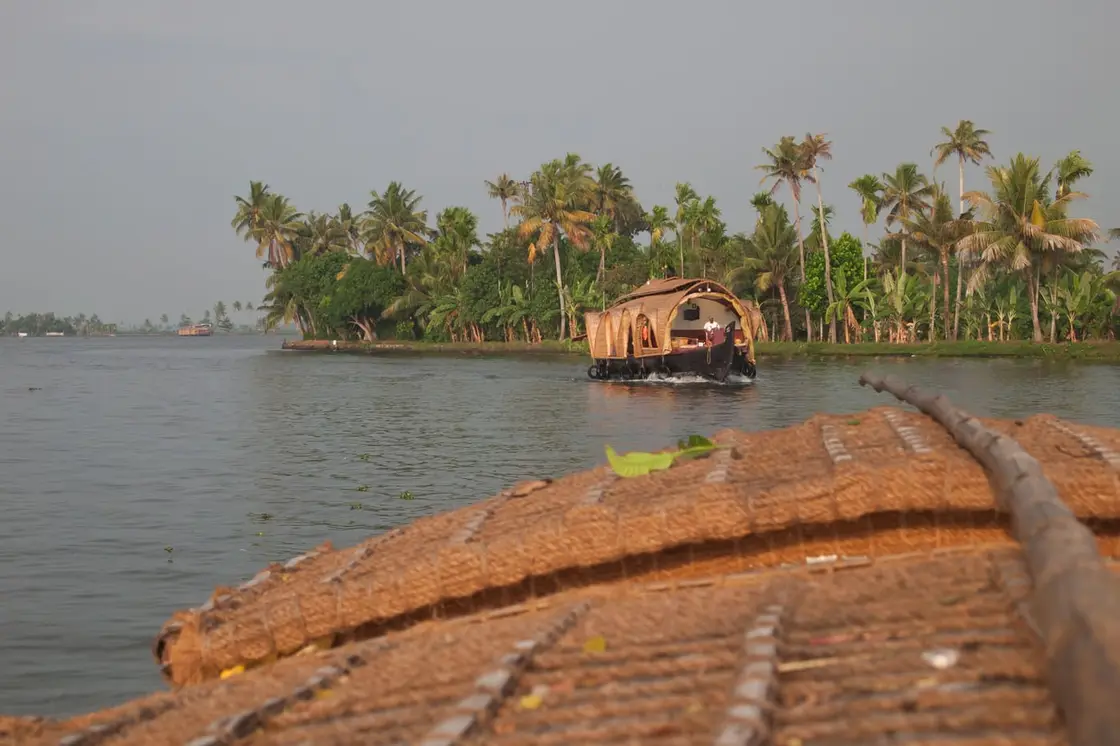
A day on Vembanad is measured in the slow arithmetic of a boat. The classic vessel is the kettuvallam, the old rice barge reborn as a houseboat, its ribs of jackwood lashed with coir rope and roofed in woven palm — no nails in the traditional build, only knots. ⚠ On a boat delivered today that is heritage rather than specification: Kerala Tourism’s own account of houseboat making describes bronze nails as an alternative to tying, plus plywood, tar sheets, aluminium and an engine. It glides at walking pace past villages where life is lived at the water’s edge: women beating laundry on the ghats, toddy tappers shinning up palms, a church bell and a temple gong sounding across the same stretch of water.
For the narrow arteries a houseboat cannot enter, there is the shikara or a slender country canoe, poled into canals so tight the coconut fronds meet overhead. This is where you see the real Kuttanad — ducks herded in their hundreds across open water, mussel gatherers wading chest-deep, prawn farmers tending their sluice gates. The lake is not scenery here; it is a working landscape, a place where people have farmed below the level of the sea for generations.
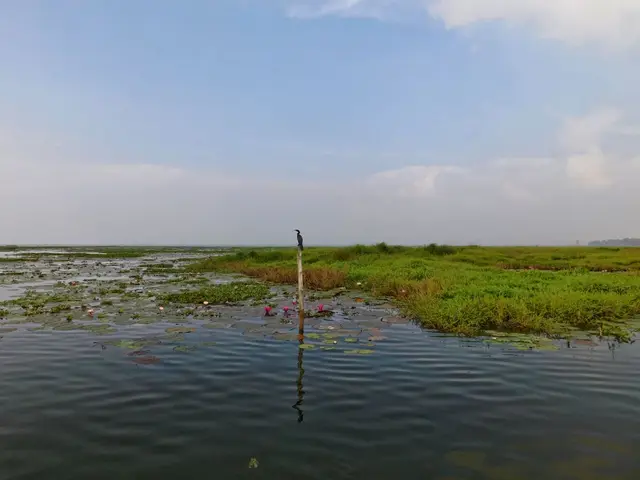
The most magical hours are the edges of the day. At dawn the water is a sheet of pewter and mist hangs in the palms while cormorants and darters fan out to fish; by late afternoon the light turns molten gold and the returning fishing canoes cut long silhouettes against it. A sunset cruise out of Kumarakom, with the sky bleeding orange into the lake and the first lamps flickering on the far shore, is for many travellers the single image they carry home from Kerala.
And then there is the birdlife. The Kumarakom Bird Sanctuary spreads over the lake’s shore in a tangle of mangrove and greenery, drawing egrets, herons, darters and cormorants year round and, in the cool months, flocks of migrants that have flown down from Siberia and the Himalayas. To sit in a canoe at first light with the trees noisy above you and the lake still as glass is to understand why this modest corner of Kottayam became one of Kerala’s most beloved retreats.
Local tradition offers a poetic explanation for how such a vast body of water came to be. The name Vembanad is said to descend from an ancient realm called Vempoli Nadu, through which the sacred river Pampa once flowed. As the story goes, in a distant age this land — along with a stretch of the Pampa — sank into the earth, and the great lake welled up to fill the wound it left behind.
The tale is best enjoyed as legend rather than geology; geographers attribute the lagoon to the slow, natural drowning of the coast and the shifting of river mouths over millennia. Still, the idea of a submerged kingdom lingering beneath the still water gives an old, mythic weight to a lake that can feel, on a misty dawn, genuinely otherworldly.
Vembanad is a coastal lagoon — one of a chain of such backwaters strung along the Kerala shore where rivers, sea and shifting sandbars have woven land and water into a single amphibious country. For centuries it was a highway before it was a holiday: rice, coir, spices and timber moved along it in country boats, and the ports at its northern end grew rich on the trade that passed through its mouth to the Arabian Sea.
The lake’s modern shape was written by human hands as much as by rivers. From the early nineteenth century, farmers in the region now called Kuttanad began the audacious work of reclaiming land from the shallow lake itself — throwing up bunds around patches of water, pumping them dry and planting rice on the lakebed. These reclaimed fields, the kayalnilams, sit below sea level, making Kuttanad one of the very few places on earth where paddy is farmed several feet beneath the tideline, kept dry only by an unending cycle of bunds and pumps.
The single greatest intervention was the Thanneermukkom barrage, built across the lake to stop salt water from the sea creeping up and ruining the paddy, linking Thanneermukkom in Alappuzha with Vechoor in Kottayam. 🛑 It is very widely called “the largest mud regulator in India”; it is neither — it is a reinforced-concrete barrage designed for 90 shutters and 4 navigation locks, and no national inventory supports “largest”. It also was not built in one campaign: the Kerala Irrigation Department records the Vechoor half completed in 1965 and the Thanneermukkom half in 1975, with the 428-metre middle standing as an earthen cofferdam until the central stage opened to traffic on 31 July 2018. Its shutters split Vembanad in two: a freshwater southern half held back for the farmers, and a tidal, brackish northern half open to the sea.
The barrage let Kuttanad’s farmers raise two or three crops a year where once they managed one, but it came at a steep ecological price. With the tidal flushing choked off, the southern lake stagnates for months, weeds such as water hyacinth choke the surface, and the famed inland fishery has collapsed — the catch of Karimeen, the pearl spot that is Kerala’s state fish, falling dramatically in the decades since the shutters closed. Silting and encroachment have shrunk and shallowed the lake, and its long-term health is now a live public debate.
In recognition of its outsized importance to wildlife and to people, Vembanad — together with the Kol wetlands to its north — was designated a Wetland of International Importance under the Ramsar Convention in 2002, ranking among the largest such sites in the country. It remains a vast, stressed, still astonishing ecosystem, and Kumarakom is the window through which most travellers come to know it.
This is the backwaters at their most iconic — the very landscape that made Kerala famous. A cruise from Kumarakom across Vembanad delivers the postcard in motion: houseboats on open water, coconut palms leaning to their own reflections, and villages living at the waterline.
It is the largest lake in Kerala and widely counted the longest in India, a genuinely vast expanse that gives the horizon a sea-like openness rare among lakes — the sense of scale alone is worth the trip.
The Kumarakom Bird Sanctuary on the shore turns the lake into one of South India’s finest birding grounds, alive with egrets, herons, darters and cormorants year round and with Siberian and Himalayan migrants from November to February.
The choice of boats suits every appetite: a slow overnight kettuvallam houseboat for romance, a nimble shikara or canoe for the hidden canals of Kuttanad, or a short sunset cruise for those with only an evening to spare.
Kumarakom itself is a calm, green, well-served base — a cluster of islands and quiet resorts on the lake’s edge — that lets you experience the vastness of Vembanad without the bustle of a town, making it a favoured spot for honeymooners and unhurried travellers.
In August the lake near Alappuzha explodes into the Nehru Trophy snake-boat race and the wider Vallam Kali season, one of India’s great spectacles of colour, chant and sinew — a very different, thunderous face of the same tranquil water.
Road km to Kottayam; ghat roads and traffic vary — allow extra.
November to February is easiest for lake travel. Monsoon is scenic but more variable for small boats and outdoor plans.
Live forecast loads in your browser.
Check the official alert before you travel. Kerala’s beaches, waterfalls and trekking routes close at short notice during heavy rain, and district alert levels change day to day. We do not publish an alert level of our own — read it from the state authority: Kerala State Disaster Management Authority, or the district control room on 1077.
Sun and moon are calculated for this location and shown in IST. Photography windows are the hour around sunrise and sunset; the sunset bearing is degrees clockwise from true north. Moon phase is accurate to about half a day.
Verified hotels, homestays, restaurants, experiences, sights, shops and rentals around Vembanad Lake — commission-free, with direct contact. Filter by what you need.

Attraction in Kumarakom, Kottayam, Kerala, India.
Church in Kumarakom, Kottayam, Kerala, India.

The great backwater lake system Kochi’s harbour opens from — this record marks the water itself; boat trips from the Fort Kochi and Mattancherry jetties are the way onto it.

Direct-source Kumarakom houseboat operator with Cheepunkal boarding point. Contact direct · Kumarakom, Houseboat, Cheepunkal Jetty.

Direct-source Kumarakom houseboat operator based at Chakranpady. Contact direct · Kumarakom, Houseboat, Chakranpady.

Kumarakom responsible-tourism desk context for village experiences and local activity enquiries. Depends on booked experience; contact desk · Kumarakom, Responsible Tourism, Official desk.

Official Kerala Tourism and Kottayam district bird sanctuary record on Vembanad Lake. Kumarakom, Birding, Vembanad Lake.

KTDC Kumarakom property with district tourism contact evidence. Contact KTDC · Kumarakom, KTDC, Government hotel.
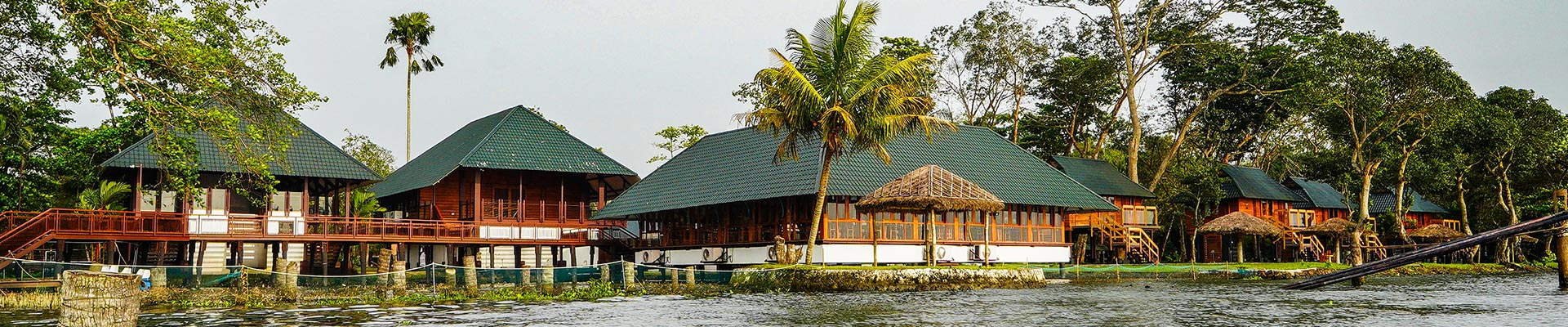
Abad-managed backwater resort with lakeside cottages and villas overlooking Vembanad Lake at Kumarakom.

Resort in Kumarakom. 5-star luxury resort and spa · Kumarakom, Karottukayal, Zuri.

Taj hotel at Kavanattinkara, Kumarakom with Kerala Tourism-listed contacts. 5-star luxury lake resort and spa · Kumarakom, Taj, Kavanattinkara.

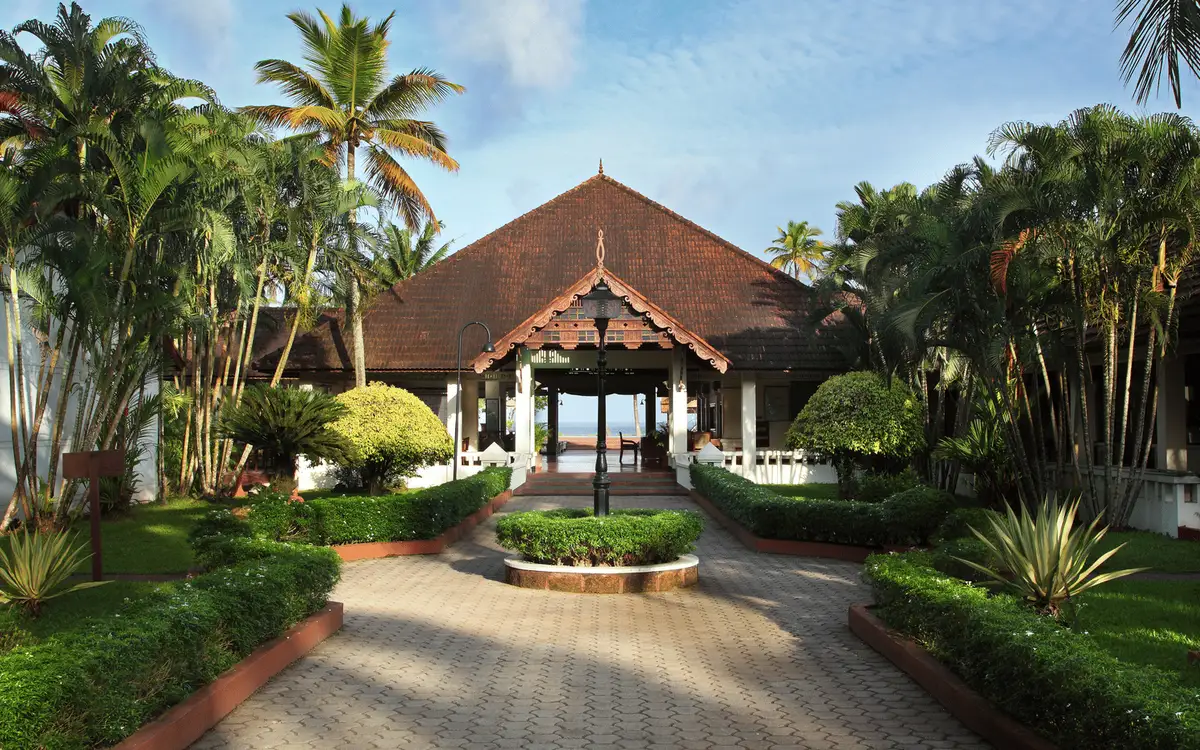
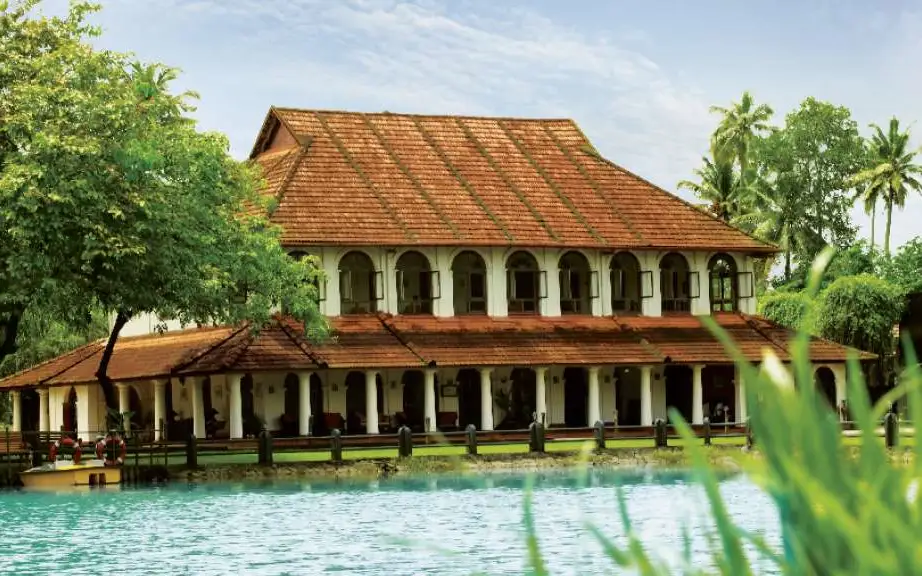
Luxury heritage backwater resort set on the banks of Vembanad Lake at Kumarakom, Kerala. Kumarakom Lake Resort, Kumarakom North Post, Kottayam, Kerala 686563 · 5-star luxury heritage resort with private villa cottages · Kumarakom, Vembanad Lake, Luxury resort.
Heritage island backwater resort by CGH Earth on Vembanad Lake at Kumarakom. The property lies in Kottayam district and is reached by boat.
KTDC-run premium backwater resort with stilted cottages inside Kumarakom Bird Sanctuary on Vembanad Lake.
Lakeside resort on the banks of Vembanad Lake at Kumarakom, offering backwater cruises and a spa. It stands on Nazerath Church Road in Kottayam district.
Family-run lakefront cottages on the shores of Vembanad Lake at Kumarakom. They are located at Ammankary, Nazareth Road, in Kottayam district.
Restored 1870s heritage bungalow hotel on the banks of Vembanad Lake at Kumarakom.
Eastend-group backwater resort on the banks of Vembanad Lake at Kumarakom. It sits on the Vembanad shore in Kottayam district, Kerala.
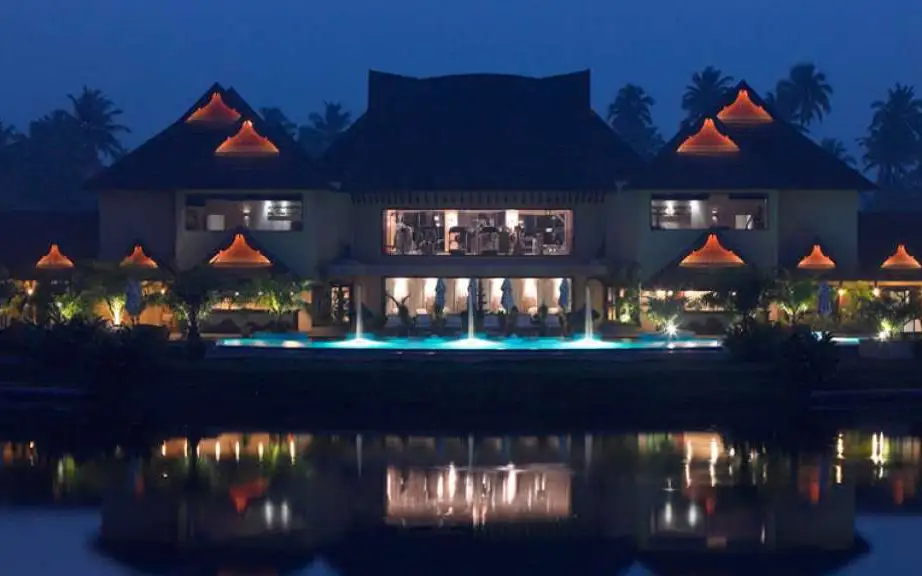
Five-star lakefront resort and spa on the shores of Vembanad Lake at Kumarakom. It is set on the Vembanad backwaters in Kottayam district, Kerala.
Boutique backwater resort fronting Vembanad Lake at Kumarakom, accessible by water. Kumarakom North, Kottayam, Kerala 686563.
24-room boutique resort with lake-view rooms on the shores of Vembanad Lake at Kumarakom. Near Nazreth Church, Kumarakom P.O., Kottayam, Kerala 686563.
Coconut Palms is a Kerala Tourism-classified family homestay in Kumarakom, a short walk from the Vembanad backwaters and bird sanctuary. It offers en-suite rooms in a traditional-style house with home-cooked Kerala meals and direct booking.
Taj Kumarakom restaurant on the Vembanad side for resort dining and backwater stays. Contact direct / check current rules · kumarakom, eat, All-day dining restaurant.
Kumarakom resort on Nazerath Church Road with official reservation contacts. Contact direct · Kumarakom, Nazerath Church Road, Backwater resort.
Book with the place itself. India’s cyber-crime coordination centre warned in April 2025 that convincing copies of hotel and pilgrimage booking sites are being pushed through sponsored search and social ads, taking payment for rooms the property never hears about. Every listing here links to the business’s own contact details and its own Google or Bing profile — we take no commission and sit in nobody’s payment path. If a booking page reached you through an ad, check the address bar against the property’s own site before you pay. Fraud can be reported on cybercrime.gov.in or on 1930.
Vembanad Lake sits in Kumarakom, and these rank everything verified across the town rather than this one spot — built from the same listings shown above, ordered by the strength of the source evidence behind each entry rather than by anyone's star score. Every card shows how many places are really on it. Nobody pays to appear.
3 more places around Kumarakom, each worth a day of its own.

1.2 km · 15 min walk
Lakefront village on Vembanad known for bird sanctuary, resorts and houseboat cruises.


A five-step waterfall in the rubber-growing countryside near Pallickathode, east of Kottayam; this is the Kottayam Aruvikkuzhi, not the similarly named Pathanamthitta falls.
Roampedia is commission-free — own or know a stay, eatery, guide or shop near Vembanad Lake? List it and it appears here once verified.
Add a nearby businessEntry: There is no charge to view the lake; boat cruises are priced per trip and vary widely by vessel and duration, and the Kumarakom Bird Sanctuary levies a modest entry ticket with a small extra charge for cameras.
Festivals: The Nehru Trophy Boat Race on Punnamada Lake near Alappuzha, held on the second Saturday of August, is the headline event, with towering Chundan Vallam snake boats over 100 feet long; it anchors a wider Vallam Kali race season through the Onam festival, and Onam itself (August to September) is a vivid time across the backwaters.
Photography: Bring a camera with a good zoom for birds and distant boats, and a wide lens for the vast horizons; dawn and dusk give the best light. The bird sanctuary usually charges a small separate camera fee, and drones require permission — do not fly without checking.
Work out your return before you settle in for the sunset. Public transport here thins out sharply in the evening, and Vembanad Lake is easier to reach than to leave. We do not publish departure times: there is no official live feed we are permitted to republish, and a wrong time here would strand you. Check the operator directly on the day.
Ask at the bus stand for the time of the last service back, not the next one. If you miss it, an auto or app cab is the fallback — agree the fare before you get in.
We have not assessed physical access at this place yet. Across India, step-free routes, handrails and accessible toilets are the exception rather than the rule, and pavements are often interrupted — if step-free access matters to you, contact the site or a local operator before committing to the trip.
Mapped within about 1.2 km of Vembanad Lake, with real walking routes rather than straight-line distances. Community-mapped data: opening hours are shown only where they are recorded, and this is not a complete list — something unmapped may well be closer. Please confirm on the ground.
Emergency numbers are verified against official government and state tourism sources. 112 works anywhere in India.

Lakefront village on Vembanad known for bird sanctuary, resorts and houseboat cruises.
1.2 km · 15 min walk · straight line
Wetland birding area on the Vembanad shore.
3.2 km · ~8 min by auto · straight line
One of Kerala’s oldest mosques, in the heritage riverside quarter of Thazhathangadi on the Meenachil river in Kottayam.
9.4 km · ~16 min by cab · straight line
St Mary’s Knanaya Valiyapally at Thazhathangadi, built in 1550 — home to two ancient granite Persian (Nasrani) crosses, each carved from a single slab and bearing Pahlavi (and, on one, Syriac) inscriptions, brought from an older church at Kodungallur.
9.8 km · ~16 min by cab · straight line
St Mary’s Orthodox “small church” (1579) in Kottayam, known for its Portuguese-influenced architecture and vivid interior murals.
9.9 km · ~16 min by cab · straight line
The centuries-old Shiva temple at the heart of Kottayam town, with a koothambalam and the annual Thirunakkara Arattu festival.
10.9 km · ~18 min by cab · straight line
The Panachikkadu Dakshina Mookambika Saraswathi temple, about 11 km south of Kottayam — the “Mookambika of the South”, famous for daily Vidyarambham (the child’s first lesson), a creeper that grows around the goddess and a sacred pond that never dries.
16.1 km · ~27 min by cab · straight line
A great Shiva temple in north Kottayam, one of Kerala’s most important, and the site of the historic 1924 Vaikom Satyagraha.
16.9 km · ~28 min by cab · straight line
An inhabited wetland and paddy island near Kaduthuruthy, suited to slow village observation and birding with private homes and working fields left undisturbed.
16.9 km · ~28 min by cab · straight line
A famous Shiva temple with a golden flagstaff and celebrated 16th-century murals, including the Nadanta-dancing Shiva.
17.5 km · ~29 min by cab · straight line
St Mary’s Jacobite Syrian Cathedral at Manarcad, about 8 km from Kottayam town — famed for the eight-day Ettu Nombu lent (1–8 September) and the Manarcad Rasa procession on the sixth day, one of the largest ceremonial processions in Asia.
18.1 km · ~30 min by cab · straight line
A small cave feature on the Vennimala heritage hill, to be combined with a careful reading of the hill and temple landscape rather than promoted as a large show cave.
20.4 km · ~34 min by cab · straight lineNearby toilets, pharmacies, ATMs, seating and vets are community-mapped and may be incomplete or out of date. Map data © OpenStreetMap contributors | Walking times © openrouteservice.org by HeiGIT
It is very widely described that way, and it is undisputedly the largest lake in Kerala, running roughly 96 km through Alappuzha, Kottayam and Ernakulam districts. As with many such superlatives the exact ranking can be debated, so it is best taken as the commonly stated claim rather than an official measurement.
Take to the water. A traditional kettuvallam houseboat is the classic overnight option; a shikara or country canoe reaches the narrow Kuttanad canals a houseboat cannot; and a short sunset or early-morning cruise is ideal if time is limited. Dawn is best for birds and mist, dusk for golden light.
Both, and it changes along its length and with the seasons. It is a coastal backwater lagoon that is naturally brackish, but the Thanneermukkom barrage holds the southern portion as freshwater to protect the Kuttanad paddy fields, while the northern half near Kochi stays tidal and saline.
The migratory season at the Kumarakom Bird Sanctuary runs roughly from November to February, when species fly in from Siberia and the Himalayas. Resident and local breeding birds are best seen from around June to August. Early morning, roughly 6 to 8 am, gives the finest viewing.
The best-known event is the Nehru Trophy Boat Race, held on Punnamada Lake near Alappuzha — the same Vembanad water — on the second Saturday of August each year. Several other Vallam Kali races run through the Onam season from roughly July to September.
The lake is at its greenest and fullest in the monsoon months of June to September, but heavy rain can bring choppy water and occasional restrictions on boating. Always travel with a licensed operator, wear the life jackets provided and follow local advice, especially on open stretches in bad weather.
November to February is easiest for lake travel. Monsoon is scenic but more variable for small boats and outdoor plans.
Entry: There is no charge to view the lake; boat cruises are priced per trip and vary widely by vessel and duration, and the Kumarakom Bird Sanctuary levies a modest entry ticket with a small extra charge for cameras.. Timings: The lake is open water and can be seen at any hour, but boating is typically arranged in daylight; the adjoining Kumarakom Bird Sanctuary generally opens early morning to evening, and dawn cruises around 6 am are prized for birds and mist.
Choose the base first: Kumarakom for quiet lake stays, Alappuzha for boat choice, Kottayam for rail logistics. Ask operators to name the route, jetty, meal plan, AC timing and whether the cruise uses open lake or narrow canals. Keep weather flexibility because wind and heavy rain can affect open-lake movement.
2 hours to overnight depending on cruise type; 2 days if combining Kumarakom and Alappuzha.
Nearby you can pair Kumarakom (1.2 km), Kumarakom Bird Sanctuary (3.2 km), Thazhathangadi Juma Masjid (9.4 km), Kottayam Valiyapally (9.8 km).
Avoid overloaded boats and unclear pickup/drop points. Use life jackets on small craft. Do not pressure boat crews to continue during rough weather.
We have not published a story about Vembanad Lake itself yet. These cover Kumarakom, the town it sits in, and the wider district.
Vembanad Lake sits in Kumarakom, so these cover the streets, buildings and surroundings around it.


Written about Kumarakom as a whole rather than about Vembanad Lake — its history, its streets, and how to spend a day in it.
Route-level itineraries and practical guides for the rest of Kerala.
Photographs: Vyacheslav Argenberg (CC BY 4.0), Anoop Joy (CC BY 2.0), Shijan Kaakkara (CC BY-SA 4.0), Vis M (CC BY-SA 4.0), Challiyan (Dr. Vipin Challiyil) (CC BY-SA 4.0). Wikimedia Commons.