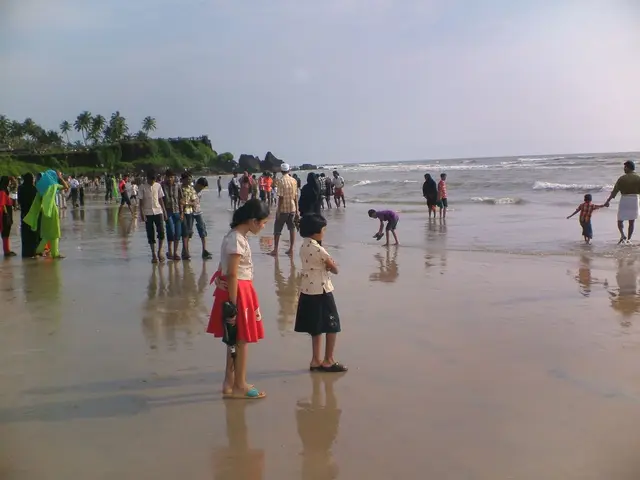
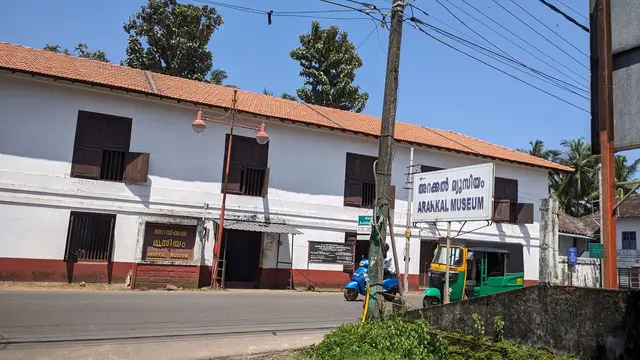
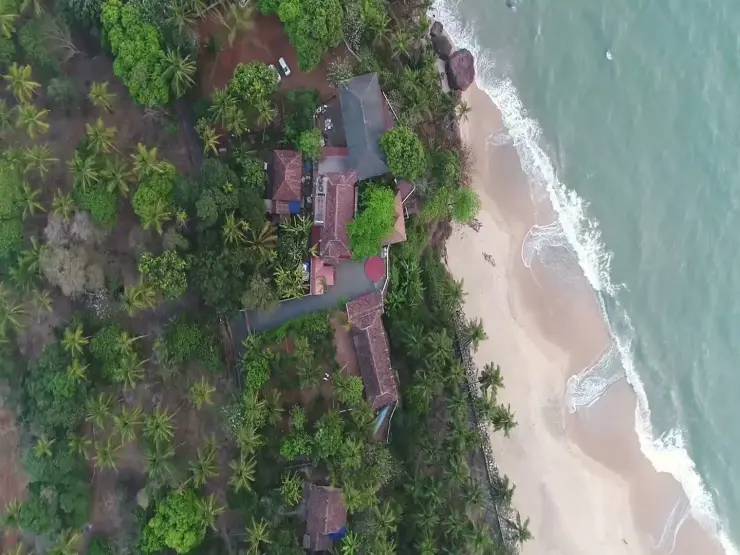
Kannur — Cannanore on the older maps — is the fifth-largest city in Kerala and the least resort-like of its coastal towns. It has eight kilometres of shoreline and sits barely a metre above the sea, but its character was set by soldiers and by looms. This was the seat of Kolathunadu, and of the Arakkal house, the only Muslim royal family Kerala ever had, whose writ ran out to the Laccadive islands until 1905. The British made it their military headquarters on the west coast until 1887 and laid out a cantonment at Burnacherry that is still, today, the only cantonment board in Kerala. Around that garrison grew a working town of weavers and beedi-rollers, both trades later rebuilt as worker cooperatives. The fort and the beach are the postcard; the city behind them is the story.
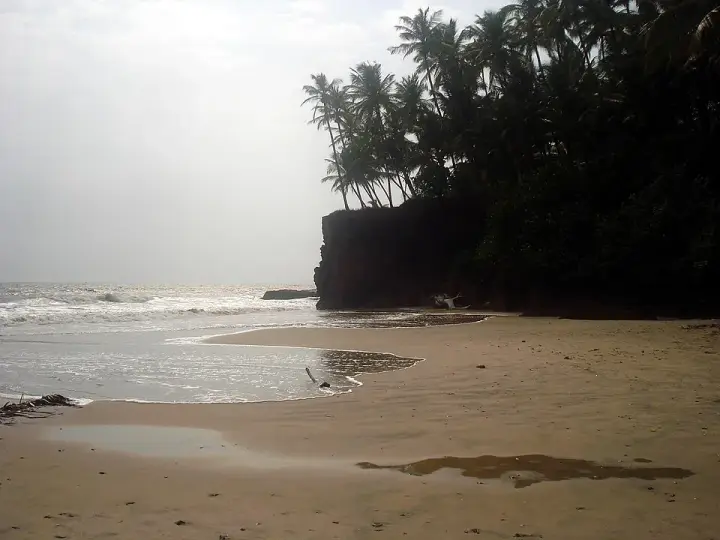
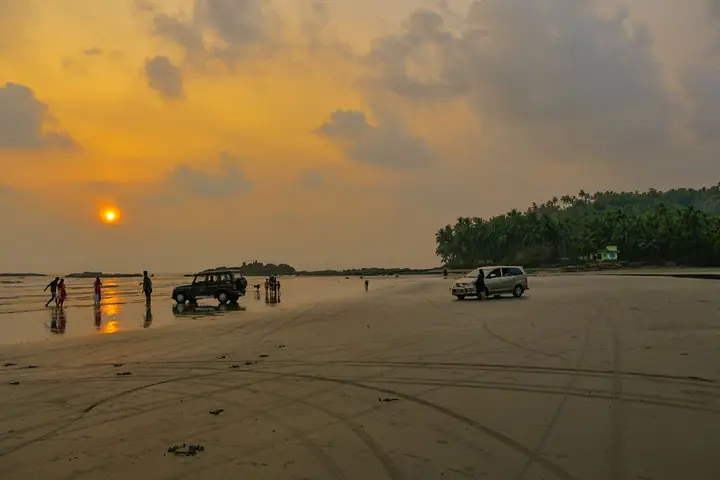
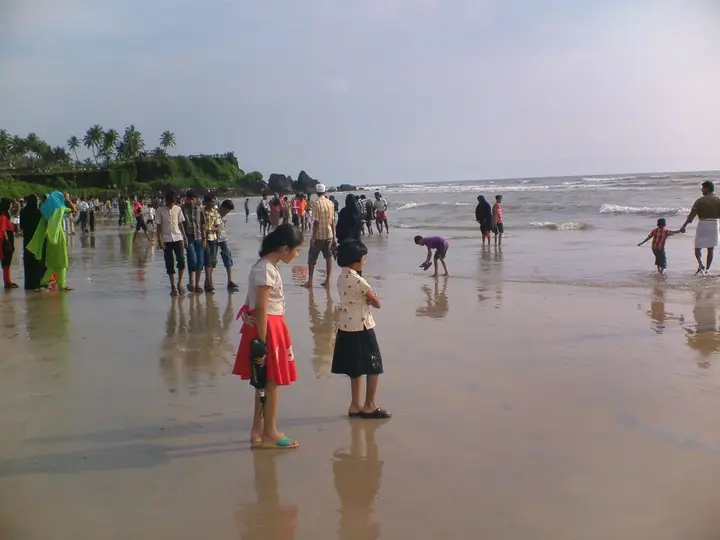
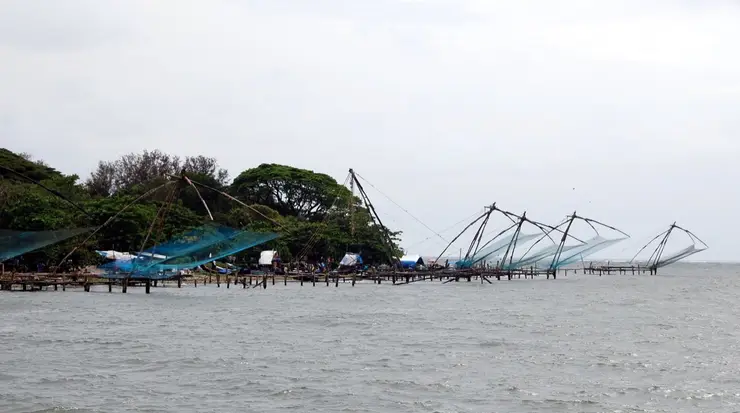
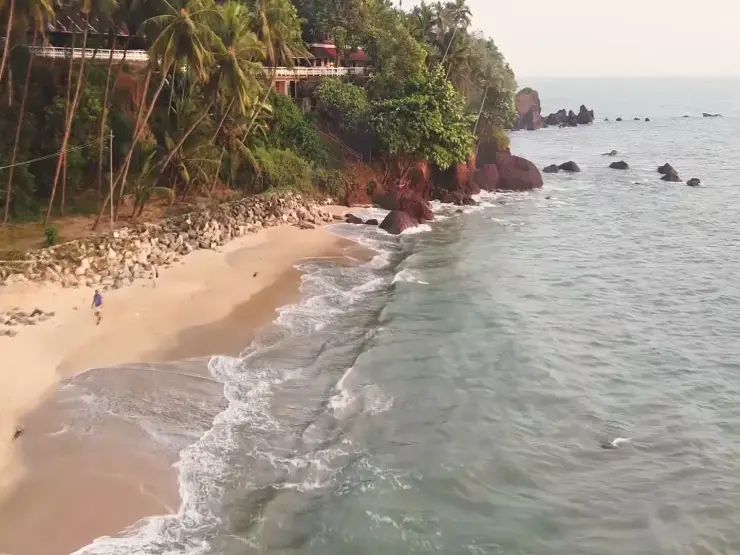
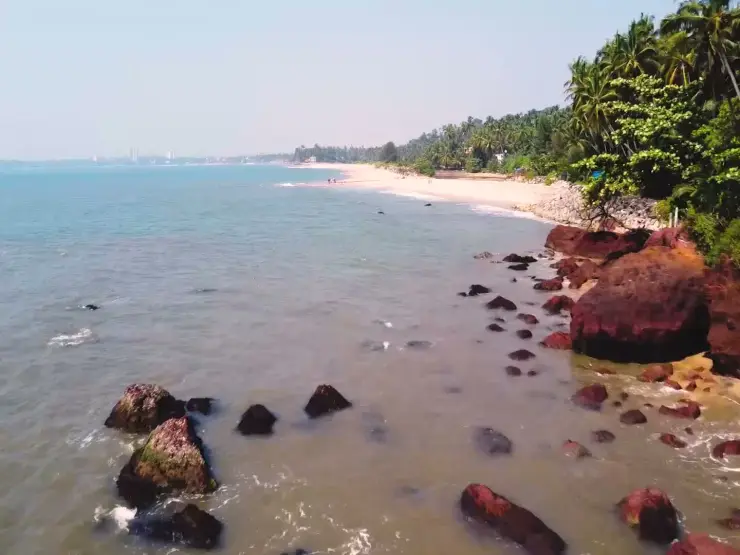
Kannur city is long rather than deep. The Municipal Corporation covers about 78.35 square kilometres in six zones — Kannur town, Pallikunnu, Puzhathi, Edakkad, Elayavoor and Chelora — divided into fifty-five electoral divisions, and at the 2011 census it held 232,486 people with a literacy rate of 96.23 per cent. The coast runs for roughly eight kilometres, the ground stands only about a metre above sea level, and the one real indentation in it is Mappila Bay at Ayikkara, a natural harbour full of wooden boats where the fishing fleet works. Kannur became a municipality on 1 November 1866 and a corporation only in 2015, the fifth in the state, with E. P. Latha as its first mayor.
The word most likely to puzzle a visitor is “city”. In Kannur it does not mean the centre of town. The quarter that was held by the Arakkal house is still called City, and it lies out towards Ayikkara; the commercial heart, with the bus stand, the railway station and the shops around Thavakkara and Fort Road, is called Town. Between the two sits a third thing again — the Cantonment, at Burnacherry, which the British spelled Burnassery. Locals use all three names in the same sentence and expect you to keep up.
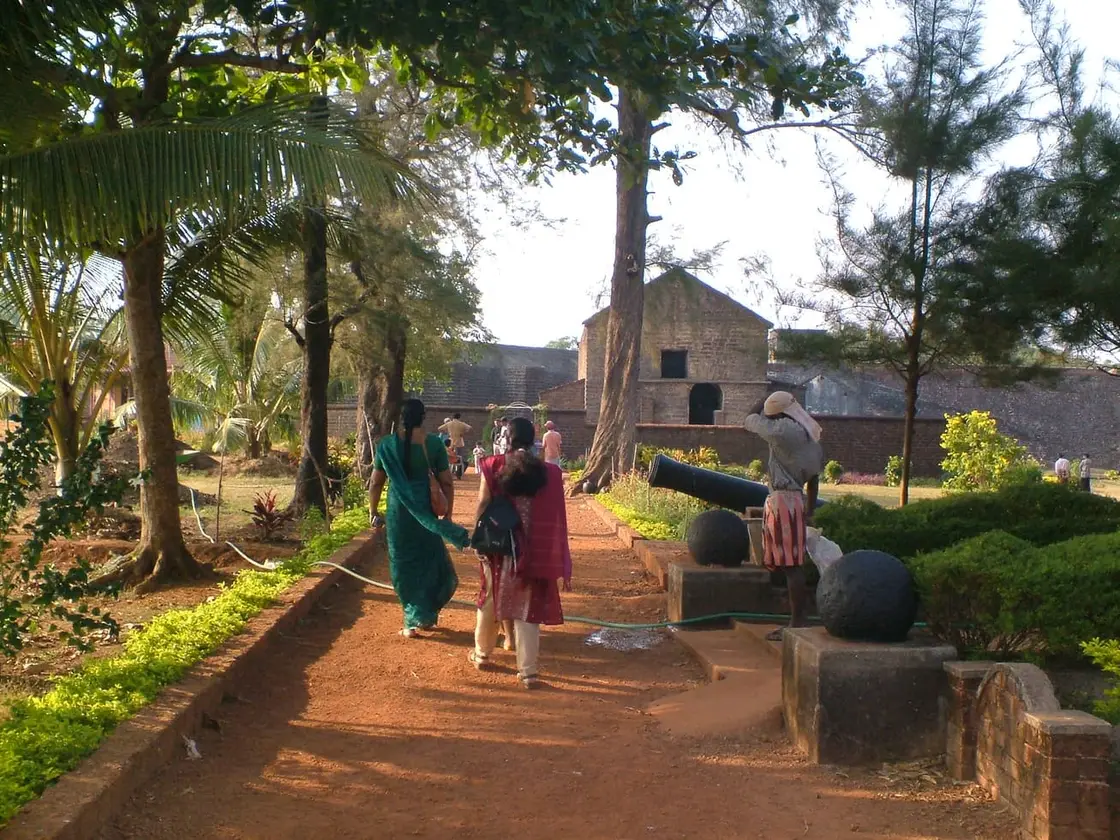
The cantonment is the piece of Kannur that most travellers walk through without registering what it is. India has sixty-two cantonment boards; exactly one of them is in Kerala, and this is it, classified Class III. The Kannur Cantonment Board came into existence in 1938 and has twelve members, six of them elected by the civilian residents, with the Officer-in-Command as chairman. At the 2011 census the cantonment held 4,798 people. The streets are wider than the town’s, the plots are larger, the trees are older, and building is controlled in a way that has kept the area low and green while the rest of the city went vertical.
The garrison is not ceremonial. The Defence Security Corps — the sixth-largest corps of the Indian Army, whose job is guarding defence installations of all three services — has its Centre, its Records office and its Pay Accounts Office here, on the road out to Payyambalam, and the Kannur centre is the mother depot for every DSC platoon in the country. The corps was approved by the Government of India on 25 February 1947 and raised as the Defence Department Constabulary that April, renamed the Ministry of Defence Security Corps in 1948, and brought under Army Headquarters as the Defence Security Corps in 1958. It is manned largely by superannuated soldiers who re-enrol, which is why Kannur has an unusual number of second-career servicemen in it, and its motto is Raksha Tatha Suraksha — defence and security.
Around the cantonment lives Kannur’s Anglo-Indian community, concentrated at Burnacherry and in the neighbouring pockets of Thillery, No. 3 Bazaar and Camp Bazaar. Its institutions are older than the cantonment board by a long way: St Michael’s School was established for boys in 1807 and St Teresa’s for girls in 1871, both by the Apostolic Carmelites, and both still run as Anglo-Indian higher secondary schools. The Holy Trinity Cathedral stands, by the diocese’s own account, on the ground where Franciscan missionaries were permitted to build a chapel in the first years of Portuguese contact; the Diocese of Kannur itself is recent, created by Pope John Paul II on 9 December 1998 out of the Diocese of Calicut.
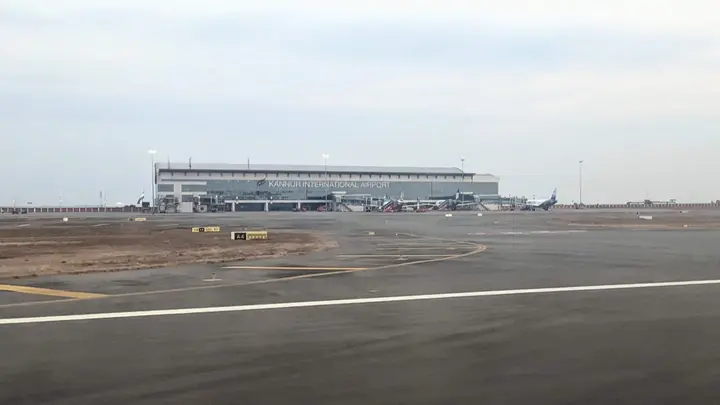
One more thing happened inside the cantonment that is worth knowing before you fly into Kannur today. There was an airstrip at Fort Maidan, within the cantonment boundary, and from 29 October 1935 Tata Airlines used it on a weekly Bombay–Thiruvananthapuram service that also called at Goa. The service did not last. The airport Kannur uses now is a very different proposition and sits inland at Mattannur, and it has its own page here.
The looms are the other half of the city’s identity, and Kerala Tourism’s phrase for the district — the land of looms and lore — is not marketing invention. The Malayalam Wikipedia article on the district names handloom, beedi and laterite as its three traditional trades in a single sentence, and then adds, without softening it, that the first two have reached a state of dying out. That is the honest position. Weaving in and around Kannur is still real, but it is a shrinking industry sustained by cooperatives, by export orders for furnishings rather than by the local sari trade, and by state institutions. One of the ten Indian Institutes of Handloom Technology is here: IIHT Kannur was registered under the Societies Registration Act in 1987 and is an autonomous institute under the Kerala Industries Department.
If you want to see the craft rather than take it on trust, the Handloom Museum at Payyambalam is the place. Its displays are unusually plain-spoken — an entire panel is given to the loom itself, labelling every part in Malayalam and English, from paavu (warp) and oodu (weft) to the odam (shuttle) and the chavittu kaal (treadle) — and another wall traces the Basel Mission’s weaving establishments in Malabar in old photographs. It is worth saying what Kannur is not: Kerala’s geographical-indication handloom fabrics are Balaramapuram, Chendamangalam, Kuthampully and Kasaragod, and Kannur is not among them. Its reputation was built on volume and on export furnishings, not on a protected sari.
The beedi story is the one that changed the town’s politics. Agitation from the 1940s produced the Beedi and Cigar Workers (Conditions of Employment) Act in 1966, and Kerala was the first state to implement it. The private manufacturers responded by moving production to Karnataka, throwing thousands of Kannur rollers out of work. When negotiations failed the unions proposed a cooperative instead, and the Kerala Dinesh Beedi society was inaugurated in 1969, capitalised by the state with ₹13.5 lakh in share capital and a ₹7,00,000 working-capital loan, with G. K. Panicker, then Joint Commissioner in the Industries Department, doing much of the institutional work. It went from a ₹50,000 profit in its first year to ₹44 crore in 1994–95, and at its peak in the nineties it was making some 6.85 billion beedis a year. It is now among the most studied worker cooperatives in India, with a Cornell University Press book to its name. What survives is a good deal smaller and no longer really a beedi business: the society’s own website today claims full-time employment for about 6,000 people and lists curry powders, squashes, jams, pickles, coconut products, tea, garments, umbrellas and software among its lines. A city that once rolled beedis by the billion now sells you curry powder made by the same cooperative — which is either a decline or an adaptation, depending on the day you ask.
As a place to spend time, Kannur rewards low expectations and a good appetite. The city is a major stop on the coastal railway, so trains are frequent and cheap; the KSRTC stand and the shops around it are the busiest ground in town. Eat what the coast eats: Malabar biriyani, kuzhi mandi with its Yemeni ancestry, mussels (kallummakkaya), pathiri, irachi puttu, and the sweets Europeans once called sweet meat and everyone here calls halwa, alongside banana chips fried wafer-thin. Then walk the cantonment roads in the late afternoon, when the light is long and the traffic is somewhere else.
Legend & myth
Kannur cannot agree with itself about its own name, and both explanations are worth having. The first reads it as Kannan-ur, the town of Kannan — Krishna — and points to the Kadalayi Sree Krishna temple, which once stood inside the Kolathiri rajas’ Kadalayi fort within what is now the city. The second is drier and possibly better: that the name comes from Kanathur, an old village whose name still survives inside the corporation’s own boundaries. Neither has been settled. What is documented is that in the Thalassery records from 1796 the place is written Kannanur, which fits the first reading and does not prove it.
The Kadalayi story is the town’s real legend, and unusually for a legend it has dates attached. The temple stood at Kararinakam Kadalayi, about six kilometres south-east of the town centre, established by Valabhan — reckoned among the foremost of the Kolathiri line — as the guardian shrine of the Kadalayi fort. In the Kollam year 964, which falls in 1788–89, when Tipu Sultan’s forces were plundering temples across Malabar, the melsanthi of Kadalayi is said to have prised the Krishna idol out of its pedestal, hidden it in the well of his own illam, and got word to the Kolathiri. The raja then built a temple south-east of the Chirakkal palace, and in Kollam 1023 — 1847–48 — the Kadalayi Krishna was consecrated there.
The old site was never recovered. The fort and the temple decayed, the temple tank silted up, and the ground passed out of the community’s hands. What is left is a map made of names: the spot is still called Kottammal, the fort’s rubble is still visible there, and the surrounding house-names and place-names — Chirakkadavath, Molothu, Illathil, Manayullathil, Ambalathil, Kadalayi Nada — read like a plan of a settlement that no longer exists. Local memory adds one detail that is pure folklore and none the worse for it: that in the deep hours of the night at the place where the idol had been carried, people used to hear a flute, and the sound of cattle hooves.
That listening is what eventually rebuilt the shrine. A devotee held a puja on the spot on Ashtami Rohini in the Chingam of Kollam 1140, which is 1965; the following year a handful of people began marking Krishna Jayanti there with offerings and harikatha; by 1970 the neighbourhood decided the celebration needed a proper seat and commissioned an astrological prasnam. The idol they had made for it — Gopalakrishnan, cattle-goad in the right hand, the tip of the flute held at the waist in the left, smiling — was carved from krishnasila at Kanyakumari and kept at the Thalap Sree Sundareswara temple until it was carried out to Adikadalayi and installed on 15 March 1981, in the muhurtham between 11:45 and noon, by Brahmasri Paravur Sreedharan Thanthri.
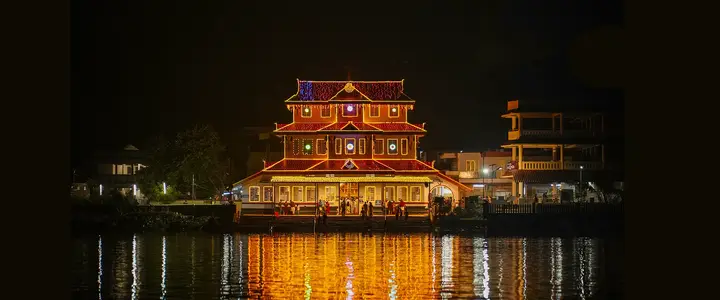
That holding temple has a story of its own. The Thalap Sree Sundareswara temple, about three kilometres from the centre of Kannur, was consecrated by Sree Narayana Guru himself, who installed the Shiva idol here on 14 April 1916 — the reform movement arriving in Kannur in the most concrete form it takes. Its eight-day festival begins on the Pooyam asterism in Meenam, in March or April, and it ends where nearly everything in this city ends, with the aarattu procession going down to the sea at Payyambalam.
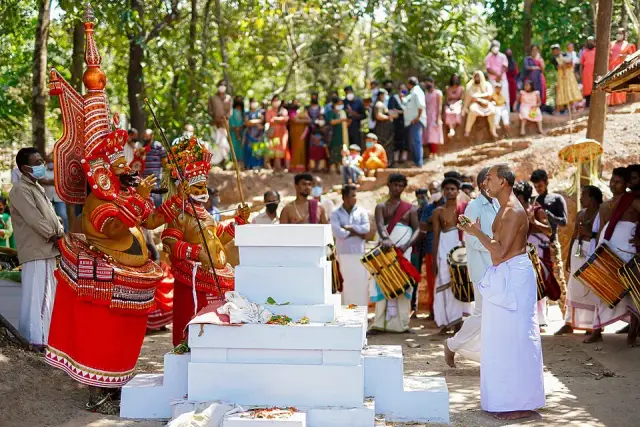
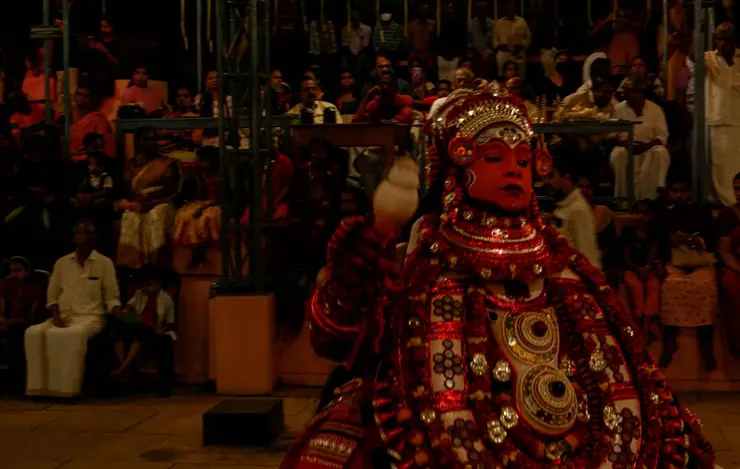
The ritual season the old city really belonged to was the pooram, and this is where an honest record has to record a loss. Poorakkali is the nine-day observance of the Mushika country — Kannur and Kasaragod — held at Bhagavathi kavus from the Karthika asterism to Pooram in the month of Meenam, danced traditionally by the Thiyya and Maniyani communities. Its footwork is openly borrowed from the kalari: scholars read the steps as kalari steps, the panicker’s silk and headcloth answer the kachi and chura of the training ground, and before the great sequences the dancers are given oil to work into their bodies exactly as a kalari student is oiled. And the territory it is danced in runs from the Chandragiri river down to the Valapattanam river — no further. South of the Valapattanam, which is to say in Kannur city itself and below it, poorakkali has disappeared completely.
The origin stories the poorakkali songs carry are worth hearing even where the dance has gone. One is Kamadahanam: Kamadeva looses his flower-arrow at Shiva to unsettle his mind and is burned to ash for it, and only the unrelenting prayers of Rati and the young women soften Shiva into telling Rati to go to Shambara’s fort and worship an image of him — an image the goddesses then make and adore until Kama is remade. Another says the observance remembers the birth of Pradyumna, Kamadeva reborn as Rukmini’s son. A third is gentler: that Poora was a naga maiden and a celebrated dancer of Brahmaloka, and Krishna brought her down to earth to dance at Vrindavan and himself began the pooravela. The vasanthapuja verses recited before the poorakkali garland simply say the vow and the worship of Kama began in the season of spring, and that the figure of Madana should be traced in flowers on the day of Pooram.
One legend this record deliberately refuses. The romantic accounts of how the Arakkal house began — the Kolathiri princess pulled from the water by a Muslim man who covered her with his own cloth, the minister named Arayankulangara Nair who took the name Mammad Ali — are the best-known stories in Kannur, and they belong to the Arakkal palace, which is a separate page on this site and tells them properly. The same goes for the Cheraman Perumal legend, which is Kodungallur’s before it is anyone’s. Taking them here would only mean telling them twice and worse.
More about Kannur city
History
The site is old. The Taliparamba–Kannur–Thalassery stretch is thick with rock-cut caves, dolmens, burial circles and menhirs, and the Sangam-era kingdom based at Ezhimala held this coast in the first five centuries CE. The port of Naura, named in the Periplus of the Erythraean Sea as lying somewhere north of Muziris, is generally identified with Kannur. Later the Mushika dynasty succeeded Ezhimala, and the Kolathiri or Chirakkal rajas succeeded the Mushikas; Kolathunadu was one of the four great powers of the Malabar coast alongside the Zamorin of Calicut, Cochin and Quilon, and Kannur was its seat. In the medieval spice trade it was a commercially important secondary port, ranking behind Kozhikode but ahead of most.
The Arakkal house rises against that background, its list of rulers beginning with Adi Raja Ali in 1545. It was a vassal of the Kolathiris, from whom it received the Laccadive islands as a jagir in the sixteenth century, and its power was maritime rather than territorial: historians describe Kannur under the Ali Rajas as a Muslim thalassocracy, with a fleet, a horse trade out of West Asia and enough reach that European charts called the nine-degree channel separating Minicoy from the Laccadive group Mammali’s Channel. Succession followed marumakkathayam, the matrilineal rule of much of old Malabar — the eldest member of the family, man or woman, became its head. Four of the reigning names on the list are women, among them Bibi Harrabichi Kadavube (1728–1732), Bibi Junumabe I (1732–1745) and Bibi Junumabe II, who ruled for forty-two years from 1777 to 1819.
The unwinding of that kingdom is precise and worth setting out, because it is usually compressed into a sentence. After the treaties of Srirangapatam the Beevi signed an agreement in 1796 that guaranteed her continued possession of Cannanore town and the Laccadives but stripped her of any claim to sovereignty. Rank outlasted power: as late as 1864 the Bibi of Cannanore still appeared on the official list of native sovereigns and chiefs entitled to a seven-gun salute. The British took over administration of the islands from 1854 to 1861, and again from 1875, that time for good. In 1905, in exchange for the remission of overdue tribute, a pension for the head of the family and the title of Sultan, the Ali Raja gave up all rights to the Laccadives including Minicoy. By 1909 the family had lost Kannur and the cantonment, the last of it going under the Beevi Imbichi Adi-Raja Bibi; by 1911 the sceptre and sword had gone too.
The town’s modern institutions are almost all colonial in date. Kannur served as the East India Company’s military headquarters on the west coast of India until 1887. Government Brennen College, the first college in the district, opened in 1862. Kannur municipality was constituted on 1 November 1866 under Madras Act 10 of 1865, in the same batch as Thalassery, Kozhikode, Palakkad and Fort Kochi — the first modern municipalities anywhere in what is now Kerala. Before the state was formed Kannur was the headquarters of the Chirakkal taluk of Malabar District in the Madras Presidency, and it kept the name when the district was created around its offices.
The twentieth century pulled the town in two directions at once. It became a centre of the organised left — the socialist and communist politics that grew out of Malabar’s tenancy struggles and reform movements are inseparable from the beedi and weaving workforces here — and at the same time it stayed a garrison town, the cantonment board formed in 1938 and the DSC depot arriving after Independence. The educational build-out came late: Kannur University was created by Act 22 of 1996, having first appeared as Malabar University by an ordinance of 9 November 1995, and was inaugurated on 2 March 1996 by Chief Minister A. K. Antony. The thirteenth NIFT campus opened at Dharmashala, sixteen kilometres north of the city. The corporation followed in 2015, and the lighthouse out at the Payyambalam end — whose present tower dates from 1975–76, replacing a light that in its oil-lamp era was only shown in the fair season from September to May — still marks the seaward edge of it all.
Why visit
It is the only place in Kerala with a cantonment: wide, quiet, tree-shaded roads and low colonial-era buildings a ten-minute walk from a busy Indian city centre.
The Handloom Museum at Payyambalam explains the loom part by part in Malayalam and English, which makes every weaving shed in the district readable afterwards.
Kannur is the home of the Kerala Dinesh Beedi cooperative, founded in 1969 after a lockout and now one of the most studied worker cooperatives in India.
The Thalap Sree Sundareswara temple was consecrated by Sree Narayana Guru in person on 14 April 1916, and its eight-day Meenam festival ends with an aarattu at the sea.
Ayikkara and Mappila Bay give you a working fishing harbour rather than a scenic one — boats, ice, nets and an early-morning auction.
It is the easiest base in north Malabar: a major coastal railway station, the NH 66 running through, and the whole district within a short drive.