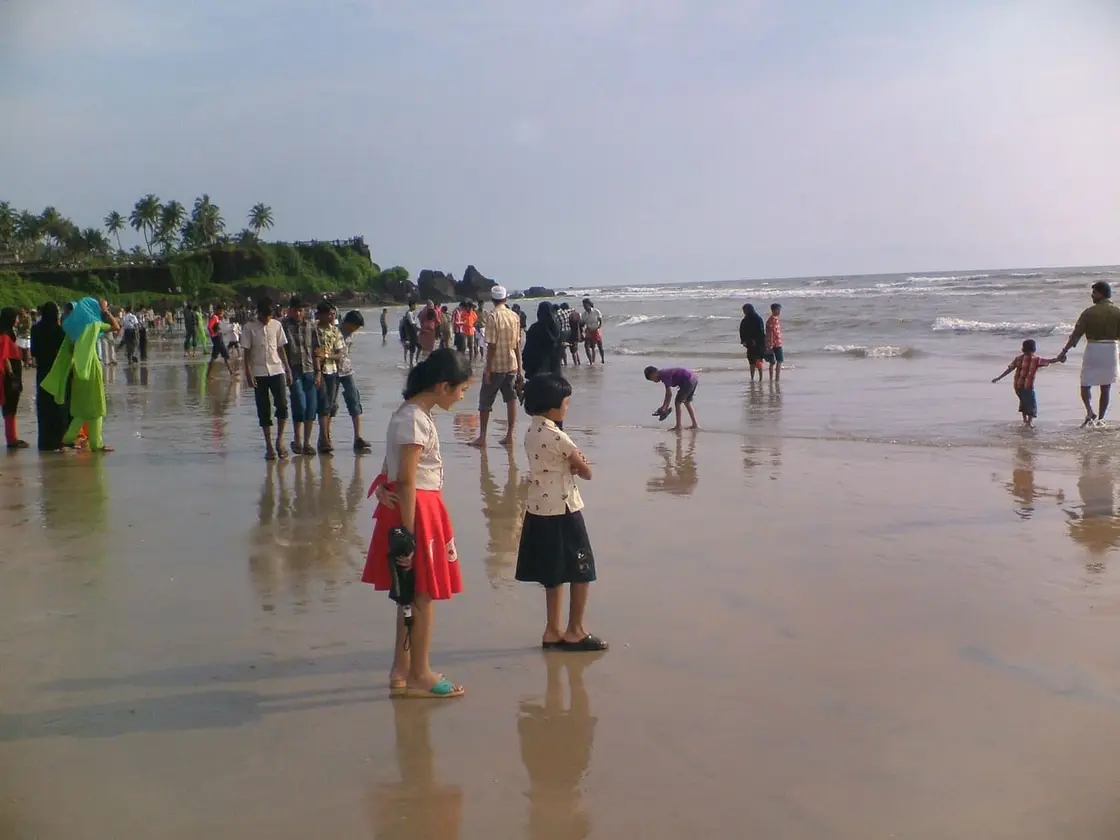
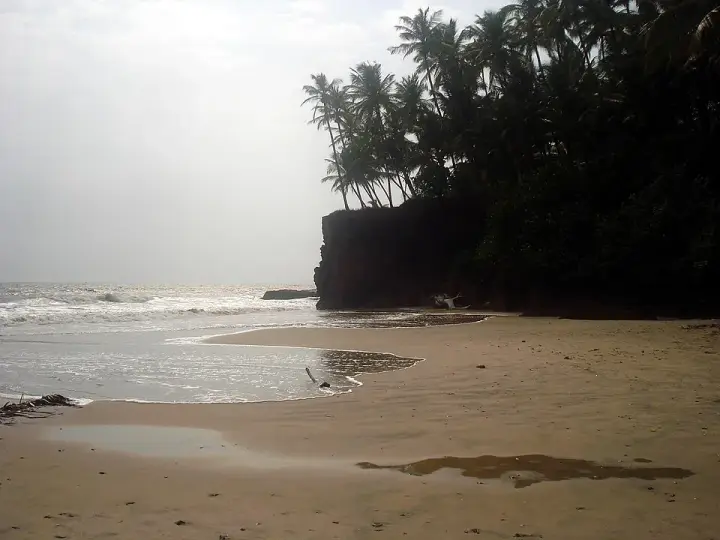
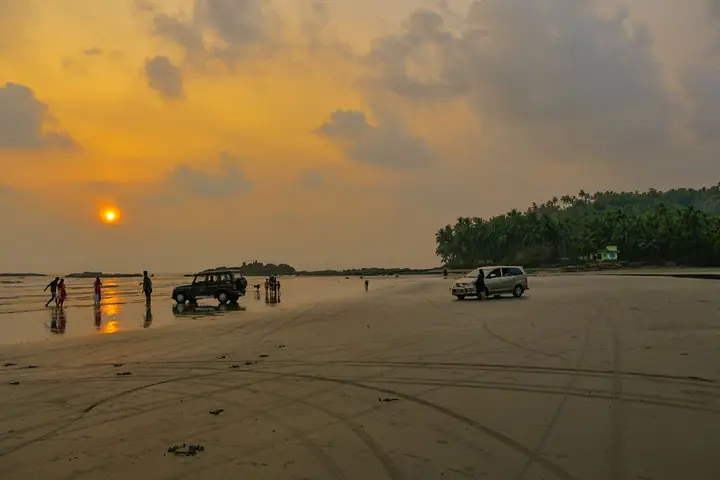
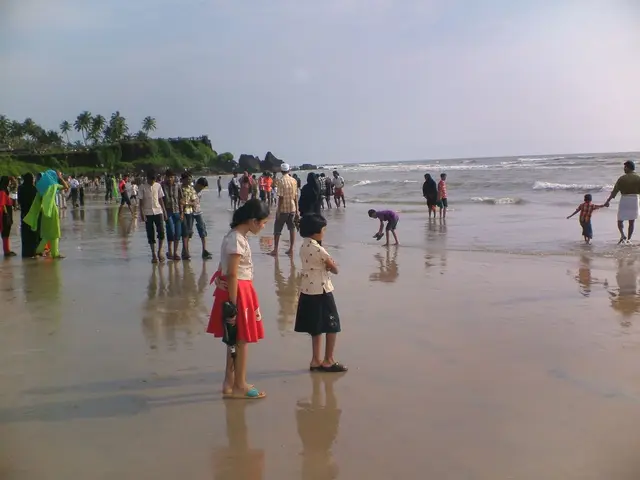
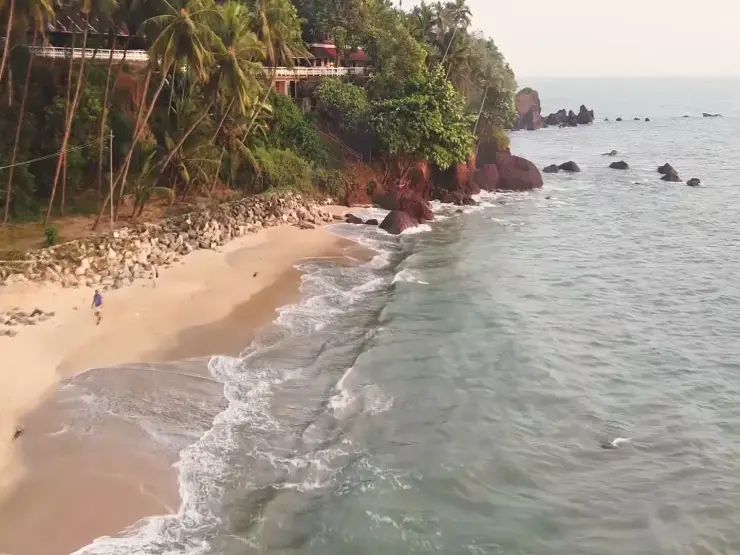
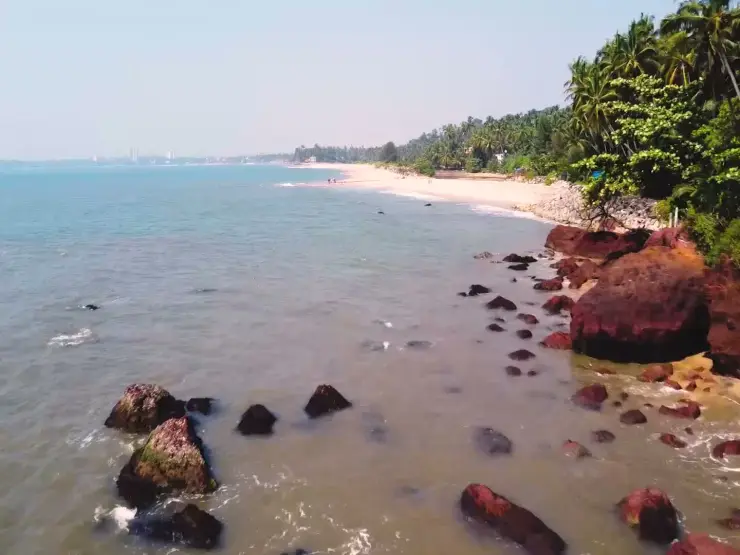
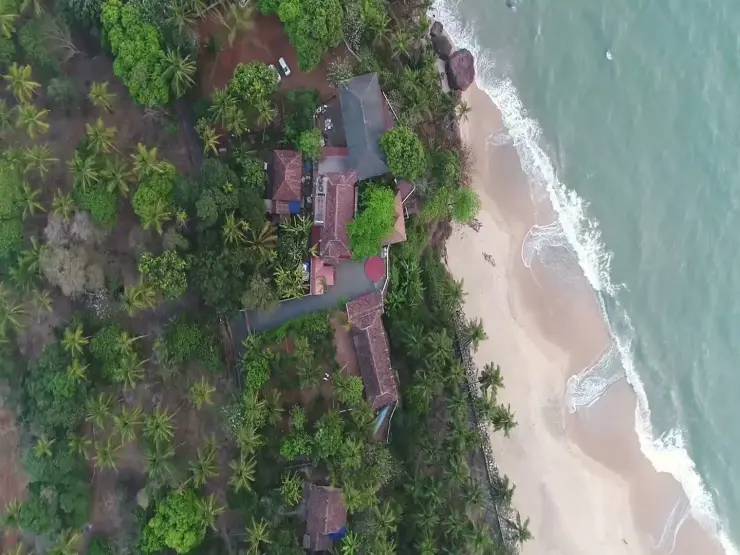
Payyambalam is the north-western edge of Kannur town, where the streets stop at a tidal creek and a low green headland runs out to the Arabian Sea. Most visitors come for the beach. What makes the place unusual is what stands behind it: a public burial ground where nine of Kerala’s best-known public figures lie within a few minutes’ walk of one another — a journalist deported from Travancore in 1910, four Communist leaders, a Congress trade unionist, a Bharatiya Janata Party state president and a literary critic — with no wall, no gate and no fee between them and the families eating ice cream on the sand. Around them stand three works by the sculptor Kanayi Kunhiraman, only one of which is famous. Beyond the creek lie the cantonment, Baby Beach and a working lighthouse.
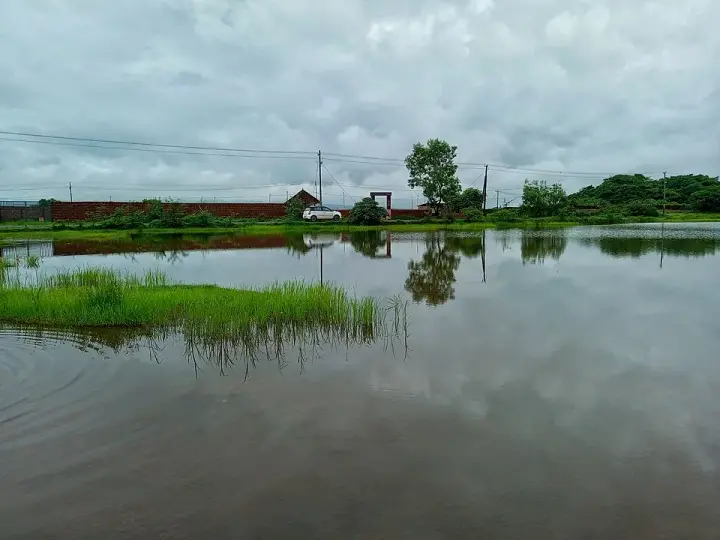
Payyambalam is not really one place but two, separated by perhaps forty metres of brackish water. On the seaward side is the sand. On the landward side, across a low timber footbridge on concrete piles, is a raised, grassed headland dotted with granite and laterite memorials. The creek behind the beach is tidal and shallow, spanned upstream by a road bridge; from the air the whole arrangement reads as a sandbar, a lagoon and a green shelf of land, with the coconut canopy of Kannur town closing in behind. Almost everything this record is about sits on the far side of that footbridge.
The roll-call on the headland, as Malayalam Wikipedia’s article on the beach lists it, runs: Swadeshabhimani Ramakrishna Pillai, A. K. Gopalan, Pamban Madhavan, K. G. Marar, E. K. Nayanar, Azhikodan Raghavan, C. Kannan, Chadayan Govindan and Sukumar Azhikode. Read as a group rather than as individuals, that list is the point. It contains at least four political parties, three of them mutually hostile, and it contains no member of a royal house, no bishop and no industrialist. It is a civic pantheon assembled by a working town.
The oldest grave is also the strangest. Swadeshabhimani Ramakrishna Pillai was not a Kannur man at all. He was the editor of the Swadeshabhimani newspaper in Travancore, whose press was seized and who was deported from the princely state in 1910 for what he had printed about the Diwan. He lived out his exile in British Malabar, where his wife B. Kalyani Amma had found work as a teacher, and he died at Kannur on 28 March 1916, aged thirty-seven. A man expelled from one Malayalam-speaking state was buried by another, on the beach of the town that took him in.
The Communist graves are the ones most visitors have heard of. A. K. Gopalan — Ayillyath Kuttiari Gopalan Nambiar, 1 October 1904 to 22 March 1977 — was a member of parliament continuously from 1952 and never once held office, and he is remembered in Malayalam as “the poor people’s commander”. He was also the first person in independent India to be detained under preventive detention, which produced A. K. Gopalan v. State of Madras, still argued in Indian constitutional law. E. K. Nayanar — Eramballa Krishnan Nayanar, 9 December 1918 to 19 May 2004 — was Chief Minister of Kerala three times and governed for 4,010 days in total, more than anyone else has.
Two more Communist graves belong to men whose trades were Kannur’s trades. Azhikodan Raghavan (1 July 1919 – 23 September 1972) left school in class five to roll beedis at Thekkibazaar in Kannur town, rose through the Beedi and Cigar Workers’ Union, was jailed in 1964 on an accusation of being a Chinese spy, and was stabbed at Thrissur while state secretariat member and united-front convener. Chadayan Govindan (12 May 1929 – 9 September 1998) organised handloom weavers, was named in a 1965 arrest warrant on the same Chinese-spy charge, won the Azhikode seat in 1977 and became state secretary of the CPI(M) in 1996. Beedi and handloom are exactly the two industries north Malabar is known for.
The graves that complicate the picture are the ones that are not Communist at all. Pamban Madhavan — P. Madhavan, born July 1911, died 5 March 1992 — was a Congress member of the second Kerala Legislative Assembly for Kannur-2, a Salt Satyagraha volunteer, founder-president of the Kerala Labour Congress before it merged into the INTUC, and editor of a fortnightly called Masdoor; he too organised north Malabar’s handloom workers, from the other side of the political line. K. G. Marar — K. Govinda Marar, 1934 to 1995 — was twice state president of the Bharatiya Janata Party in Kerala, taught Malayalam at Parassinikkadavu High School for ten years before giving it up for the Jana Sangh, spent eighteen months in jail during the Emergency, and, remarkably for a man of his standing, was never elected to anything, not even a panchayat seat.
The most photographed memorial on the headland is the newest of the well-known ones. Sukumar Azhikode (12 May 1926 – 24 January 2012) was a critic, an orator, a commentator on the Upanishads and Pro-Vice-Chancellor of Calicut University, and his memorial is a black granite plinth carrying four open granite “books”, one bearing his portrait and his dates. Behind them stand five squat pillars painted orange-red with flared, lamp-like capitals, and between them a plain white stele cut with a single Malayalam word: തത്ത്വമസി — Tat Tvam Asi, “that thou art”, the Upanishadic sentence he spent much of his working life explaining. The dates on the stone read 12-05-1926 and 24-01-2012, which is a useful thing about memorials: they let you check the encyclopaedias.
Scattered on the lawns beside the creek are the pieces of public sculpture almost nobody writes about. Everyone knows the giant mother and child. Fewer notice that a few dozen metres away stand a pair of tall, red broken-tile mosaic forms shaped as usable seats with high backs, and a separate black-and-white mosaic work whose small metal plaque reads, in plain capitals, “LOVE — SCULPTOR: KANAYI KUNHIRAMAN”. English Wikipedia’s table of his works lists Seats and Thai (Mother), both concrete, both dated 2001, at Payyambalam Beach. It does not list Love. His own published biodata lists neither, mentioning only that he did the work of “another tourist centre in Kannur”. The plaque on the ground is currently the best evidence there is.
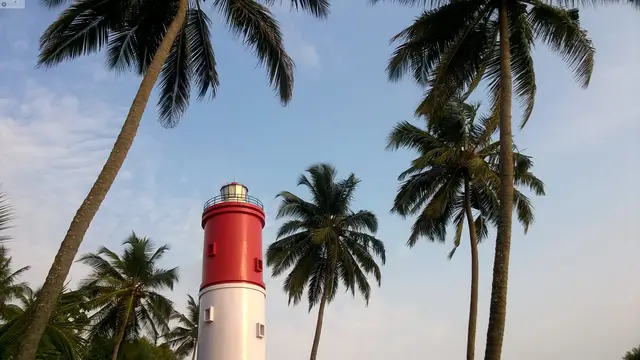
Landward and south of all this the ground changes character again. The Cannanore Cantonment at Burnassery — the only cantonment in Kerala, notified with effect from 1 January 1938, six wards, a resident population of 4,798 at the 2011 census — is now the headquarters of the Defence Security Corps, and the small cove inside it is called Baby Beach, the name usually explained simply as the little sister of Payyambalam. Above it stands the Kannur lighthouse: a 23-metre cylindrical concrete tower banded red-white-red, its light 35 metres above sea level, flashing white every ten seconds and visible for 18.8 nautical miles, commissioned on 25 July 1976 to replace a light that had lived on St Angelo Fort since the British began hoisting an oil-wick lantern there in 1843.
Legend & myth
The obvious question about Payyambalam is its name, because the second half of it is അമ്പലം, the ordinary Malayalam word for a temple. It is tempting to conclude that a temple once stood on the headland and gave the place its name. We could not establish that. Malayalam Wikipedia’s articles on both പയ്യാമ്പലം and പയ്യാമ്പലം കടപ്പുറം give no etymology at all, and neither does the Kannur district portal. What we can say is that the temptation is real, that the answer is not written down anywhere we could find, and that an unsourced etymology is worse than none.
Two look-alike names have to be refused explicitly, because both have real lore attached and neither belongs here. The first is Payyampalli — Payyampalli Chandu, the martial hero of north Malabar who is danced as a kaaranavar theyyam at Manikkakavu in Kannur and at the Chozhan Rayarothu tharavadu in Kathirur. That is a genuine Kannur legend, and it is not a Payyambalam legend; the two names differ by one syllable and about fifteen kilometres. The second is Payyanur, the temple town at the far north of the district. Swami Ananda Theerthan, the anti-caste reformer and last disciple of Narayana Guru, attained samadhi on 21 November 1987 — at Sree Narayana Vidyalayam in Payyanur, not at Payyambalam. He is not buried on this headland, and we say so here because the mistake is easy and we nearly made it ourselves.
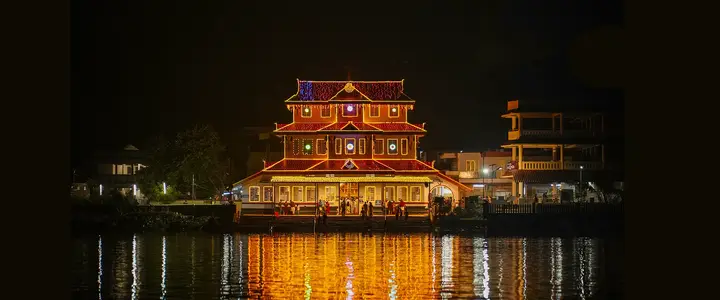
There is, however, one genuinely sacred rite that lands on this sand every year, and it comes from a mile inland. Sree Sundareswara Temple at Talap, one of only two temples in Kannur district consecrated by Sree Narayana Guru, was proposed in 1908 and consecrated by the Guru at a muhurtham between 3.00 and 3.20 in the morning on 11 April 1916, under the star Pooyam. Its annual festival runs eight days in the Malayalam month of Meenam, and on the last of them the procession leaves the temple at four in the afternoon and carries the deity down to Payyambalam for the Arattu, the ceremonial bath in the sea. The state declares an official half-holiday in Kannur from four o’clock that day. So the same water that receives the ashes of the town’s Communists receives, once a year, a Shiva consecrated by a Guru who spent his life dismantling caste.
The temple carries one story that touches the missing-temple question sideways. Its own account holds that when the Talap site the Guru had approved was dug for foundations, the remains of an older, forgotten temple came up out of the ground. English Wikipedia reproduces this and flags the section as unreferenced, so we pass it on as the community’s own tradition rather than as fact. It is at least a reminder that this stretch of coast has buried and forgotten more than one sanctuary, and that a name ending in അമ്പലം on a shore with no visible temple is not, on the face of it, absurd.
The founding story of the burial ground itself has the shape of family legend rather than record. Malayalam Wikipedia’s article on Payyambalam states that the crematorium was built in 1920 by Aryabandhu P. K. Bappu, to cremate his daughter Lakshmikutty after her death. The same article carries a banner warning that it lacks citations to reliable sources, and we could find no independent confirmation of Bappu, of Lakshmikutty, or of the year in Malayalam or English. We print it because it is the only origin anyone gives, and we attribute it plainly because that is all it can bear. Note also that it cannot be the whole story: Swadeshabhimani Ramakrishna Pillai was buried at Payyambalam in 1916, four years before the ground is said to have been made.
What the headland has instead of old myth is new liturgy, and watching it form is the more interesting thing. The vocabulary is entirely borrowed from religion. The graves are called samadhis; the enclosures are smruthi mandapams and kudeerams, words for shrines; people circle them, garland them, and stand in silence on death anniversaries in numbers that would satisfy any temple. A. K. Gopalan is “the poor people’s commander”; Sukumar Azhikode was “the walking conscience”. Party workers bring flowers to Nayanar’s memorial every 19 May. An atheist movement that spent the twentieth century arguing against shrines has, on this headland, built a very good one.
We searched in Malayalam before writing any of this down. Queries on പയ്യാമ്പലം paired with ക്ഷേത്രം, ഐതിഹ്യം, ഭഗവതി, കാവ്, തെയ്യം and ശ്മശാനം return the beach, the burial ground and the political biographies, and nothing else — no sarpakkavu, no goddess legend, no origin tale for the headland. Kannur district is saturated with theyyam and with shrine legend, and this particular half-kilometre of coast appears to be one of the places where the older layer either never formed or was long ago lost. We would rather record the search than invent the story.
More about Payyambalam
History
For most of its recorded past this was empty ground on the edge of a garrison town. A hand-drawn colonial map of about 1860, compared with modern imagery by local historians, shows the same road geometry that Payyambalam still has, laid across marsh and open sand with almost nothing on it; the marsh has since been filled and built over, and only the beach road is genuinely new. That reclaimed spit — the Payyambalam munamp — is still partly in military hands, which is why the northern approach to the sand is narrower than the map suggests.
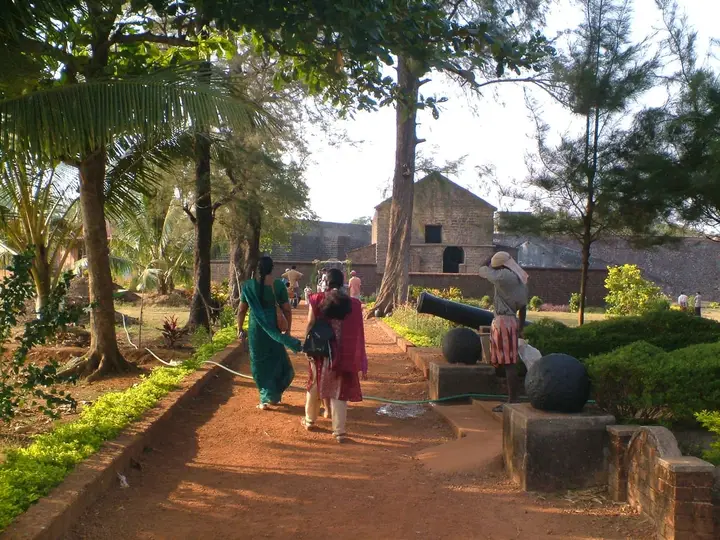
The garrison itself is the reason the town’s edge stayed open so long. A military camp under the Portuguese, the Dutch and then the British, the ground at Burnassery was formally declared the Cannanore Cantonment with effect from 1 January 1938 — the only cantonment in Kerala. It is a small entity: six wards, Category III, and 4,798 residents at the 2011 census. It holds St Angelo Fort, Holy Trinity Cathedral and St Thomas Orthodox Church, and it is today the headquarters of the Defence Security Corps.
The light on this coast has moved twice. From 1843 the British hoisted a lantern with an oil-wick lamp at the fort. In 1902 the Presidency Port Officer at Madras sanctioned Rs 3,430 for a stone tower on the ramparts, commissioned in 1903, and a masonry pedestal carried a double-wick lamp inside a fourth-order dioptric lens, lit only in the fair season from September to May. The sea eventually took that tower and part of the fort with it. In 1939 the light was shifted onto a sixteen-metre steel trestle on the fort’s northern bastion, which is still standing; a flashing ten-second light on dissolved-acetylene gas replaced the equipment in 1948; and the present tower, built in 1975–76 north-west of the town, was commissioned on 25 July 1976.
The burial ground grew by accretion rather than by plan, and its dates are its history: 1916 for Ramakrishna Pillai, 1972 for Azhikodan Raghavan, 1977 for A. K. Gopalan, 1992 for Pamban Madhavan, 1995 for K. G. Marar, 1998 for Chadayan Govindan, 2004 for E. K. Nayanar, 2012 for Sukumar Azhikode. Nobody appears to have decided that Payyambalam would become Kerala’s civic cemetery; each funeral simply followed the last onto the same rise of grass, until a habit hardened into an institution and the state began arranging its ceremonies here.
The art arrived late and in stages. Kanayi Kunhiraman, born at Kuttamath in Kasaragod district on 25 July 1937, took his sculpture diploma at Madras in 1960, studied at the Slade in London from 1965, headed sculpture at the College of Fine Arts in Thiruvananthapuram from 1976, and chaired the Kerala Lalithakala Akademi in 1978 and again in 2001. His biodata records that he landscaped a tourist centre at Veli in 1986 and did the work of “another tourist centre in Kannur”; English Wikipedia dates two Payyambalam pieces, Seats and Thai (Mother), to 2001. The third piece, Love, is on the ground with his name on it and in neither list.
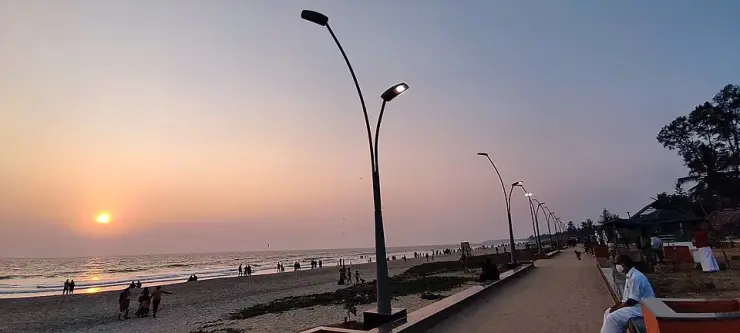
The last layer is the most ordinary and the most visible: apartment towers. What the 1860 map shows as marsh now carries high-rise blocks whose upper floors look straight down the beach, and the seafront between the sand and the creek has been fitted out with railings, lamp standards, an open-air gym and a timber-framed gateway signed “The amphibian — where man meets sea”. Payyambalam has become, in about thirty years, the promenade of a city.
Why visit
To stand in the only place in Kerala where a deported Travancore editor, four Communists, a Congress trade unionist and a BJP state president are buried within sight of one another.
For Sukumar Azhikode’s memorial — four granite open books, five lamp-capital pillars and a white stele cut with the single word തത്ത്വമസി.
For the two Kanayi Kunhiraman works almost nobody photographs: the red mosaic seats by the creek, and the black-and-white piece plaqued “Love”.
For the tidal creek and its timber footbridge, which is the actual boundary between the holiday side of Payyambalam and the memorial side.
For the Arattu of Sree Sundareswara Temple, when a deity consecrated by Sree Narayana Guru in 1916 is carried down to this beach to bathe.
For the 1976 lighthouse and the cantonment cove at Baby Beach, five minutes south and a completely different kind of shoreline.