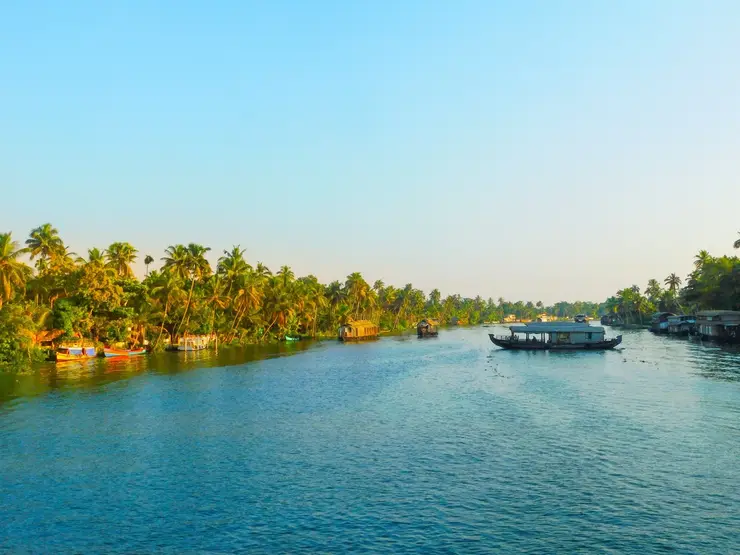
What to expect
Highlights
- Heritage experience at Coir villages
- Architecture, local stories and old trade/cultural routes
- Good fit for guided walks and nearby cafes/shops
The coir-working settlements of Munroe Island, where coconut husk is retted in the backwater and spun into yarn — a working craft economy on the canal banks rather than a demonstration laid on for visitors.
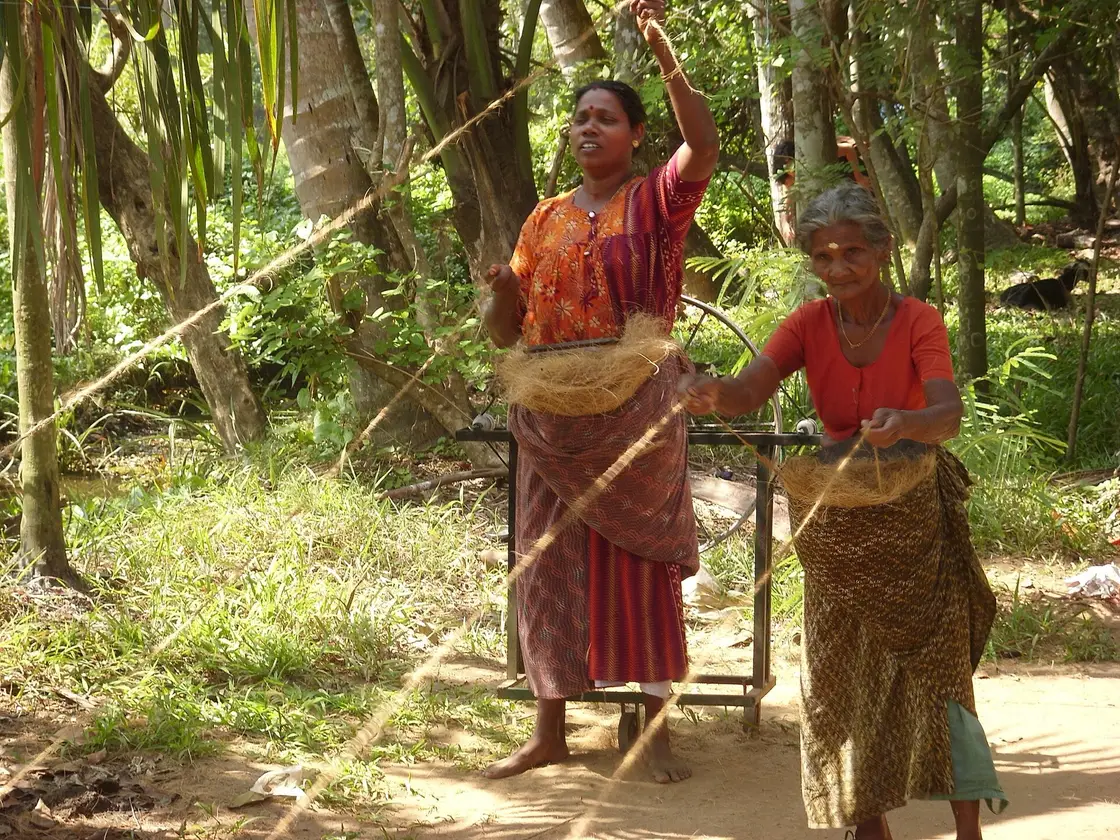
Coconut husk soaked in the backwater for months, beaten by hand until only fibre remains, then spun into yarn on a wheel at the water's edge. On Munroe Island the spinning is real paid work. The soaking, by the Kerala government's own account, very largely is not — and the fibre on the wheel probably came by lorry from Tamil Nadu.
Coir is the fibre of the coconut husk, and Kerala has made it for centuries. The traditional process is slow in a way that is difficult to credit until you see it: husks are steeped in the brackish shallows for months until the soft tissue rots away, then taken out, beaten with wooden mallets to free the fibre, cleaned, dried and spun into yarn.
That is the chain as it is described to visitors, and it is worth knowing before you take the trip that for most yarn spun in Kerala today the first two steps did not happen in Kerala at all. The fibre arrives dry and machine-extracted from Tamil Nadu. What you are looking at on these banks is not a closed local loop but the last surviving stages of one — which is a more interesting thing to be shown, provided somebody tells you.
The retting frames are the first thing you notice from a canoe — bundles of husk staked out in the shallows, some of them submerged for the better part of a year. The smell is part of it. Retting is decomposition, and pretending otherwise would be dishonest; on a hot afternoon near an active retting bed you will know exactly what is happening.
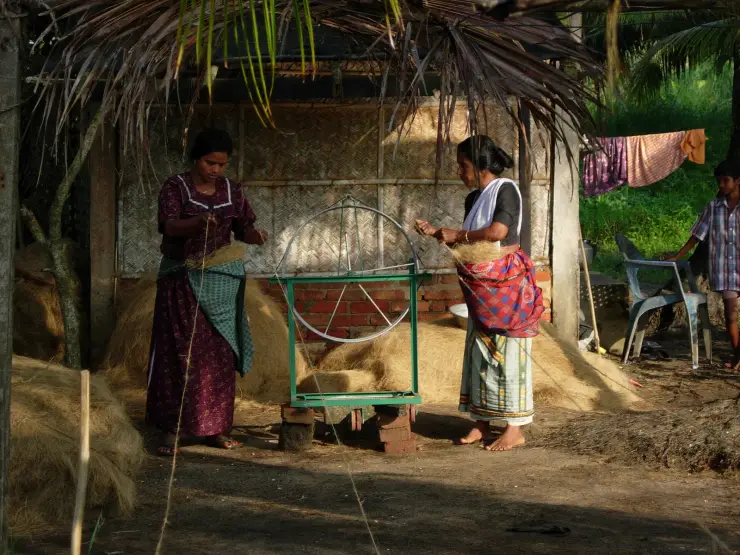
The spinning is the part most visitors remember. It is usually done by women, often in the shade beside a house, working a wheel that twists two strands of loose fibre into yarn at speed. The rhythm is fast and completely unshowy, and the skill in it is obvious the moment you try to imagine doing it yourself.
This is a household and small-unit economy rather than a factory one. Work happens in yards, on verandahs and at the water's edge, families rather than shifts, and it is fitted around everything else the day contains. There is no visitor centre and no scheduled demonstration — if you come on a day when nobody is spinning, nobody is spinning.
One practical thing to know before you plan: there is no coir village here in the sense of a place you can navigate to. We ran an OpenStreetMap query for any coir-tagged or coir-named feature across the whole Munroe and Ashtamudi area, and there is not one on the island itself. Whatever a canoe trip stops at is a private household yard, reached by an arrangement between your boatman and that family. The access is the boatman. The nearest mapped, named society is the Chittayam Coir Vyavasaya Co-operative Societies unit about five kilometres south, on the Ashtamudi side.
The honest position on visiting is the same as at any working craft, with one addition. You are a guest at someone's job: ask before photographing, accept a refusal without argument, and if someone has stopped work to show you the process, pay them for their time. Buying something is usually more welcome than a tip — and here it does specific good, because household units receive no state grant, keep no accounts, and sell through middlemen. A direct sale removes that layer entirely. Note too that a woman on a ratt earning somewhere between roughly ₹110 and ₹300 a day is under no obligation to be photographed for free, and being asked is the whole difference between a visit and an intrusion.
A small vocabulary point that guides and captions get wrong interchangeably: what you photograph being made on a ratt is usually yarn. Rope is a second stage, twisting two yarns together.
The fibre in the rope you are being shown was probably grown and extracted in Tamil Nadu. That is the single most important thing to know on this page, and it comes from the Government of Kerala's own labour institute rather than from any critic of the industry.
Coir here is often said to be presented as heritage preserved for visitors when it is really a working industry, the households doing it for income rather than for demonstration. That is half right, and it is right about the wrong half. The Kerala Institute of Labour and Employment's 2015 study of the industry inverts it: the spinning is real paid work, and it is the retting — the months in the water, the thing the canoe trip is built around — that has very largely stopped being production.
The mechanism is documented and blunt. When mechanical de-fibering machines arrived, opposition meant they were not installed in Kerala; Tamil Nadu built them instead. The report then records what followed, verbatim: with retting and manual extraction becoming more and more difficult and costly, the yarn-spinning industry started to use more and more un-retted Tamil Nadu fibre. Initially, it was a 10% TN fibre mixed with 90% Kerala retted fibre, and this equation slowly shifted to 100% TN fibre for most qualities of yarn. Its conclusion is that with the gradual disappearance of retting in Kerala, the scope of fibre production in the State is very minimal.
Un-retted is the key word. Tamil Nadu fibre is crushed from dry husk by machine without soaking, so the husk retting in front of you may not become the yarn being spun nearby; much fibre now arrives by lorry from Pollachi or Tuticorin. Secondary reporting places Tamil Nadu’s share of Kerala’s fibre consumption at around 90%, although primary Coir Board material cited here does not publish that exact percentage. Kerala’s strength remains its finished products and cooperative movement, including about 76% of India’s coir societies.
The productivity gap explains the rest. Hand-spinning in Kerala yields about 10 kg per person per day, a figure the report says has not changed in decades; in mechanised Tamil Nadu it is about 60 kg. Cost to company for the same job is around ₹810 a day in Kerala against ₹368.21 in Tamil Nadu. Kerala subsidises its spinners at roughly ₹150 a day per worker and still cannot compete, and the report frames the choice as either even more subsidy to support a lost cause, or adopting modern and efficient methods. That phrase is the state's own.
Then there is the part nobody says out loud on a canoe. Retting is a documented pollutant of Ashtamudi, and Ashtamudi is a Ramsar Wetland of International Importance. Husk soaking releases pectin, fats, tannins and polyphenols; the bacterial load strips the dissolved oxygen out of the water, and in the anoxic conditions that follow, sulphate-reducing bacteria generate hydrogen sulphide. A 2022 study in the Indian Journal of Environmental Protection, on this estuary specifically, found high values of BOD and polyphenols and low dissolved oxygen at retting sites and concluded that husk retting has increased the organic pollution load in the estuary. Kerala's own report is more direct still: retting is to be discouraged since it strongly pollutes ponds, canals and lakes, and it affects the health of the workers engaged in retting, beating and willowing — who are overwhelmingly women, standing in it.
Which forces an honest correction to something else this page said. We told you the retting smell is not pollution, and that explaining it as pollution is a visitor's mistake. The chemistry does not support that. The smell is hydrogen sulphide from anaerobic decomposition — that much we had right — but the same process is measurably deoxygenating a protected wetland. It is both the point of the craft and a pollutant. Those are not alternatives.
There is a fix, and it was invented forty kilometres up the coast. The Coir Board's Central Coir Research Institute at Kalavoor, Alappuzha developed Coirret, a bacterial consortium reported to cut the retting period to as little as 78 hours. Reported reductions vary by application and we would not lean hard on one figure. It has never displaced either the months-long soak or the Tamil Nadu machines at scale.
And the third pressure is the one this island cannot escape. Retting needs a particular water — shallow, brackish, in a fixed place. Munroe Island is losing land after the damming of the Kallada cut its sediment supply, and more than 500 households have been forced to vacate their homes. Residents who once lived by agriculture, fish farms, coir retting and weaving are now largely daily-wage labourers. So this shore is losing retting three times over: to cheaper machine fibre from another state, to an environmental verdict from its own government, and to the water itself.
None of which makes the trip less worth taking. It makes it a different trip from the one that was advertised. And it leaves an ending with no comfortable shape: Ashtamudi is losing a heritage industry and gaining dissolved oxygen, and there is no framing in which both of those are simply good news.
Coir — the fibre extracted from coconut husk — has been produced along the Kerala coast for centuries, and the belt around Ashtamudi and the Kollam backwaters is one of its traditional centres.
The traditional process depends on brackish backwater: husks are retted in the shallows for months until the soft tissue decomposes, then beaten to free the fibre, cleaned, dried and spun into yarn, largely by hand and largely in household units.
On Munroe Island this work is carried out on the canal banks and in village yards rather than in factories, with spinning predominantly done by women.
The sector has come under sustained pressure from mechanised production and synthetic substitutes, and hand-processed coir now operates on very narrow margins. The audited figures for the Kollam project office of the Directorate of Coir Development, for 2014-15, give the shape of it: eight circles, 82 working coir cooperative societies, 45,488 members — and 1,404 workers actually engaged in production, for an average of 123 working days each. Coir produced came to 8,182 quintals, at a cost of ₹4,893 per quintal and a loss of ₹293 on each one. Of 159 units in the Kollam circle, 82 were operating, 25 non-operating, 23 had never commenced production and 29 were under liquidation.
Statewide the pattern is the same: of 993 coir societies registered up to 2015, only 536 were working, and the Directorate recorded only 154 generating a profit in 2014 and 164 in 2015. How many people the industry employs is genuinely unknown — Kerala's own report gives a range of between 40,000 and 3.5 lakh, a ninefold spread inside a single government document, and says plainly that the correct number is not available. The majority are women.
On Munroe Island specifically, that pressure compounds with land subsidence and tidal flooding following the interruption of the Kallada river's sediment supply — a process that has already forced more than 500 households to vacate their homes and that directly affects the water conditions retting requires.
The stages of a traditional process are visible within a few hundred metres — retting in the shallows, beating, drying and spinning — even though they no longer form a single chain.
The spinning is genuinely impressive to watch, and it is done by people who have been doing it their whole lives rather than by demonstrators.
It is the economic reality behind the scenery: the same canals that make a pretty canoe trip are the retting beds this work depends on.
You can buy the product where it is made, which is both a better souvenir than a shop and a more useful thing to leave behind than a tip.
And it is disappearing, for reasons — mechanisation, synthetics, and an island losing its land — that are documented rather than sentimental.
Road km to Kollam; ghat roads and traffic vary — allow extra.
November to February and early mornings are best for walking; avoid midday heat where possible.
Live forecast loads in your browser.
Sun and moon are calculated for this location and shown in IST. Photography windows are the hour around sunrise and sunset; the sunset bearing is degrees clockwise from true north. Moon phase is accurate to about half a day.
Verified hotels, homestays, restaurants, experiences, sights, shops and rentals around Coir villages — commission-free, with direct contact. Filter by what you need.
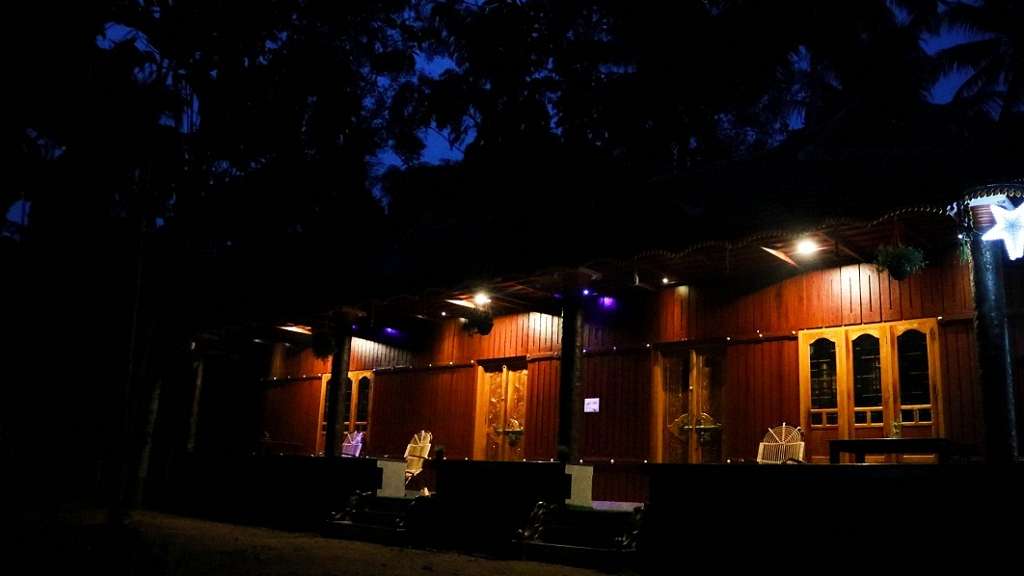
Kerala Tourism-listed homestay in timber-and-tile cottages at Nenmeni on Munroe Island, set among the canals and paddy of the Ashtamudi backwaters in Kollam. The hosts offer quiet garden-side rooms and home-cooked island meals, a laid-back base for backwater canoeing.
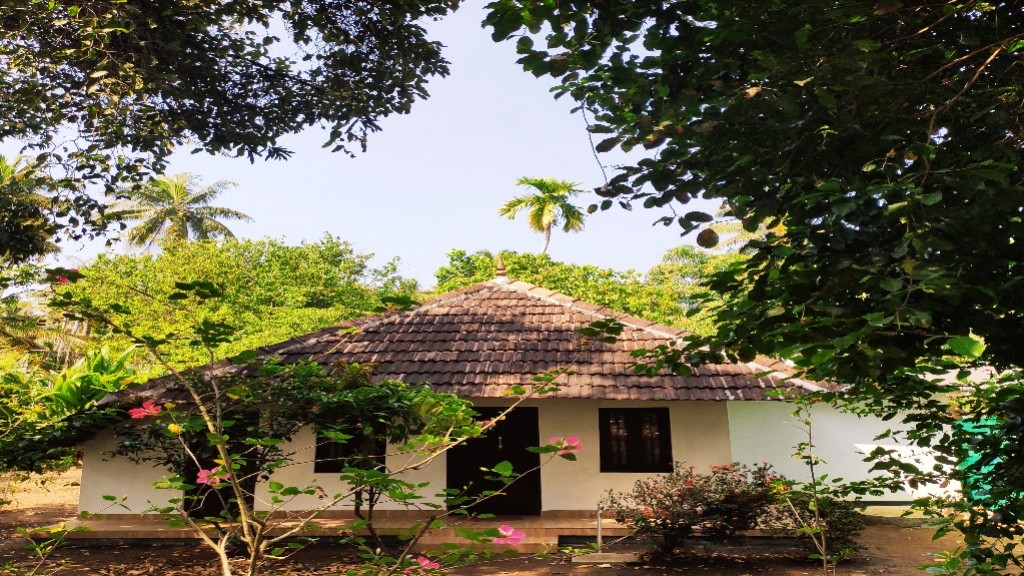
Kerala Tourism Silver House-classified homestay in a traditional tiled Kerala house on Munroe Island, amid the coconut groves and canals of the Ashtamudi backwaters. The host family offers clean rooms, home-cooked meals and guided canoe trips, a personal island base rather than a hotel.
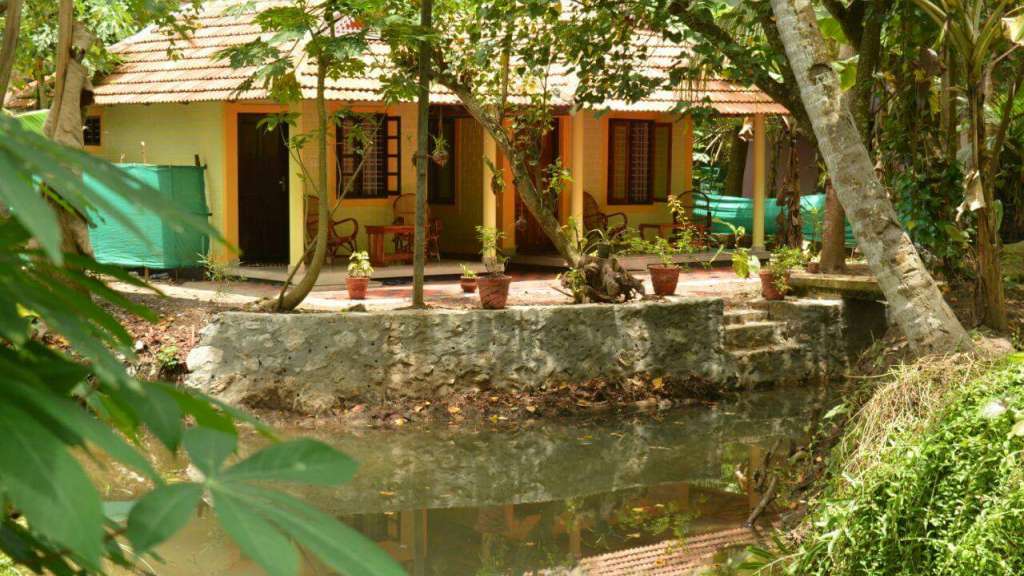
Kerala Tourism Silver House-classified homestay in a traditional tiled Kerala cottage beside a canal on Munroe Island, in the Ashtamudi backwaters of Kollam. The resident hosts offer simple canal-side rooms and home-cooked food, an authentic island stay for canoe rides and village walks rather than a hotel.
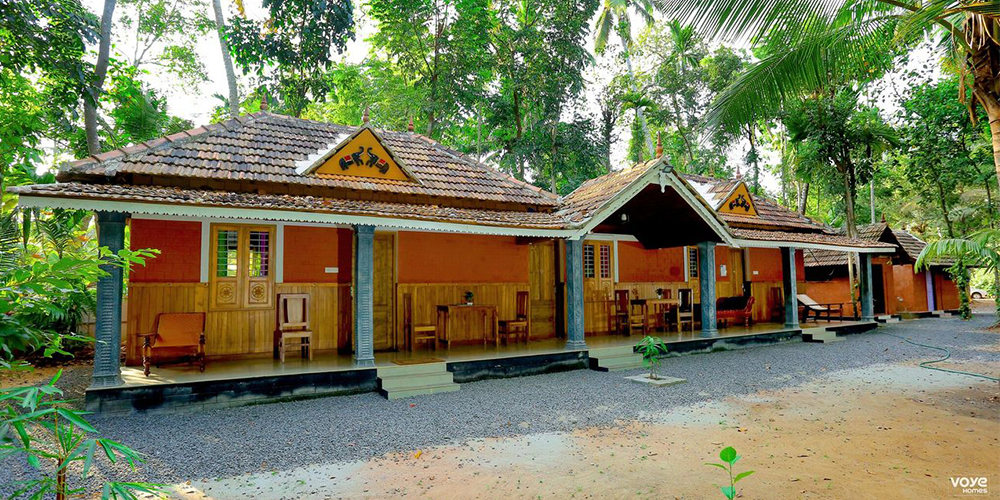
Private holiday home in Munroe Island. Mundro Green Land, Munroe Island, Kollam, Kerala · Munroe Island, Holiday home, Backwater view.
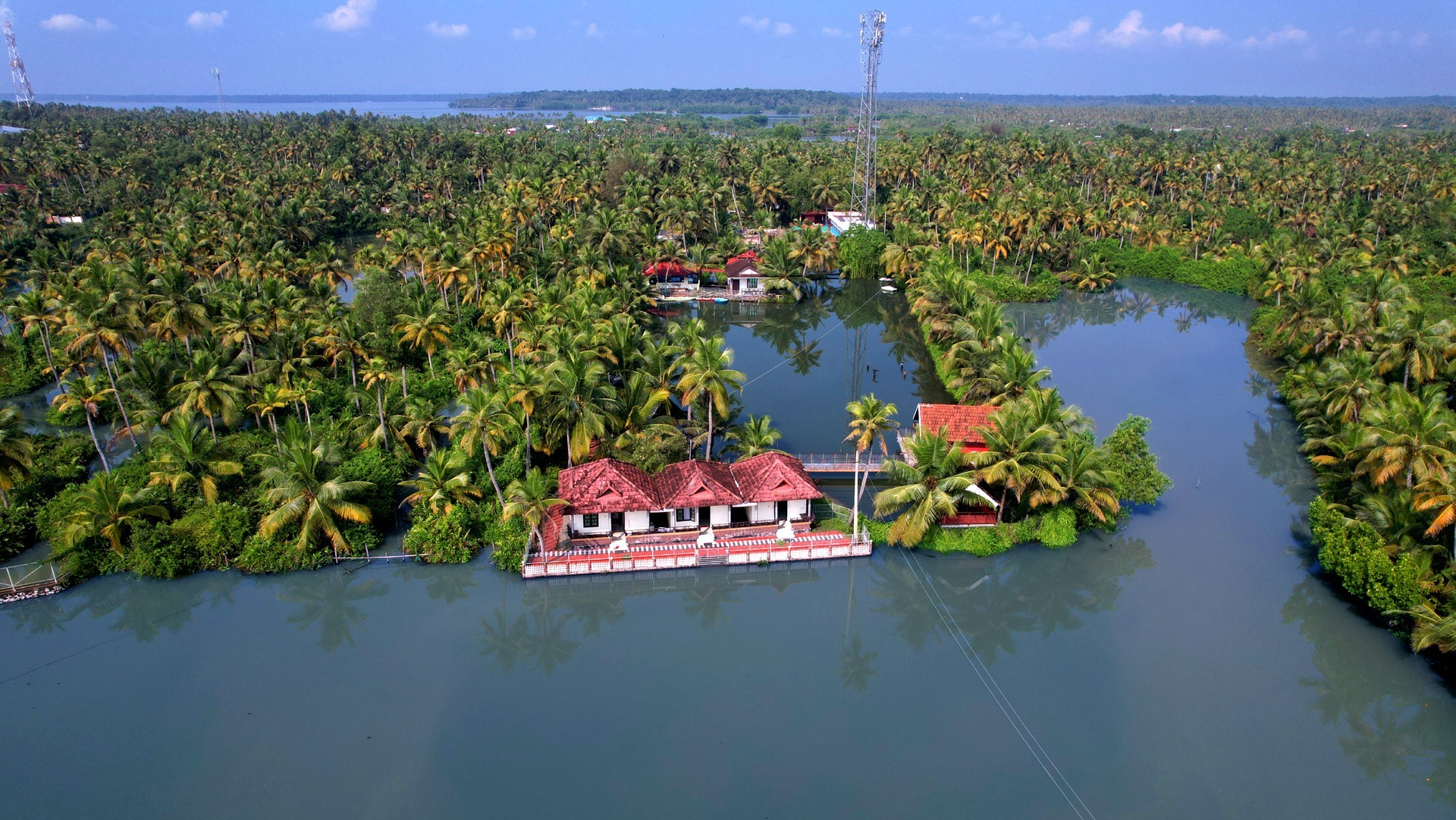
Resort in Munroe Island. Nenmani South, Munroethuruth P.O., Munroe Island, Kollam, Kerala 691502 · Munroe Island, Resort, Backwaters.
A homestay at Thoompum Mukham on Munroe Island. Canoe tours run the local waterways and the kitchen serves Kerala dishes and signature mocktails.
A homestay on Munroe Island built around paddling the backwaters. Kayak trips and canal boating explore the island's narrow waterways.
Private island farm stay on Munroe Island with organic food, backwater setting and direct booking contact.
Backwater resort in Munroe Island. Munroethuruth P.O., Munroe Island, Kollam, Kerala · Munroe Island, Backwater stay, Canoe.
Book with the place itself. India’s cyber-crime coordination centre warned in April 2025 that convincing copies of hotel and pilgrimage booking sites are being pushed through sponsored search and social ads, taking payment for rooms the property never hears about. Every listing here links to the business’s own contact details and its own Google or Bing profile — we take no commission and sit in nobody’s payment path. If a booking page reached you through an ad, check the address bar against the property’s own site before you pay. Fraud can be reported on cybercrime.gov.in or on 1930.
Find food, accommodation and activities across Munroe Island. Browse the guides for places to eat, stay and explore along your route.
4 more places around Munroe Island. Open a guide to plan the visit and onward journey.
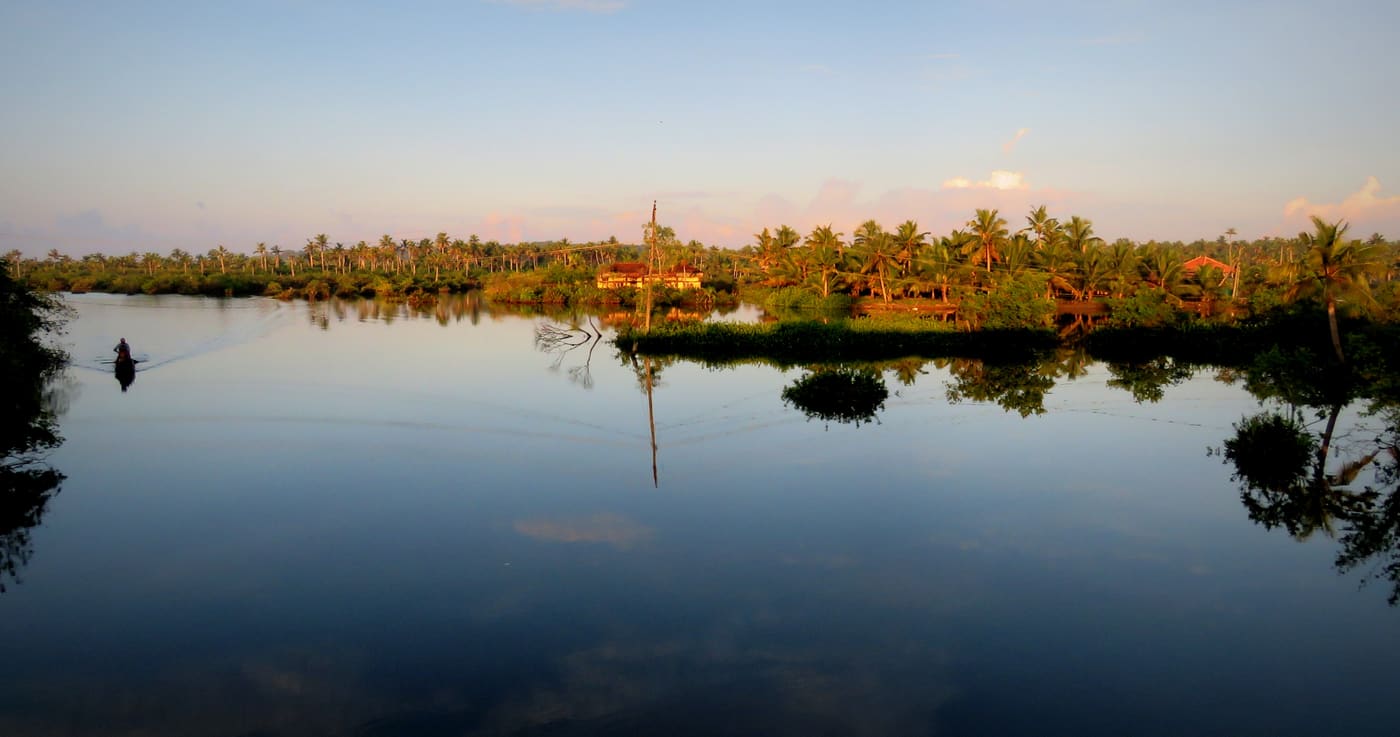
3.4 km · 6 min drive
Canal village island known for canoe trips, coir work and slow backwater life.
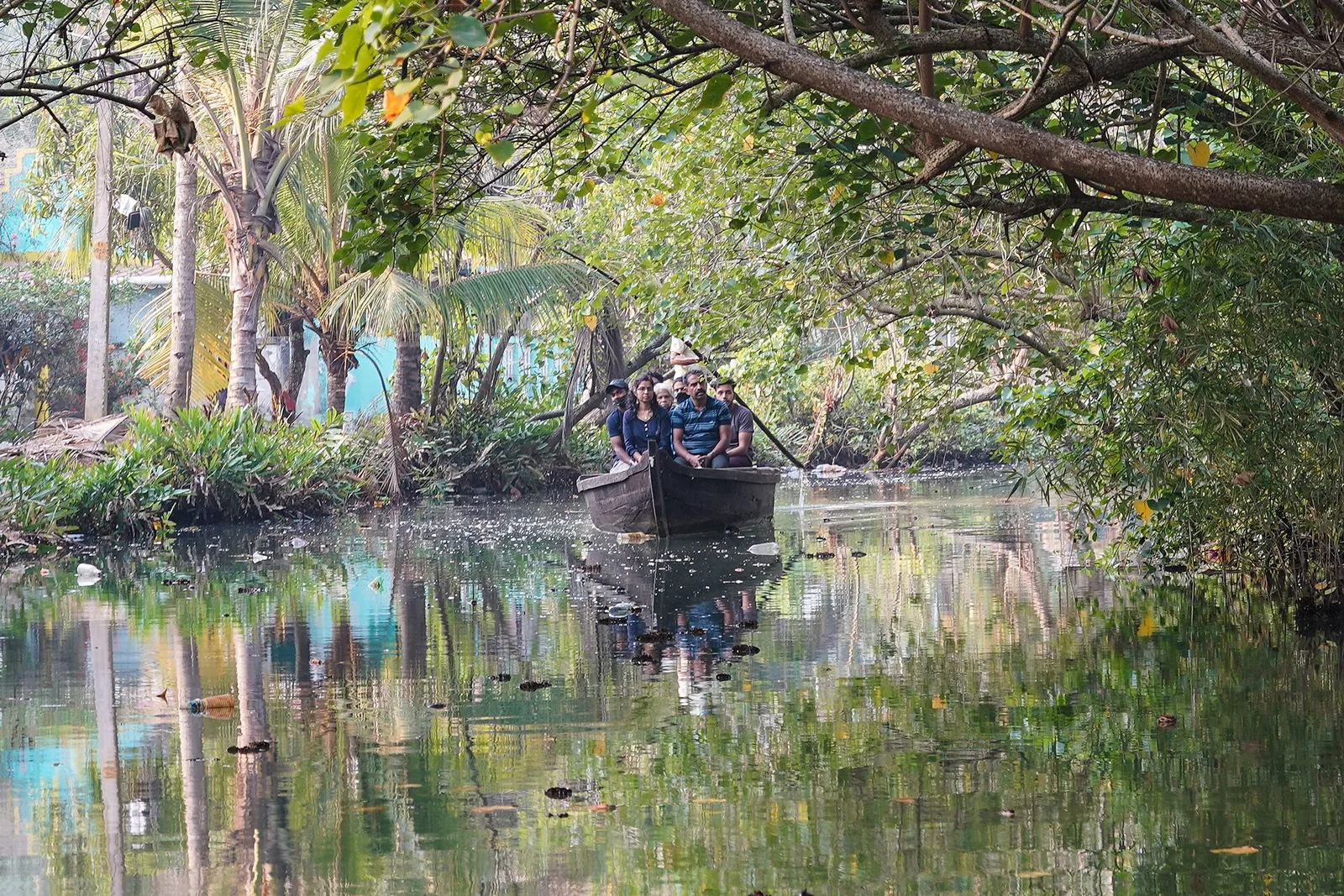
2.4 km · 29 min walk
The narrow inland canal network threading Munroe Island, navigable only by small country canoe — the reason the island is visited at all, and a different waterway entirely from the open Ashtamudi lake.
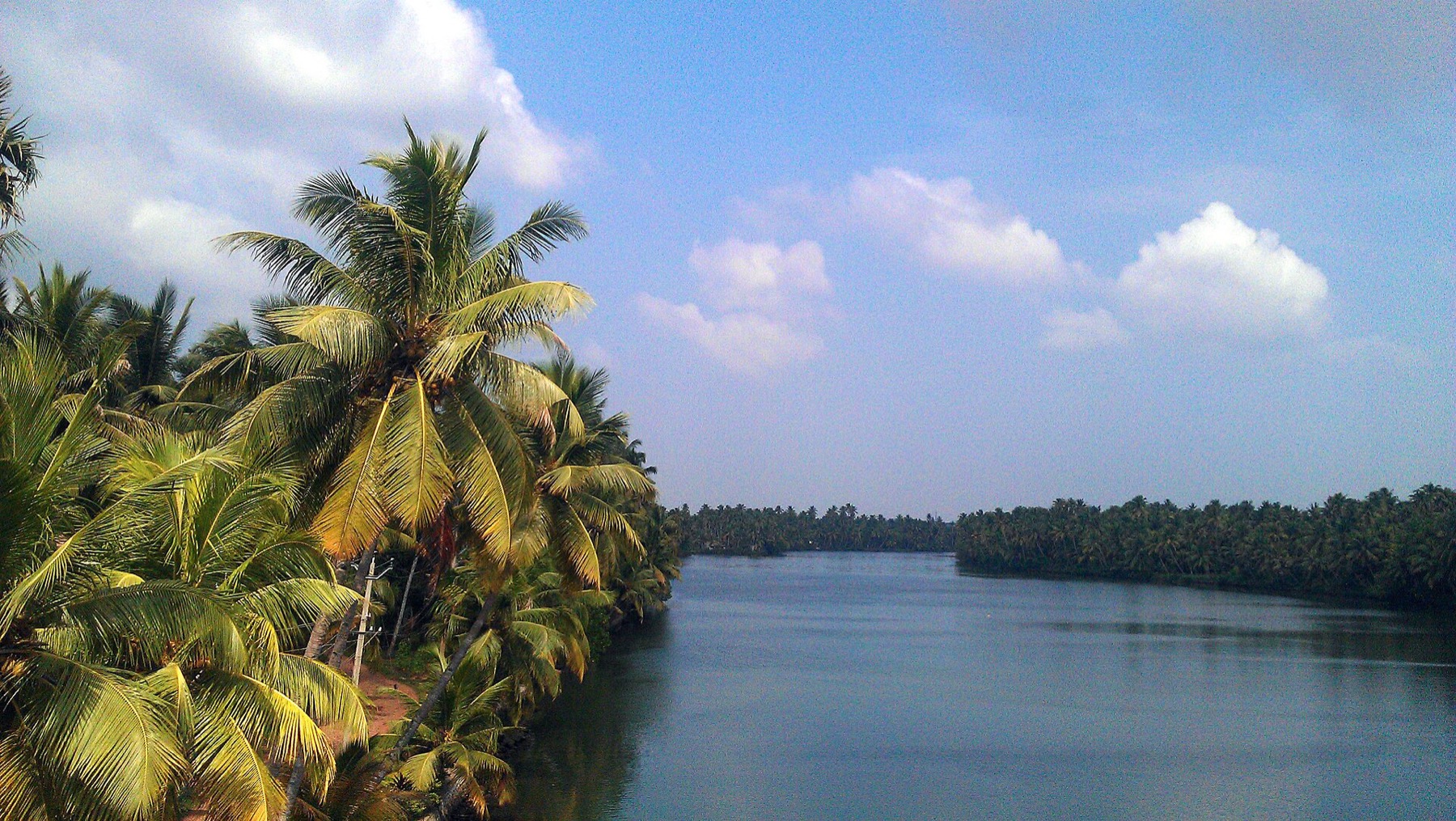
2.9 km · 5 min drive
The river that rises in the Western Ghats behind Thenmala, is impounded at the Parappar dam, and reaches the sea through Ashtamudi past Munroe Island — the thread that connects the east of this district to the west.
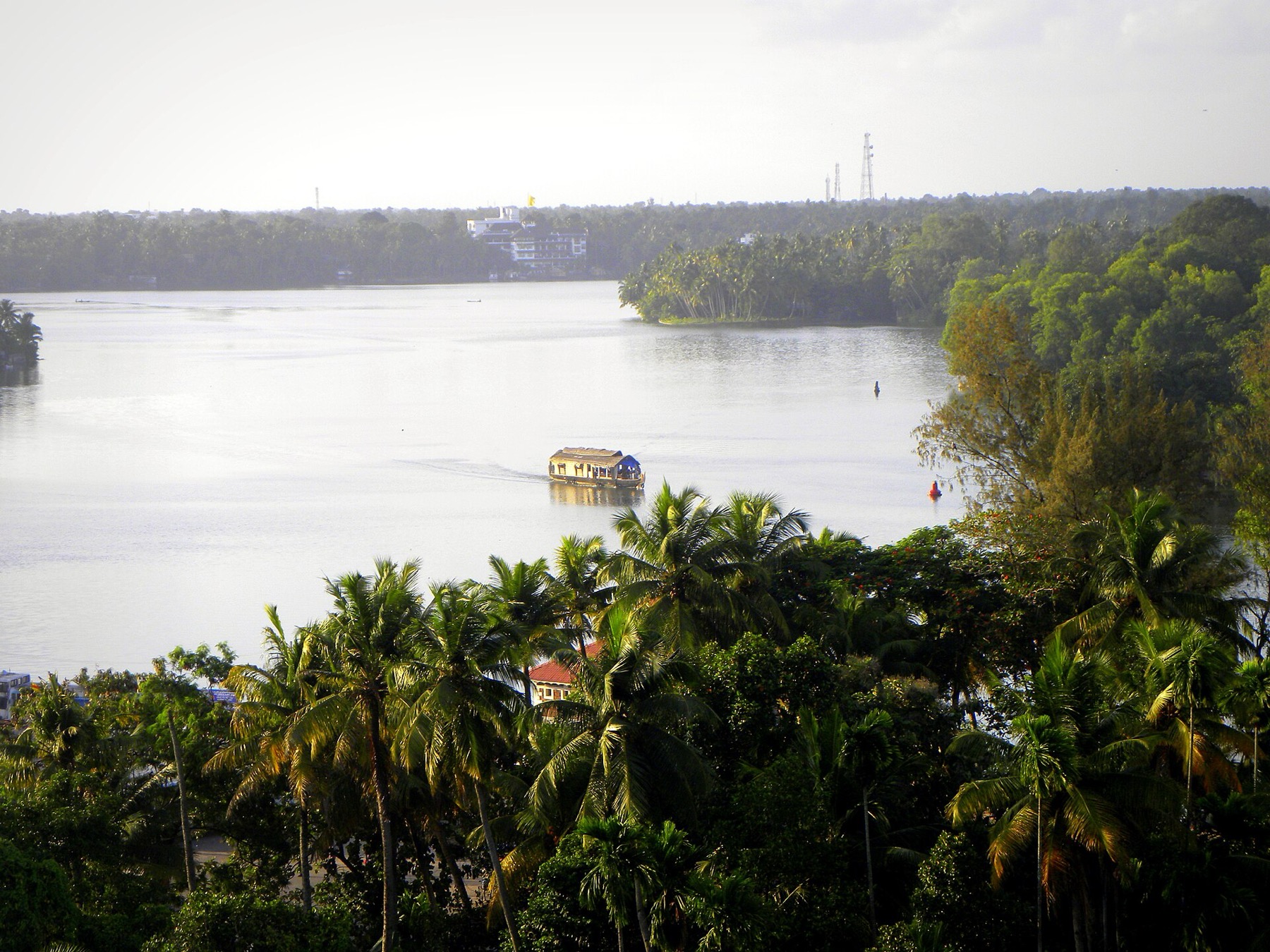
4.7 km · 11 min drive
The open-water outlooks on the Munroe Island and Perumon side of Ashtamudi, where the lake widens out — the wide views the canal trips themselves do not give you.
Roampedia is commission-free — own or know a stay, eatery, guide or shop near Coir villages? List it and it appears here once verified.
Add a nearby businessEntry: Free to see from the canals and lanes. Canoe trips that include a stop at a coir unit are priced as part of the trip.
If you are travelling by bus or ferry, check the return service with the operator before setting out. Leave time to reach the stop or jetty after your visit.
Ask at the jetty or stand for the time of the last service back, not the next one. If you miss it, an auto or app cab is the fallback — agree the fare before you get in.
If you need step-free access, contact the site before travelling. Ask about a level entrance, steps along the route, the nearest drop-off point, seating and accessible toilets.
These services are listed within about 1.2 km of Coir villages. Walking distances follow mapped routes; access and opening hours can change. Other services may be closer but are not included here.
Emergency numbers are verified against official government and state tourism sources. 112 works anywhere in India.
The narrow inland canal network threading Munroe Island, navigable only by small country canoe — the reason the island is visited at all, and a different waterway entirely from the open Ashtamudi lake.
2.4 km · 29 min walkThe river that rises in the Western Ghats behind Thenmala, is impounded at the Parappar dam, and reaches the sea through Ashtamudi past Munroe Island — the thread that connects the east of this district to the west.
2.9 km · 5 min driveCanal village island known for canoe trips, coir work and slow backwater life.
3.4 km · 6 min driveThe open-water outlooks on the Munroe Island and Perumon side of Ashtamudi, where the lake widens out — the wide views the canal trips themselves do not give you.
4.7 km · 11 min drive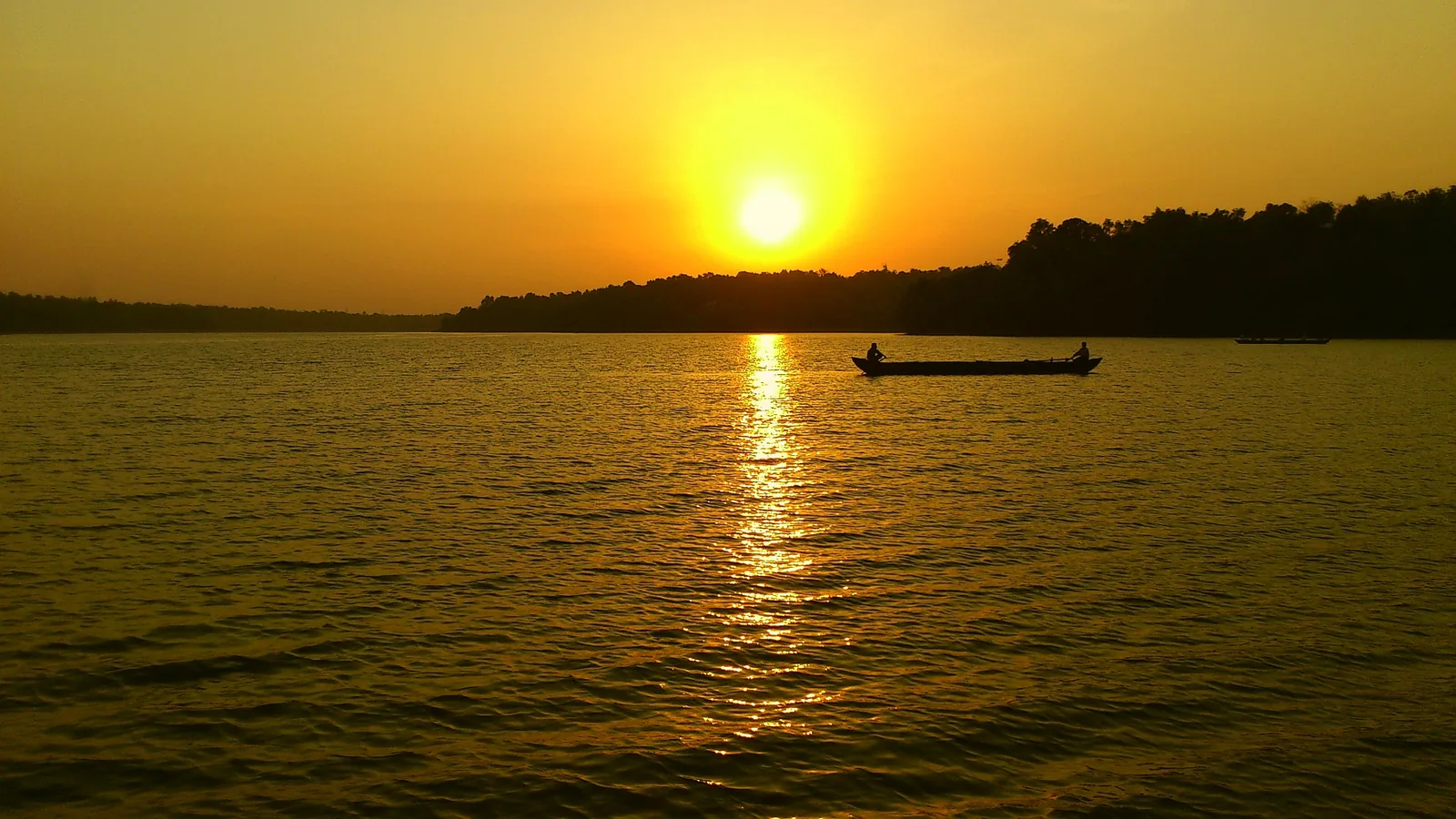
Kerala’s largest freshwater lake, a Ramsar wetland ringed by hills and a Sastha temple, north of Kollam.
6.8 km · ~17 min by auto · straight line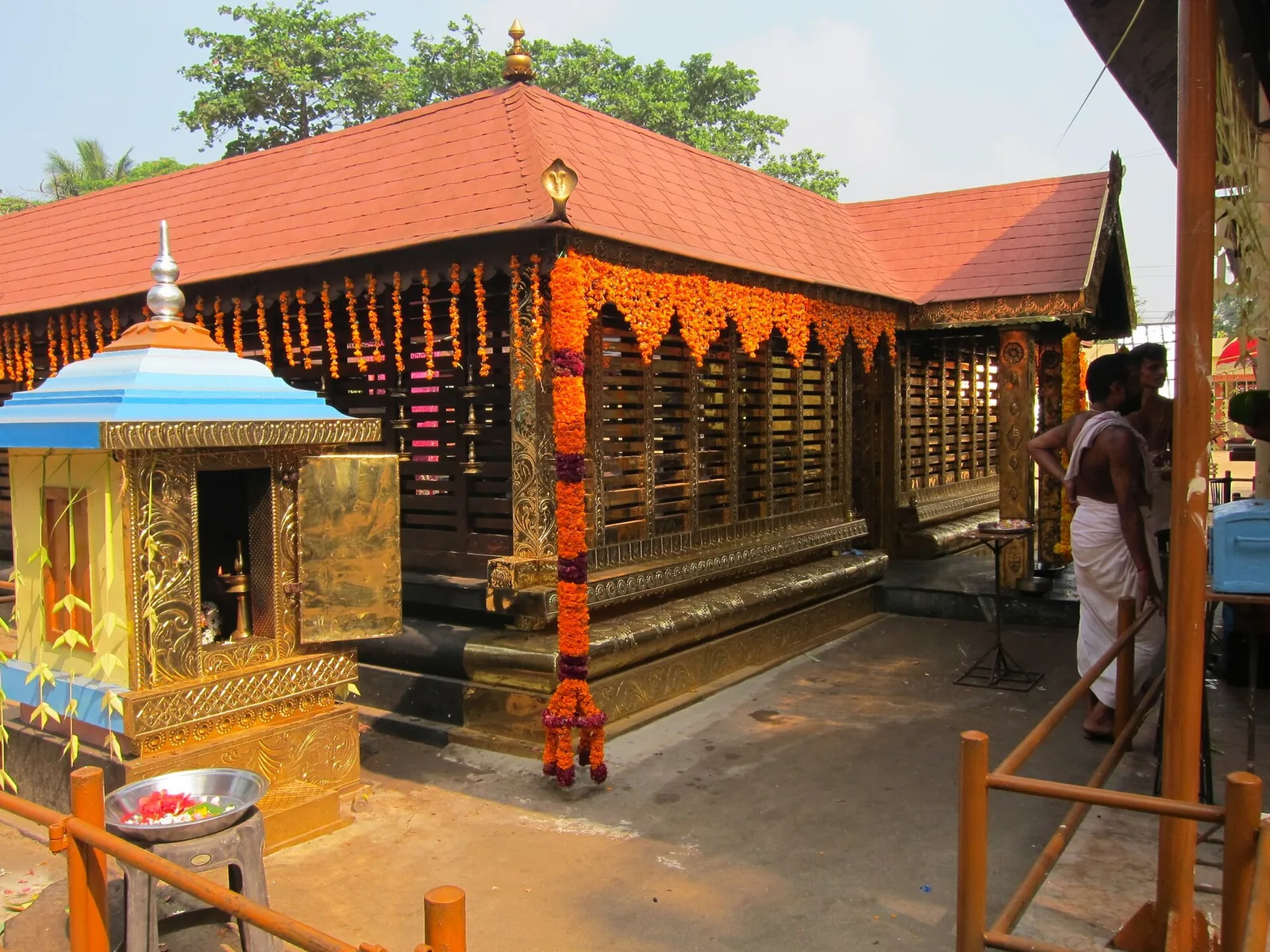
A Devi temple at Chavara north of Kollam, known across Kerala for Chamayavilakku — the two nights in Meenam when men and boys dress in saris and carry lamps in procession to the goddess, re-enacting the cowherd boys of its founding legend.
8.0 km · ~20 min by auto · straight line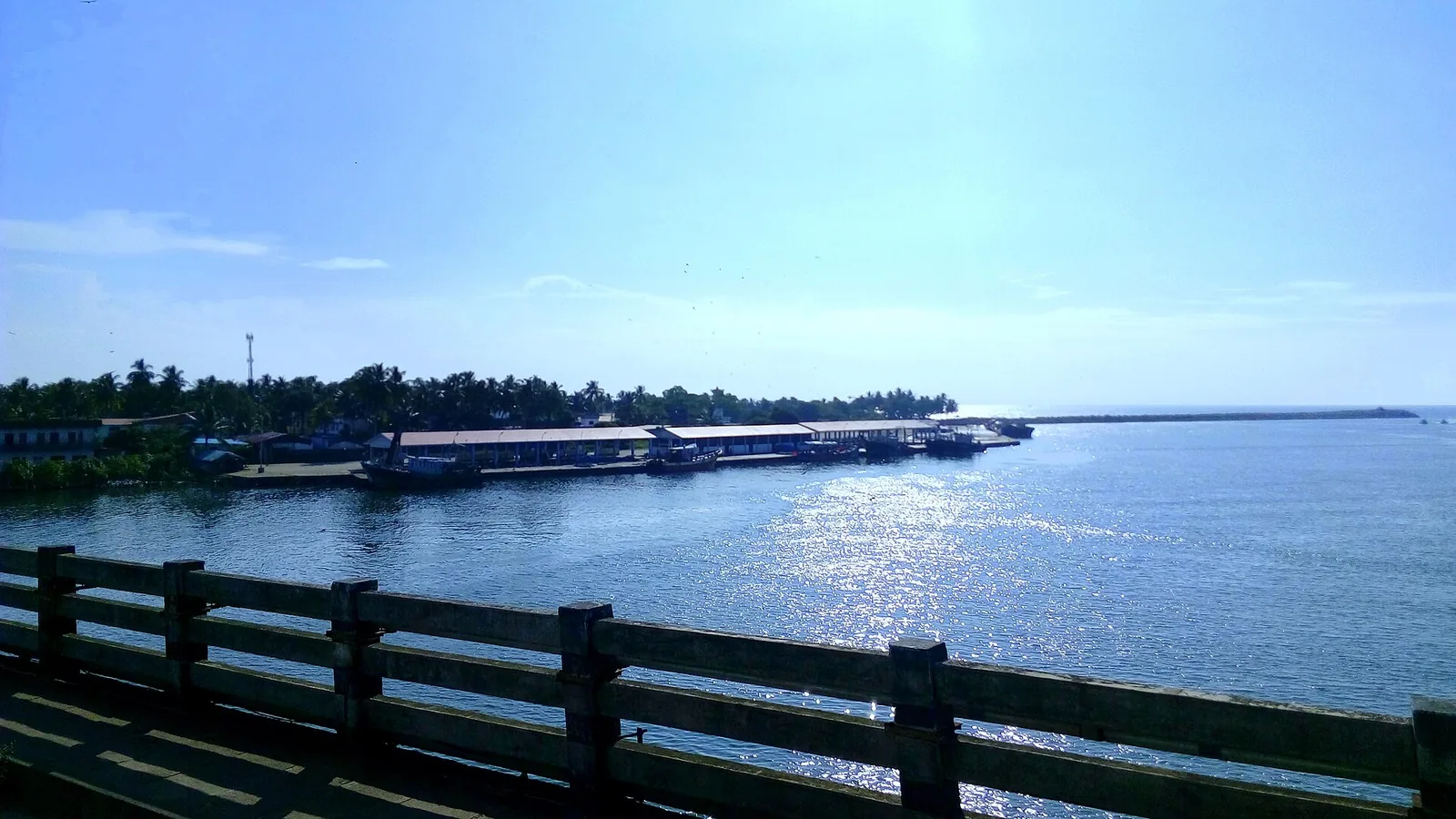
By most accounts Kerala’s largest fishing harbour, at the mouth of Ashtamudi Lake about 9 km from Kollam town, and where Indian fishing was mechanised; two bridges cross the confluence and the early-morning auction is the sight to catch.
9.0 km · ~15 min by cab · straight line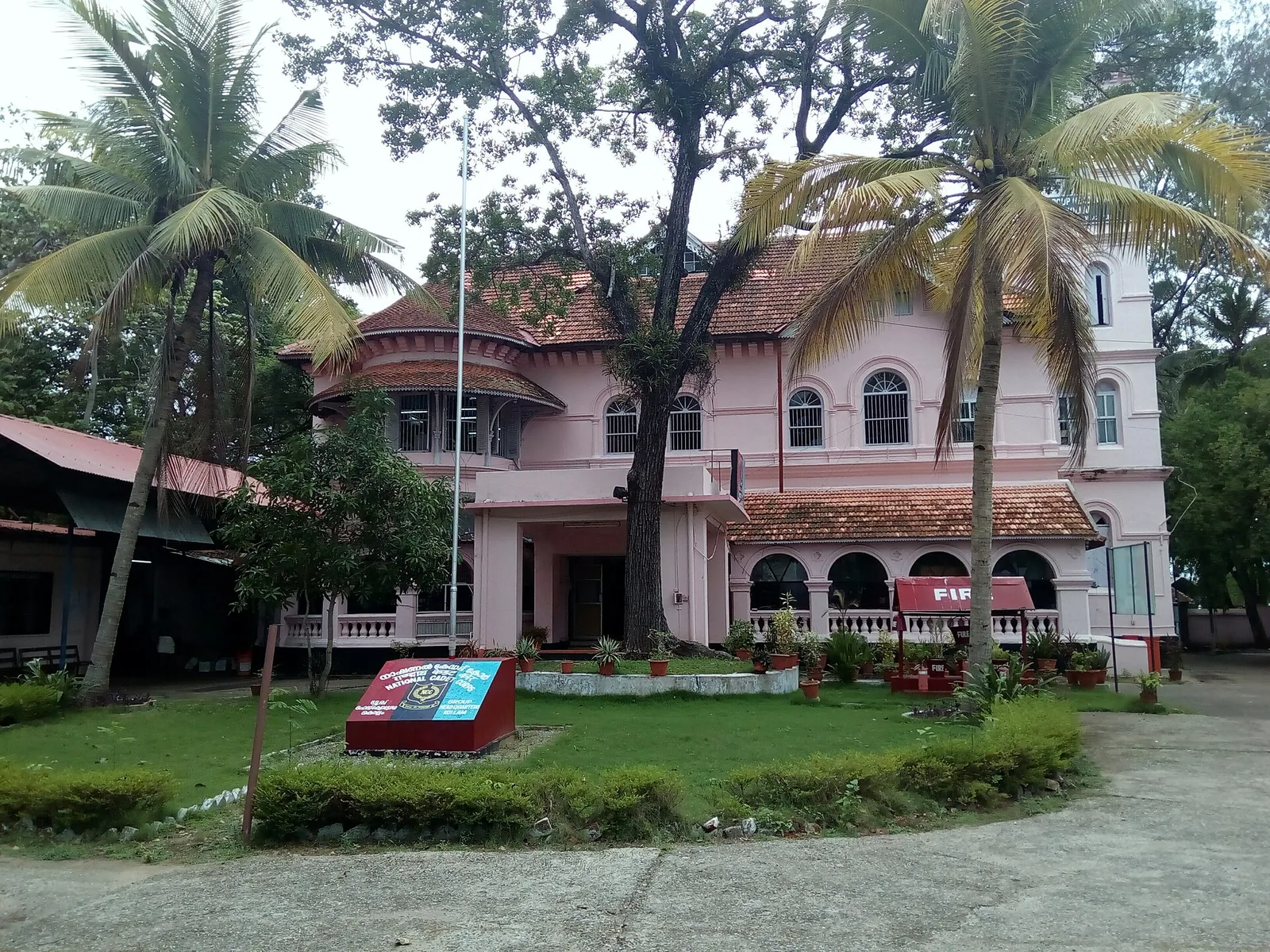
A Travancore royal residence on the Ashtamudi shore in Kollam, built to be arrived at by boat and now a working NCC establishment — viewed from outside or from the water.
9.3 km · ~16 min by cab · straight line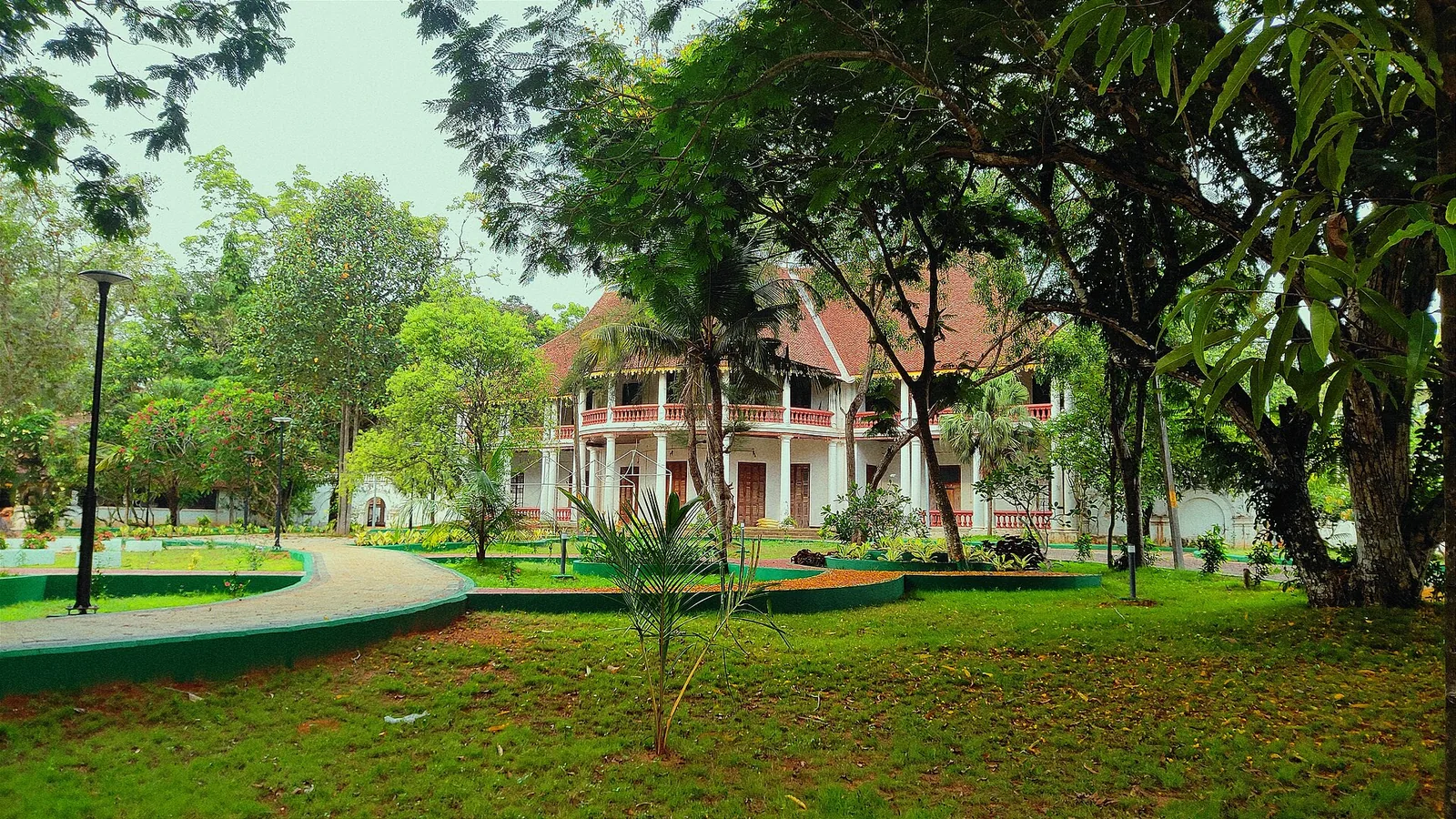
The former British Residency at Asramam survives as a government guest house beside Kollam’s backwater landscape. Its architecture is the attraction, with access governed by its working use.
9.6 km · ~16 min by cab · straight line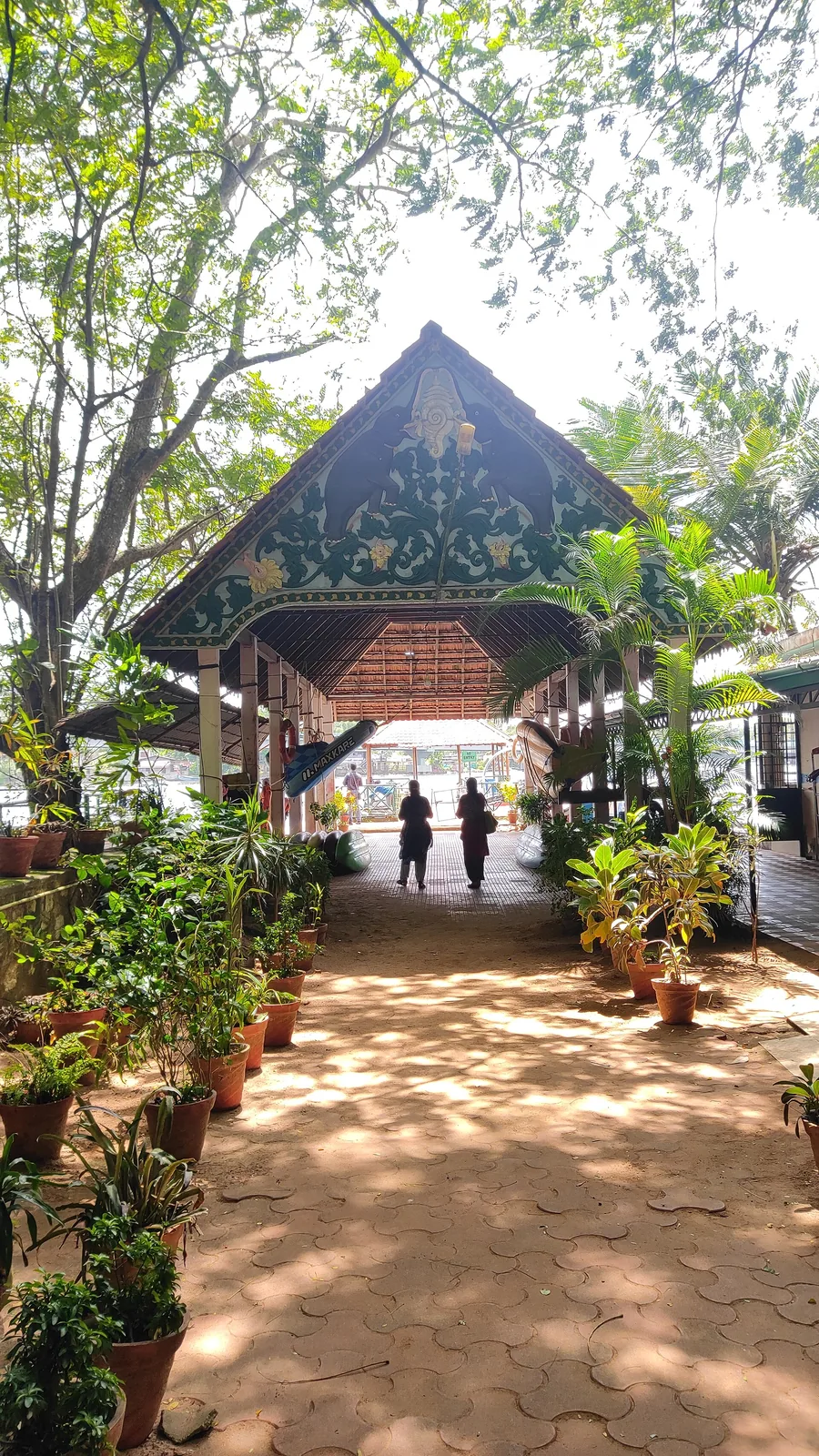
Forty-eight acres of municipal park on the Ashtamudi shore in the middle of Kollam, run by the DTPC — boating and kayaking off a painted jetty, ziplines and rope courses, a heritage walkway of terracotta reliefs, contemporary sculpture left behind by a 2012 festival, and a mangrove wetland with a state biodiversity heritage tag.
9.7 km · ~16 min by cab · straight line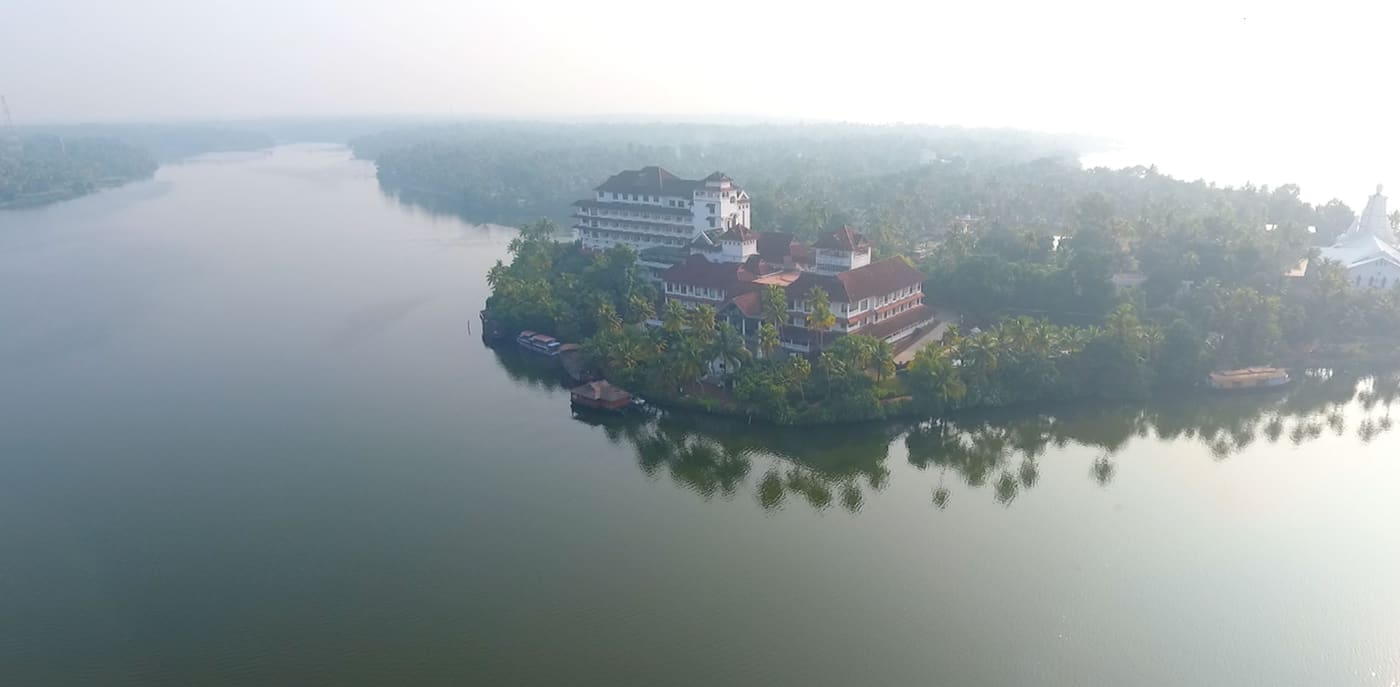
Large palm-fringed backwater system and houseboat base around Kollam.
10.1 km · ~17 min by cab · straight line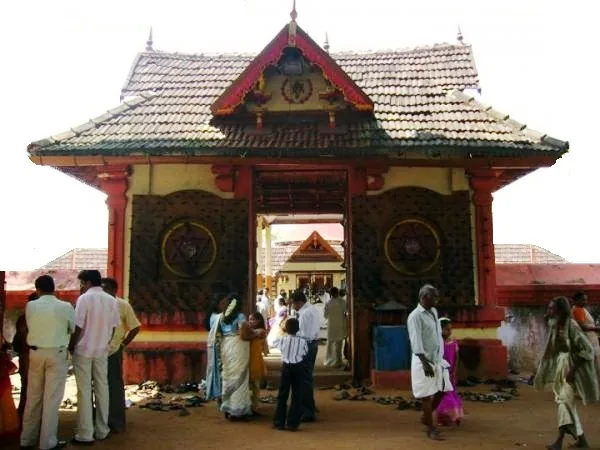
Anandavalleeswaram is an active Shiva temple in Kollam, with an Anandavally shrine and a ten-day annual festival in March or April. Ritual processions and cultural performances bring another dimension to the temple visit. Follow its worship session, admission and photography rules.
10.5 km · ~17 min by cab · straight lineWalking and driving times are real routed distances, except the few marked “straight line”, which are direct-line estimates and will read short. Fare figures are estimates from Kerala’s notified auto/taxi tariff and exclude waiting and night charges. Routing: © openrouteservice.org by HeiGIT | Map data © OpenStreetMap contributors
Nearby toilets, pharmacies, ATMs, seating and vets are community-mapped and may be incomplete or out of date. Map data © OpenStreetMap contributors | Walking times © openrouteservice.org by HeiGIT
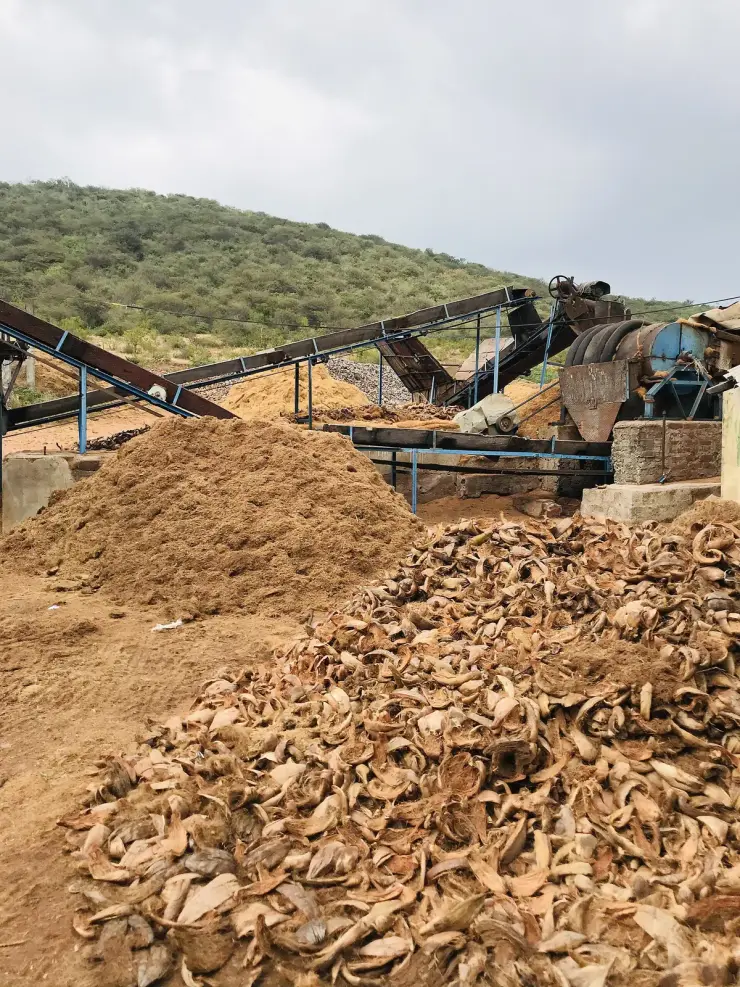
Coir is the fibre of the coconut husk. The traditional Kerala method soaks bundled husk in shallow backwater for months so bacteria rot away the binding pectin, then the fibre is beaten out with mallets, dried and spun on a wheel called a ratt. The modern method skips the soaking entirely: dry husk is crushed by machine, mostly in Tamil Nadu. Most coir fibre used in Kerala today is the second kind.
Often not. Kerala’s yarn-spinning shifted progressively to un-retted Tamil Nadu fibre; the state’s 2015 report describes 100% Tamil Nadu fibre for most yarn qualities and says local fibre-production scope is now minimal. Secondary reports put the imported share near 90%, although the cited primary Coir Board material does not give that exact percentage.
It depends which part, and the usual answer has it backwards. The spinning is much more likely to be genuine paid work. The retting has largely disappeared from Kerala for both economic and environmental reasons, so a retting yard on a tourist canal route may well be maintained more for showing than for supplying. Ask, and accept the answer.
Hydrogen sulphide. Retting is anaerobic decomposition: the husk releases pectin, fats and tannins, bacteria strip the dissolved oxygen out of the water, and sulphate-reducing bacteria then generate the rotten-egg smell. Visitors are often told this is simply how the backwater smells, and it is not. It is also not harmless — the same process is a documented pollutant of Ashtamudi.
Ask first, every time, and accept a refusal. People are working. If someone stops work to show you the process, pay them for their time — buying something they have made is usually more welcome than a tip.
No, and the state's own audit is stark. In 2014-15 the Kollam project office's 82 working societies had 45,488 members but employed 1,404 people in production, for an average of 123 days each, and sold coir at a loss of ₹293 per quintal. Statewide, of 993 registered societies only 536 were working and only 164 made a profit in 2015. Hand-spinning yields about 10 kg per person per day against roughly 60 kg on a Tamil Nadu machine, and Kerala subsidises its spinners about ₹150 a day and still cannot compete.
Yes, and it is documented. Retting husk releases pectin, fats, tannins and polyphenols; bacterial decomposition strips the dissolved oxygen and generates hydrogen sulphide. A 2022 study in the Indian Journal of Environmental Protection, on Ashtamudi specifically, found high BOD and polyphenol values and low dissolved oxygen at retting sites and concluded that husk retting has increased the organic pollution load in the estuary. Kerala's own labour institute recommends the practice be discouraged, both for the water and for the health of the workers standing in it.
Yes, and it was developed in Kerala. The Coir Board's Central Coir Research Institute at Kalavoor, Alappuzha produced Coirret, a bacterial consortium reported to cut the retting period to as little as 78 hours. Reported reductions vary with how it is applied. It has never displaced either the months-long traditional soak or the Tamil Nadu dry-crushing machines at scale.
From the canal trips, which pass retting frames in the shallows, and on foot in the village lanes where the beating and spinning happen. It is a stop on a canoe tour rather than a destination, and there is no navigable address: OpenStreetMap has no coir-tagged feature anywhere on Munroe Island, so whatever you are shown is a private household yard reached by arrangement between your boatman and that family.
Months. Husks are staked out in the brackish shallows and left until the soft tissue has decomposed enough to release the fibre — in some cases for the better part of a year. It is the slowest step by a wide margin and the reason the frames are a permanent feature of the canal banks.
Households rather than factories, and about three-quarters of coir workers are women. Spinning accounts for around 75% of household-unit work. Earnings are hard to pin down: the Kollam societies' 2014-15 wage bill works out to roughly ₹110 a day across 123 working days, while secondary reporting on the traditional sector puts daily wages at ₹250–300 with fewer than 20 working days a month. Kerala's own report notes that for many of the women the household ratt is a leisure-time activity, that no accounts are kept, and that unlike the cooperatives these units are left to fend for themselves.
Usually, yes, and it is the most useful thing you can do. Household units receive no state grant or subsidy, keep no accounts, and are exposed to middlemen; the cooperative sector was selling at a loss of ₹293 per quintal. Buying directly from the person who made it removes that layer entirely, and it is generally more welcome than a tip if someone has stopped work to show you the process.
November to February and early mornings are best for walking; avoid midday heat where possible.
Entry: Free to see from the canals and lanes. Canoe trips that include a stop at a coir unit are priced as part of the trip.
Base yourself in Munroe Island or a nearby town in Kollam, then confirm the last-mile route locally before leaving. Walkable heritage areas are best done slowly; combine nearby streets, museums, markets and food stops. If the visit depends on forest, temple, boat, ferry, weather or seasonal access, check the official/local rule on the day before travel.
1 to 3 hours.
Nearby you can pair Munroe canals (2.4 km), Kallada river (2.9 km), Munroe Island (3.4 km), Ashtamudi backwater viewpoints (4.7 km).
Watch traffic on narrow heritage streets. Keep valuables close in crowded markets.
Written about Coir villages itself — its history, its legends and the arguments about them.
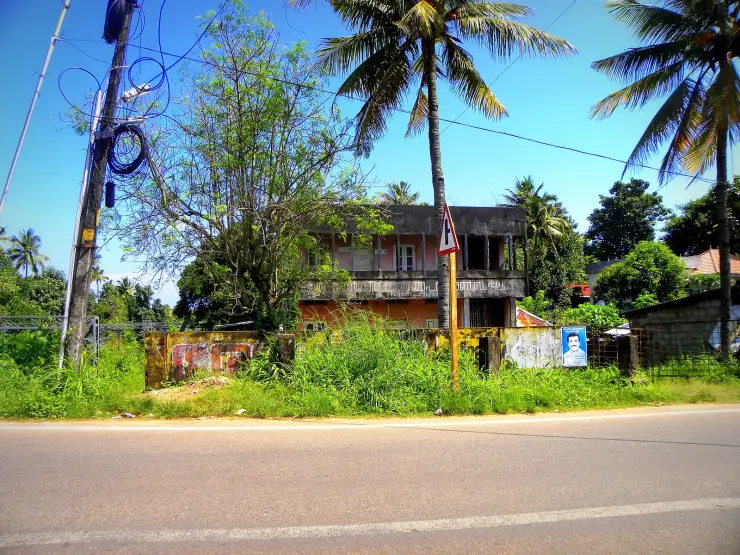
These guides explore Munroe Island and the surrounding area. Choose a visit that fits your interests, allowing separately for travel between stops.
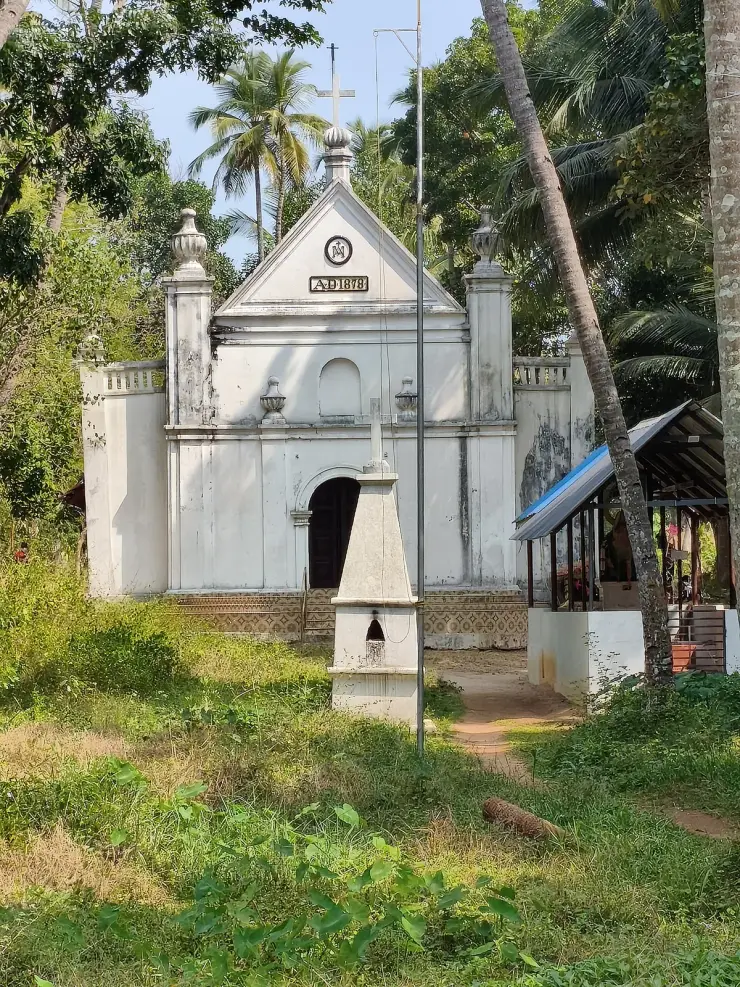
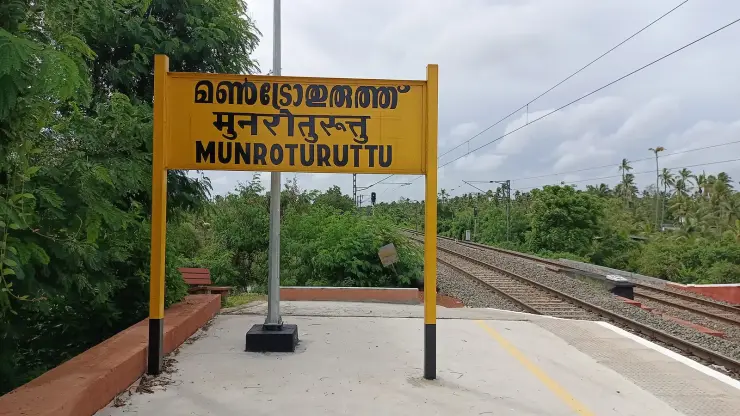
Route-level itineraries and practical guides for the rest of Kerala.
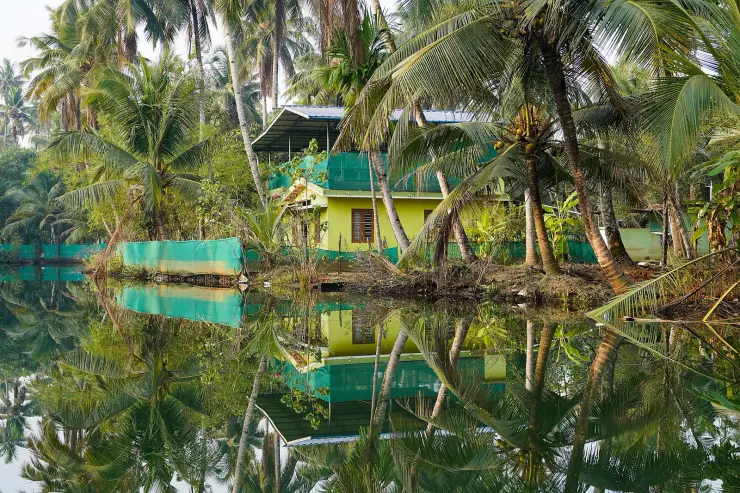
Photographs: fraboof (CC BY-SA 2.0), albert from The Netherlands (CC BY-SA 2.0), PeterKeerthi (CC BY-SA 4.0), Arunvrparavur (CC BY-SA 3.0). Wikimedia Commons.