Kochi is two cities that share a name, and this is the one nobody writes about. Ernakulam is the mainland half — the courts, the railway stations, the metro, the hospitals, the wholesale streets and very nearly everybody who actually lives here — while the guidebooks send you across the water to the peninsula. What makes the mainland worth understanding is not a monument. It is that the most consequential ground in the city was manufactured. Between 1920 and 1941 a British engineer cut a shipping channel through a bar that had kept ocean-going vessels out of one of the finest lagoons on the coast, and stacked the spoil into an island of some 780 acres that now carries the port authority, a naval command and a locked railway terminus. Everything modern about Kochi — the port, the metro, the IT corridor — sits downstream of that decision.
Get the geography right first, because the names fight each other. Kochi the city is the peninsula of Fort Cochin and Mattancherry, the mainland strip called Ernakulam, Willingdon Island in the middle of the harbour, and a scatter of islands to the north. Ernakulam is the eastern shore: the Kerala High Court, the Corporation offices, both main railway stations, the KSRTC stand, the boat jetties and the commercial district. The Kochi Municipal Corporation recorded 677,381 people over 94.88 square kilometres in 2011, with a metropolitan area of over 2.1 million across roughly 440 square kilometres. Ernakulam district — 2,408 square kilometres, about 3.4 million people, roughly 68 per cent of them urban — is the richest in Kerala and returns the state’s largest share of tax revenue. This is the working half.
The thing that made all of it possible was a bar across the harbour mouth. Kochi had a magnificent sheltered lagoon and a doorway too shallow to use: ships lay off in the open roads and cargo was lightered ashore in small boats, which is a slow, expensive and weather-dependent way to run a port. Attempts on the problem go back to a Captain Cassar in 1859. Nothing came of them. What changed was a decision taken in Madras: Lord Willingdon, then Governor of Madras Presidency, wanted a modern harbour on the south-west coast, and the engineer sent to build it arrived at Cochin on 13 April 1920.
Robert Charles Bristow was thirty-nine, London-born, and had joined the civil engineering service in 1903. His solution was not clever so much as patient: study the winds and the currents, build granite groynes to stop the foreshore washing away once the bar was cut, dredge the channel — and, crucially, do something useful with the spoil rather than dumping it back into the estuary. A purpose-built suction dredger was completed in 1925 and reached Kochi in May 1926. Over three working seasons ending in 1929 it cut a channel about 450 feet wide and three and a half miles long through the bar. On 26 May 1928 the steamship Padma came in through it, and Kochi had a harbour that a ship could sail into.
The spoil became the island. Roughly 3.2 square kilometres of land was reclaimed during the dredging, and about 780 acres of it was raised out of the lake into a single new landmass in the middle of the harbour — named Willingdon Island after the man who had commissioned the scheme and who was by then Viceroy of India. Bristow told a BBC audience that he lived on a large island made from the bottom of the sea. He was not being poetic. There is nothing under the port authority’s offices but dredged estuary bed, and the island measures 314 hectares — about 775 acres — today.
The rest of the works finished the job. The Venduruthy bridge went up in 1938 to tie the island to the mainland, Cochin was declared a Major Port, and the first ship docked officially at the new wharf on 2 June 1939. The bridge to Mattancherry followed in 1940. On 13 April 1941 Bristow sailed for England — twenty-one years to the day after he had arrived. He later taught at Manchester, wrote a memoir called Cochin Saga in 1959, and died in 1966 at eighty-five. A road on the island carries his name.
One piece of his harbour has an ending worth knowing. Cochin Harbour Terminus opened on the island in 1943, with a Cochin–Shoranur passenger service, and for sixty years it was the railhead of the port — a station reached across a bridge, on land that had been water. In 2004 a dredger struck the Venduruthy bridge, passenger services stopped, and they never properly resumed; the last trains from Ernakulam Junction were withdrawn in 2013 and the building is now locked, used occasionally for tourist specials and film shoots. The dredging that made the island eventually closed the way in.
The mainland’s institutions arrived after independence and they are what give Ernakulam its character as a city of offices. The High Court of Kerala was established on 1 November 1956, succeeding the Travancore–Cochin High Court of 7 July 1949, with jurisdiction over Kerala and Lakshadweep; it moved into a new nine-storey building of 550,000 square feet on five acres, inaugurated on 11 February 2006 after construction that had begun with a foundation stone in March 1994 and cost about ₹85 crore against an original estimate of ₹10 crore. The Southern Naval Command was established in 1958. Cochin Shipyard was incorporated in 1972, launched its first ship, the MV Rani Padmini, in 1981, and delivered INS Vikrant, commissioned on 2 September 2022 — the only yard in India that can build a carrier.
Then the city moved east. The district headquarters left Ernakulam for Kakkanad, five kilometres out on the ring road, and in 2004 the state opened Infopark there. It now runs to 323 acres across two phases, with 582 companies and around 72,000 people working in it as of 2025, and SmartCity Kochi immediately alongside. That is a bigger shift than it sounds: for four centuries this city’s centre of gravity moved with the water, and in one generation it moved to a junction with no waterfront at all.
Getting about is the one part of Kochi that has genuinely improved in living memory. The metro opened in stages — Aluva to Palarivattom, 13.4 kilometres and eleven stations, on 17 June 2017; on to Maharaja’s College that October; to Thaikoodam on 3 September 2019; and finally to Thrippunithura on 6 March 2024, completing 28.125 kilometres and twenty-five stations at a cost of about ₹5,181 crore. It is worth riding for its own sake: KMRL contracted station operations to Kudumbashree, the state’s women’s self-help network, in December 2016, and hired transgender staff alongside them. The Water Metro, opened in 2023, is covered on our Marine Drive and Vypin pages, and the old State Water Transport ferries still run.
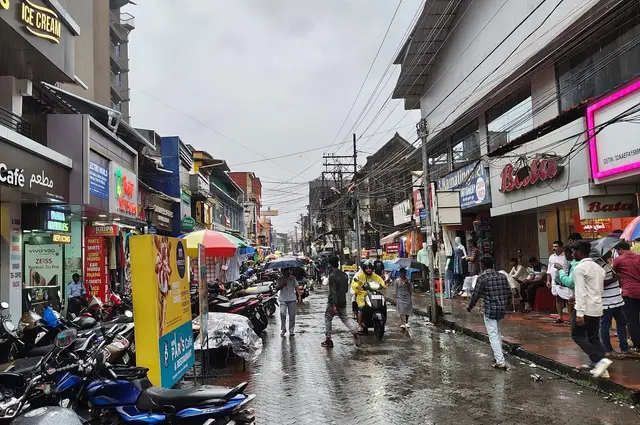
Practically, the mainland is where to stay if you want a city rather than a set. Hotels and food are cheaper than on the peninsula and there is far more of both; the ferries and the Water Metro put Fort Kochi about twenty minutes away, which is faster than the road; and the metro gets you to Aluva for the airport buses without touching the traffic. What you give up is atmosphere. Ernakulam is loud, dense, commercial and largely unbeautiful, and it does not pretend otherwise.
Legend & myth
This half of Kochi has no founding legend of its own, and we are not going to lend it one. Two stories are constantly attached to it and both belong elsewhere. The great Periyar flood of 1341, which tradition says choked Muziris and scoured open this harbour, is told on our Fort Kochi pages and we leave it there. The four rival derivations of the word Ernakulam — the serpent-sage and the pond, the Tamil Erayanar, the eerangi mud, and the temple’s own name — belong to the Ernakulathappan record, which prints all four and refuses to pick. What the mainland has instead is a founding claim that is engineering rather than myth, and it has been mythologised hard in both directions.
Start with the bar, because the heroic version turns on it having been impossible. The story goes that every engineer before Bristow declared the obstruction immovable. The sources cannot agree what it was: a rock-like sandbar in one account, a massive limestone bar in another, and simply mud in a third. That range is a warning. A bar of consolidated limestone and a bar of silt are different engineering problems, and the harder the material in the telling, the larger the man who removed it. What is not in doubt is that Captain Cassar had a go at the harbour in 1859 and it came to nothing, and that for the next sixty years ships anchored outside and cargo came ashore in boats.
The dredger cannot even keep its name straight. English sources, including the port’s own history, call it the Lord Willingdon, completed in 1925 and arrived in May 1926. Malayalam Wikipedia calls it the Lady Willingdon in one place and renders it Lady Wellington in another, and adds that the machine set world records for speed, efficiency and length of service. We print the disagreement rather than choosing, and we would treat the world records as a port authority’s account of its own plant until somebody produces the register they were set in.
The dates are the part most worth pinning down, because our own pages carry two framings of them and they are not in conflict. You will see the works dated 1920 to 1936 and you will also see them dated from 1928, and both are right about different things: 1920 is Bristow’s arrival, 1928 is the year the cut channel opened to shipping, 1936 is the Major Port declaration, 1939 is the first official docking at the wharf, and 1941 is his departure. One genuine disagreement survives that reconciliation. Most sources date the Major Port declaration to 1936; one account puts a maritime board declaration in 1932, opening the port to vessels of thirty-foot draught. We cannot settle it and we print both. The island’s size does the same thing: about 780 acres was raised out of the lake, and the island measures 775 acres now, which is a century of erosion, causeways and definition rather than a contradiction.
Two epithets attach themselves here and neither is as solid as it sounds. Willingdon Island is routinely called the largest artificial island in India, which is very probably true and is also doing quiet work with the word island — a great deal of Indian coastline has been reclaimed without anybody calling the result an island, and there is no register that settles it. And Kochi is the Queen of the Arabian Sea, a phrase our own Fort Kochi page uses without an owner; one Malayalam account credits it to Sir R. K. Shanmukham Chetty, Dewan of Cochin, in 1936, at exactly the moment the port opened. That is a satisfying origin and it may well be a late one, since the epithet reads older than the harbour works. Enjoy it, do not date it.
The stranger thing that has happened to Bristow is that other men’s work has migrated onto him. The iron pier at Alappuzha, built in 1862 by Captain Hugh Crawford, is credited to Bristow so often that we published a correction about it — he was seventy-eight years and fifty-five kilometres away. The recovery of the Karumadikkuttan, the black granite Buddha pulled out of a canal in Alappuzha district, is also credited to him, in a Malayalam account that names him twice and disagrees with itself, calling him A. H. Bistro, a European chief engineer, in its second passage. The same article has him arriving as an engineer of the East India Company, which had been wound up in 1874. This is what happens to a named foreigner in a story that needs one: deeds accrete, spellings drift, and a whole coastline’s Victorian engineering ends up under a single name.
The other half of the correction is who is missing from it. An island does not get raised out of a lake by one man with a plan, and the labour that dug, carried, walled and filled it is not recorded anywhere we could find. Nor is the money usually traced. Our own Nilambur record has part of the answer: the forest tramway that hauled teak out of the Malabar hills produced a timber revenue that helped fund the construction of Cochin Port and the reclamation of Willingdon Island, worked over by the Kadar for wages and a trade in turmeric, honey and cardamom. There is a forest inside this island. That is a truer sentence about how it was made than anything in the heroic version.
So the honest summary is this. We searched the Malayalam — എറണാകുളം, കൊച്ചി തുറമുഖം, വെല്ലിങ്ടൺ ഐലൻഡ് and റോബർട്ട് ബ്രിസ്റ്റോ — as well as the English, and the folklore of mainland Kochi turns out to be temple folklore, already told on the Ernakulathappan page. What this side of the water has instead is an island that was a lake bottom within living memory, a station on it that no train reaches, and a hero story with the workforce edited out. That is not less interesting than a legend. It is just newer.
More about Kochi City
History
Ernakulam spent most of its history as the mainland shore of a kingdom whose action was elsewhere — the Portuguese and Dutch at Fort Cochin, the merchants at Mattancherry, the Cochin royal house at Tripunithura from about the mid-nineteenth century. Its own municipal life begins late. Fort Cochin became a municipality under the British in 1866; Ernakulam, on the Raja’s side, became one only in 1910. The first state census the following year counted 21,901 people in it — 11,197 Hindus, 9,357 Christians, 935 Muslims and 412 Jews — which is the scale of a market town, not a city.
The harbour works of 1920 to 1941 are the hinge of everything after. Robert Bristow arrived on 13 April 1920 under Lord Willingdon’s direction, dredged the bar over three seasons ending in 1929 with a purpose-built suction dredger delivered in 1926, and opened the channel to the steamship Padma on 26 May 1928. Around 3.2 square kilometres of estuary bed was reclaimed and some 780 acres of it raised into Willingdon Island. Cochin was declared a Major Port in 1936, the Venduruthy bridge was built in 1938, the first ship docked officially on 2 June 1939, and the Mattancherry bridge followed in 1940. Bristow left on 13 April 1941.
The Second World War used the island hard. The Royal Air Force built an aerodrome on it, and on 1 October 1942 the Royal Navy took the site over as an aircraft repair yard capable of handling 180 aircraft, decommissioning it on 1 April 1946. The port itself returned to civil control on 19 May 1945. Cochin Harbour Terminus opened in 1943 with a passenger service to Shoranur. The civil airfield on the island closed when Cochin International opened at Nedumbassery; the naval air station remains as INS Garuda.
Then, in quick succession, Ernakulam acquired the institutions that made it the mainland capital. The High Court of Kerala was established on 1 November 1956 on the formation of the state, taking over from the Travancore–Cochin High Court that had sat since 7 July 1949. The Southern Naval Command was established in 1958. Ernakulam district was formed on 1 April 1958 and took its name from this stretch of the city, where its headquarters then sat; the headquarters has since moved out to Kakkanad. The Cochin Port Trust was constituted in 1964.
On 1 November 1967, eleven years to the day after the state was created, Ernakulam, Fort Cochin and Mattancherry municipalities were merged with Willingdon Island and a group of surrounding panchayats into the Corporation of Cochin. The council politics of that merger belong to Mattancherry and we tell them there. What it produced on this side of the water was a single city administration of 94.88 square kilometres, which recorded 677,381 residents in 2011, with Ernakulam as its commercial and administrative core.
The modern layer is transport and offices. Cochin Shipyard was incorporated in 1972 and launched the MV Rani Padmini in 1981. Infopark opened at Kakkanad in 2004, the year the Goshree bridges were completed. The International Container Transshipment Terminal at Vallarpadam opened on 11 February 2011 — India’s first, a story we tell in full alongside Vizhinjam. Kochi Metro ran its first trains on 17 June 2017 and reached Thrippunithura on 6 March 2024. The Water Metro began in 2023. Cochin Harbour Terminus, meanwhile, lost its passenger trains after a dredger hit the Venduruthy bridge in 2004 and was shut altogether in 2013.
Why visit
It is the working half of Kochi — courts, markets, hospitals, offices and almost everyone who lives here — and it is a far more honest picture of the city than the peninsula.
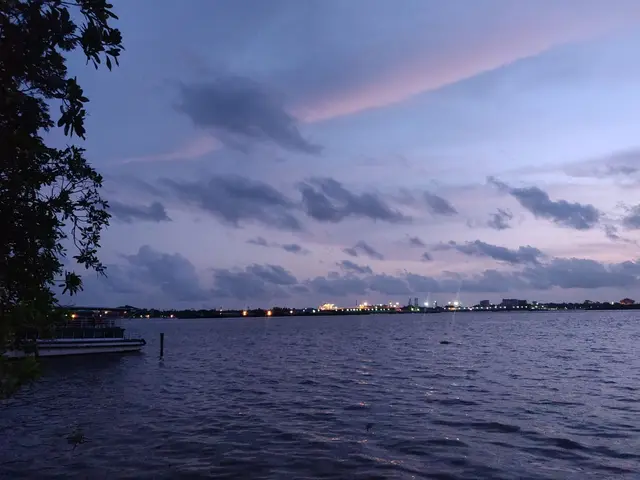
Willingdon Island is a hundred-year-old piece of ground that was a lake bottom, and you can walk its waterfront and read the whole harbour story off it.
The Cochin Port Authority building, seen from a ferry, is one of the more striking modern buildings on the Kerala coast and almost nobody photographs it.
Cochin Harbour Terminus is a 1943 railway station on a made island that no train has reached since 2013 — locked, intact, and quietly extraordinary.
The metro from Aluva to Thrippunithura is the cheapest way to understand how the city is arranged, and its stations are run by Kudumbashree.
Everything on the peninsula is twenty minutes away by boat, and the mainland is cheaper to sleep and eat in by a wide margin.