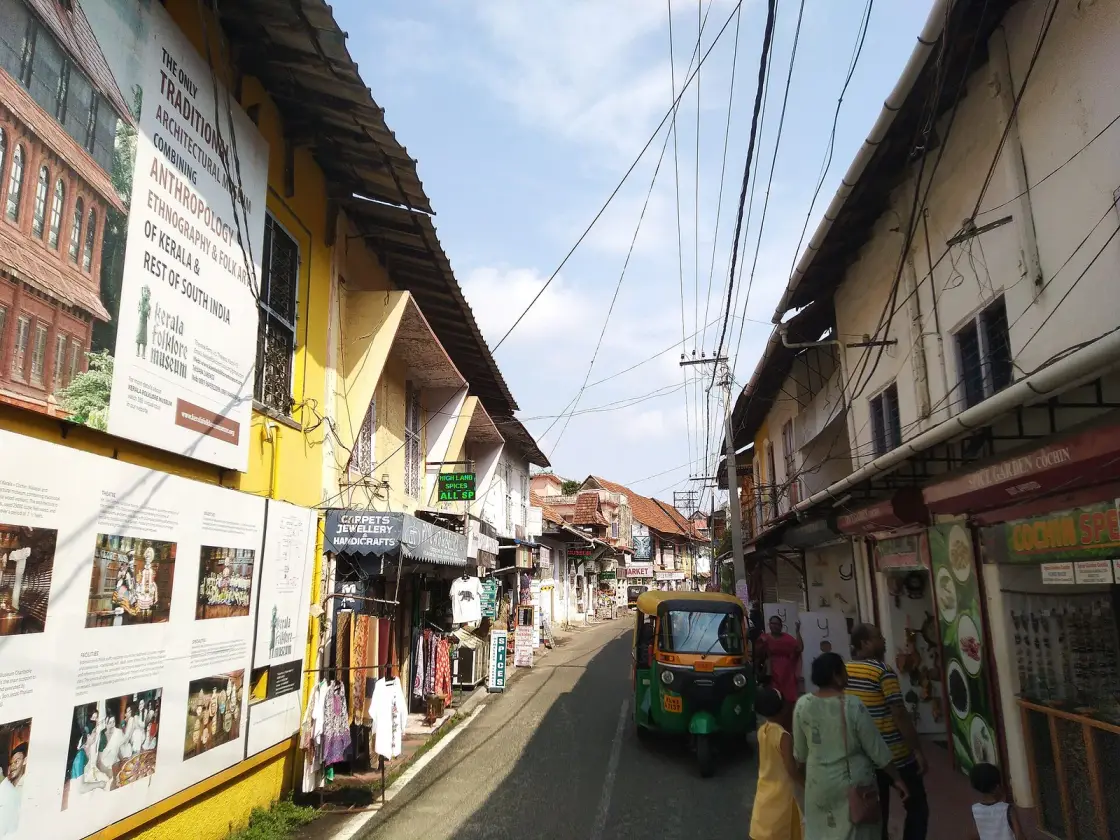
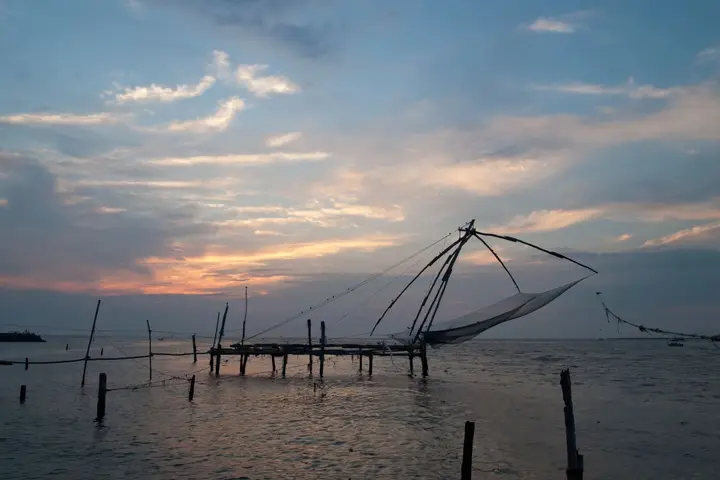
Mattancherry is not a street, and for a hundred years it was not part of Kochi either. It was a municipality — its own council, its own sanitary board from 1896, its own budget — and on 9 July 1960 that council passed the resolution that abolished it, asking the government to fold Mattancherry, Ernakulam and Fort Cochin into a single corporation. Fort Cochin’s councillors fought it. They lost, and on 1 November 1967 the three towns became one city. What is left is a quarter that still behaves like a town: wards with their own names and their own communities, a waterfront built entirely out of warehouses, four merchant diasporas that each arrived for a particular commodity, and a shutter-down hour in the early evening that no amount of tourism has moved.
Start with what the name covers, because almost every visitor uses it to mean about six hundred metres. Mattancherry proper is the southern half of the Kochi peninsula, roughly nine or ten kilometres from the mainland city centre, and it is made of wards: Kochangadi, Cherlai, Gosripuram, Panayappilly, Kappalandimukku, Karippalam, with Palluruthy immediately beyond. The 2011 census recorded 10,144 people in the Mattancherry ward itself — 5,035 men and 5,109 women — with literacy at 85.70 per cent and just under 11 per cent of residents aged six or under. Those are ward figures, not quarter figures, and the distinction matters: the thing people photograph is a fraction of the thing that has an address.
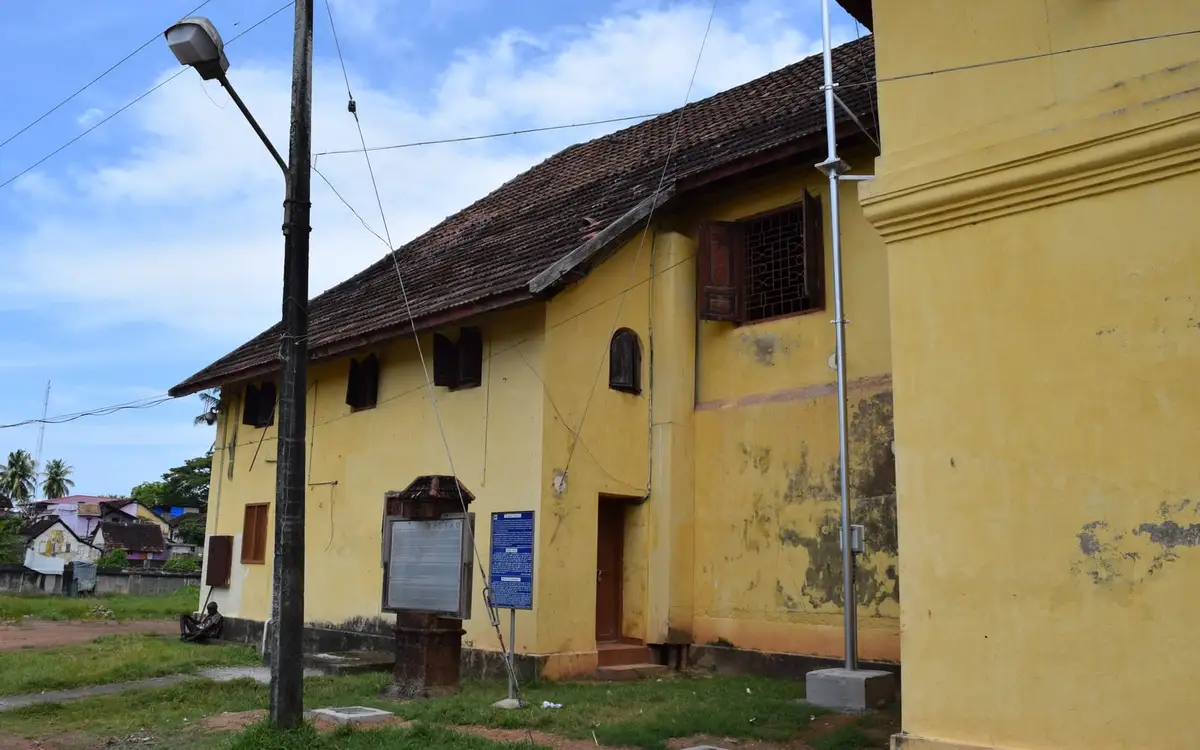
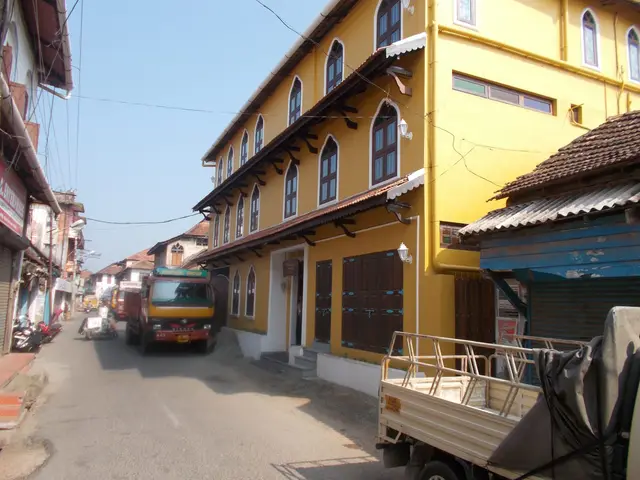
The building type is the key to the whole place and it is easiest to read from the water. A Mattancherry godown was built to face two ways: the front door onto the road for the carts and the bookkeeping, and a private jetty at the back opening onto the lagoon for the boats. Floors were laid in wooden panels, which resist damp and discourage pests better than stone in a climate that ruins a consignment in a fortnight. Take a ferry across and the waterfront resolves into exactly that — a continuous rank of tile-roofed sheds with their working sides turned to the water, and a few colonial houses among them. It is a town built back-to-front on purpose.
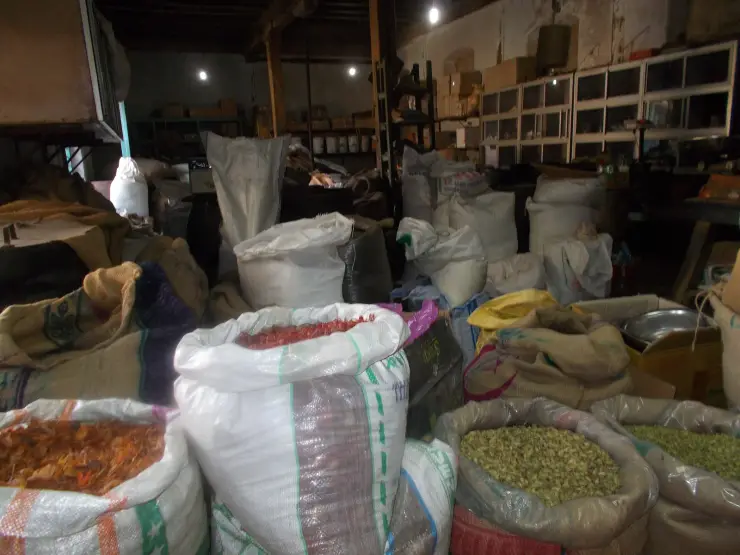
What went through those doors was never only pepper. Under Dutch rule between 1663 and 1795, Kochi grew rich on spices, coir, coconut and copra together — dried coconut kernel pressed for oil and sold on for feed, and coconut-husk fibre worked into matting and rope. Copra and coir are bulk trades rather than glamorous ones, and they are the reason the warehouses are the size they are. A quarter that handled only cardamom would not have needed this much floor.
The communities here are trade diasporas, not a decorative mosaic, and each one can be traced to a commodity and a decade. The Gowda Saraswat Brahmins came down from Goa in the sixteenth century. Jain families from Kutch and Saurashtra came for the spice business. Gujarati Hindu merchants settled the street that still carries their name. And from about 1815, a group of Memon Muslim businessmen from Kutch established themselves in Kochi, and the influx that followed built one of the quarter’s durable commercial communities — a people whose roots run back through Kutch to Sindh, who speak a language mixing Sindhi and Gujarati, and who put a good deal of their money into charitable trusts here.
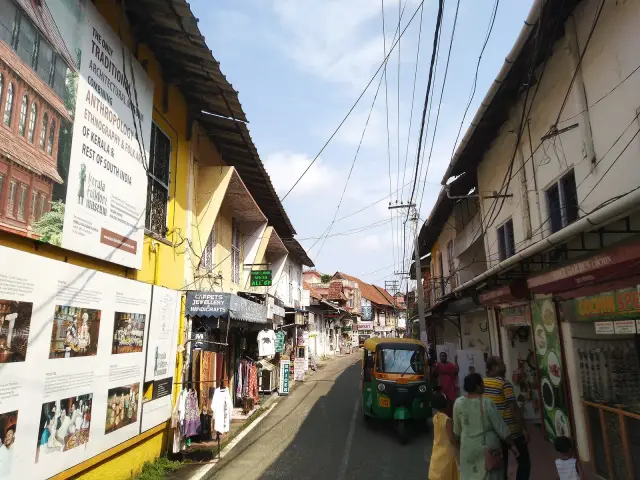
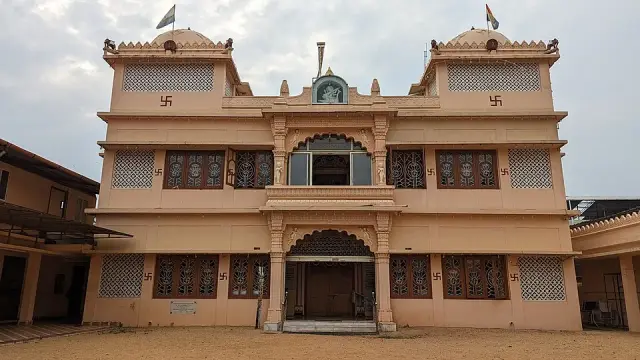
Gujarati Street is the clearest surviving example of what a merchant street does with its own calendar. Navaratri, Holi, Shivaratri and the Ganapati festival are all kept there in a form that is recognisably Gujarati rather than Keralan, in a lane of a Malayalam-speaking city, several generations after the families that brought them arrived. It is a small street and it is not a sight; it is a working address where a community decided not to assimilate its holidays.
The Muslim quarter of Mattancherry is older than any of that and gets almost no attention. Chembitta Palli in Kochangadi was built somewhere between 1520 and 1540, founded by the Sufi Syed Moulana Bukhari Thangal and funded by the King of Kochi, and it is one of the oldest mosques in Kerala. The name is literal: chempu is copper and palli is mosque, and the roof was once laid in copper tiles. It is built in the Kerala-Islamic manner — timber beams, temple-and-house proportions rather than imported domes — with three gates facing Panayappilly, Kochangadi and the bazaar, Tamil and Arabic inscriptions over the prayer-hall doors, and old gravestones by the southern gate. It is an active Friday mosque, so treat it as one.
Getting here changed in 2025 and the change is worth planning around. On 11 October 2025 the Chief Minister opened the Mattancherry Water Metro terminal on Jew Town Road — a station built entirely on the water — completing the High Court–Willingdon Island–Mattancherry route. Fares on the network run roughly ₹20 to ₹40, and arriving by boat puts you at the Jew Town end rather than depositing you in traffic at the bus stand. It is also the only way to see the godown waterfront the way it was designed to be seen.
The other thing to plan around is the hour. This is a commercial quarter, not an entertainment one: the shutters come down through the late afternoon and by nightfall Bazaar Road is a lit, empty street of closed timber shopfronts. That is not decline in itself — a wholesale district has no reason to stay open — but it does mean that an evening visit shows you an empty stage. Come on a weekday morning if you want the town working, and arrange your ride back before the light goes.
And keep the relationship with Fort Kochi the right way round. Fort Cochin was the European fort town and became a municipality on 1 November 1866; Mattancherry, on the Raja’s side of the water, did not get even a sanitary board until the Maharaja created one in 1896. The two were separate towns with separate councils for a century, and when amalgamation came it was Mattancherry that proposed it and Fort Cochin that resisted. They adjoin, they are twenty-five minutes apart on foot, and they have never been the same place.
Legend & myth
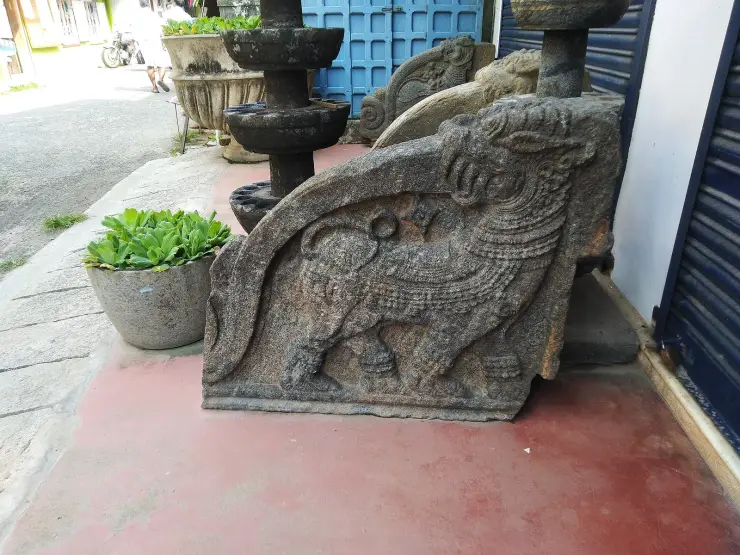
The largest claim made in Mattancherry is carved in granite and almost nobody who visits the quarter ever reads it. On a relief panel at the Coonan Cross church in Mattancherry, an English plaque reads “Leaning Cross Oath — Declaration of Independence — 3rd January 1653 - AD”, and the Malayalam beneath it goes further: ഭാരത്തിലെ ഒന്നാം സ്വാതന്ത്ര്യസമരം — “India’s first freedom struggle”. The relief shows ranks of men holding a rope that runs to a leaning cross, with the outline of India behind them. That is a very large reading of the event, and it is worth taking seriously before deciding what to do with it.
What is not in dispute is that something happened here on 3 January 1653. The Saint Thomas Christians of the Malabar coast — an ancient Eastern church that had been placed under Portuguese Padroado jurisdiction and Latinised by the Synod of Diamper in 1599 — assembled in Mattancherry and swore never again to submit to the Portuguese or to the Jesuits. The community split into the Pazhayakoottukar, the Old Allegiance, who returned to Rome, and the Puthenkoottukar, the New Allegiance, who did not, and almost every Syrian Christian denomination in Kerala today traces its line through that fork. A church-governance revolt in a Kochi side street reorganised a religion.
The bent cross is the part that is tradition rather than record. In the telling, the crowd was too large for everyone to touch the granite cross, so ropes were tied to it and held instead — and under the weight of so many hands the cross leaned. Whether a granite cross physically bent is not something any source establishes, and it is the sort of detail that improves in the retelling. But the name is the evidence that the story is old: koonan kurishu, the bent cross, is what the event has been called for centuries, and a name that specific does not usually arrive late.
There is also a disagreement about which building, and it sits inside this one town. The standard account puts the oath at Our Lady of Life Church, a sixteenth-century Roman Catholic church in Mattancherry — its own record is uncertain enough that Wikipedia’s text says sixteenth century while its infobox says AD 1600. The Orthodox Koonan Kurishu Pilgrim Centre, also in Mattancherry, holds the memory, the memorial relief and the pilgrimage. Two churches on opposite sides of a 372-year-old schism both keep the same afternoon, a few hundred metres apart. We are not going to adjudicate that, and you should be suspicious of any guide who does.
One number attached to the oath deserves a caution. It is often written that after Mattancherry, out of some 200,000 Saint Thomas Christians, only 400 remained loyal to Archbishop Garcia. That figure comes from the chronicle of an interested party in an ecclesiastical quarrel, not from a census, and both halves of it — the size of the community and the size of the remnant — are round in the way that polemical numbers are round. Use it as a description of a rout, not as a count.
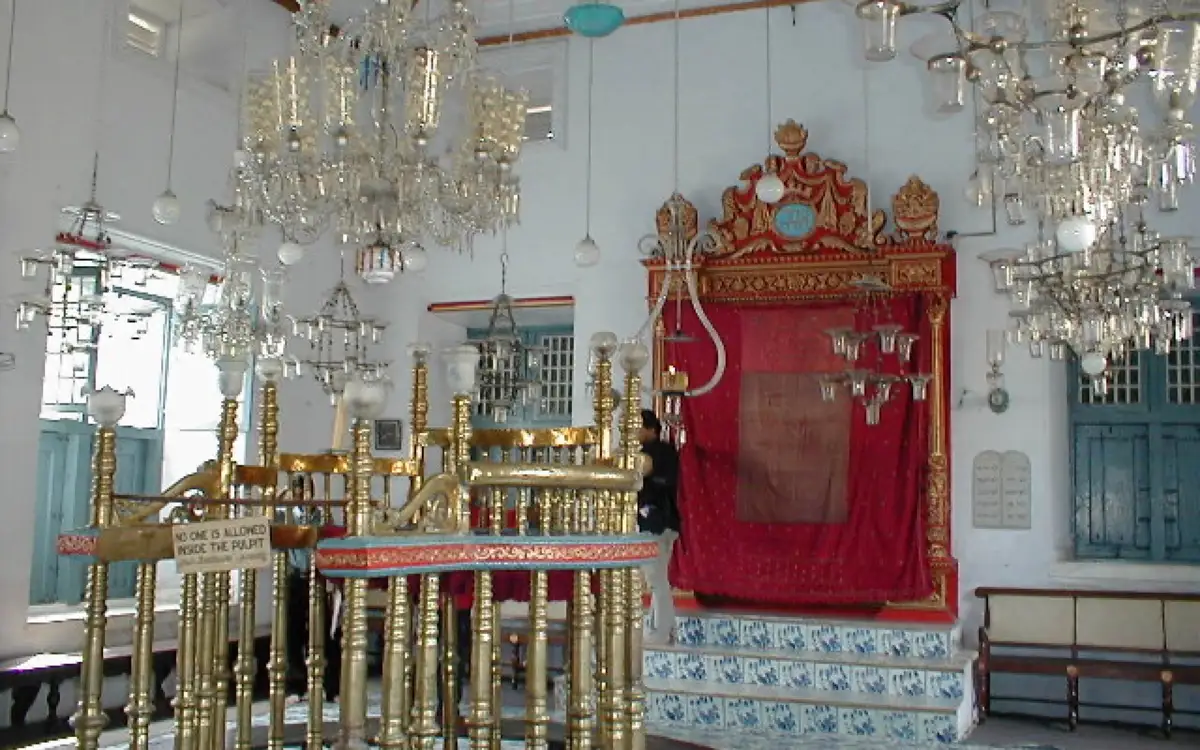
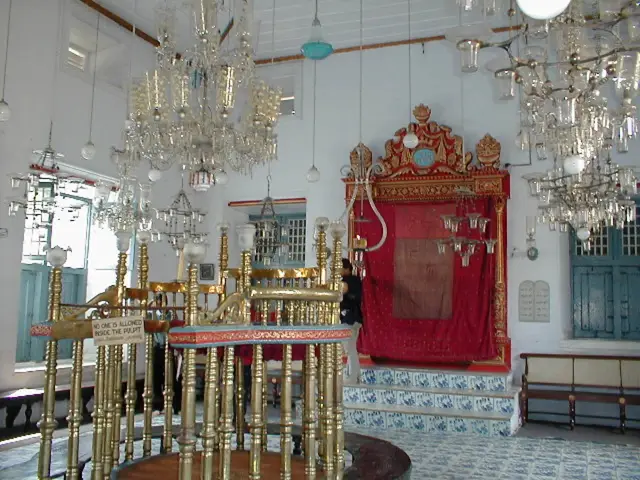
The second great Mattancherry claim is a slab of stone, and this one checks out. In the ward of Kochangadi, Malabari Jews who had left Cranganore built a synagogue in 1344, and its Hebrew foundation inscription records the year 5105 and describes the building as an abode for the spirit of God. It is the oldest known relic from any synagogue in India. The founding is attributed to Joseph Azar, remembered as the seventy-second heir of Joseph Rabban, and accounts of why the community moved differ — a catastrophic flood in 1341, Portuguese pressure, or a quarrel within the community.
The stone’s afterlife is stranger than its origin. The Kochangadi synagogue was destroyed during Tipu Sultan’s raids into Kerala, and here the sources contradict each other openly: some place it in the 1780s and name the Second Anglo-Mysore War, others give 1789, which falls outside that war altogether. We print both because they cannot both be right and we cannot settle it. What is agreed is what followed. The building was never rebuilt; the congregation carried the inscription north and set it into the Kadavumbhagam synagogue in Mattancherry, where it was plastered over and forgotten until 1818, when the plaster fell away and revealed it. It is now inset in the east wall of the Paradesi Synagogue’s courtyard. The ruins at Kochangadi survived into the late twentieth century under the local name Misro Palli, and nobody knows where that name came from either.
The quarter’s smaller legends run the same way — inter-communal, commercial, and about materials. The tradition at Chembitta Palli is that a Jewish merchant, overhearing the Sufi saint recite from the Old Testament, recognised what he was listening to and donated the timber for the mosque, which the Raja of Kochi then paid to finish. It is a story about a Hindu king, a Muslim saint and a Jewish trader building one roof, told in a ward where all three lived within a few hundred metres, and it is exactly the story a trading town tells about itself. Enjoy it as that. The harder and better-documented account of how these communities actually treated one another is on our Cochin Thirumala Devaswom and Paradesi Synagogue pages, and it is not nearly as comfortable.
More about Mattancherry
History
Mattancherry’s recorded municipal life begins late and separately from Fort Cochin’s. Fort Cochin became a municipality on 1 November 1866 under British administration. Mattancherry lay on the Cochin Raja’s side, and it was only in 1896 that the Maharaja constituted separate sanitary boards for Mattancherry and for Ernakulam — the first formal local administration either place had. From there Mattancherry grew into a municipality with its own council, and in 1962 part of the Palluruthy panchayat was merged into it.
The end of the town as an administrative unit was its own decision. On 9 July 1960 the Mattancherry Municipal Council passed a resolution asking the Government of Kerala to create a Cochin Municipal Corporation by amalgamating Ernakulam, Mattancherry and Fort Cochin. The Fort Cochin council opposed the proposal strongly. The Kerala Assembly approved the formation of the Corporation on 1 July 1967, and the Corporation of Cochin came into being on 1 November 1967, combining the three municipalities with Willingdon Island, the panchayats of Palluruthy, Vennala, Vyttila and Edappally and two small islands — 83.524 square kilometres at formation. The city now covers 94.88 square kilometres and recorded 677,381 residents in 2011.
The commercial history the buildings were raised for is older and simpler. Kochi’s harbour drew Chinese, Arab, Portuguese, Dutch and English merchants, and under Dutch control from 1663 to 1795 the port prospered on spices, coir, coconut and copra. The Mattancherry godown — road door at the front, private jetty at the back, wooden-panelled floors — is the physical form that trade took, and the reason the quarter’s waterfront is a wall of warehouses rather than a promenade.
The Jewish chapter of the town starts in Kochangadi in 1344 and ends, more or less, in living memory. The Kochangadi congregation moved north to Jew Town after their synagogue was destroyed in Tipu Sultan’s raids, and the community was thought to be settled in Kochi by no later than 1795. Emigration to Israel began in earnest in the early 1950s, with the largest single year in 1954. The 2001 census of India recorded 51 Jews in the whole state of Kerala; recent estimates put the number remaining in Kochi at fewer than twenty, and in Kerala at under thirty-five. Sarah Jacob Cohen, the Jew Town embroiderer widely described as the last of her generation on the street, died in 2019.
In 1653 the town was briefly the centre of a much larger story. The Coonan Cross Oath of 3 January that year rejected Portuguese Padroado authority over the Saint Thomas Christians and split the community into the Pazhayakoottukar and the Puthenkoottukar; the modern Syro-Malabar, Jacobite Syrian, Malankara Orthodox and Mar Thoma churches all descend from that division. Reconciliation with Rome for a large part of the community was managed from 1662 by Msgr Giuseppe Sebastiani.
The most recent entry is transport. On 11 October 2025 the Mattancherry Water Metro terminal on Jew Town Road was inaugurated by Chief Minister Pinarayi Vijayan, together with the Willingdon Island terminal, completing the High Court–Willingdon Island–Mattancherry route of the Kochi Water Metro — a 78-kilometre, fifteen-route electric ferry network. The terminal is built entirely on water. For the first time since the godown jetties fell out of use, the quarter has a working front door on the lagoon again.
Why visit
It is a town rather than a sight, and the parts with no ticket — Kochangadi, Cherlai, Gujarati Street, the bazaar beyond the cafes — are where it still behaves like one.
The waterfront reads as a single continuous piece of industrial architecture from the ferry: rank after rank of tile-roofed godowns with their jetties and working doors facing the water.
Four merchant diasporas kept their language, calendar and buildings in one square kilometre — Konkani, Gujarati, Kutchi Jain and Kutchi Memon — and you can walk between all four in under half an hour.
Two events of national consequence happened here: the Coonan Cross Oath of 1653, which reorganised Kerala’s ancient Christianity, and the 1344 Kochangadi synagogue inscription, the oldest dated Jewish relic in India.
Chembitta Palli in Kochangadi, built between 1520 and 1540 with a roof once laid in copper tiles, is one of Kerala’s oldest mosques and almost never appears on a Kochi itinerary.
Since October 2025 you can arrive by Water Metro directly onto Jew Town Road, at a terminal built entirely on the water, for the price of a bus ticket.