Theyyam performances

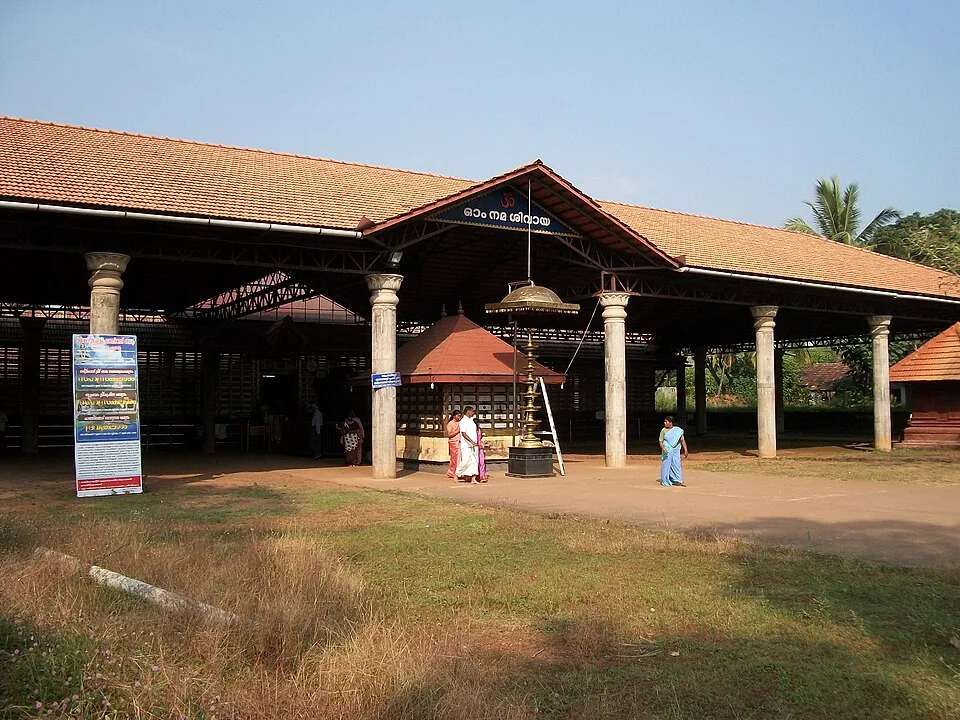
The first thing to understand is that this is not a place, and the map on this page is being honest with you about that. Theyyam is a season, not an address: between the tenth of Thulam and the middle of Edavam it is performed at several hundred kavus, kottams and family shrines scattered across Kannur and Kasaragod, most of them a lane and a rice field away from anywhere signposted, each on its own date. The pin here is the Parassinikkadavu Muthappan temple, 18.33 km north of Kannur railway station, because it is the one shrine that performs on a published daily schedule instead of waiting for its year to come round. It is an anchor for planning, not the subject.

Theyyam performances, Kannur city
Practical guide

Plan Theyyam performances

Who's going?Tailor Theyyam performances to your trip
Before you go to Theyyam performances

Open to visitors of all faiths.Parassinikkadavu admits everybody regardless of caste or religion, which is what it is known for and is unusual among Kerala temples; Kerala Tourism describes devotees of all religions as free to go round the temple and up to the sanctum. Village kavus publish no entry policy — visitors are generally made welcome, but you are a guest at a private act of worship and should ask.

Dress code
Dress modestly and cover the legs. Beyond that the published guidance genuinely conflicts: several accounts say men wear a mundu with the shirt removed, while another states there is no clothing restriction for entering the madappura, and the temple itself publishes no rule. Ring 0497 278 0722 and ask if it matters to your plans.
Footwear, bags & phones
Footwear is left outside, as at Kerala temples generally. Cameras and mobile phones are reported to be prohibited inside the temple; this is not published by the temple itself, so confirm on the telephone if you intend to carry either.
Darshan & ritual times
Thiruvappana and Vellattam are performed from about 05:45 to 08:00 in the morning and from about 18:30 in the evening, with the temple open 05:00 to 20:00. These are the ritual times rather than the opening hours, and they are what people come for.
Busiest season
Puthari Thiruvappana, the first Thiruvappana of the ritual year, falls on Vrischikam 16 — the first or second of December — and is the temple’s great annual occasion. In the village kavus, the crowded months are January to April.
  • Food is given away rather than sold: prasadam from 07:30, lunch 12:30 to 14:30, dinner 20:30 to 21:30.
  • The offerings here are dried fish, toddy, boiled black gram and tea, which is not what a Kerala temple usually receives and is part of why this one admits everyone.
  • At a village kaliyattam, ask the shrine’s own people where to stand and whether to photograph, before doing either.

Checked 31 August 2026 against source 1source 2source 3source 4. Check the institution’s current rules and visiting session before travelling.

Typeheritage
AreaKannur city
DistrictKannur
Best timeMid-October to late May is the season,…
Time neededA whole evening and often a whole night
EntryNothing is ticketed
Places to visit4Listed businesses40

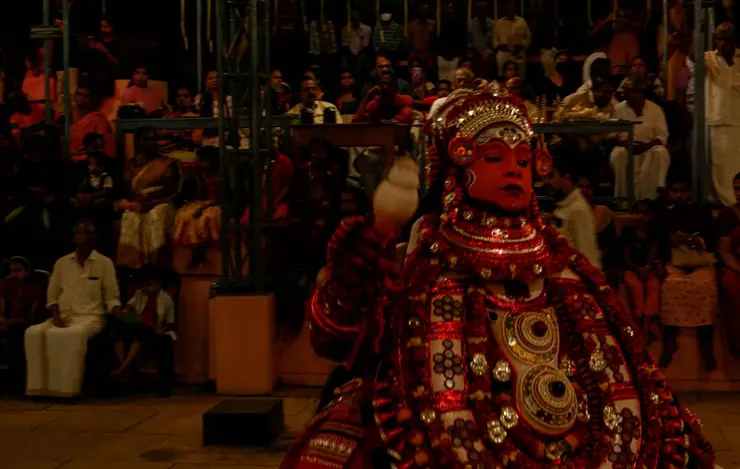
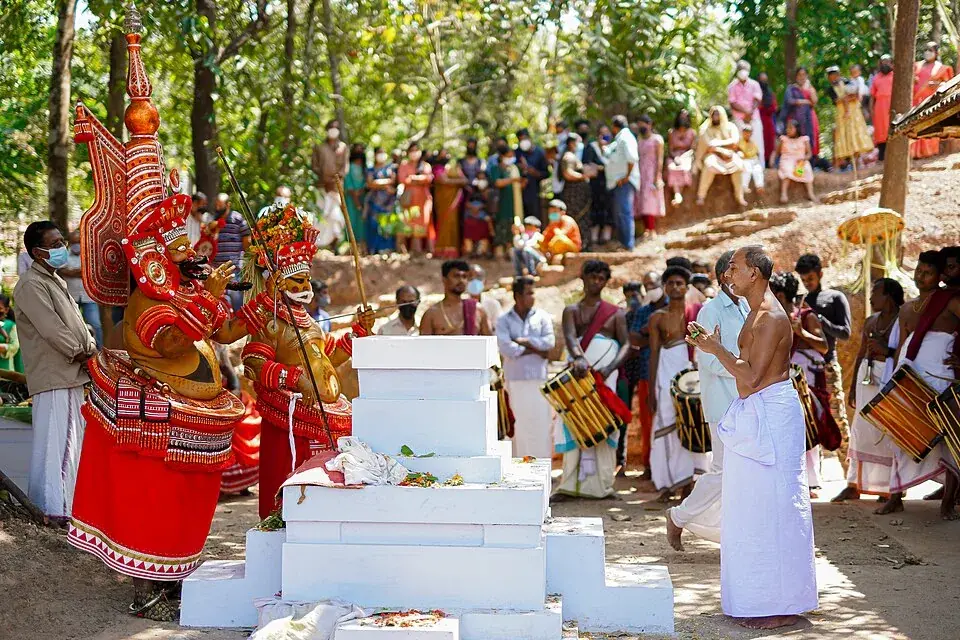
What happens is that a man is turned into a god and then turned back. Over hours of drumming and ritual song a performer from the Vannan or Malayan community is painted in rice flour, turmeric and charcoal, dressed in coconut frond and lacquered wood, and crowned with a mudi that can stand taller than he does; when the headdress goes on, the shrine treats him as the deity. People who would not otherwise be spoken to by the village bring him their troubles, and he answers them by name, for as long as it is on.

The story

Theyyam is not a dance that represents a god. For the hours the headdress is on, the shrine, the village and the man himself take it that the god is present and the man is not, and people bring him the things they would not say aloud to anyone — a debt, an illness, a son who has stopped speaking to them — and he answers them by name. Then it comes off. What makes this the most extraordinary thing to see in north Kerala is not the fire or the costume; it is that the person the whole village kneels to is, an hour later, someone most of them would not have eaten beside within living memory.

The story of Theyyam performances

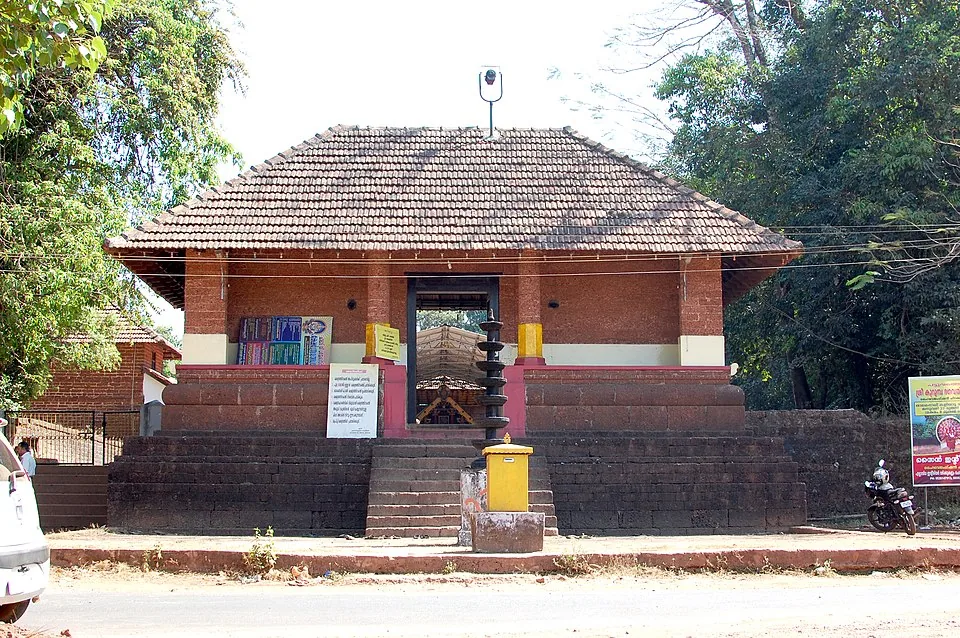
It runs on the Malayalam calendar, not on yours. The season opens on the tenth day of Thulam, around the third week of October, at Kolacheri east of Kannur, and closes seven and a half months later around the middle of Edavam at Kalarivathukkal by the Valapattanam river, 7.63 km from Kannur railway station. In between it moves from kavu to kavu across Kannur and Kasaragod on a rota no single authority sets: each shrine has its own days, fixed by its own reckoning, and the villages around it have known them since long before anyone thought to write them down for visitors.

A kaliyattam is a night, not an hour. The performer eats little and keeps a period of ritual discipline beforehand; on the day he is painted freehand in patterns that have their own names, in rice flour, turmeric and charcoal ground into coconut oil, and the face alone can take most of an afternoon. Around the painting the costume is built on the ground out of split palm leaf, cloth, lacquered wood and silver — a heap of components with a knife lying beside it. The mudi, the headdress, can stand taller than the man who will carry it. First he dances the vellattam, in a small red head-cloth and no great costume, while the thottam songs tell the deity’s story to the drums. Then the mudi is fitted, and from that moment nobody in the courtyard addresses him as himself.

The costume is worth more than most of the men wearing it earn in a season. A single headdress, or a set of silver anklets, runs to twenty-eight or thirty thousand rupees, and the performing family buys and keeps it. Against that: a performer interviewed about a day in 2018 was paid a thousand rupees for three Theyyams; another, for three in 2016, two and a half thousand, divided among five to eight assistants. Drummers take a thousand to fifteen hundred for the day. A survey of two hundred performers found most owned under five cents of land and had no social security of any kind, and the state pension attached to the senior artists among them stood at seven hundred rupees a year.

The right to perform is hereditary, and it is territorial. Nine communities hold it — the Vannan and Malayan above all, with the Velan, Pulayan, Mavilan, Anjoottan, Munnoottan, Koppalan and others — and every one of them is a Scheduled Caste or Scheduled Tribe. A family’s right attaches to particular shrines and does not travel; performing outside them is not done. Which makes the sanction available to a shrine that falls out with its performer close to total, and it has been used: a man barred at Pappinisseri in 1986 over money and replaced by another community’s performer, another banned outright at Annur in 2006 after a disagreement about ritual. In 1932 at Mattul, a performer’s father and two relatives lost their rights for bathing in a pond a higher-caste community reserved for itself.

The reversal at the end of the night is the part nobody photographs. The same man who has been touched, embraced and asked for blessings by the whole village goes back to where caste puts him. In April 2021 at Kunhimangalam in this district, a Theyyam performer receiving an award was the one man on the platform the officiating priest would not drape with the honorary shawl by hand. At some shrines, performers from the Nalkadaya, Mavilan and Velan communities still dance outside the courtyard at a set distance from it — and the performers themselves say there is no basis for the distance.

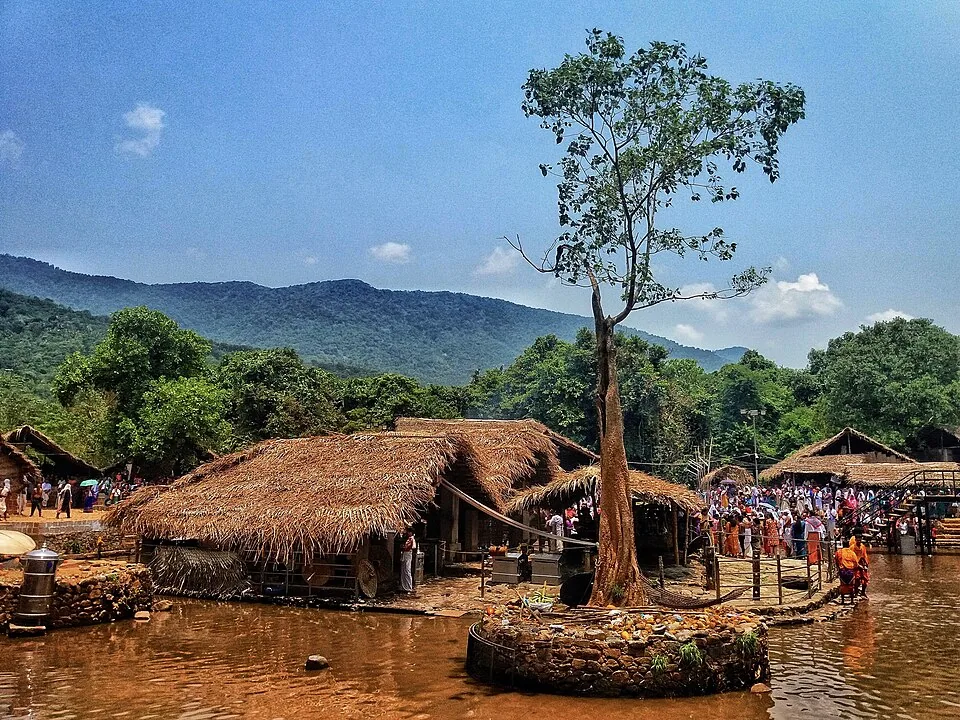
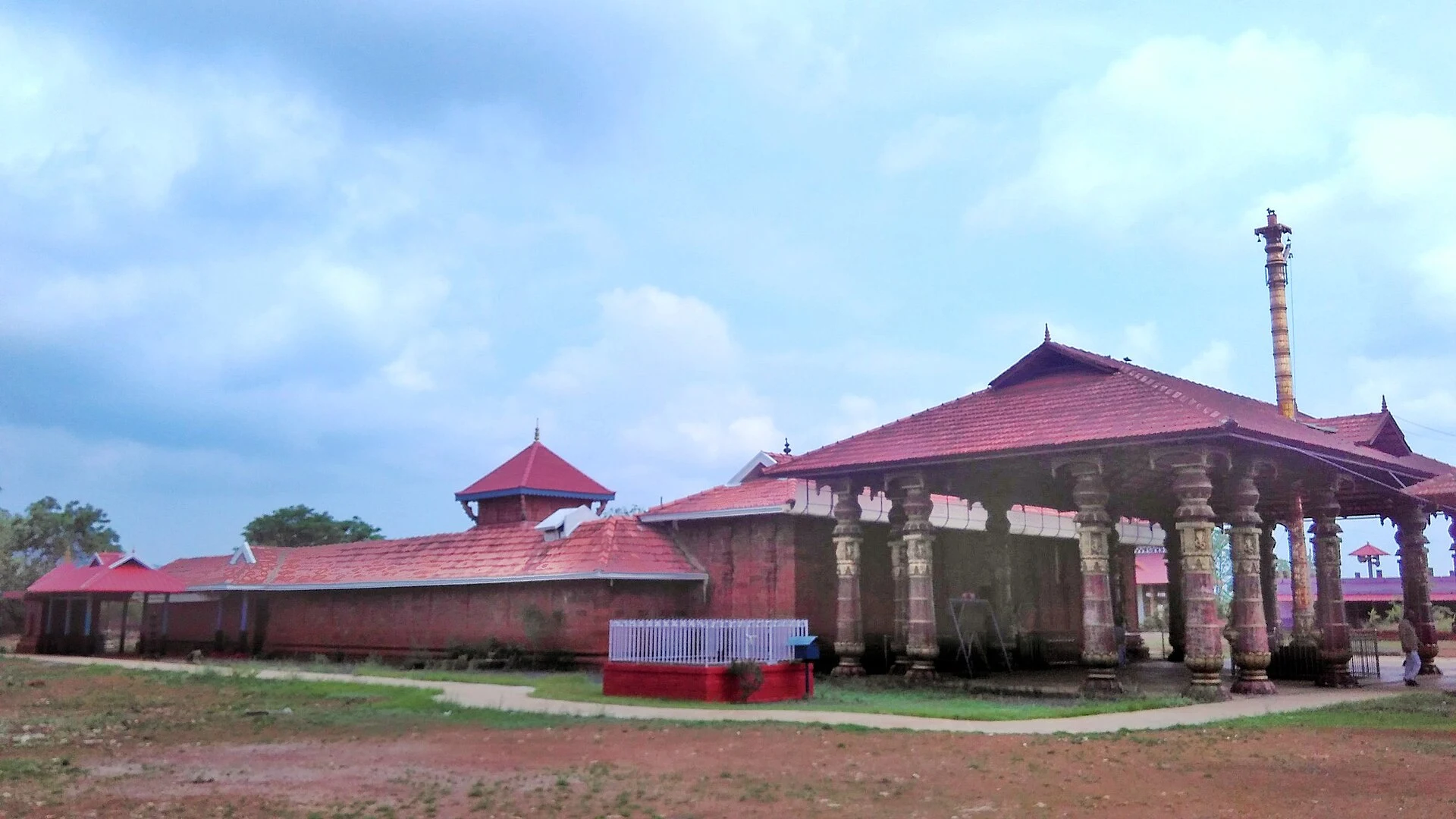
The exception to all of it stands 18.33 km north of Kannur station at Parassinikkadavu, on the west bank of the Valapattanam. There, Theyyam is not a festival event but the ordinary daily form of worship: Muthappan is performed morning and evening, by men of the Vannan community, on nearly every day of the year, and the temple admits everybody regardless of caste or religion. Muthappan is offered dried fish, toddy, boiled black gram and tea, and the first share of what is handed out goes to a dog before any person gets it, because the god is said to keep one. It is the answer for anyone whose dates will not fall — and, being a shrine with a calendar of its own, it has one catch of its own.

Legend & myth

Muthappan was not born grand. The story told at Parassinikkadavu makes him a foundling raised in the Mannanar house at Eruvessi, a boy who would not behave as a boy of that household should: he hunted, he ate meat and fish, he drank toddy, he kept the company of people the house did not keep company with. When his mother Padikkutty Amma challenged him he showed her, for a moment, what he actually was, and she let him go. The shrines that took him in are Madappuras rather than temples — which is why his worship still has fish and toddy in it, and why it never acquired the rules that would have kept most of his devotees outside.

Pottan Theyyam is an argument rather than a story. Shiva, in the form of a Pulaya — a man of a community treated as untouchable — stands in the way of the philosopher Adi Shankara on a narrow mountain path and will not stand aside. He asks what makes the two of them different, and puts it in terms nobody can dodge: if you cut me and you cut yourself, is the blood a different colour? The Theyyam that performs this is danced by a man from one of the communities the question is about, in front of villages built on the answer being no in principle and yes in practice.

Kathivanoor Veeran was a man before he was a deity, and not a distinguished one. Mandappan of the Thiyya community quarrelled with his family, left for Coorg, and was killed in a fight far from home; his wife followed him onto the pyre. He is one of the Hero Theyyams — ordinary people raised to godhood for the manner of their living and dying rather than for anything cosmic — and women in this part of Kannur have asked him for a good husband ever since.

Devakkoothu is the exception that shows how firmly the rest is held. At the Koolom Thazhekkavu shrine on Thekkumbad, near Cherukunnu, one Theyyam and only one is performed by a woman: the goddess Valliyamma, who is said to have wandered into a flowering thicket and lost her way until the sage Narada found her. It comes round once every two years, in the Malayalam month of Dhanu, which falls in December.

Read the full history of Theyyam performances 449 more words

History

Older than the records. Kerala Tourism dates the ritual to more than eight centuries, which is a floor rather than a measurement. What is not in doubt is that it belongs to the religious world of north Malabar that predates the temple orthodoxy layered over it, and that its deities are heroes, ancestors, snakes, smallpox and the dead at least as often as they are anything out of a Sanskrit text.

How many there are is genuinely disputed, and the disagreement is between official sources rather than between an official and a rumour. Kerala Tourism says nearly four hundred; the district tourism council says over four hundred; English Wikipedia says about four hundred and fifty-six, of which a hundred and twelve are well known; the Malayalam article says around five hundred exist and about a hundred and twenty are performed with any regularity. All four are set down here because no census of a living ritual spread across two districts has ever actually been taken.

The rare form is the Perumkaliyattam, which a shrine holds not annually but once in twelve years, or twenty-five, or longer, and which the villages around it spend a great deal of money and a year of preparation on. Most people living beside a kavu will see a handful in a lifetime. Some will see one.

The state took an interest late and unevenly. The Kerala Folklore Academy has sat at Chirakkal in this city since it was established to document and support the folk arts, and its fellowship is the closest thing to formal recognition a Theyyam artist receives — the 2015 fellow, P P Kunhiraman Peruvannan, is among the senior practitioners of the Vannan community. The pension that went with that recognition was seven hundred rupees a year.

Why visit

The season’s two ends are both here. It opens at Kolacheri and closes at Kalarivathukkal, and no other district can say that.

It is unstaged. Nobody sells a ticket, nobody sets a start time to suit an audience, and the people standing beside you are there to be blessed rather than entertained.

The god answers. A Theyyam speaks to individual people at length, by name, about their own circumstances — which is not something you can watch anywhere else in the country.

Kannur is where the season begins and where it ends, and both bookend shrines are a short drive from the city.

Parassinikkadavu removes the one thing that usually defeats a visitor, the calendar, by performing on a fixed daily schedule and admitting everybody.

The craft alone would carry the trip: the mudi, the mukhathezhuthu drawn freehand, the poykkannu, the chilampu — made or fitted by the performing family rather than bought in.
What to expect

Highlights

  • A ritual, not a performance — the god speaks to individual devotees, out loud, in Malayalam, and answers them.
  • The Parassinikkadavu Muthappan temple, where Theyyam is the daily form of worship and not a festival event, and where entry is open to all castes and religions.
  • A costume assembled on the ground in front of you from split palm leaf, cloth, lacquered wood and silver — the mudi alone can be taller than the man wearing it.
  • Kandanar Kelan and the other fire Theyyams, who dance in and over burning embers with torches lashed to the headdress.
  • Devakkoothu at Thekkumbad, near Cherukunnu — the one Theyyam performed by a woman, and only once every two years.
  • The season's own bookends, both within reach of Kannur city: it opens at Kolacheri and closes at Kalarivathukkal, 7.63 km from the railway station.
Getting there

How to visit

  • Fix the date before the room. Nothing about this is arranged around visitors — a kaliyattam happens when the shrine's calendar says it does, and there may be nothing at all within an hour's drive on the night you have booked.
  • Use the state's Theyyam calendar as a directory of shrines and telephone numbers rather than as a calendar. Ring the contact it names for the kavu you want.
  • If the dates will not fall for you, go to Parassinikkadavu instead, where the same ritual happens twice a day for most of the year and needs no arrangement at all.
  • Turn up for the beginning, not the middle. The painting, the ritual songs and the fitting of the headdress are hours long and are most of what there is to understand.
  • Bring somebody who can explain what is being sung, or accept that you will watch the surface of it. The thottam songs carry the whole story and they are not translated for anyone.

Distance by road

  • Kozhikode92 km
  • Mangaluru143 km
  • Mysuru179 km
  • Coimbatore267 km
  • Kochi270 km

Road km to Kannur; ghat roads and traffic vary — allow extra.

Timing

Best time

Mid-October to late May is the season, and January to April is when most of it happens — the state's own shrine records for Kannur cluster in those four months. Outside the season the kavus are shut and there is nothing to see, with the single exception of Parassinikkadavu, which runs its own year in the opposite phase and closes for six weeks in exactly the autumn window when everywhere else is starting.

Weather in Theyyam performancesSeasonal guide

Live forecast loads in your browser.

Today at Theyyam performances
Sunrise6:17 am
Sunset6:21 pm
Golden hour best light5:21 pm–6:21 pm
Blue hour after sunset6:21 pm–6:46 pm
Sun sets toward compass bearingW · 268°
Moon tonight🌖 Waning gibbous · 97%
South-west monsoon. June to September is the south-west monsoon in Kerala. Expect heavy showers, mostly in bursts rather than all day — carry rain cover, allow extra time for getting around, and note that ferries and open-air sites are the first things affected.

Sun and moon are calculated for this location and shown in IST. Photography windows are the hour around sunrise and sunset; the sunset bearing is degrees clockwise from true north. Moon phase is accurate to about half a day.

Visitor notes

  • This is worship. The people around you are not an audience, they are there for the blessing, and the queue that forms is a queue to be spoken to.
  • The dates move with the Malayalam calendar and are set shrine by shrine, so anything printed in a Gregorian month is an approximation until a person at that kavu confirms it.
  • Nothing here is ticketed and nothing is scheduled for your convenience; a kaliyattam that was due at ten may begin at one.
  • The costume is not a symbol of the deity to the people watching. Treat the person wearing it accordingly, from the moment the headdress goes on to the moment it comes off.
  • Small shrines have no parking, no lighting on the lane and nowhere to buy a bottle of water at two in the morning.
Safety

Good to know

  • The fire Theyyams work with live embers and burning torches at close range, and the crowd is what keeps the ring open. Stand where the shrine's people tell you to stand.
  • Most of this happens in the dark on unlit village roads. Arrange the drive back before you go, rather than at four in the morning.
  • A kaliyattam draws a dense, slow-moving crowd into a small courtyard; keep a child within reach and know where the way out is.
  • The ground at a kavu is beaten earth and tree root, often wet, and the lighting is whatever the shrine has strung up.
Stay · eat · do · rent · see · shop

Stays, food & things to do near Theyyam performances

Verified hotels, homestays, restaurants, experiences, sights, shops and rentals around Theyyam performances — commission-free, with direct contact. Filter by what you need.

5 places to eat near Theyyam performances

Restaurant · Kannur city
MVK Heritage Foods Kannur
16.9 km · 22 min drive ~₹410–480 by taxi

Restaurant in Kannur city. Pamban Madhavan Road, Talap, opposite AKG Hospital, Kannur, Kerala 670002 · MVK Heritage Foods, Talap, Malabar food.

Directions Commission-freeView details
Cooperative head office · Kannur city
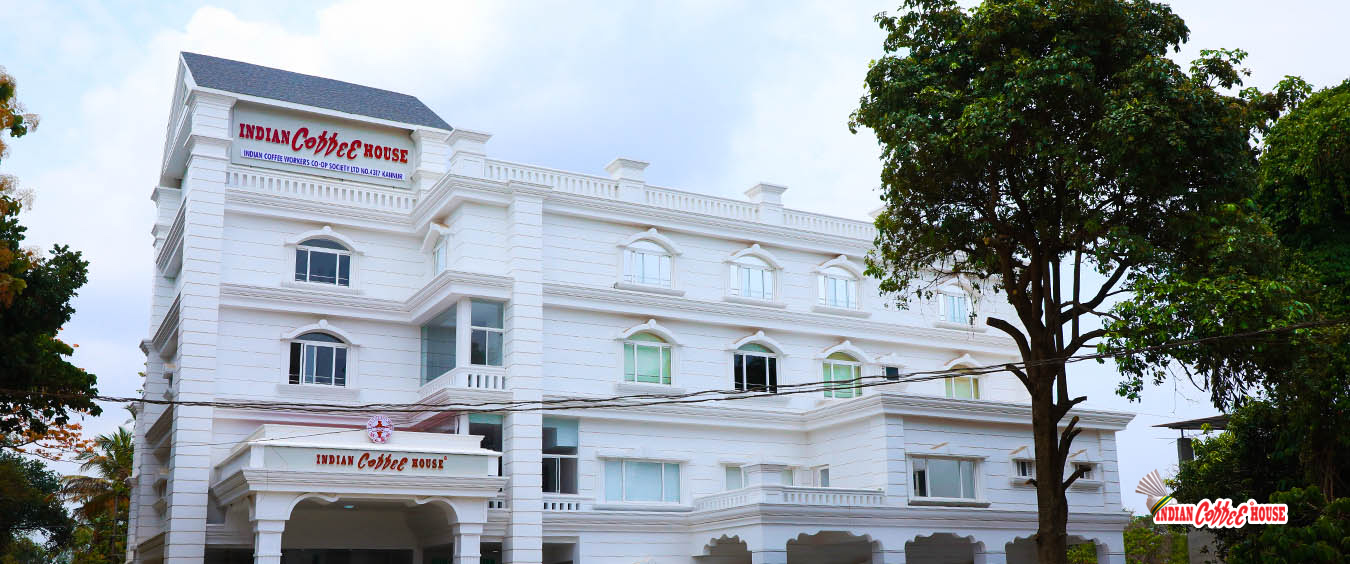
Indian Coffee House Kannur
17.7 km · 22 min drive ~₹420–500 by taxi

Indian Coffee House Kannur is the cooperative contact at M.H. Tower, Makkani, South Bazar. Choose the dining branch separately using the operator directory before requesting its menu, opening hours or a group booking.

Directions Commission-freeView details
Top pick
Café · Kannur city
Juishop
16.4 km · 21 min drive Closed now burger, ice cream, indian, local, tea ~₹400–470 by taxi

Café (burger, ice cream, indian, local, tea) on Thana Kakkad Road in Kannur City.

Directions Commission-freeView details
Top pick
Restaurant · Kannur city
kairali hotel
17.3 km · 21 min drive Open · till 10:00 pm regional ~₹420–490 by taxi

Restaurant (regional) on Kannur-Calicut-Valanchery Highway in Kannur City.

Directions Commission-freeView details
Restaurant · Kannur city
MVK Heritage Foods
16.9 km · 22 min drive Kerala / Malabar ~₹410–480 by taxi

Malabar restaurant on Pamban Madhavan Road in Talap, running over 25 years. Known for Malabar dum biriyani, plantain-leaf meals and Arabian Sea seafood.

Directions Commission-freeView details

Book with the place itself. India’s cyber-crime coordination centre warned in April 2025 that convincing copies of hotel and pilgrimage booking sites are being pushed through sponsored search and social ads, taking payment for rooms the property never hears about. Every listing here links to the business’s own contact details and its own Google or Bing profile — we take no commission and sit in nobody’s payment path. If a booking page reached you through an ad, check the address bar against the property’s own site before you pay. Fraud can be reported on cybercrime.gov.in or on 1930.

Ranked guides

Top experiences around Kannur city

8 more places around Kannur city. Open a guide to plan the visit and onward journey.

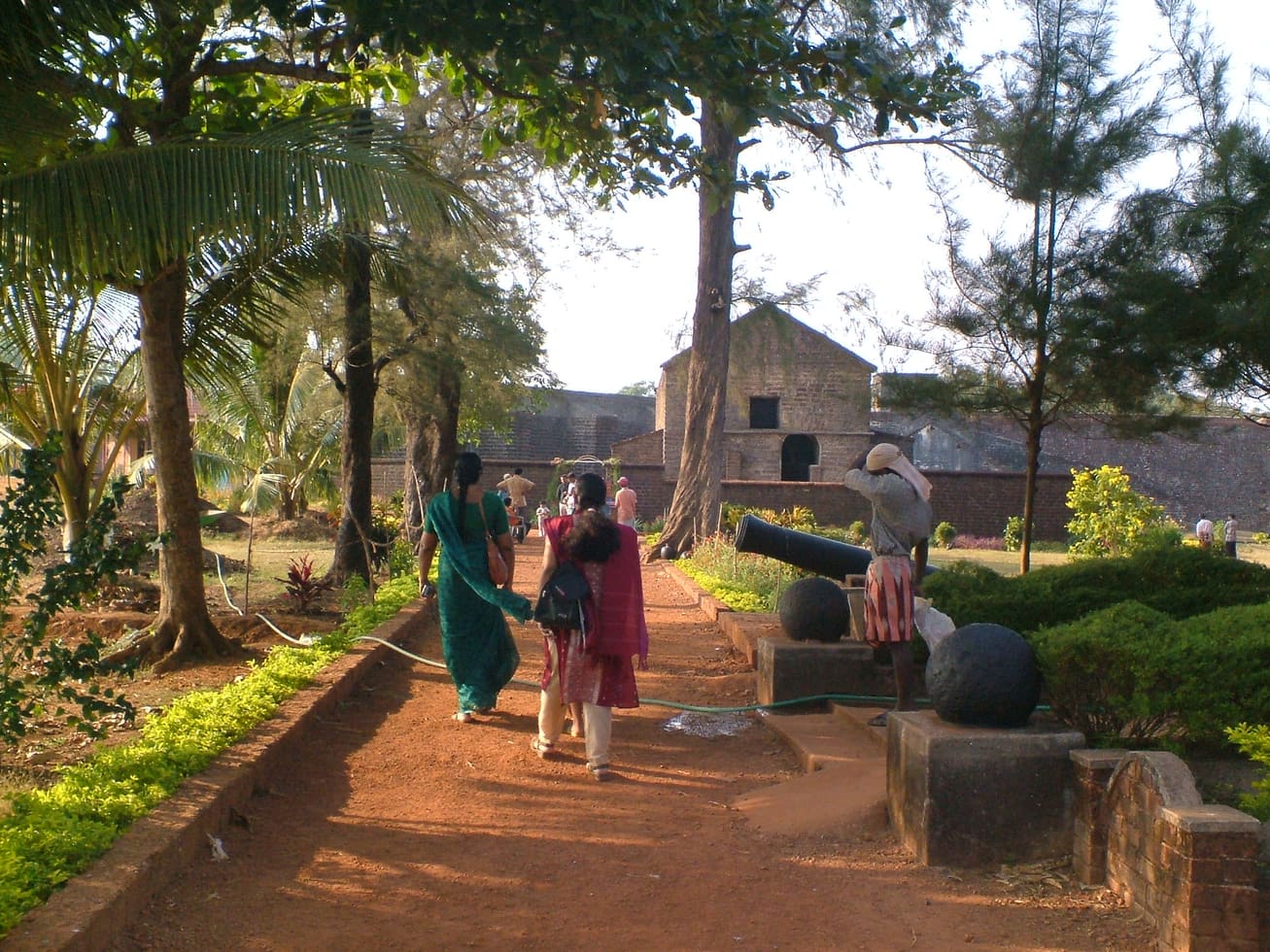
heritageSt. Angelo Fort

20.6 km · 27 min drive

Sea-facing laterite fort built by the Portuguese in 1505, later held by the Dutch, the Arakkal royal house and the British — Kannur city’s great coastal landmark overlooking Mappila Bay.

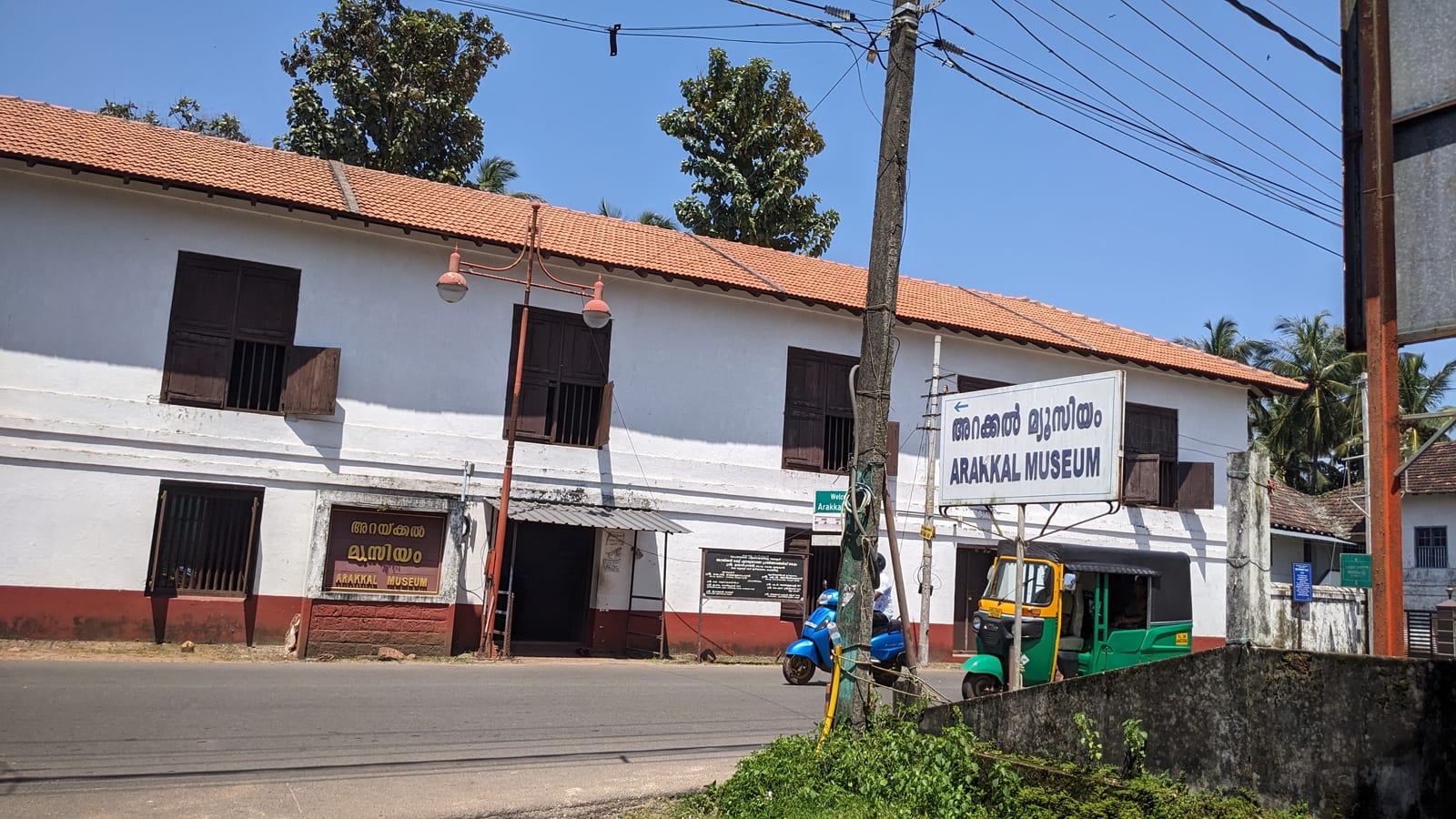
museumArakkal Museum

19.8 km · 25 min drive

The Arakkal Kettu (palace museum) of the Arakkal Ali Rajas — Kerala’s only Muslim royal house, matrilineal so ruled at times by a Beevi (queen).

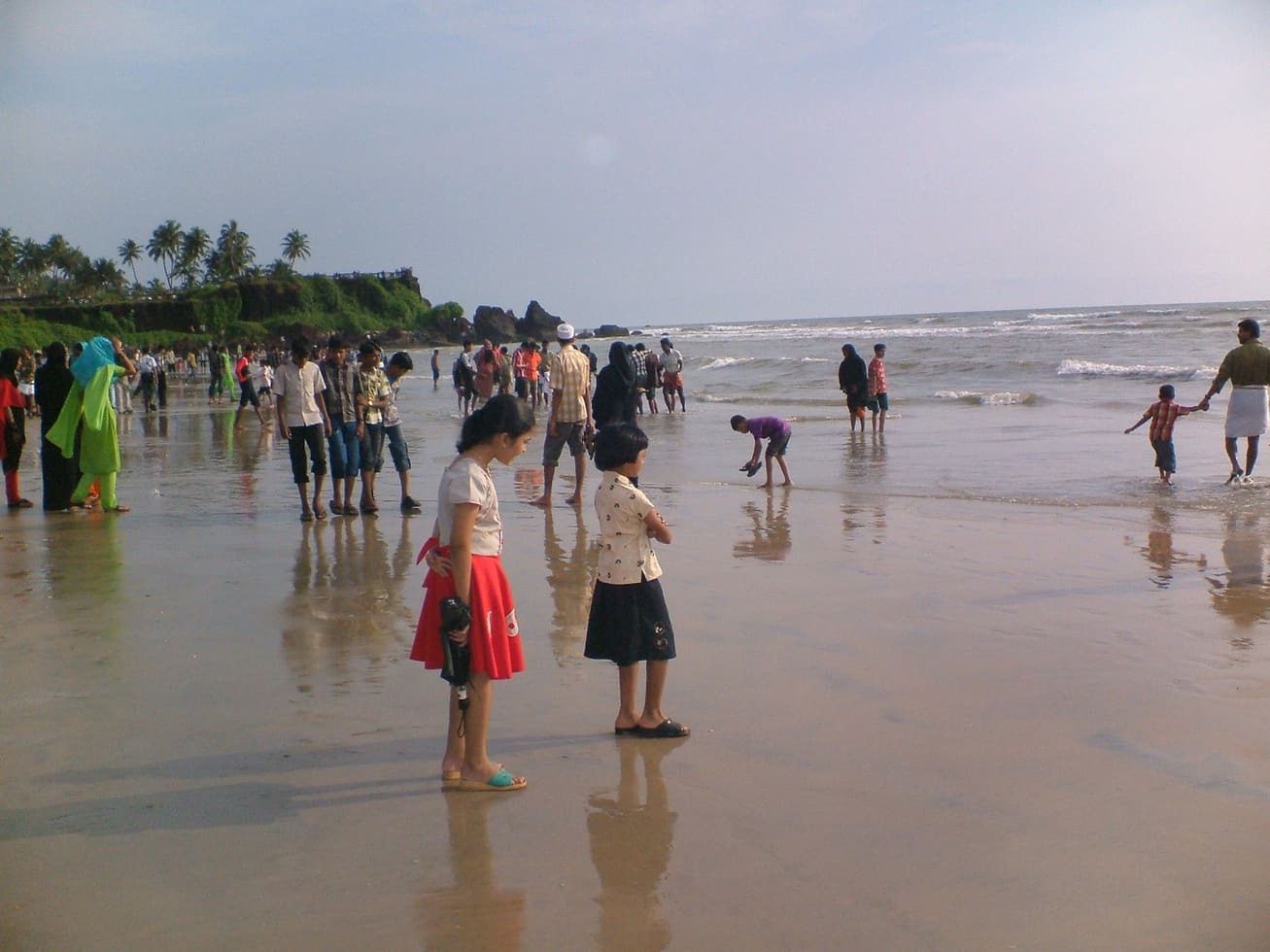
beachPayyambalam Beach

18.6 km · 24 min drive

Kannur city’s main beach, with a landscaped garden, the mother-and-child sculpture and long sunset walkways.

templeRajarajeswara Temple, Taliparamba

8.9 km · ~15 min by cab

An ancient Shiva temple at Taliparamba, one of the 108 Shiva temples and the Dwadasha Shivalayams of old Kerala; men remove their shirt to enter and photography is restricted.

templeKalarivathukkal Temple

8.4 km · ~14 min by cab

A Bhagavathy temple near Valapattanam regarded as the mother shrine of Kalaripayattu — Kerala’s martial art — where Theyyam is performed; the goddess is guardian of the kalari.

templeKottiyoor Temple

A remote forest Shiva shrine on the Bavali river, site of the ancient 28-day Kottiyoor Vaisakha Mahotsavam pilgrimage; the Akkare shrine has no permanent roof and is open only during the festival.

viewpointEzhimala

A dramatic 286 m headland near Payyannur, now home to the Indian Naval Academy — the hill itself is off-limits, but the beach and views below are open; rich in legend and rare herbs.

viewpointPalakkayam Thattu

A misty grassland hill viewpoint in the Western Ghats near Kolari, ~3,000 ft, known for cloud-touched meadows, a small waterfall and adventure activities.

Roampedia is commission-free — own or know a stay, eatery, guide or shop near Theyyam performances? List it and it appears here once verified.

Add a nearby business
Before you go

Theyyam performances — at a glance

DifficultyEasy
DurationA full night at a village kavu; about two and a quarter hours for the morning ritual at Parassinikkadavu.
TimingsThere are no opening hours, because there is nothing open. A kaliyattam at a village kavu typically begins in the evening and runs past dawn, with the best-known Theyyam of that shrine often appearing between midnight and sunrise. The exception, Parassinikkadavu, does publish times: the temple is open 05:00 to 20:00, and Thiruvappana and Vellattam are performed from about 05:45 to 08:00 in the morning and again from about 18:30 in the evening. ⚠ It stops for six weeks a year — no Thiruvappana from the first of Thulam to the fifteenth of Vrischikam, which is roughly mid-October to the end of November, and the ritual year restarts with Puthari Thiruvappana on Vrischikam 16, the first or second of December. That closure overlaps the very weeks the kavu season is opening.
Best timeThe season runs from the tenth of Thulam, in the second half of October, to the middle of Edavam in late May — about seven and a half months — and January to April is when most of it happens. It opens at Kolacheri and closes at Kalarivathukkal, both in this district. Between June and mid-October there is nothing to see at the kavus at all, and Parassinikkadavu is the only thing running.

Entry: Nothing is ticketed. A kaliyattam is a shrine’s own festival and there is no admission to it; Parassinikkadavu charges no entry either, and gives food away rather than selling it — prasadam from 07:30, lunch 12:30 to 14:30 and dinner 20:30 to 21:30. What money is involved goes the other way, in offerings, and none of it is required of a visitor.

Permit: None. Village kavus are private religious ground and you attend as a guest rather than by right, so ask; Parassinikkadavu explicitly admits all castes and religions.

Booking: Nothing can be booked, and the official calendars will not do the job either. Kerala Tourism’s Theyyam calendar and the Kannur district council’s both return no entries for every month checked, the state one across all twelve and the district one across 2025, 2026 and 2027. What the state calendar does hold is a record for 101 individual shrines, 97 of them in this district, each listing the Theyyams performed there, the Malayalam-calendar dates, directions and one or two named contacts with mobile numbers — and that is how to use it: as a phone book. Ring the contact for the kavu you want and ask what date it falls on this year. The district tourism office is on 0497 270 6336 and 0497 296 0336, and the Parassinikkadavu temple on 0497 278 0722 and 95629 80722.

Parking: At Parassinikkadavu there is parking by the temple. At a village kavu there is generally nowhere designed for it: cars end up on the verge of a narrow lane with a great many other cars, which matters most when several hundred people leave at four in the morning.

Getting here

How to reach Theyyam performances

  • ✈︎ By air Kannur International Airport at Mattannur, 26.04 km and about 31 minutes from Parassinikkadavu — much the nearest, and closer to the temple than the city’s own station is.
  • 🚆︎ By train Kannur is the main railhead and the practical arrival point. Pappinisseri, 9.52 km from Parassinikkadavu, and Kannapuram, 11.67 km, are both nearer the temple but are small stops with far fewer services.
  • 🚗︎ By road The Kannur–Taliparamba road north out of the city, then the turn at Parassinikkadavu — 18.33 km and about 24 minutes from the railway station to the temple. For a village kavu, get the directions from the shrine contact rather than from a map: most of them sit at the end of unnamed lanes and the pin you will be given is often the nearest junction, not the courtyard.
  • 🚌︎ By bus Buses run north from the Kannur stands towards Taliparamba and Parassinikkadavu through the day, and for the morning ritual you would need to be on one before first light. For a night kaliyattam, buses are no use in either direction — arrange a car and arrange the return leg at the same time.
Getting back

If you are travelling by bus or ferry, check the return service with the operator before setting out. Leave time to reach the stop or jetty after your visit.

Ask at the bus stand for the time of the last service back, not the next one. If you miss it, an auto or app cab is the fallback — agree the fare before you get in.

Do

Things to do

  • Get there for the mukhathezhuthu rather than the dance — the face is painted freehand over hours, and watching it is watching the whole thing happen.
  • Stay for the vellattam, the plain version danced before the costume goes on, when the thottam songs are telling the deity’s story.
  • Look at what the costume is made of when it is still on the ground: split palm leaf, cloth, lacquered wood, silver, and a knife.
  • Watch the conversations rather than the dance. The queue that forms in front of a Theyyam is people waiting to be spoken to about their own lives.
  • Eat at Parassinikkadavu. The meals are free, open to anyone, and served three times a day.
  • Take in the Kerala Folklore Academy at Chirakkal, in this city, which holds the state’s collection of the ritual arts and is where the artists’ fellowships come from.
Plan

Good to know

  • Fix the date before anything else, and fix it by telephone. Nothing published in a Gregorian month is reliable until a person at that shrine confirms it.
  • Assume the night, not the evening. If you have booked a car until eleven you will miss the part you came for.
  • Take cash, water and something warm. There is nothing to buy at a kavu and the small hours are cooler than the day suggests.
  • Ask where to stand before you stand there. The clear ground in front of a Theyyam is kept clear for a reason, and it matters most around the fire ones.
  • If your dates fall outside mid-October to late May, do not build the trip around Theyyam at all.
Facilities

On site

  • At Parassinikkadavu: free meals through the day, and prasadam given out from the morning
  • At Parassinikkadavu: parking, and a snake park a short walk away
  • At a village kavu: nothing provided — no seating, no lighting beyond the shrine’s own, no refreshment and often no toilet
  • Named contacts for 101 shrines, with mobile numbers, on the state’s Theyyam calendar pages
Stay safe

Safety

  • The fire Theyyams handle burning embers and carry torches on the headdress, in a crowd, in the dark. Keep the distance the shrine’s people set.
  • Village roads at three in the morning are unlit and narrow, and there is no transport. Arrange the return before you leave.
  • A popular kaliyattam packs a large crowd into a small courtyard; know where the exit is and keep children in hand.
  • The ground is beaten earth and tree root, frequently uneven and often wet.
Getting around Theyyam performancesPartly wheelchair accessible
Terrain
Mostly flat
From the entrance
Two entirely different answers. Parassinikkadavu is a built temple beside a road, with parking, level ground and a short walk in from the vehicle, and the ritual happens in a covered space you can stand or sit in. A village kavu is the opposite: a shrine at the end of an unmade lane, with the ritual performed on beaten earth in an open courtyard, no seating of any kind, and the viewing position determined by where the crowd lets you stand for a night that may run twelve hours.
Step-free access
Parassinikkadavu is the realistic option and it is partial rather than accessible: the approach and the temple ground are level and reachable by car, but neither the temple nor Kerala Tourism publishes an accessible route, a ramp specification or an accessible toilet, and the morning ritual draws a standing crowd into a confined space. A village kaliyattam should be treated as not accessible — unsurfaced ground, no made path, no lighting to speak of, no facilities, a dense crowd and a duration measured in hours. If this matters, ring the shrine contact and ask before travelling; the numbers are published per shrine on the state calendar.
Prams
Manageable at Parassinikkadavu in the quieter part of the day, and a poor idea at a night kaliyattam — uneven earth, no lighting, a crowd that moves suddenly, and fire at close quarters in the case of the fire Theyyams. A carrier is the better answer if a small child is coming at all.

Parassinikkadavu: parking at the temple, free meals through the day and prasadam from the morningParassinikkadavu: open to all castes and religions, which removes the entry question that applies at most Kerala templesVillage kavus: no seating, no toilets, no refreshment and no lighting beyond the shrine’s ownA named contact with a mobile number is published for 101 shrines on the state’s Theyyam calendar pages

  • The fire Theyyams work with burning embers and carry lit torches on the headdress within a few metres of the crowd.
  • A kaliyattam commonly runs through the night; there is no transport at the end of it and the lanes are unlit.
  • Crowds at a well-known shrine are dense and the courtyard is small, with no marshalling and no obvious exit.
  • Drumming at close range is genuinely loud and sustained for hours.

Checked 31 August 2026 against source 1source 2source 3source 4source 5source 6. Conditions change and surfaces vary with weather — if step-free access is essential, confirm with the site before you travel.

Practical things near Theyyam performances
What the cash actually costs
  • Withdrawing from a bank that is not your own is free for a set number of times a month, then costs up to ₹23 plus GST — about ₹27 a withdrawal. This is not one of the RBI’s six metro centres, so the allowance here is the higher one: at least five free other-bank withdrawals a month, and at least five at your own bank.
  • That free allowance belongs to Indian bank accounts. On a card issued abroad your own bank’s international withdrawal and exchange charges apply instead. If the machine offers to bill you in your home currency, choose rupees — the conversion rate on that offer is set by the machine, not by your bank.
  • Choose a well-lit ATM, preferably at a bank branch. Shield your PIN, avoid help from strangers and use your bank’s support number if a withdrawal fails or the machine retains your card.

Charge cap and free-transaction limits: Reserve Bank of India, in force since 1 May 2025.

These services are listed within about 1.2 km of Theyyam performances. Walking distances follow mapped routes; access and opening hours can change. Other services may be closer but are not included here.

If you need help at Theyyam performances
112All emergencies (police · fire · medical)The single number to call in any emergency (ERSS).

Emergency numbers are verified against official government and state tourism sources. 112 works anywhere in India.

Nearby

What’s near Theyyam performances

templeKalarivathukkal Temple

A Bhagavathy temple near Valapattanam regarded as the mother shrine of Kalaripayattu — Kerala’s martial art — where Theyyam is performed; the goddess is guardian of the kalari.

8.4 km · ~14 min by cab · straight line
templeRajarajeswara Temple, Taliparamba

An ancient Shiva temple at Taliparamba, one of the 108 Shiva temples and the Dwadasha Shivalayams of old Kerala; men remove their shirt to enter and photography is restricted.

8.9 km · ~15 min by cab · straight line
beachBaby Beach

A small rocky beach in the Kannur cantonment, an extension of Payyambalam and within a few minutes of St Angelo’s Fort and the Kannur lighthouse. Not a swimming beach — the draw is the rocks, the quiet and the lighthouse beam after dark.

14.5 km · ~24 min by cab · straight line
beachAdikadalayi Beach

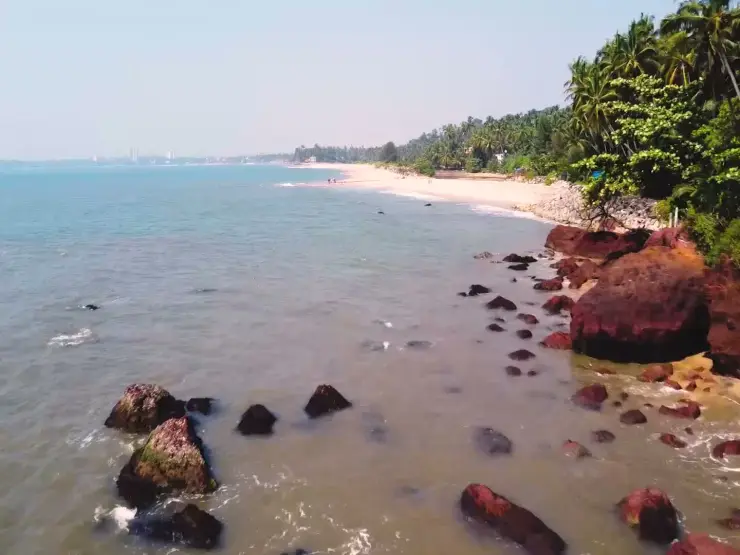
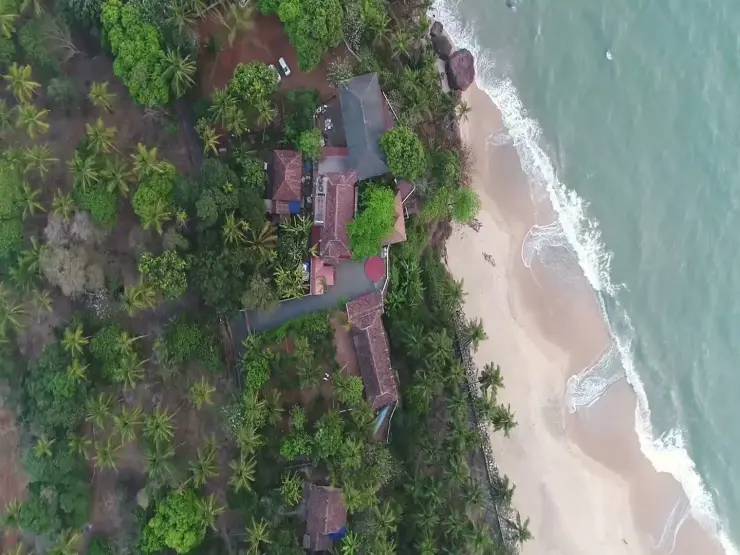
Adikadalayi Beach, also called Kadalayi Beach in Kerala’s coastal tourism study, is a Kannur shore with sandy pockets, exposed red coastal rock and palms above the water. It belongs to the Adikadalayi locality, not the separately named Thottada, Kizhunna or Ezhara beaches farther along the coast. Use the mapped public steps from Tippu Sulthan Beach Road as the arrival reference. Nearby cliff-side homestays have their own entrances and facilities, and should not be used as assumed public access.

15.4 km · ~26 min by cab · straight line
beachThottada Beach

A quiet, unspoilt cove-and-stream beach south of Kannur city, known for its homestays and calm, uncrowded sands.

16.3 km · ~27 min by cab · straight line
beachKizhunna Beach

Kizhunna’s sandy shore lies between Thottada and Ezhara, with palm-backed village edges and the Cherakallu rock formations breaking up the coastline.

17.0 km · ~28 min by cab · straight line
viewpointMadayipara

A vast laterite plateau near Pazhayangadi that bursts into wildflower bloom after the monsoon, with the Madayi Kavu, an old mosque and a temple pond — a botanist’s and birder’s hill.

17.0 km · ~28 min by cab · straight line
templeVadukunnu Siva Temple

Madai Sree Vadukunda Siva Temple is the Shiva shrine beside the laterite plateau and sacred pond at Madayipara, near Pazhayangadi in Kannur. It is distinct from Thrissur’s Vadakkunnathan and from nearby Madayikavu.

17.1 km · ~29 min by cab · straight line
beachPayyambalam Beach

Kannur city’s main beach, with a landscaped garden, the mother-and-child sculpture and long sunset walkways.

18.6 km · 24 min drive
museumArakkal Museum

The Arakkal Kettu (palace museum) of the Arakkal Ali Rajas — Kerala’s only Muslim royal house, matrilineal so ruled at times by a Beevi (queen).

19.8 km · 25 min drive
heritageSt. Angelo Fort

Sea-facing laterite fort built by the Portuguese in 1505, later held by the Dutch, the Arakkal royal house and the British — Kannur city’s great coastal landmark overlooking Mappila Bay.

20.6 km · 27 min drive
beachMuzhappilangad Drive-in Beach

A ~4 km hard-sand beach, the longest drive-in beach in India — you can drive along the sand at low tide; Dharmadam Island lies just offshore.

21.2 km · ~35 min by cab · straight line

All 4 places to visit in Kannur city →

Walking and driving times are real routed distances, except the few marked “straight line”, which are direct-line estimates and will read short. Fare figures are estimates from Kerala’s notified auto/taxi tariff and exclude waiting and night charges. Routing: © openrouteservice.org by HeiGIT | Map data © OpenStreetMap contributors

Nearby toilets, pharmacies, ATMs, seating and vets are community-mapped and may be incomplete or out of date. Map data © OpenStreetMap contributors | Walking times © openrouteservice.org by HeiGIT

On the map

Where Theyyam performances is

Good to know

Theyyam performances — frequently asked

Can I just turn up in Kannur and see a Theyyam?

Not reliably, and this is what most trips get wrong. Outside the season — roughly late May to mid-October — there is nothing at all. Inside it there is a great deal, but every shrine performs on its own dates, most are small village kavus with no signage and no website, and the calendar runs on Malayalam months rather than on anything you can look up in advance. The one place that does not depend on a date is Parassinikkadavu, 18.33 km north of the city, where Muthappan is performed morning and evening on most days of the year.

Is there an official Theyyam calendar I can plan from?

There is one, and it does not work as a calendar. Kerala Tourism publishes a Theyyam calendar holding a record for 101 shrines, 97 of them in Kannur, each with the shrine’s Malayalam-calendar dates, the Theyyams performed there, directions, and — the useful part — one or two named contacts with mobile numbers. But its month-by-month view returns nothing for all twelve months, and the Gregorian dates on the individual records were each last set in a different year, spread between 2019 and 2026. The district council’s own calendar likewise reports no performance scheduled for every month checked across 2025, 2026 and 2027. Use the state’s calendar as a directory of shrines and telephone numbers, which is what it is genuinely good for, and ring the number.

When exactly is the season?

It opens on the tenth day of Thulam, which falls in the second half of October, and closes around the middle of Edavam, which is late May or the first days of June — about seven and a half months. The concentration is January to April: of the state’s shrine records for Kannur, the great majority of festival dates fall in those four months.

How long does one last, and when should I arrive?

A kaliyattam commonly runs from evening until after sunrise, and the Theyyam a shrine is best known for may not come out until the small hours. Come for the start rather than the climax — the painting, the building of the costume and the vellattam with its thottam songs run for hours, and they are where you find out what any of it means. Parassinikkadavu is the manageable version, at about two and a quarter hours in the morning.

Am I allowed to attend, and can I photograph it?

At Parassinikkadavu, entry is open to all castes and religions, which is what the temple is known for. At village kavus you are generally welcome to stand and watch, but you are a guest at somebody’s act of worship rather than a spectator at an event — ask the shrine’s people where to stand, and ask before pointing a camera at anyone. Parassinikkadavu itself is reported to prohibit cameras and phones inside; its number is 0497 278 0722, and asking first costs nothing.

Is the man performing it a priest?

No, and that is much of the point. The right to perform belongs by descent to particular families in nine communities — chiefly the Vannan and the Malayan, all of them Scheduled Castes or Scheduled Tribes — and it attaches to particular shrines rather than to the person, so a performer cannot simply take an engagement elsewhere.

Is any Theyyam performed by a woman?

One. Devakkoothu, the goddess Valliyamma, at the Koolom Thazhekkavu shrine on Thekkumbad near Cherukunnu, performed once every two years in the Malayalam month of Dhanu, in December. Every other Theyyam is danced by men.

What is the difference between Theyyam and Thira?

They are close relatives rather than the same thing, and the words get used loosely. Broadly, Theyyam belongs to north Malabar — Kannur and Kasaragod — and Thira to the country south of it, around Kozhikode and Malappuram; the costume, the drums and the degree to which the performer is held to be the deity all differ. In Kannur, what you will be watching is called Theyyam.

When is the best time to visit Theyyam performances?

Mid-October to late May is the season, and January to April is when most of it happens — the state's own shrine records for Kannur cluster in those four months. Outside the season the kavus are shut and there is nothing to see, with the single exception of Parassinikkadavu, which runs its own year in the opposite phase and closes for six weeks in exactly the autumn window when everywhere else is starting.

What are the entry fee and timings at Theyyam performances?

Entry: Nothing is ticketed. A kaliyattam is a shrine’s own festival and there is no admission to it; Parassinikkadavu charges no entry either, and gives food away rather than selling it — prasadam from 07:30, lunch 12:30 to 14:30 and dinner 20:30 to 21:30. What money is involved goes the other way, in offerings, and none of it is required of a visitor. Timings: There are no opening hours, because there is nothing open. A kaliyattam at a village kavu typically begins in the evening and runs past dawn, with the best-known Theyyam of that shrine often appearing between midnight and sunrise. The exception, Parassinikkadavu, does publish times: the temple is open 05:00 to 20:00, and Thiruvappana and Vellattam are performed from about 05:45 to 08:00 in the morning and again from about 18:30 in the evening. ⚠ It stops for six weeks a year — no Thiruvappana from the first of Thulam to the fifteenth of Vrischikam, which is roughly mid-October to the end of November, and the ritual year restarts with Puthari Thiruvappana on Vrischikam 16, the first or second of December. That closure overlaps the very weeks the kavu season is opening.

How do I reach Theyyam performances?

Fix the date before the room. Nothing about this is arranged around visitors — a kaliyattam happens when the shrine's calendar says it does, and there may be nothing at all within an hour's drive on the night you have booked. Use the state's Theyyam calendar as a directory of shrines and telephone numbers rather than as a calendar. Ring the contact it names for the kavu you want. If the dates will not fall for you, go to Parassinikkadavu instead, where the same ritual happens twice a day for most of the year and needs no arrangement at all. Turn up for the beginning, not the middle. The painting, the ritual songs and the fitting of the headdress are hours long and are most of what there is to understand. Bring somebody who can explain what is being sung, or accept that you will watch the surface of it. The thottam songs carry the whole story and they are not translated for anyone.

How much time do I need for Theyyam performances?

A whole evening and often a whole night — a kaliyattam commonly runs from dusk until well after dawn, and the Theyyam a shrine is famous for may not appear until three in the morning. Parassinikkadavu is the short version: the morning ritual runs about two and a quarter hours and the evening one rather less.

What else is near Theyyam performances?

Nearby you can pair Kalarivathukkal Temple (8.4 km), Rajarajeswara Temple, Taliparamba (8.9 km), Baby Beach (14.5 km), Adikadalayi Beach (15.4 km).

What should I know before visiting Theyyam performances?

The fire Theyyams work with live embers and burning torches at close range, and the crowd is what keeps the ring open. Stand where the shrine's people tell you to stand. Most of this happens in the dark on unlit village roads. Arrange the drive back before you go, rather than at four in the morning. A kaliyattam draws a dense, slow-moving crowd into a small courtyard; keep a child within reach and know where the way out is. The ground at a kavu is beaten earth and tree root, often wet, and the lighting is whatever the shrine has strung up.

Image credits

Photographs: Lightframer007 (CC BY-SA 4.0), Anoopan (CC BY-SA 4.0), Navaneeth Krishnan S (CC BY-SA 4.0), Vinayankavullapura (CC BY 4.0), Vijayakumarblathur (CC BY-SA 4.0), Vaikoovery (CC BY 3.0), rajeshodayanchal (CC BY 3.0), Avinash P C (CC BY-SA 4.0), Abhiraj Panakkadan (CC BY-SA 4.0), Sreejithk2000 (CC BY-SA 3.0), Jayan.thanal (CC BY-SA 4.0), Ashleymzach (CC BY-SA 4.0). Wikimedia Commons.